Cancer Drug List (CDL) 2026: What Your Integrated Shield Plan Actually Covers
A plain-English guide to how MOH’s Cancer Drug List sets your claim limits, and what happens when your prescribed drug isn’t on it.
Your Integrated Shield Plan (IP) only pays for outpatient cancer drugs listed on MOH’s Cancer Drug List (CDL), each with its own monthly claim limit set by the drug’s category. MediShield Life and MediSave have followed the CDL since 1 September 2022, and IPs followed from 1 April 2023, upon policy purchase or renewal. If your drug isn’t on the list, you can still receive it, but you will likely pay a larger share yourself.
Not financial advice. All figures are for educational reference only. Data verified against MOH sources as at 19 August 2026.
- Your Integrated Shield Plan only covers outpatient cancer drugs on MOH’s Cancer Drug List (CDL), each with a monthly claim limit tied to its category — roughly category number x $200.
- There’s a separate annual limit of up to S$3,600 (MediShield Life) for cancer drug services like scans and consultations, plus S$600 from MediSave.
- If your drug isn’t on the CDL, you’re not left without options — MediSave, cash, and some 2026 riders can still help, just with more limits and conditions.
Table of Contents
Contents — Click to expand
- What Is the Cancer Drug List (CDL)?
- How the CDL Affects Your Integrated Shield Plan Claims
- Cancer Drug List Claim Limits: A Worked Example
- The Separate Cancer Drug Services Limit
- What Happens If Your Drug Isn’t on the CDL
- How Your 2026 Rider Affects Cancer Drug Coverage
- What Singapore Policyholders Should Do Now
- Frequently Asked Questions
What Is the Cancer Drug List (CDL)?
The Cancer Drug List (CDL) is MOH’s official list of outpatient cancer drugs that are claimable under MediShield Life, MediSave, and most Integrated Shield Plans. It covers chemotherapy, targeted therapy, and immunotherapy drugs used to treat specific cancers.
Before September 2022, cancer drug claims worked differently. MediShield Life paid up to $3,000 a month for any cancer drug, and most Integrated Shield Plans covered the rest on an as-charged basis, with only a small co-payment. There was no requirement that the drug be clinically proven or cost-effective relative to other options.
That open-ended design had a side effect. Drug companies had little incentive to price treatments competitively, since insurers would pay almost regardless of cost. Singapore ended up paying more for many cancer drugs than comparable countries like Australia, South Korea, and the United Kingdom.
The CDL fixed this by tying coverage to evidence. A drug qualifies for the list if it is registered with the Health Sciences Authority (HSA) and assessed by the Agency for Care Effectiveness (ACE) as cost-effective for a specific cancer type. Each listed drug then gets its own monthly claim limit.
Here’s why this matters for you. The CDL isn’t static. MOH reviews and updates it three times a year, adding new drugs, adjusting claim limits, and occasionally removing treatments that are no longer considered cost-effective. Whatever list applies on your date of treatment is the one that counts — not the list on the date you were first diagnosed.
How the CDL Affects Your Integrated Shield Plan Claims
The CDL rolled out in two stages. From 1 September 2022, MediShield Life and MediSave started following the CDL. From 1 April 2023, upon your IP’s purchase or renewal, your Integrated Shield Plan followed suit too.
That second date matters. If your IP hadn’t renewed yet by 1 April 2023, you kept your old, broader coverage until your next renewal. By August 2026, virtually every active IP policy has now gone through at least one renewal cycle since the change, so this transition is largely behind us — but it’s a useful reminder that IP terms can shift at renewal, not just at time of purchase.
The CDL only applies to outpatient drug-based treatment. It does not touch surgery, radiotherapy, or diagnostic scans like MRI and PET — those remain claimable under your regular MediShield Life, IP, and rider limits, just through a separate claims track. If you’re still getting familiar with the basics of what an IP covers more broadly, our guide on what an Integrated Shield Plan covers is a good starting point.
Cancer Drug List Claim Limits: A Worked Example
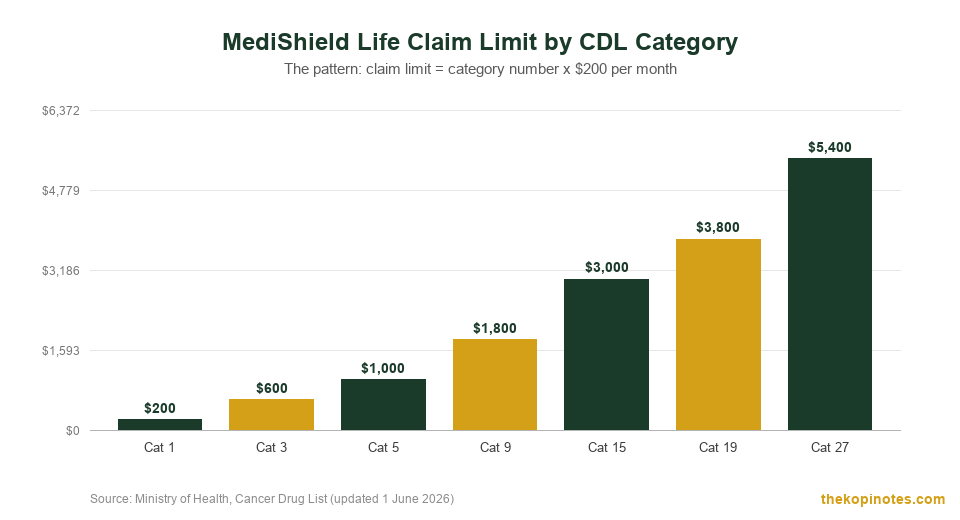
Each drug on the CDL sits in a numbered category. Here’s the useful shortcut once you know it: your MediShield Life monthly claim limit is simply the category number multiplied by $200. We checked this against every published category, and it holds exactly.
| CDL Category | MediShield Life Claim Limit (per month) |
|---|---|
| Category 1 | $200 |
| Category 3 | $600 |
| Category 5 | $1,000 |
| Category 9 | $1,800 |
| Category 15 | $3,000 |
| Category 19 | $3,800 |
| Category 27 | $5,400 |
Source: Ministry of Health, Cancer Drug List (updated 1 June 2026). MediSave withdrawal limits and IP claim limits are set separately.
Categories 1 to 37 are considered the CDL’s “first tier,” and categories 38 to 64 the “second tier,” under the CPF Medisave Account Withdrawal Regulations. Higher categories generally mean pricier, more specialised treatments — for context, category 48 tops out at $9,600 a month under MediShield Life.
Your Integrated Shield Plan claim limit for the same drug is a separate number, set by your insurer, not MOH. It’s often higher than the MediShield Life limit, which is why most cancer patients rely on their IP as the main layer of protection, with MediShield Life as the base.
Let’s make this concrete. Say you’re prescribed a targeted therapy drug in Category 9, costing $2,800 a month at a private oncology clinic.
| Item | Amount |
|---|---|
| Monthly drug cost | $2,800 |
| MediShield Life claim limit (Category 9) | $1,800 |
| Balance after MediShield Life | $1,000 |
| Balance your IP, MediSave, or cash covers | Up to $1,000/month |
Illustrative calculation by The Kopi Notes, based on published MediShield Life claim limits. Actual drug pricing varies by brand, dosage, and clinic; your IP’s own claim limit for this drug may cover some or all of the $1,000 balance.
If your IP’s own limit for that drug fully covers the remaining $1,000, your out-of-pocket cost could be close to zero. If it doesn’t, MediSave and cash fill the rest, which is where a rider can genuinely help.
The Separate Cancer Drug Services Limit
Drug costs are only part of cancer treatment. You’ll also have scans, blood tests, doctor consultations, and supportive care drugs like anti-nausea medication. MOH covers these under a separate “Cancer Drug Services” limit — separate from, and on top of, your drug claim limit above.
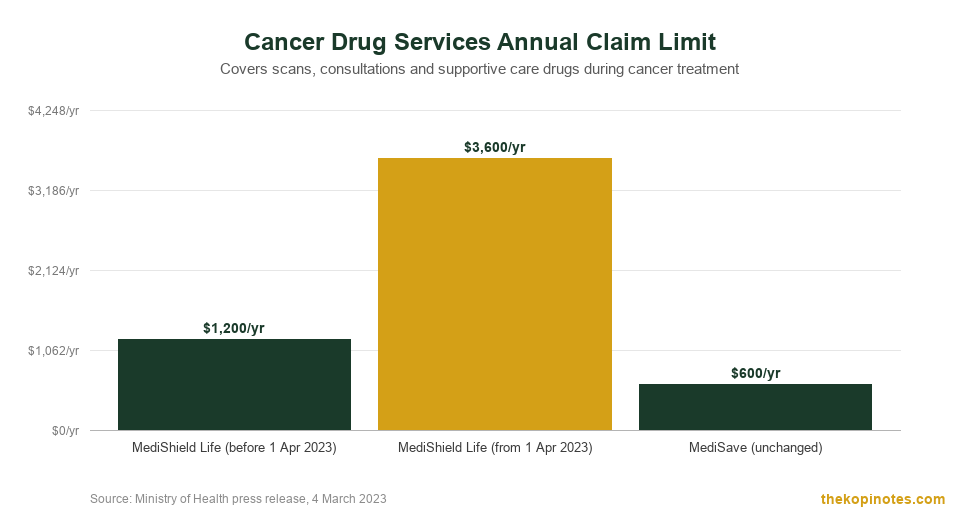
This limit was introduced on 1 September 2022 at $1,200 a year under MediShield Life, plus $600 a year from MediSave. Feedback showed that wasn’t enough for patients needing frequent monitoring, so MOH raised the MediShield Life portion to $3,600 a year from 1 April 2023 — a threefold increase. The MediSave portion stayed at $600.
| Period | MediShield Life Limit | MediSave Limit |
|---|---|---|
| 1 Sep 2022 – 31 Mar 2023 | $1,200/year | $600/year |
| From 1 Apr 2026 (unchanged since 1 Apr 2023) | $3,600/year | $600/year |
Source: Ministry of Health, “Higher MediShield Life claim limit for Cancer Drug Services” (4 March 2023).
Here’s a detail many policyholders miss: you can claim from the Cancer Drug Services limit even if the treatment itself isn’t on the CDL, as long as the service is a supportive one — like an anti-nausea drug or a blood test. But if the drug is doing the actual cancer-fighting work and it isn’t listed, it doesn’t qualify for this limit either.
What Happens If Your Drug Isn’t on the CDL
Getting a “not on the CDL” answer from your insurer is understandably alarming. But it doesn’t mean you can’t get the treatment. It means MediShield Life, MediSave, and your base IP won’t pay for that specific drug — you’ll need other layers to fund it.
There are two common reasons a drug isn’t CDL-claimable. First, it may not be listed at all, often because it’s newer, or was assessed as not cost-effective enough for the price asked. Second, and more easily missed, the drug might be listed — but not for your specific cancer type. A drug approved for breast cancer, for example, is only CDL-claimable when used for breast cancer. Using the same drug off-label for another cancer makes it a non-CDL claim, even though it appears on the list.
Not all non-CDL drugs are treated equally, either. The Life Insurance Association Singapore (LIA) maintains a Non-CDL Classification Framework that sorts these drugs into Classes A to F based on clinical evidence:
- Class A to C: Stronger clinical evidence, more widely recognised in treatment guidelines. More likely to get some rider support.
- Class D to E: Emerging or moderate evidence. Coverage is possible but assessed case by case.
- Class F: Limited evidence, often experimental. Generally not covered.
In practice, if your recommended drug falls outside the CDL, you and your doctor typically weigh three things: whether a clinically suitable CDL-listed alternative exists, how much of the gap your MediSave and any rider can close, and how much you’re prepared to pay in cash. None of this happens in a vacuum — it’s worth having this conversation with your oncologist and your insurer early, rather than after treatment has started.
How Your 2026 Rider Affects Cancer Drug Coverage
Riders still matter for cancer treatment, even after the April 2026 ISP rider reform tightened how much they can cover overall. Two things changed that are directly relevant here.
First, riders bought from 27 November 2025 onward can no longer fully absorb your policy deductible, and the minimum co-payment cap rose to $6,000 a year. That means even with a rider, you’ll typically face some out-of-pocket cost on a cancer-related hospital stay or day-surgery bill — you can see exactly how much by ward class in our breakdown of the 2026 Integrated Shield Plan deductible.
Second, riders can still top up your CDL claim limit above the MediShield Life and base IP amount, and some offer limited support for non-CDL drugs in Classes A to E. This is separate from the deductible and co-payment mechanics — it’s about how much of the drug bill itself gets paid, not who pays the excess. The extent of this top-up varies by insurer, panel arrangement, and whether pre-authorisation was obtained, so the exact numbers are worth confirming directly with your insurer or adviser rather than assuming a fixed figure.
The upshot: a rider is still one of your strongest tools against a large cancer drug bill, particularly for non-CDL or higher-category treatments. It’s just no longer a guarantee of zero out-of-pocket cost, the way older riders sometimes were.
What Singapore Policyholders Should Do Now
A cancer diagnosis is stressful enough without untangling claim limits at the same time. These steps help you prepare before you need them.
Ask your oncologist early whether your treatment is CDL-listed. This single question shapes your entire financing plan, and your doctor can usually check quickly.
Check your specific IP’s claim limit for the drug, not just MediShield Life’s. Your insurer sets this separately, and it’s often the more generous number. If you’re still comparing plans, our Integrated Shield Plan comparison guide covers how insurers differ.
Review your MediSave balance and withdrawal limits. Between the drug claim gap and the Cancer Drug Services limit, MediSave often bridges a meaningful chunk of the cost. See our guide on how MediSave works for your Integrated Shield Plan for the full withdrawal rules.
Confirm your rider’s non-CDL and top-up terms in writing. Don’t rely on general marketing material — ask your insurer specifically what Class A to F support looks like for your policy.
Build a financial buffer beyond insurance. Even well-covered patients often take time off work during treatment. If you haven’t modelled how a major medical event affects your broader finances, our Singapore retirement calculator can help you see the bigger picture, and platforms like the ones behind our Endowus referral code are worth exploring for growing that buffer over time.
Frequently Asked Questions
What is the Cancer Drug List (CDL) in Singapore?
It’s MOH’s official list of outpatient cancer drugs claimable under MediShield Life, MediSave, and most Integrated Shield Plans. Each listed drug has its own monthly claim limit based on clinical effectiveness and cost. It does not cover surgery, radiotherapy, or diagnostic scans, which are claimed separately.
When did the CDL start applying to Integrated Shield Plans?
MediShield Life and MediSave followed the CDL from 1 September 2022. Integrated Shield Plans followed from 1 April 2023, upon each policy’s purchase or renewal — so the exact date your IP switched over depended on your renewal cycle.
How is my MediShield Life claim limit for a cancer drug calculated?
Each CDL drug sits in a numbered category, and the MediShield Life monthly claim limit equals the category number multiplied by $200. Category 9, for example, has a $1,800 monthly limit. Your Integrated Shield Plan sets its own separate limit, which is often higher.
What is the Cancer Drug Services limit?
It’s a separate annual limit covering scans, blood tests, consultations, and supportive care drugs during cancer treatment. It’s currently $3,600 a year under MediShield Life (raised from $1,200 in April 2023) and $600 a year from MediSave.
What if my cancer drug isn't on the CDL?
You can still receive the treatment, but MediShield Life, MediSave, and your base IP generally won’t pay for that specific drug. The Life Insurance Association’s Non-CDL Classification Framework (Classes A to F) determines whether your rider offers any support, with Class F drugs generally not covered.
Does my 2026 rider still help with cancer drug costs?
Yes. Riders can still top up your claim limit above the CDL and base IP amounts, and some support Class A to E non-CDL drugs. However, since April 2026, riders no longer fully cover your deductible, and the minimum co-payment cap rose to $6,000 a year, so some out-of-pocket cost is still likely.
Plan Ahead for Major Medical Costs
Model a major medical event against your long-term finances, or compare plans before you need to claim.
Get Free Insurance Advice
Speak with a licensed insurance advisor. No obligation, no cost.
By submitting this form, you agree to our Privacy Policy.
This article was researched with the help of AI. While we strive to keep all information accurate and up to date, there may be errors. If you notice any discrepancies, please contact us.