MediSave Limit 2026: Your November & December Hospital Planning Guide
BHS is S$79,000 — here's how to time your hospitalisation, ISP rider, and year-end top-up to minimise your out-of-pocket costs.
If you're planning a hospital admission or elective procedure before December 31, 2026, the MediSave limit you need to know is the Basic Healthcare Sum of S$79,000. That's the cap on how much you can hold in your MediSave Account — and it directly determines how much buffer you have for hospitalisation, ISP rider premiums, and year-end top-up tax relief. Here's exactly what to do before the December 31 deadline.
Not financial advice. All figures are for educational reference only. MediSave withdrawal limits and ISP rider terms are set by CPF Board and MOH respectively — verify current rates at cpf.gov.sg before making any healthcare financing decisions. Data as at October 2026 unless noted.
In This Guide
- Why November–December Is the Critical MediSave Window
- MediSave Limit 2026: The S$79,000 BHS Explained
- MediSave Withdrawal Limits for Hospitalisation
- How the April 2026 ISP Rider Rules Affect Your December Bill
- Elective Surgery in Q4: Before or After Year-End?
- MediSave Top-Up Tax Relief — The December 31 Deadline
- Your November–December Pre-Admission Checklist
- Frequently Asked Questions
Why November–December Is the Critical MediSave Window
For most Singaporeans, healthcare financing decisions are made reactively — you get sick, you get admitted, you settle the bill. But the final two months of the year carry a cluster of deadlines that make proactive planning genuinely worthwhile.
The first deadline is December 31 for Year of Assessment (YA) 2027 tax relief. Any voluntary cash top-up you make to your MediSave Account before December 31, 2026 counts toward your 2026 income year — which means a potential reduction in your income tax payable in 2027.
The second factor is the April 2026 ISP rider rule change. If you or a family member cancelled your Integrated Shield Plan (ISP) rider earlier in 2026 — joining the 181,800 Singaporeans who did so according to MOH data released in October 2026 — your hospitalisation cost structure has fundamentally changed for any November or December admission.
The third factor is simply utilisation timing. If you've been deferring an elective procedure and your annual deductible has already been met, finishing the treatment before December 31 means the deductible resets to zero in January — you won't be able to carry it over.
All three of these converge in Q4. Here's how to navigate them.
MediSave Limit 2026: The S$79,000 Basic Healthcare Sum Explained
The MediSave limit most Singaporeans need to know is the Basic Healthcare Sum (BHS). Set at S$79,000 for 2026, the BHS is the cap on how much can sit in your MediSave Account. Contributions above the BHS overflow to your Special Account (SA) or Retirement Account (RA) if you are 55 and older.
Crucially, the BHS does not reset at year-end. It is a lifetime cumulative cap, not an annual spending allowance. Whether you use S$5,000 on hospitalisation in March or S$30,000 on a major surgery in November, your BHS ceiling remains S$79,000 throughout the year — and any MediSave balance below the BHS continues to earn 4% p.a. interest, compounded monthly.
The BHS has grown steadily over the years to keep pace with healthcare inflation. The table below shows how it has moved since 2022:
| Year | Basic Healthcare Sum (BHS) | Year-on-Year Increase |
|---|---|---|
| 2022 | S$68,500 | — |
| 2023 | S$71,500 | +S$3,000 |
| 2024 | S$74,500 | +S$3,000 |
| 2025 | S$77,500 | +S$3,000 |
| 2026 | S$79,000 | +S$1,500 |
Source: CPF Board, 2026. The 2026 increase was smaller than prior years as BHS nears its medium-term target.
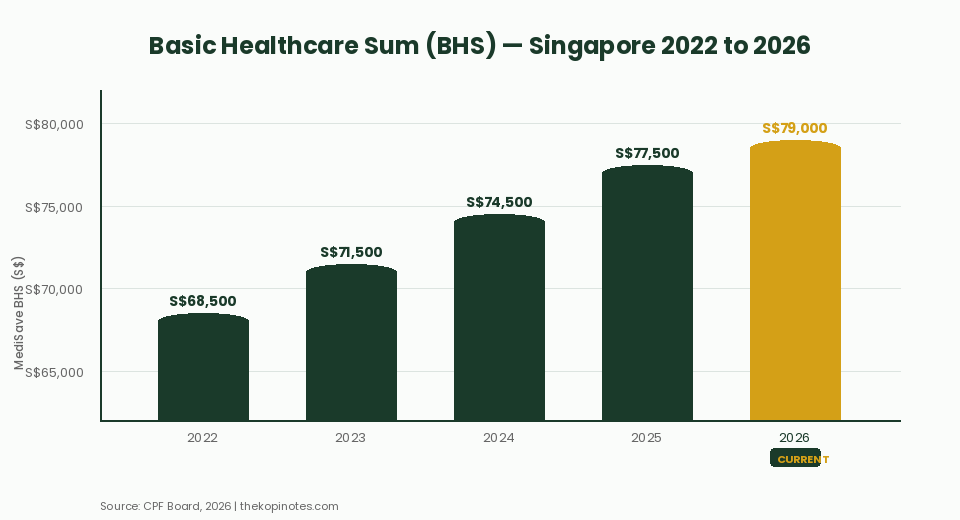
BHS growth 2022–2026. Source: CPF Board. | thekopinotes.com
For November–December planning, the key question is: how much of your MediSave balance remains available, and how much room do you have to top up before December 31? Your current balance is visible on the CPF website under My Statement.
For a deeper breakdown of every way MediSave can be used — from hospitalisation to chronic disease management to maternity — see our full guide to MediSave withdrawal limits in Singapore.
MediSave Withdrawal Limits for Hospitalisation in Singapore
When you are hospitalised, MediSave does not pay your entire bill. It covers the portion of your hospital costs that MediShield Life does not pay — including the deductible, co-insurance (the percentage you pay after the deductible), and amounts above MediShield Life's benefit limits.
MediSave withdrawal limits for hospitalisation are set by the CPF Board and vary by ward class, type of charge, and treatment category. The table below summarises the main categories. For the current precise dollar caps — which the CPF Board updates periodically — always check the official CPF MediSave page.
| Type of Charge | MediSave Coverage | Withdrawal Limit |
|---|---|---|
| MediShield Life Deductible | ✅ Yes — full deductible | Up to S$2,500–S$5,000 (varies by ward class) |
| Co-Insurance (10%) | ✅ Yes — co-insurance amount | Up to 10% of approved claim amount |
| Daily Ward & Treatment Charges (above MSLIF limits) | ✅ Yes — up to daily limit | Subject to CPF Board's daily ward limits (Class-specific) |
| Surgical Procedures (TOSP) | ✅ Yes — up to TOSP table cap | S$150–S$12,600+ depending on complexity |
| ISP Rider Premium (if applicable) | ✅ Yes — annual premium payment | Up to S$300/year (non-integrated riders) or per ISP schedule |
| Day Surgery | ✅ Yes — day surgery charges | Subject to surgical TOSP limits + day surgery cap |
| Cosmetic Procedures | ❌ No | Not claimable |
| Outpatient Consultations (non-CDMP) | ❌ No | Not claimable (unless CDMP-approved chronic condition) |
Source: CPF Board MediSave withdrawal limits schedule. Verify current dollar limits at cpf.gov.sg.
For November and December admissions, the practical implication is this: if your Integrated Shield Plan rider is still active, your ISP insurer pays the bulk of charges above MediShield Life limits, leaving your MediSave balance largely intact. If your rider was cancelled earlier in 2026, you will need to draw on your MediSave more heavily — or pay cash — for private or Class A hospital stays.
How the April 2026 ISP Rider Rules Affect Your December Bill
From 1 April 2026, the Ministry of Health introduced new rules for all newly issued Integrated Shield Plan (ISP) riders. These rules directly affect how much you pay out-of-pocket — and how much MediSave you'll draw — for a November or December 2026 hospitalisation.
Key changes for new ISP riders (issued from April 2026):
New riders must now include a minimum 5% co-insurance component, with the total co-insurance capped at S$3,500 per policy year. This means even with a rider, you will pay at least 5% of your hospital bill — up to the S$3,500 cap — before your insurance covers the remainder. Prior to April 2026, many “full riders” covered 100% of the bill with no co-payment from the insured.
For existing (legacy) riders purchased before April 2026: your rider terms remain unchanged until your next policy renewal or until April 2028, whichever comes first. If you have a legacy full-rider and have not renewed since April 2026, your December hospital bill will still be handled under the old terms — with no mandatory co-insurance.
The chart below illustrates estimated out-of-pocket costs for a 5-night Class A stay under three scenarios:
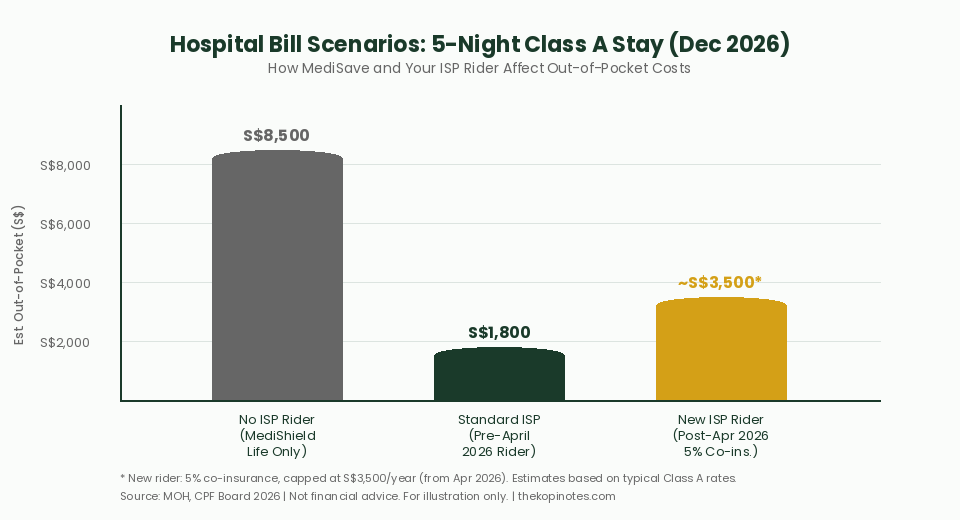
Estimated out-of-pocket costs. For illustrative purposes only. Actual costs depend on specific procedures, surgeons, and ward class. | thekopinotes.com
The practical question for November–December planning: do you know which category your current rider falls into? Check your insurer's policy anniversary date. If your policy renews between now and April 2028, your rider may convert to the new co-insurance structure at that renewal point.
The MOH data from October 2026 showed that 181,800 Singaporeans had already cancelled their IP riders in 2025 — a 114% increase from the prior year. Many of those Singaporeans are now effectively in the “no rider” scenario for any November or December 2026 admission. If you cancelled your rider, consider whether a Class B1 or B2 public hospital stay might significantly reduce your out-of-pocket exposure compared to Class A or private.
Elective Surgery in Q4: Before or After Year-End?
If you have a planned or elective procedure — joint replacement, cataract surgery, fibroid removal, hernia repair — timing it relative to December 31 can have a meaningful impact on your total cost for the year.
The case for going before December 31: If you have already been hospitalised earlier in 2026 and have already paid your annual MediShield Life deductible for this policy year, any additional procedure before year-end may attract a lower out-of-pocket cost — because the deductible has already been met. Many ISP policies also run on a calendar-year basis, meaning a December procedure draws from your 2026 benefit limits rather than resetting to zero in January 2027.
The case for waiting until January 2027: If you have not been hospitalised in 2026 at all, going into January with a fresh year means starting from a clean deductible slate. For MediShield Life, deductibles reset annually — so if January 2027 is your only hospitalisation, you pay the deductible once. You also start fresh on any annual benefit limits under your ISP rider.
The nuance: Deductibles under MediShield Life run by calendar year (January to December). ISP rider policy years may differ — many run from the policy issuance anniversary date, not calendar year. Check with your insurer whether your rider's benefit year runs January–December or some other cycle. Your treating doctor's schedule and bed availability also matter far more than calendar optimisation in most real-world cases.
MediSave Top-Up for Tax Relief — The December 31 Deadline
If your MediSave Account balance is below the BHS of S$79,000, you can make a voluntary cash top-up — and claim that amount as personal income tax relief for YA 2027 (your 2026 income). The relief is dollar-for-dollar: every S$1 you top up reduces your taxable income by S$1, up to the amount needed to reach the BHS.
The deadline is December 31, 2026. Top-ups made after December 31 count toward YA 2028 instead. For Singaporeans on higher income tax bands, the tax saving is substantial:
| MediSave Top-Up Amount | Income Tax Band | Estimated Tax Saved (YA 2027) |
|---|---|---|
| S$3,000 | 7% (S$40k–S$80k income) | ~S$210 |
| S$3,000 | 11.5% (S$80k–S$120k income) | ~S$345 |
| S$5,000 | 15% (S$120k–S$160k income) | ~S$750 |
| S$5,000 | 18% (S$160k–S$200k income) | ~S$900 |
| S$10,000 | 19.5% (S$200k–S$240k income) | ~S$1,950 |
Estimates based on IRAS personal income tax rates for YA 2027. Tax savings are estimates only — actual savings depend on total chargeable income and other reliefs claimed. Verify at iras.gov.sg.
To make a top-up, log in to the CPF website and go to my cpf > Healthcare > MediSave top-up, or use the CPF mobile app. Top-ups are irreversible — MediSave funds can only be withdrawn for approved healthcare uses — so calculate how much room you have under the BHS before proceeding. If your current MediSave balance is, say, S$62,000 and the BHS is S$79,000, you can top up a maximum of S$17,000.
Beyond your own account, you can also top up MediSave for your spouse, parents, parents-in-law, grandparents, grandparents-in-law, or siblings, and claim those top-ups as tax relief too — subject to separate relief caps. Check the IRAS CPF Cash Top-Up Relief page for current limits.
If you're thinking about long-term CPF strategy beyond MediSave — including how to invest CPF-OA for higher returns — our Endowus referral code guide explains how Singaporeans use Endowus to invest CPF funds in low-cost funds with potential for higher returns than the OA floor rate.
Your November–December Hospital Pre-Admission Checklist
Use this checklist before any planned or semi-elective hospitalisation in November or December 2026:
| Step | What to Check | Where to Find It |
|---|---|---|
| 1 | Check MediSave balance vs BHS (S$79,000) | CPF website → My Statement |
| 2 | Confirm ISP rider status: active, lapsed, or cancelled? | Insurer's policy portal or latest premium notice |
| 3 | Check if ISP rider is legacy (pre-Apr 2026) or new-rules rider | Insurer — ask if 5% co-insurance applies |
| 4 | Has your MediShield Life deductible been met this year? | CPF website or insurer claims history |
| 5 | Request an itemised cost estimate from the hospital | Hospital billing or patient relations office |
| 6 | Calculate gap between MediSave balance and BHS | S$79,000 minus your current MediSave balance |
| 7 | If gap > S$0: consider voluntary top-up before December 31 for YA 2027 tax relief | CPF website → Healthcare → MediSave Top-Up |
| 8 | If no rider: consider ward class downgrade to reduce exposure | Discuss with treating specialist |
This checklist is for general planning purposes. Healthcare decisions should always be made in consultation with your medical team first.
Frequently Asked Questions: MediSave Limit 2026
What is the MediSave limit for 2026?
How much MediSave can I use for hospitalisation in 2026?
Has the BHS changed in 2026 compared to 2025?
Can I top up my MediSave in December 2026 and get tax relief?
How do the April 2026 ISP rider rules affect my November-December hospital bill?
What happens to my MediSave balance at year-end? Does it reset?
I cancelled my ISP rider in 2025. What are my options for a December 2026 hospitalisation?
Disclaimer: This article is for general educational purposes only and does not constitute financial, insurance, or medical advice. MediSave withdrawal limits, ISP rider terms, and tax relief caps are set by CPF Board, MOH, and IRAS respectively and are subject to change. Always verify current rates and limits at cpf.gov.sg, moh.gov.sg, and iras.gov.sg. Consult a licensed financial adviser or insurance agent for advice tailored to your personal situation. The Kopi Notes does not receive any fee from CPF Board, MOH, or IRAS. Data as at October 2026.
Get Free Insurance Advice
Speak with a licensed insurance advisor. No obligation, no cost.
By submitting this form, you agree to our Privacy Policy.
This article was researched with the help of AI. While we strive to keep all information accurate and up to date, there may be errors. If you notice any discrepancies, please contact us.