Sasseur REIT Dividend History 2018–2026: DPU Track Record & EMA Model Explained (SGX: CRPU)
A complete dividend history guide — annual DPU table, yield-on-cost analysis, ex-dates, and EMA model mechanics for Singapore investors.
Sasseur REIT (SGX: CRPU) has distributed dividends twice yearly since its March 2018 IPO, drawing income from four Chinese outlet malls through a unique Entrusted Management Agreement (EMA) that blends fixed base rent with a variable sales-linked component. As at November 2026, the REIT yields approximately 9% at a share price of around S$0.595, with cumulative distributions since IPO exceeding 42 SGD cents per unit — well above 50% of the original S$0.80 IPO price returned to unitholders in cash.
Not financial advice. All figures are for educational reference only. Data as at November 2026 unless noted. Past distributions are not a guarantee of future payouts.
Table of Contents
Contents — Click to expand
How the EMA Model Drives Sasseur REIT’s Dividends
Unlike most S-REITs that collect rent directly from tenants, Sasseur REIT entrusts its four Chinese outlet malls to Sasseur Group — the sponsor — through an Entrusted Management Agreement (EMA). Under this structure, the REIT receives income in two parts:
- Fixed component: A guaranteed base payment that provides income stability regardless of retail sales performance.
- Variable component: Approximately 4.5% of retail sales at each mall, directly linking the REIT’s income to consumer spending at the outlets.
This model means Sasseur REIT’s dividend growth is ultimately tied to outlet mall retail sales growth in China — a key distinction from Singapore industrial or office REITs where rent drives income. When Chinese consumer spending is strong (as in FY2019 and FY2022), DPU rises. When retail slows — as it did during COVID (FY2020) and the uneven post-zero-COVID reopening (FY2023) — DPU dips.
The REIT distributes 100% of its distributable income and pays out twice a year: an interim distribution (covering the first half-year) and a final distribution. Singapore investors receive dividends in SGD, shielding them from direct RMB currency conversion — though exchange rate movements between RMB and SGD do affect the underlying income translated from China.
Sasseur REIT’s manager (Sasseur Asset Management Pte. Ltd.) receives a base management fee and a performance fee — these are deducted before the distributable income available to unitholders is calculated. As at 2026, the manager’s fee structure remains largely unchanged from IPO, keeping management costs relatively predictable.
Sasseur REIT DPU History 2018–2026 (Full Table)
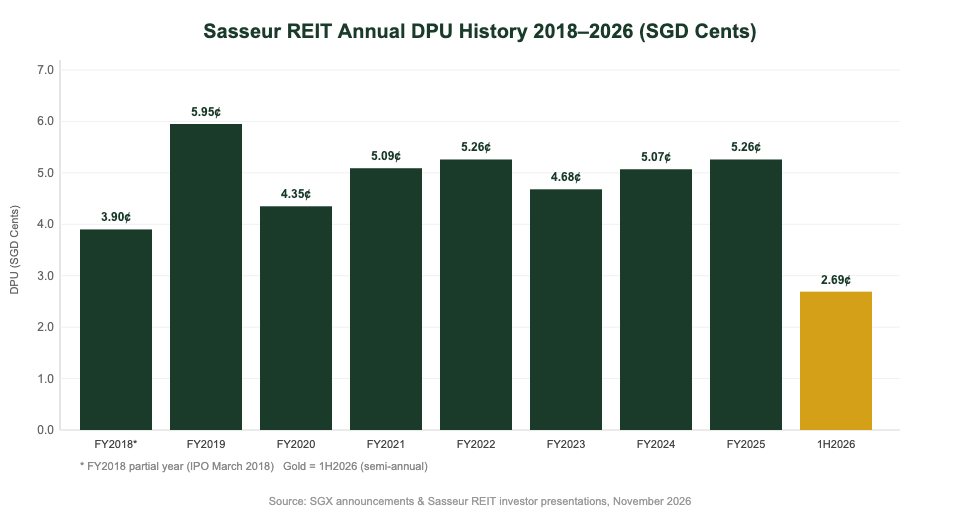
The table below shows Sasseur REIT’s distribution per unit (DPU) from IPO year FY2018 through the latest available data in 2026. All figures are in SGD cents per unit.
| Financial Year | Total DPU (SGD ¢) | YoY Change | Key Driver |
|---|---|---|---|
| FY2018 (partial)* | 3.90¢ | — (IPO year) | First distributions post-March 2018 IPO |
| FY2019 | 5.95¢ | +52.6% | First full year; strong China outlet sales |
| FY2020 | 4.35¢ | −26.9% | COVID-19 mall closures; variable component fell |
| FY2021 | 5.09¢ | +17.0% | China retail recovery; mall sales rebound |
| FY2022 | 5.26¢ | +3.3% | Record outlet sales pre-zero-COVID exit |
| FY2023 | 4.68¢ | −11.0% | Uneven post-COVID reopening; RMB depreciation |
| FY2024 | 5.07¢ | +8.3% | Normalisation; outlet sales recovery |
| FY2025 | 5.26¢ | +3.7% | Steady growth; Chinese consumer recovery |
| 1H2026 (interim) | 2.69¢ | +10.2% (vs 1H2025) | Strong outlet retail sales growth; stable RMB |
| Cumulative (IPO to 1H2026) | ~42.25¢ | — | 52.8% of S$0.80 IPO price returned as dividends |
* FY2018 partial year from March 2018 IPO. Source: SGX announcements & Sasseur REIT investor presentations, November 2026. All DPU figures approximate; verify against official SGX filings.
Yield Analysis & Yield-on-Cost
Sasseur REIT’s headline distribution yield of approximately 9% as at November 2026 is among the highest of any SGX-listed S-REIT. For income-focused investors, the yield-on-cost calculation — based on what you actually paid, not today’s price — matters as much as the current yield.
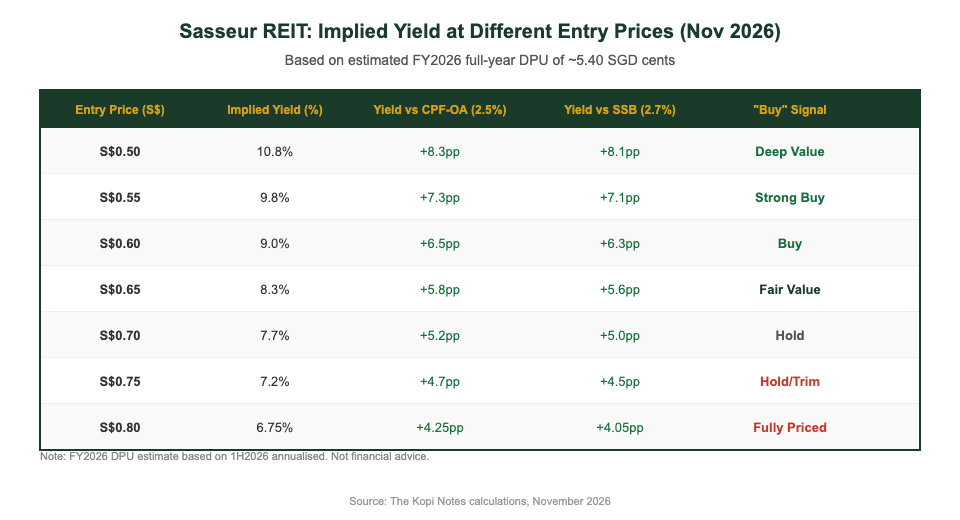
Using an estimated FY2026 full-year DPU of approximately 5.40 SGD cents (based on 1H2026 annualised at a 10.2% growth rate), here is the implied yield across a range of entry prices:
| Entry Price (S$) | Implied Yield | vs CPF-OA (2.5%) | vs SSB (2.7%) |
|---|---|---|---|
| S$0.50 | 10.8% | +8.3pp | +8.1pp |
| S$0.60 (current ~) | 9.0% | +6.5pp | +6.3pp |
| S$0.65 | 8.3% | +5.8pp | +5.6pp |
| S$0.74 (NAV estimate) | 7.3% | +4.8pp | +4.6pp |
| S$0.80 (IPO price) | 6.75% | +4.25pp | +4.05pp |
Source: The Kopi Notes calculations based on estimated FY2026 DPU ~5.40¢. Not financial advice.
A key insight: even at the original S$0.80 IPO price, Sasseur REIT’s estimated FY2026 yield of 6.75% still significantly exceeds the Singapore T-bills 2026 rate and Singapore Savings Bonds guide returns of 2.5–2.7%. For investors who bought at current prices near S$0.60, the yield-on-cost sits at ~9%, making Sasseur REIT one of the most income-generative S-REITs available to Singapore retail investors in 2026.
Distribution Schedule & Ex-Dates
Sasseur REIT distributes income semi-annually — once for the first half of the financial year (1H results, typically declared around August) and once for the second half (2H results, declared around March the following year). Both ex-dividend dates and payment dates are announced via SGX when distributions are declared.
Investors must hold Sasseur REIT units before the ex-dividend date to qualify for each distribution. Units purchased on or after the ex-dividend date will not receive that period’s distribution. For passive income investors on platforms such as moomoo Singapore or via the FSMOne referral code platform, it is worth checking SGX announcements ahead of the ex-date to plan entry timing.
| Distribution Period | Announcement (~) | Ex-Date (~) | Payment (~) |
|---|---|---|---|
| 1H results (interim) | August | September | October |
| 2H results (final) | March | April | May |
Source: Sasseur REIT investor presentations & SGX filings. Exact dates vary — confirm on SGX website ahead of each ex-date.
Sasseur REIT vs Peer High-Yield REITs
Sasseur REIT’s ~9% yield stands out in the S-REIT universe. Here is how it compares to other Singapore-listed REITs with elevated yields as at November 2026:
| REIT | SGX Ticker | Asset Type | Approx Yield | Gearing (~) | Key Risk |
|---|---|---|---|---|---|
| Sasseur REIT | CRPU | China outlet malls | ~9.0% | ~26% | China retail, RMB/SGD, EMA renewal |
| iREIT Global | UD1U | European office/retail | ~8.3% | ~45% | EUR/SGD, occupancy |
| Starhill Global REIT | P40U | Orchard Rd & overseas retail | ~6.9% | ~36% | AUD/MYR FX, master lease expiry |
| AIMS APAC REIT | O5RU | Singapore industrial | ~7.5% | ~27% | Rate sensitivity, AUS exposure |
| CapitaLand China Trust | AU8U | China retail/logistics | ~8.0% | ~40% | China macro, RMB, occupancy |
Source: SGX data & The Kopi Notes estimates, November 2026. Yields are approximate and fluctuate with share price. See our best S-REITs in Singapore 2026 guide for the full ranked list.
Sasseur REIT’s low gearing (~26%) is a standout — it carries significantly less debt than peers like iREIT Global (~45%) or CapitaLand China Trust (~40%), giving it more financial buffer and flexibility. The main trade-off is China-concentration risk: 100% of assets are in one country and one retail sub-sector (outlet malls).
FY2026 DPU Outlook & Key Risks
Based on 1H2026 DPU of ~2.69 SGD cents (up 10.2% year-on-year), the full-year FY2026 DPU is estimated at approximately 5.40 SGD cents if the second-half maintains a similar pace. This would represent a new post-IPO high and imply approximately 2.7% growth over FY2025.
Key risks to watch for the DPU outlook:
- EMA renewal risk: The EMA between Sasseur REIT and its sponsor is periodically renewed. Any unfavourable renegotiation of EMA terms — particularly the fixed component or variable percentage — could directly reduce distributable income.
- RMB depreciation: Sasseur REIT’s income is ultimately generated in Chinese RMB. If the RMB weakens significantly against SGD, the SGD-denominated DPU falls even if mall sales hold steady in local currency terms.
- China retail slowdown: The variable EMA component is tied to outlet retail sales. Weakness in Chinese consumer sentiment — from property sector headwinds, unemployment, or macro slowdown — directly reduces the variable income the REIT receives.
- Concentration risk: Four malls in four Chinese cities means any single-asset shock (fire, regulatory action, construction near the mall) has an outsized impact on overall DPU.
For a deeper look at Sasseur REIT’s portfolio, EMA terms, and gearing, see our Sasseur REIT Complete Investor Guide 2026. For passive income Singapore strategies beyond individual REITs, the Singapore REIT ETF route offers broader diversification with comparable yield levels — see our Singapore REIT ETF guide for details.
Where to Buy Sasseur REIT in Singapore
Sasseur REIT (SGX: CRPU) is listed on the Singapore Exchange and can be purchased through any SGX-connected brokerage. For regular income investors building a dividend portfolio, consider these platforms:
- FSMOne — Low-cost platform with no custody fee for SGX stocks. Use our FSMOne referral code for account opening benefits. Suitable for lump-sum purchases of CRPU.
- moomoo Singapore — Commission-free trades for the first few months with competitive ongoing rates. See our moomoo Singapore review for the latest sign-up bonus.
- Syfe — For investors who prefer a managed REIT portfolio rather than hand-picking individual REITs, Syfe’s REIT+ portfolio holds a diversified basket of S-REITs. Use our Syfe referral code for a fee waiver on sign-up.
- Endowus — For CPF OA investors, Endowus offers access to diversified REIT funds (note: Sasseur REIT itself is not CPF-investable as a single stock, but REIT-focused unit trusts accessible through Endowus can offer similar exposure). Use our Endowus referral code for initial fee rebates.
Note: Sasseur REIT units are NOT eligible for direct CPF investment. They may be purchased using SRS funds through eligible brokers. Use our Singapore retirement calculator to model how a ~9% yield dividend REIT fits your passive income target.
Fees stated are general market rates as at November 2026. Always verify current commission schedules on each broker’s website before transacting.
Frequently Asked Questions
How often does Sasseur REIT pay dividends?
Sasseur REIT (SGX: CRPU) distributes dividends twice a year — an interim distribution for the first half of its financial year (typically paid around October) and a final distribution for the second half (typically paid around May). Both distributions are paid in SGD to Singapore investors, regardless of the underlying RMB income from its Chinese outlet malls.
What is Sasseur REIT's current dividend yield in 2026?
As at November 2026, Sasseur REIT yields approximately 9% at a share price of around S$0.595, based on an estimated FY2026 full-year DPU of approximately 5.40 SGD cents. The 1H2026 interim DPU was approximately 2.69 cents, up 10.2% year-on-year. Yield will vary depending on the entry price and actual final DPU for the year.
What is the EMA model and how does it affect Sasseur REIT's dividends?
The Entrusted Management Agreement (EMA) is the contractual arrangement between Sasseur REIT and its sponsor, Sasseur Group, through which Sasseur Group manages the four outlet malls on behalf of the REIT. Under the EMA, the REIT receives a fixed base income plus a variable component tied to approximately 4.5% of retail sales at each mall. This means DPU moves up and down with Chinese outlet mall sales performance, creating a direct link between Chinese consumer spending and the dividends received by Singapore investors.
Is Sasseur REIT a good dividend stock for income investors?
Sasseur REIT’s ~9% yield, low gearing (~26%), and consistent semi-annual payout history since 2018 make it appealing for income-focused investors. However, it comes with China-concentration risk, RMB/SGD currency exposure, and EMA renewal uncertainty. It suits investors with a higher risk tolerance who want a high-yield complement to more defensive S-REITs like ParkwayLife or CapitaLand Integrated Commercial Trust. It is not suitable as a core holding for conservative retirees due to its single-country, single-sector concentration.
Can I use CPF to buy Sasseur REIT?
No. Sasseur REIT (SGX: CRPU) is not on the CPF Investment Scheme (CPFIS) approved list, meaning CPF Ordinary Account (OA) or Special Account (SA) funds cannot be used to purchase CRPU units directly. However, Sasseur REIT may be purchasable using SRS (Supplementary Retirement Scheme) funds through eligible brokers. For CPF-compatible S-REIT options, see our CPF investment strategy guide.
What was Sasseur REIT's highest and lowest DPU since IPO?
Based on available SGX announcements, Sasseur REIT’s highest annual DPU since IPO was approximately 5.95 SGD cents in FY2019 (its first full financial year). The lowest full-year DPU was approximately 4.35 cents in FY2020, when COVID-19 caused mall closures across China and significantly reduced the variable sales-linked component of EMA income. The REIT has since recovered and in FY2025 matched the FY2022 level of ~5.26 cents.
Build Your S-REIT Dividend Portfolio
Track your passive income targets with our free calculator — or explore the best S-REITs for 2026.
This article was researched with the help of AI. While we strive to keep all information accurate and up to date, there may be errors. If you notice any discrepancies, please contact us.