Best ETFs in Singapore (2026): The Complete Guide by Category
There is no single “best” ETF — here is the top pick in every major category, with real TER and tax-cost data for Singapore investors.
There is no single “best ETF” for every Singapore investor — the right pick depends on your goal. For core global growth, CSPX or VWRA on the LSE offer the lowest total cost after tax. For Singapore income, the STI ETF (ES3/G3B) or a S-REIT ETF like CLR fits better. This guide ranks the best ETF in each category for 2026, with real TER and tax data.
Not financial advice. All figures are for educational reference only. Data verified as at November 2026 against fund factsheets and SGX filings unless otherwise noted.
Table of Contents
What Makes an ETF the “Best” Pick for a Singapore Investor?
“Best ETF in Singapore” is not one product — it is a shortlist that changes by goal. A Singapore resident building a core retirement portfolio weighs different factors than someone topping up CPFIS funds or chasing S-REIT income. Four things decide whether an ETF earns a “best in category” spot on this list: total expense ratio (TER), withholding tax (WHT) drag on dividends, US estate tax exposure, and whether the fund is CPFIS or SRS-eligible.
A UCITS ETF domiciled in Ireland and listed on the London Stock Exchange (LSE) — such as CSPX, VWRA or IWDA — typically wins on tax efficiency: US-sourced dividends are taxed at 15% withholding tax under the Ireland-US treaty, versus 30% for a US-domiciled ETF like VOO, and there is no US estate tax exposure above the USD 60,000 non-resident threshold. SGX-listed ETFs win on CPFIS/SRS eligibility and SGD-denominated simplicity — no FX conversion, no foreign brokerage fees. Neither structure is universally “best”; this guide picks the strongest option in each category and explains the trade-off.
Best ETFs in Singapore by Category
1. Best Core Global Equity ETF: CSPX and VWRA (LSE)
For broad, low-cost global exposure, CSPX (iShares Core S&P 500 UCITS ETF, TER 0.07% p.a.) and VWRA (Vanguard FTSE All-World UCITS ETF, TER 0.14% p.a. after Vanguard’s July 2026 fee cut from 0.19%) are the two most-held core holdings among Singapore investors on IBKR, Saxo and Syfe. CSPX is pure S&P 500; VWRA adds developed and emerging markets outside the US for broader diversification. A Singapore investor putting SGD 50,000 into CSPX pays roughly SGD 35 a year in fund fees; the same amount in VWRA costs about SGD 70 a year — both far below the typical 0.5–1% TER of an actively managed unit trust.
Read the full S&P 500 ETF Singapore guide and the VWRA ETF Singapore guide for step-by-step buying instructions.
2. Best Developed-Markets Alternative: IWDA (LSE)
IWDA (iShares Core MSCI World UCITS ETF, TER 0.20% p.a.) tracks developed markets only — no emerging markets exposure, unlike VWRA. It suits investors who want to control their emerging-market allocation separately, or who prefer MSCI World’s slightly different sector weighting. See the full IWDA ETF Singapore guide for a side-by-side with VWRA.
3. Best Singapore Equity ETF: STI ETF (ES3 or G3B, SGX)
For direct exposure to the Singapore stock market, the two STI ETFs are ES3 (SPDR Straits Times Index ETF, TER 0.28% p.a. per SSGA’s September 2026 factsheet) and G3B (Nikko AM Singapore STI ETF, TER capped at 0.25% p.a. since December 2023). Both track the same 30-stock Straits Times Index, dominated by the three local banks (DBS, OCBC, UOB) and SGX-listed REITs. G3B’s lower fee cap makes it the marginally cheaper choice; ES3 has deeper liquidity and a longer track record. Both are CPFIS-OA approved. Full comparison in the STI ETF Singapore guide.
4. Best S-REIT ETF: Lion-Phillip S-REIT ETF (CLR, SGX)
CLR (Lion-Phillip S-REIT ETF, TER 0.60% p.a. per SGX semi-annual reports) is the most established pure-play Singapore REIT ETF, giving one-ticket exposure to roughly 25–27 SGX-listed REITs with no stock-picking required. It is higher-cost than the core global funds because active REIT selection and SGX brokerage pass-through costs more, but it remains cheaper than most REIT unit trusts. See the Singapore REIT ETF guide for the full breakdown against CFA (NikkoAM-StraitsTrading Asia Ex Japan REIT ETF) and buying direct S-REITs instead.
5. Best Gold ETF: SPDR Gold Shares (O87, SGX)
For inflation hedging and portfolio diversification, O87 (SPDR Gold Shares, TER approximately 0.40% p.a.) is SGX’s most liquid, physically-backed gold ETF, tradable in USD. The LionGlobal Singapore Physical Gold ETF (GLU/GLS, TER capped at 0.39% p.a.) is a close SGD-denominated alternative with similar cost. Neither is CPFIS-eligible. Full options in the gold ETF Singapore guide.
6. Best Bond ETF: ABF Singapore Bond Index Fund (A35, SGX)
For capital preservation and income, A35 (ABF Singapore Bond Index Fund, TER approximately 0.24% p.a. per its audited product highlights sheet) holds SGD-denominated government and quasi-government bonds, making it the lowest-risk, lowest-cost fixed income ETF on SGX. Investors chasing higher yield at higher risk should instead look at the high-yield bond ETF guide, which covers USD-denominated corporate bond alternatives and their added credit and currency risk.
Cost Comparison: TER Across the Best ETFs
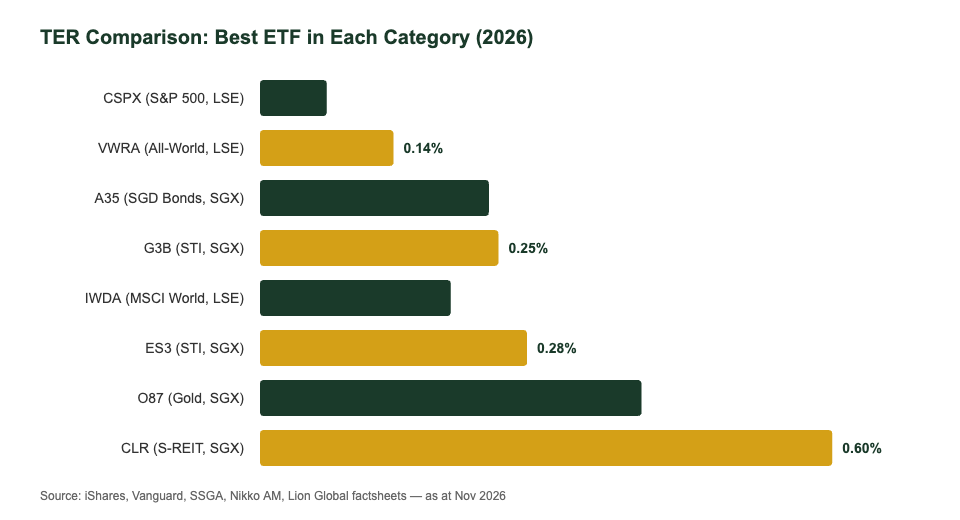
Expense ratios across these eight funds range from 0.07% to 0.60% a year — a difference that compounds meaningfully over a multi-decade holding period. Figures below are drawn from the iShares CSPX factsheet and the SSGA SPDR STI ETF product page, both current as at November 2026. The table below lists the TER and exchange for each “best in category” pick; the chart beneath it visualises the same data.
| Ticker | Category | Exchange | TER p.a. | Domicile |
|---|---|---|---|---|
| CSPX | Core — S&P 500 | LSE | 0.07% | Ireland |
| VWRA | Core — All-World | LSE | 0.14% | Ireland |
| IWDA | Developed Markets | LSE | 0.20% | Ireland |
| G3B | Singapore Equity (STI) | SGX | 0.25% (cap) | Singapore |
| ES3 | Singapore Equity (STI) | SGX | 0.28% | Singapore |
| A35 | SGD Bonds | SGX | 0.24% | Singapore |
| O87 | Gold | SGX | ~0.40% | US |
| CLR | S-REIT | SGX | 0.60% | Singapore |
Source: iShares, Vanguard, SSGA, Nikko AM and SGX factsheets/semi-annual reports, verified November 2026.
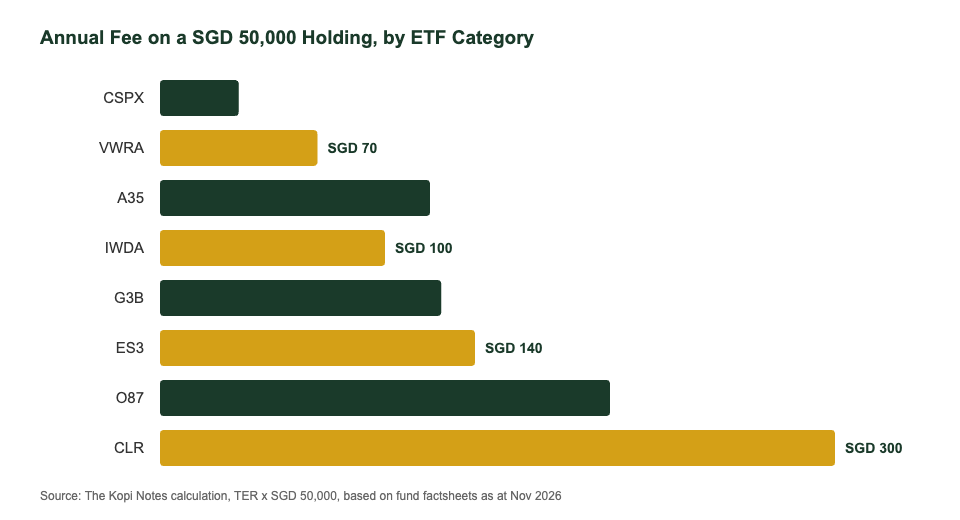
On a SGD 50,000 holding, that translates to an annual fee of roughly SGD 35 for CSPX versus SGD 300 for CLR — not because CLR is a bad fund, but because active REIT basket construction and SGX fund administration cost more than tracking a plain index. The chart below shows this calculation across all eight funds.
Tax and Singapore-Specific Rules
Tax treatment is the single biggest hidden cost difference between these categories, and it is where “best ETF” decisions are most often made wrong. An Ireland-domiciled UCITS ETF like CSPX or VWRA pays 15% US withholding tax on underlying US dividends, under the US-Ireland tax treaty, versus 30% for a US-domiciled fund such as VOO. On a SGD 50,000 CSPX position yielding roughly 1.3% in US dividends, that is the difference between losing about SGD 98 a year to withholding tax at 15%, versus SGD 195 a year at 30% — a real, recurring cost difference that the LSE-listed structure avoids.
US estate tax exposure is the second factor: non-US-resident investors holding US-situs assets (including US-domiciled ETFs like VOO) above USD 60,000 face US estate tax on the excess at rates up to 40%. Ireland-domiciled UCITS ETFs listed on the LSE are not US-situs assets and carry no such exposure, regardless of position size — one reason CSPX and VWRA dominate the “best core ETF” conversation for Singapore investors with larger portfolios.
SGX-listed ETFs — STI ETFs, CLR, A35, O87 — sit in a different tax category entirely: no Singapore capital gains tax, no Singapore dividend tax, and several (STI ETFs, A35, and some S-REIT ETFs) are CPFIS-OA approved, meaning CPF Ordinary Account savings above the first SGD 20,000 can be invested directly. None of the LSE-listed UCITS ETFs are CPFIS-eligible, though all can be bought with Supplementary Retirement Scheme (SRS) funds through brokers that support SRS trading, such as moomoo and FSMOne.
How to Buy These ETFs in Singapore
SGX-listed picks — G3B, ES3, CLR, A35, O87 — trade in SGD through any local broker: moomoo, Longbridge, Tiger Brokers, FSMOne or a traditional bank brokerage. No currency conversion is needed, and CPFIS-eligible counters can be bought directly from a CPF Investment Account.
LSE-listed picks — CSPX, VWRA, IWDA — need a broker with LSE access. Interactive Brokers (IBKR) offers the lowest LSE commission for larger, infrequent trades; moomoo and Longbridge now offer LSE access with SGD funding and no separate GBP account needed, which suits smaller or more frequent buyers. Open the account, fund it, search the ticker, select the London Stock Exchange listing specifically (not the US OTC or Amsterdam listing of the same fund), and place the order in GBP or USD depending on the broker’s quoting currency.
For a fully hands-off alternative that bundles several of these categories into one portfolio, robo-advisors like Syfe and Endowus construct and rebalance a diversified ETF portfolio automatically, at a higher all-in fee than buying the underlying ETFs yourself.
Which “Best ETF” Is Right for You?
Choose CSPX or VWRA if: you want the lowest-cost, most tax-efficient core holding for long-term growth and don’t need CPFIS eligibility. Choose IWDA if: you want developed-markets-only exposure and plan to add emerging markets separately. Choose G3B or ES3 if: you want CPFIS-eligible Singapore equity exposure or believe in the local banks and REITs that dominate the STI. Choose CLR if: you want diversified S-REIT income without picking individual REITs — pair it with our best S-REITs in Singapore 2026 roundup if you’d rather hold REITs directly. Choose A35 if: capital preservation matters more than yield, as a bond allocation alongside equities. Choose O87 if: you want a small inflation hedge, not a primary holding — gold pays no dividend and its price can be volatile.
Whatever the mix, run the numbers through our Singapore retirement calculator to see how a given ETF allocation and contribution rate tracks against your retirement target, and see the complete ETF investing guide for Singapore for the full mechanics of buying any ETF step by step.
Not financial advice. This is a starting shortlist, not a recommendation to buy any specific fund — your allocation should match your own risk tolerance, time horizon and tax situation. Figures are current as at November 2026 and will change as funds revise fees or as tax treaties are amended.
Where to Buy Each Category
SGX-listed picks (G3B, ES3, CLR, A35, O87) can be bought in SGD through moomoo or FSMOne — both support CPFIS and SRS funding for the eligible counters. LSE-listed picks (CSPX, VWRA, IWDA) need LSE market access: Interactive Brokers has the lowest commission for larger trades, while a broker such as Longbridge offers SGD-funded LSE access for smaller, more frequent buys. Compare all four in our Longbridge referral code page.
Frequently Asked Questions
What is the best ETF in Singapore right now?
There isn’t one universal answer — it depends on your goal. For core global growth, CSPX (TER 0.07%) or VWRA (TER 0.14%) on the LSE are the lowest-cost, most tax-efficient picks for Singapore investors. For CPFIS-eligible Singapore equity exposure, G3B or ES3 (the STI ETFs) are the standard choice. For S-REIT income, CLR is the most established pure-play option.
Is CSPX or VWRA the better 'best ETF' pick for a beginner?
VWRA is usually the simpler single-fund choice for a beginner because it already includes developed and emerging markets in one ticker, so there is no need to separately manage geographic allocation. CSPX is cheaper (0.07% vs 0.14% TER) but concentrates entirely in US large-caps, which suits an investor who wants to make that allocation decision deliberately rather than automatically.
Can I buy these ETFs using my CPF or SRS funds?
SGX-listed STI ETFs (G3B, ES3) and the ABF Singapore Bond Index Fund (A35) are CPFIS-OA approved, so CPF Ordinary Account savings above the first SGD 20,000 can buy them directly through a CPF Investment Account. LSE-listed ETFs like CSPX, VWRA and IWDA are not CPFIS-eligible but can be bought with Supplementary Retirement Scheme (SRS) funds through brokers such as moomoo and FSMOne that support SRS trading on LSE counters.
Why is the Lion-Phillip S-REIT ETF (CLR) more expensive than CSPX or VWRA?
CLR’s 0.60% p.a. TER reflects the higher cost of constructing and rebalancing a basket of roughly 25-27 individual S-REITs on SGX, including brokerage and custody costs passed through to the fund. CSPX and VWRA track a single large, liquid global index at much larger scale, which spreads fixed fund costs over a far bigger asset base and keeps per-unit costs low.
Which is the best gold ETF in Singapore — O87 or the LionGlobal gold ETF?
Both are reasonable choices with similar fees: SPDR Gold Shares (O87) has a TER of approximately 0.40% and trades in USD with deep liquidity, while the LionGlobal Singapore Physical Gold ETF (GLU/GLS) caps its TER at 0.39% and offers an SGD-denominated listing. Neither is CPFIS-eligible, and neither pays a dividend — gold ETFs are a diversification and inflation hedge, not an income holding.
Is it better to buy one 'best' ETF per category, or combine them into a portfolio?
Most Singapore investors combine categories rather than picking just one fund: a core global equity ETF (CSPX or VWRA) for growth, a bond ETF (A35) for stability, and optionally a S-REIT ETF (CLR) or gold ETF (O87) for income and diversification. The right mix depends on your age, risk tolerance and whether you’re investing cash, CPF or SRS funds — a hands-off option like Syfe or Endowus builds and rebalances this mix automatically for a fee.
Ready to Start Investing in ETFs?
Open a brokerage account and buy your first ETF today. Use our referral links for exclusive sign-up bonuses.
This article was researched with the help of AI. While we strive to keep all information accurate and up to date, there may be errors. If you notice any discrepancies, please contact us.