Nasdaq 100 ETF Sell-Off: Should Singapore Investors Buy the Dip? (November 2026)
What the AI-led correction means for EQQQ, CNDX and XND holders — with real NAV, TER and drawdown data as at 6 Nov 2026.
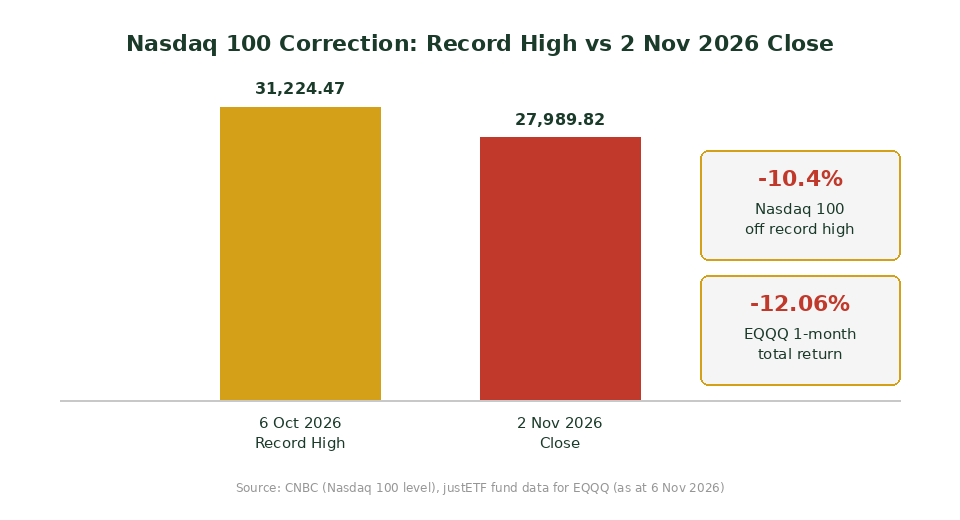
The Nasdaq 100 fell about 10.4% from its 6 October 2026 record high to a 27,989.82 close on 2 November 2026, driven by fears that AI data-centre spending won’t pay off and new data-centre moratorium risk after the US midterm elections. Singapore investors holding Nasdaq 100 ETFs like EQQQ, CNDX or XND are sitting on a real but so far orderly correction — not a 2022-style crash — and the key question is whether to average in, hold, or wait for more clarity.
Not financial advice. All figures are for educational reference only. Data verified as at 6–8 November 2026 unless otherwise noted.
What’s Happening to the Nasdaq 100?
The Nasdaq 100 — the index that EQQQ, CNDX and XND all track — set a record close of 31,224.47 on 6 October 2026. By 2 November 2026 it had fallen to 27,989.82, down 1.39% on the day and roughly 10.4% below that record, which meets the common 10% definition of a “correction.” The index partially recovered to 28,180.26 the following session as AI chipmakers rebounded ahead of US midterm election results, so this has been a volatile two-way move rather than a one-directional crash.
For context, one official fund factsheet shows just how fast sentiment turned: the Invesco EQQQ Nasdaq-100 UCITS ETF, which was up 13.58% year-to-date as at early November 2026, had still lost 12.06% of its value in the preceding month alone. That single statistic — a strong YTD figure sitting alongside a sharp one-month drawdown — is the clearest sign that this is a fast, concentrated sell-off inside an otherwise positive year, not a reversal of the 2023–2025 AI rally.
Locally, the pullback has been felt too. Singapore’s FTSE ST All-Share Technology Index fell 17.3% in October 2026 alone — the worst-performing local sector that month — while the broader Straits Times Index (STI) fell 1.5% over four consecutive sessions in early November as the Wall Street tech sell-off spilled into Asian trading.
Why the Sell-Off Is Happening Now
Two overlapping worries are driving the move. The first is an AI-capex sustainability question that’s been building since late October 2026: investors are asking whether the hundreds of billions of dollars that hyperscalers are pouring into AI data centres and chips will generate a commensurate return, with commentators drawing comparisons to the dot-com bubble of 2000. An Al Jazeera report on 23 October 2026 noted the Nasdaq falling 2.6% in a single session on these concerns, with chipmakers Intel and AMD each down roughly 8%.
The second, more acute trigger landed on 5 November 2026: reports tied to a Democratic landslide in the US midterm elections raised the prospect of new regulatory moratoriums on data-centre construction, directly threatening the capex story that has powered Nasdaq 100 mega-caps like Nvidia, Microsoft and Meta Platforms. That combination — a slow-building valuation worry plus a sudden political catalyst — is a textbook setup for a sharp, fast correction rather than a prolonged bear market, though Singapore investors should not assume the two are unrelated or temporary.
It’s worth noting that corrections of this size are not unusual for the Nasdaq 100. EQQQ’s own since-inception maximum drawdown sits at -46.75%, and the index fell 28.47% in calendar year 2022 alone. A 10–12% pullback, while uncomfortable, is well within the ETF’s normal volatility band — EQQQ’s one-year annualised volatility has been running at around 20%.
EQQQ vs CNDX vs XND: How SG Investors Hold the Nasdaq 100
Singapore investors have three main ways to get Nasdaq 100 exposure through UCITS ETFs, two on the London Stock Exchange (LSE) and one now on the SGX in SGD. All three are Ireland-domiciled, which gives SG investors the same 15% US dividend withholding tax treaty rate and no US estate tax exposure that applies to CSPX and other LSE-listed ETFs.
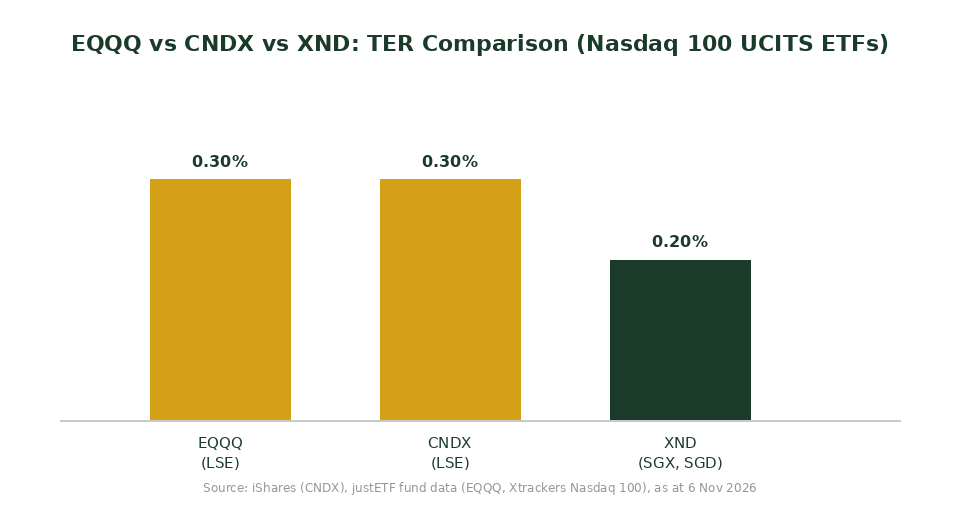
| ETF | Exchange | TER | Structure | Fund Size | Domicile |
|---|---|---|---|---|---|
| CNDX iShares Nasdaq 100 UCITS ETF |
LSE (USD) | 0.30% | Accumulating | USD 28.7B | Ireland |
| EQQQ Invesco EQQQ Nasdaq-100 UCITS ETF |
LSE (USD/GBP) | 0.30% | Distributing | EUR 12.0B | Ireland |
| XND Xtrackers Nasdaq 100 UCITS ETF |
SGX (SGD) | 0.20% | Accumulating | EUR 2.7B (global share class) | Ireland |
Source: iShares official fund page (CNDX, as at 6 Nov 2026); justETF fund data (EQQQ, Xtrackers Nasdaq 100 UCITS ETF, as at 6 Nov 2026).
XND’s 0.20% TER is the cheapest of the three because Xtrackers’ Nasdaq 100 share class undercuts both the iShares and Invesco products, and it settles in SGD on the SGX — no FX conversion needed to buy it through a local broker. CNDX and EQQQ are functionally very similar (same index, same TER, both Ireland-domiciled), with the main difference being that EQQQ distributes dividends quarterly while CNDX accumulates them inside the fund. A full breakdown of all three sits in our XND vs CNDX vs EQQQ comparison guide. Fund data for CNDX is sourced directly from iShares’ official CNDX fund page, and EQQQ/Xtrackers data from justETF’s fund profiles, both as at 6 November 2026.
Original calculation — the real cost of the drawdown: CNDX’s 52-week high was USD 1,793.99; its NAV on 6 November 2026 was USD 1,550.69 — a drop of 13.57% from the 52-week peak, slightly steeper than the headline 10.4% Nasdaq 100 figure because the 52-week high was itself set after 6 October. At an indicative USD/SGD rate of 1.28 (late October 2026), a Singapore investor who put SGD 50,000 into CNDX at the 52-week high (≈USD 39,060) would now be holding a position worth roughly SGD 42,600 (≈USD 33,770) — a paper loss of about SGD 6,780, before accounting for any dividends reinvested along the way.
Buying the Dip: How Singapore Investors Can Approach It
There’s no single right answer to “buy the dip,” but there are a few practical, non-speculative approaches SG investors commonly use:
Dollar-cost averaging (DCA): Rather than trying to time the exact bottom, continuing (or slightly increasing) a scheduled monthly purchase into XND, CNDX or EQQQ smooths out the entry price across the correction. This is the approach used in our dollar-cost averaging guide.
Rebalancing toward target weights: If Nasdaq 100 exposure has fallen below your target allocation (e.g. in a 60/40 global-tech/broad-market split), topping it back up to target is a disciplined way to buy at lower prices without making a market-timing bet.
Diversify rather than concentrate further: Nasdaq 100 ETFs are a concentrated bet on US mega-cap tech. Investors uncomfortable with that concentration can pair a smaller Nasdaq 100 position with a broader S&P 500 ETF or a globally diversified fund, which dilutes single-sector risk.
To actually place the trade, Singapore investors can buy XND directly in SGD on the SGX through brokers like moomoo or Longbridge, or buy CNDX/EQQQ on the LSE in USD through IBKR, moomoo, or Longbridge. See our broker comparison for ETF investing for current fee schedules.
Risks to Consider Before Averaging In
A correction is not a guarantee of a rebound, and Nasdaq 100 ETFs carry specific risks that are worth being explicit about rather than glossing over:
- Concentration risk: The Nasdaq 100 is roughly 68% technology by sector weight in EQQQ’s own factsheet, with the top 10 holdings — Nvidia, Apple, Microsoft, Micron, AMD, Amazon, Meta, Alphabet (A and C) and Tesla — making up almost half the fund. A handful of stocks drive most of the index’s return, for better or worse.
- Regulatory risk: The specific trigger behind this correction — potential US data-centre moratoriums — is a policy risk that didn’t exist as a major market factor a year ago. It can resolve either way and is genuinely hard to forecast.
- Valuation risk: At a reported price-to-earnings ratio above 33x for the index, Nasdaq 100 constituents are priced for continued strong earnings growth. If AI-related capex slows meaningfully, earnings could disappoint even without a change in regulation.
- Currency risk: CNDX and EQQQ are priced in USD/GBP; a weaker USD against SGD erodes returns for SG investors independent of how the index performs. XND removes this specific friction by settling in SGD, though the underlying assets are still USD-denominated.
None of this means Nasdaq 100 ETFs are unsuitable for SG investors — the asset class has still delivered a 74.76% total return over five years in EQQQ despite the 2022 drawdown — but it does mean sizing the position so that a further 15–20% pullback wouldn’t force a change in your financial plan.
Where to Buy EQQQ, CNDX & XND in Singapore
XND trades directly in SGD on the SGX, so it can be bought through local brokers without currency conversion. CNDX and EQQQ trade in USD/GBP on the LSE and are best accessed through brokers with competitive LSE commissions. TKN readers can check current sign-up offers through our moomoo referral code and FSMOne referral code pages. For a hands-off, diversified alternative to picking individual ETFs, see our passive income Singapore guide. TKN may earn a referral fee from these links.
Fees quoted on broker sites change; always check the broker’s own fee page before trading, and treat any figures here as a starting point rather than final pricing.
Not financial advice. This article is for educational purposes only and reflects market data verified as at 6–8 November 2026. Markets can continue to move materially after publication — always check the latest NAV and index levels before acting.
Frequently Asked Questions
Why did the Nasdaq 100 fall in November 2026?
The Nasdaq 100 fell about 10.4% from its 6 October 2026 record high to a 27,989.82 close on 2 November 2026. The sell-off was driven first by growing doubts over whether massive AI data-centre and chip capital spending would generate adequate returns, and then by a sharper trigger on 5 November 2026 — reports linking a Democratic landslide in the US midterm elections to the risk of new data-centre construction moratoriums, which directly threatens the AI capex story behind Nasdaq 100 mega-caps.
Is now a good time to buy Nasdaq 100 ETFs like EQQQ or CNDX?
There’s no way to know if a 10–12% pullback is the bottom. What SG investors can control is process: continuing a scheduled dollar-cost averaging plan, rebalancing back to a target allocation, or sizing any lump-sum addition so that a further 15–20% drop wouldn’t be financially painful. This article is educational, not a buy recommendation — always assess your own risk tolerance and time horizon first.
What's the difference between EQQQ, CNDX and XND?
All three track the Nasdaq 100 index and are Ireland-domiciled, giving SG investors the 15% US dividend withholding tax treaty rate. EQQQ and CNDX both carry a 0.30% TER and trade in USD/GBP on the London Stock Exchange — EQQQ distributes dividends quarterly, while CNDX accumulates them. XND is the newest option, trading in SGD on the SGX with a lower 0.20% TER and no need for USD conversion.
Can I buy XND, CNDX or EQQQ with my CPF or SRS funds?
None of these three ETFs are CPF Investment Scheme (CPFIS) approved, so they cannot be bought with CPF Ordinary Account funds. They can generally be purchased through an SRS account if your broker supports SRS trading on the relevant exchange — check with your broker, as SRS-eligible counters vary by platform.
How big was the 2022 Nasdaq 100 drawdown compared to this one?
The Nasdaq 100 fell roughly 28–33% during calendar year 2022 as the US Federal Reserve raised interest rates aggressively to fight inflation — EQQQ itself recorded a -28.47% total return that year. The current correction, at around 10–12% as at early November 2026, is materially smaller so far, though the two situations share a common thread of markets repricing growth-stock valuations.
Is XND better than CNDX or EQQQ for Singapore investors?
XND has the lowest TER (0.20% vs 0.30%) and settles in SGD, which removes currency-conversion friction for SG investors buying directly on the SGX. However, it’s a newer, smaller listing than the well-established LSE-listed CNDX and EQQQ, so investors who value longer trading history or deeper secondary-market liquidity may still prefer the LSE options.
Ready to Start Investing in ETFs?
Open a brokerage account and buy your first ETF today. Use our referral links for exclusive sign-up bonuses.
This article was researched with the help of AI. While we strive to keep all information accurate and up to date, there may be errors. If you notice any discrepancies, please contact us.