How to Open an SRS Account in Singapore 2026
DBS, UOB & OCBC — Step-by-Step Guide + Tax Savings Calculator📋 Table of Contents
- What Is the SRS (Supplementary Retirement Scheme)?
- SRS Eligibility & 2026 Contribution Limits
- How to Open a DBS SRS Account
- How to Open a UOB SRS Account
- How to Open an OCBC SRS Account
- How Much Tax Can You Save with SRS?
- What Can You Invest with Your SRS Funds?
- SRS Withdrawal Rules & Penalties
- Frequently Asked Questions
What Is the SRS (Supplementary Retirement Scheme)?
The Supplementary Retirement Scheme (SRS) is a voluntary savings programme by the Singapore Government that lets you contribute cash, invest those funds in stocks, bonds, ETFs or unit trusts, and claim full tax relief on every dollar contributed — up to S$15,300 per year for Singapore Citizens and PRs, and S$35,700 for foreigners. SRS money is only lightly taxed at withdrawal (50% of withdrawals are assessable) and can be invested to grow over your working years.
Not financial advice. All figures are for educational reference only. Data as at November 2026 unless noted.
The SRS works alongside CPF — it doesn’t replace it. Think of CPF as your compulsory safety net, and SRS as a voluntary top-up you control entirely. You choose when to contribute, how much, and how to invest. The scheme is administered by just three banks in Singapore: DBS, UOB, and OCBC.
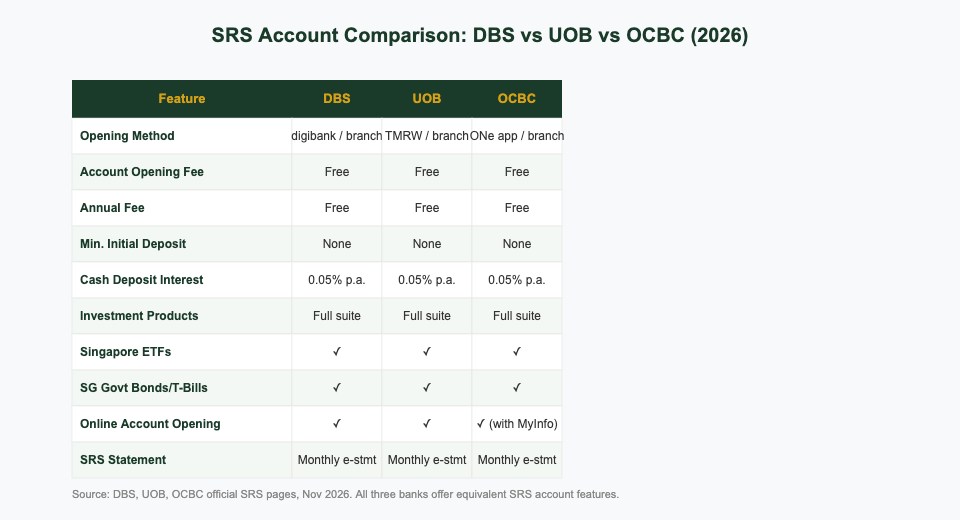
Opening your SRS account costs nothing. There are no annual fees, no minimum balance requirements, and no lock-in period for the account itself. You can open it today, contribute S$1, and claim that S$1 as tax relief this year — the account stays open indefinitely.
SRS Eligibility & 2026 Contribution Limits
To open an SRS account, you must be an individual taxpayer in Singapore. All three residency statuses are eligible:
| Status | Annual SRS Contribution Cap (2026) | Max Tax Relief |
|---|---|---|
| Singapore Citizen | S$15,300 | S$15,300 |
| Singapore PR | S$15,300 | S$15,300 |
| Foreigner (EP/SP) | S$35,700 | S$35,700 |
Source: IRAS Singapore, YA2026. SRS contribution cap is pegged at 15% of deemed income (S$102,000 for Citizens/PRs) for Citizens/PRs and 35% for foreigners.
You may only hold one SRS account in your lifetime. Once you have opened an account with DBS, UOB, or OCBC, you cannot open another. Choose your bank carefully — the main differences are the investment platform, mobile app, and the breadth of products available through each bank’s brokerage arm.
The cut-off date for SRS contributions to count toward the current Year of Assessment is 31 December. If you contribute on 1 January, it counts for the following tax year.
How to Open a DBS SRS Account (Step-by-Step)
DBS is the most popular choice for SRS account opening in Singapore, primarily because of its seamless digibank integration and the DBS Vickers platform for SRS investing. If you already bank with DBS, opening an SRS account takes under 10 minutes online.
Online (DBS digibank):
- Log in to DBS digibank (mobile app or web).
- Go to Invest → Supplementary Retirement Scheme (SRS).
- Click Apply Now. No physical documents needed.
- Verify your personal details (pre-filled from your DBS profile).
- Accept the SRS terms and conditions.
- Your SRS account number is generated instantly.
- To invest, link your SRS account to DBS Vickers under Invest → Vickers → Open Account.
At a DBS branch: Bring your NRIC (or passport + Employment Pass for foreigners), complete the SRS application form, and your account is opened on the same day.
DBS Vickers allows you to invest your SRS funds in SGX-listed stocks, REITs, ETFs, Singapore Government Securities, unit trusts, and structured deposits. DBS also offers Endowus via its platform for managed portfolio access.
How to Open a UOB SRS Account (Step-by-Step)
UOB’s SRS account is linked to UOB Kay Hian, one of Singapore’s established brokerages. If you plan to invest via UOB Kay Hian for equities and bonds, UOB is a solid choice.
Online (UOB TMRW / Personal Internet Banking):
- Log in to UOB Personal Internet Banking or the TMRW app.
- Navigate to Invest → SRS.
- Select Open SRS Account.
- Confirm your particulars (pulled from your UOB profile).
- Accept the terms. Account is activated immediately.
- To invest, link to UOB Kay Hian under Trading → SRS Investments.
Non-UOB customers can still open a UOB SRS account at any UOB branch with a valid NRIC. UOB Kay Hian provides access to SGX stocks, bonds, REITs, unit trusts, and T-bills via SRS funds.
How to Open an OCBC SRS Account (Step-by-Step)
OCBC’s SRS offering is integrated into the ONe (OCBC Digital) app. OCBC Bank Securities handles SRS investments, and OCBC is known for smooth MyInfo-verified onboarding for foreigners.
Online (OCBC ONe app):
- Download and log in to the OCBC ONe app.
- Tap Invest → Supplementary Retirement Scheme.
- Apply using your MyInfo login (Singpass) for instant verification.
- Review and confirm your details. Accept the terms.
- SRS account number is issued within minutes.
- Link to OCBC Bank Securities for equities, REITs, ETFs, and T-bills.
Foreigners on Employment Pass can also open an OCBC SRS account online if they have a Singpass Foreign user account, making OCBC especially convenient for expats.
How Much Tax Can You Save with SRS?
The tax benefit of SRS is straightforward: every dollar you contribute reduces your taxable income for that Year of Assessment, dollar-for-dollar. At the maximum S$15,300 contribution, the annual savings range from S$1,071 at the 7% tax bracket to S$2,984 at the 19.5% bracket — a material reduction with no downside risk since the funds remain yours.
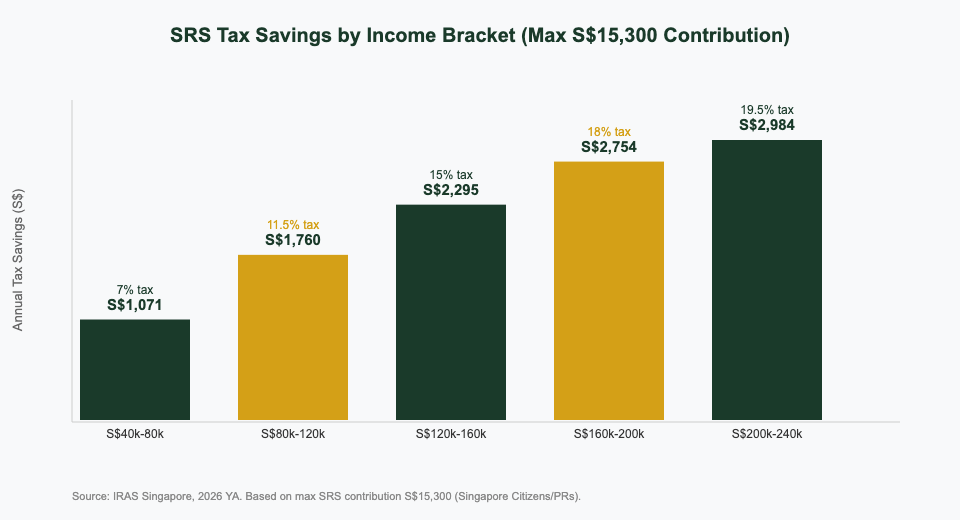
A worked example: if your annual assessable income is S$100,000 and you contribute S$15,300 to SRS before 31 December, your IRAS chargeable income drops to S$84,700. At the 11.5% marginal rate, you save approximately S$1,760 in taxes — without putting a single dollar at risk, since the SRS funds remain invested in products you choose.
Over 20 years of maximum contributions (assuming a 4% average annual return inside SRS on a balanced ETF-and-bond portfolio), the compounded value could exceed S$460,000 — most of which is shielded from tax until withdrawal. See our Singapore retirement calculator to model your own SRS growth scenario.
The SRS is especially powerful when combined with CPF cash top-ups. If you are already maximising your CPF Special Account top-up (capped at the Full Retirement Sum), SRS is the logical next vehicle for tax-efficient retirement savings. For more on combining CPF and SRS, see our CPF investment strategy guide.
What Can You Invest with Your SRS Funds?
SRS funds left idle in the account earn just 0.05% per annum — marginally above zero. The real value of SRS is what you invest it in. All three banks allow SRS funds to be used across the following asset classes:
| Investment Type | DBS Vickers | UOB Kay Hian | OCBC Securities |
|---|---|---|---|
| SGX Stocks & REITs | ✓ | ✓ | ✓ |
| Singapore ETFs (Xtrackers, Nikko AM) | ✓ | ✓ | ✓ |
| T-Bills & Singapore Savings Bonds | ✓ | ✓ | ✓ |
| Unit Trusts / Managed Funds | ✓ | ✓ | ✓ |
| Insurance Endowment (SRS-eligible) | ✓ | ✓ | ✓ |
| Robo-Advisory (Syfe, Endowus) | Via Endowus | Via Endowus | Via Endowus |
Source: DBS, UOB, OCBC official SRS product pages, Nov 2026.
For hands-off investors, Endowus (use referral code 2V343) and Syfe (use code SRPRFFFCD) both accept SRS funds and handle the investment decisions for you, charging a low platform fee. FSMOne (code P0544985) is another platform that offers a wide range of unit trusts and ETFs accessible via SRS.
SRS Withdrawal Rules & Penalties
Understanding the SRS withdrawal rules is critical before you commit. The scheme is designed for retirement income, so early withdrawals come at a cost.
Normal withdrawal (at or after statutory retirement age): You may start penalty-free withdrawals once you have reached the statutory retirement age in force at the time you first contributed to SRS. Under Singapore’s current framework, the statutory retirement age is 63 (as of 2026). Once you begin withdrawals, you have a 10-year withdrawal window. During this period, 50% of each withdrawal is added to your assessable income — so effective tax is at half the normal rate.
Early withdrawal (before statutory retirement age): Withdrawals before the retirement age attract a 5% penalty on the amount withdrawn, and 100% (not 50%) of the withdrawal is assessable for income tax. This makes early access expensive, so plan your contributions with a long horizon in mind.
Key exceptions to the 5% penalty: terminal illness, bankruptcy, and permanent departure from Singapore (for foreigners). In these cases, early withdrawal is permitted without the 5% penalty, though income tax on 100% of the withdrawal still applies.
For a full picture of how SRS interacts with CPF Life and other retirement income streams, our retirement planning calculator can model multi-scenario withdrawal ladders. Retirement planning in Singapore benefits greatly from combining CPF Life payouts, SRS drawdowns, and passive income from dividend stocks and REITs.
Ready to Start Your SRS Journey?
Opening your SRS account is the first step — the second is putting those funds to work. Here are TKN’s recommended platforms for SRS investing:
Frequently Asked Questions
Can I open more than one SRS account?
When is the deadline to contribute SRS for tax relief?
What happens to my SRS if I leave Singapore permanently?
Is SRS money guaranteed by the Singapore Government?
Can I use SRS funds to invest in S-REITs and ETFs?
How is SRS different from CPF?
This article was researched with the help of AI. While we strive to keep all information accurate and up to date, there may be errors. If you notice any discrepancies, please contact us.