Retirement Age Singapore 2026: What’s Changing on 1 July & How to Prepare
Updated April 2026 · Singapore Retirement & CPF Planning
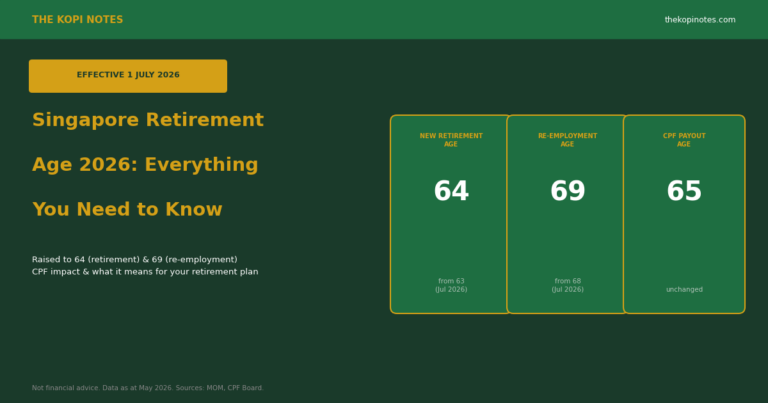
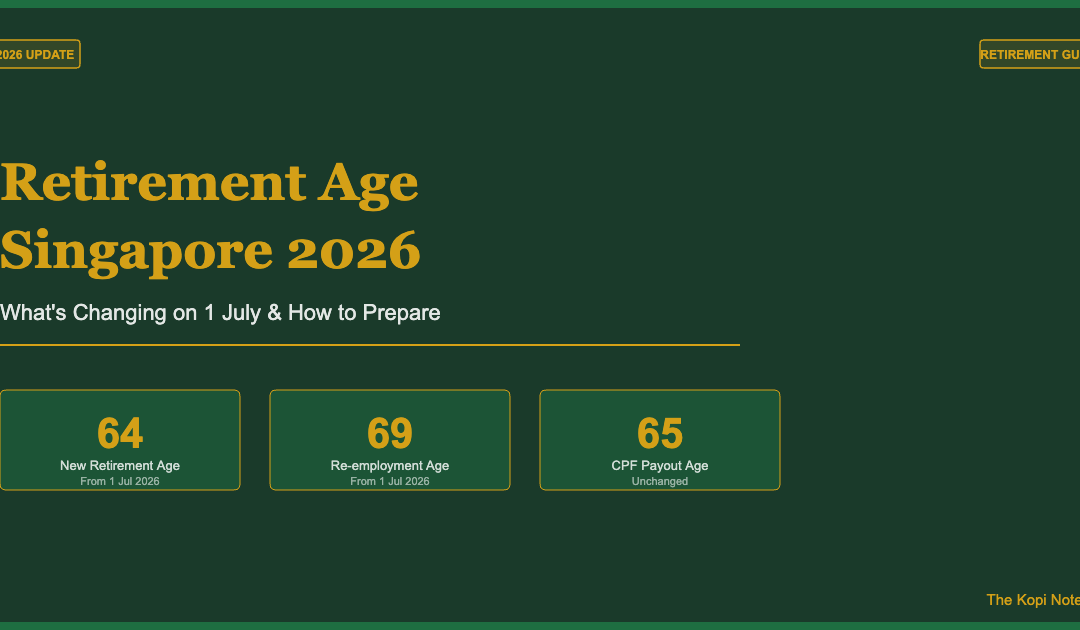
Singapore’s retirement age will increase from 63 to 64, and the re-employment age from 68 to 69, effective 1 July 2026. This change — confirmed in Budget 2026 and governed by the Retirement and Re-employment Act — gives Singaporean workers two additional years of employment protection compared to a decade ago. For employees aged 60 and above, CPF contribution rates are also rising in 2026, boosting retirement savings. If you’re planning for retirement in Singapore, here’s everything you need to know.
Not financial advice. All figures are for educational reference only. Data as at April 2026 unless noted.
Table of Contents
Contents — Click to expand
- Singapore Retirement Age 2026: The New Numbers
- What Is the Retirement Age in Singapore?
- How the Change Affects Your CPF
- CPF Contribution Rate Increases in 2026
- CPF Payout Age Is Separate — And Stays at 65
- Roadmap to 2030: Retirement Age Rising to 65
- Employer Obligations Under the RRA
- Retirement Planning by Age Group (2026)
- Use the Retirement Planning Calculator
- Frequently Asked Questions
Singapore Retirement Age 2026: The New Numbers
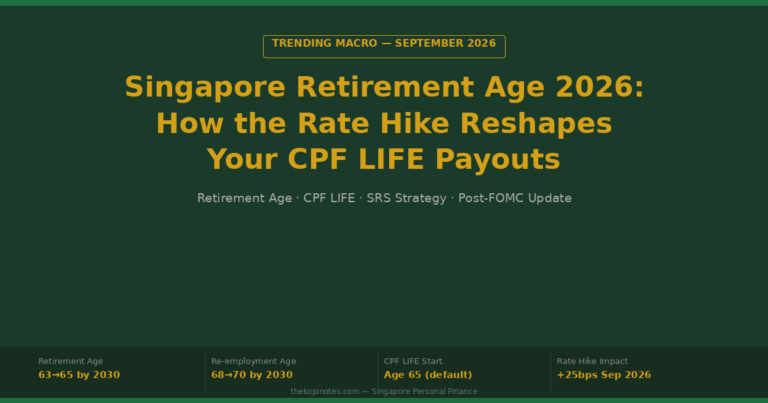
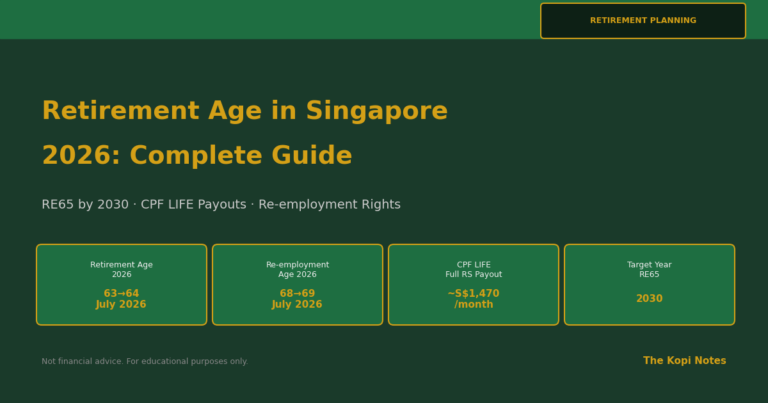
Effective 1 July 2026, Singapore’s statutory retirement and re-employment ages will increase as follows:
| Category | Before 1 Jul 2026 | From 1 Jul 2026 | Target by 2030 |
|---|---|---|---|
| Retirement Age | 63 | 64 | 65 |
| Re-employment Age | 68 | 69 | 70 |
| CPF Payout Eligibility Age | 65 | 65 (unchanged) | 65 (unchanged) |
Source: Ministry of Manpower (MOM) / CPF Board, April 2026
The retirement age sets the minimum age at which an employer can legally ask a Singapore citizen or permanent resident to stop working. It is not the age at which you must retire — many Singaporeans continue working voluntarily well beyond this threshold. The re-employment age gives workers the right to request a re-employment contract up to that age, provided they meet performance standards.
What Is the Retirement Age in Singapore?
Under the Retirement and Re-employment Act (RRA), employers in Singapore cannot dismiss an employee on the grounds of age before the statutory retirement age — currently 63, and rising to 64 from 1 July 2026.
Once an employee reaches the retirement age, the employer is not legally obligated to continue the contract — but they must offer re-employment if the worker is eligible. Re-employment contracts can differ from the original in terms of role, salary, and hours, but they provide continued employment protection up to the re-employment age (69 from July 2026).
- Applies to: Singapore citizens and permanent residents
- Governs: The minimum age for lawful age-based dismissal
- Does NOT mean: You must stop working at this age
- Does NOT affect: CPF payout eligibility age (which remains at 65)
- Covers: Employees in the private and public sector
How the Change Affects Your CPF
The retirement age change has indirect but meaningful effects on your CPF savings. An extra year of employment protection (from 63 to 64) means an additional year of CPF contributions — from both employer and employee — flowing into your Ordinary, Special, and MediSave accounts. For a median Singaporean worker earning S$5,000/month, that could mean roughly S$12,000–S$15,000 in additional CPF contributions over the extra protected year.
Crucially, CPF payout eligibility age remains at 65. This means the gap between the new retirement age (64) and CPF payout start (65) is just one year — down from two years when retirement age was 62. For workers who maximise re-employment, the gap to CPF payouts can be virtually zero.
If you’re thinking about how to optimise CPF for retirement, read our guide to CPF investment strategy for the full picture on CPF-OA investing, SA shielding, and CPF LIFE scheme selection.
CPF Contribution Rate Increases in 2026
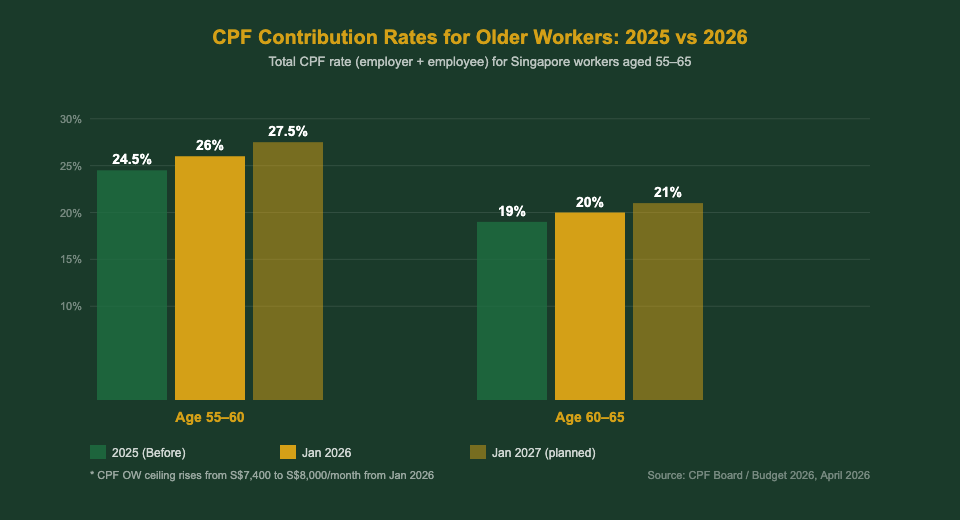
Separate from the retirement age change, CPF contribution rates for workers aged 55–65 are also increasing in 2026 — part of the ongoing step-up plan to close the CPF gap for older workers.
| Age Group | Employee + | Employer + | Total Increase | Effective |
|---|---|---|---|---|
| 55–60 | +1.0% | +0.5% | +1.5% | 1 Jan 2026 |
| 60–65 | +0.5% | +0.5% | +1.0% | 1 Jan 2026 |
| 55–60 (2027) | +1.0% | +0.5% | +1.5% | 1 Jan 2027 |
| 60–65 (2027) | +0.5% | +0.5% | +1.0% | 1 Jan 2027 |
Source: CPF Board / Budget 2026, April 2026
The CPF Ordinary Wage (OW) ceiling also rises from S$7,400 to S$8,000/month, meaning higher-earning workers will contribute CPF on a larger slice of their wages — boosting retirement balances further.
Additionally, Singaporeans aged 50 and above in 2026 (born in 1976 or earlier) will receive a CPF top-up of up to S$1,500 in their Retirement Account or Special Account in December 2026 — part of the Budget 2026 Majulah Package.
CPF Payout Age Is Separate — And Stays at 65
One of the most common sources of confusion: the CPF payout eligibility age is 65, and it is NOT changing. The retirement age (the employment protection threshold) and the CPF payout age are governed by entirely different legislation.
Here’s how the timeline looks for a worker turning 63 in 2026:
- Age 63: Currently protected from age-based dismissal (extending to 64 from July 2026)
- Age 64: New retirement age from 1 July 2026 — employer can retire you, but must offer re-employment
- Age 65: CPF payout eligibility begins — CPF LIFE monthly payouts start if you enrolled
- Age 69: New re-employment protection ceiling from 1 July 2026
Workers who defer CPF LIFE payouts beyond 65 receive higher monthly payments — deferral adds roughly 6–7% per year to the monthly payout. A worker who defers from 65 to 70 could see their CPF LIFE monthly payout increase by 30–35%.
Use our Singapore retirement planning calculator to project your CPF LIFE payouts based on your current balance and expected contribution trajectory.
Roadmap to 2030: Retirement Age Rising to 65
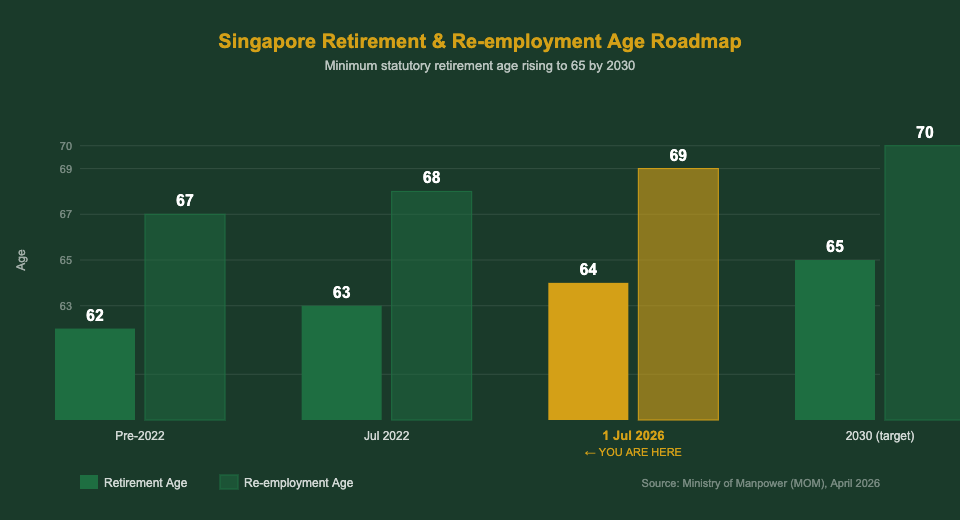
The 1 July 2026 change is not the final step. Singapore’s government has committed to raising the retirement age to 65 and the re-employment age to 70 by 2030.
| Year | Retirement Age | Re-employment Age |
|---|---|---|
| Before Jul 2022 | 62 | 67 |
| Jul 2022 | 63 | 68 |
| 1 Jul 2026 ← We are here | 64 | 69 |
| 2030 (target) | 65 | 70 |
Source: Ministry of Manpower, TAFEP, April 2026
Planning for retirement in 2026 and beyond means factoring in this escalating timeline. If you’re currently in your late 40s or early 50s, your career may extend into your mid-to-late 60s — with more years of CPF accumulation and higher eventual CPF LIFE payouts as a result.
This also has implications for passive income strategies in Singapore. The longer working life means more time to build a dividend or S-REIT portfolio that supplements CPF LIFE payouts in retirement — ideally reducing reliance on employment income before reaching the official retirement age.
Employer Obligations Under the RRA
From 1 July 2026, all employers in Singapore must comply with the updated thresholds under the Retirement and Re-employment Act:
- Cannot dismiss on age grounds before an employee turns 64 (up from 63)
- Must offer re-employment to eligible workers who reach retirement age — extending up to age 69
- Re-employment terms can differ but must be reasonable; the role must be suitable given the worker’s experience and health
- If no re-employment is possible, the employer must pay an Employment Assistance Payment (EAP) — equivalent to 3.5 months’ salary, capped at S$14,750
- No contracts that expire at retirement age: Fixed-term contracts that automatically expire at retirement age are not compliant if used to circumvent the RRA
For employees, the practical implication is clear: you have an additional year of job security. Use this period strategically — maximising CPF voluntary top-ups, reviewing your CPF LIFE payout deferral strategy, and building investment income through ETFs or best S-REITs in Singapore 2026.
Retirement Planning by Age Group (2026)
Age 40–50: Build the Foundation
You have 14–24 years before the new retirement age of 64. This is the most powerful window for compounding. Key priorities: maximise CPF SA (or RA after 55) top-ups to earn the guaranteed 4% p.a. interest, and begin building a dividend income portfolio. Even a S$200,000 portfolio in S-REITs yielding 6% generates S$12,000/year in passive income — a meaningful supplement to CPF LIFE. Read our guide to Singapore T-bills 2026 for the conservative end of your allocation.
Age 50–55: Accelerate CPF Contributions
Your CPF contribution rates increase at 55, so these years are your last chance at full younger-worker rates. Voluntary cash top-ups to the SA before 55 earn 4% tax-free. Also review your SRS account strategy: SRS contributions at this stage shelter taxable income while building a retirement nest egg. Platforms like Endowus allow CPF-OA and SRS-linked investing with low fees.
Age 55–64: Optimise the Transition
CPF RA is formed at 55 from your SA and OA (up to the Full Retirement Sum). From 55–65, you have up to 10 years of CPF LIFE deferral — each year of deferral adds approximately 6–7% to your monthly payout. Workers protected by the new RRA to age 64 can continue CPF contributions right up to payout eligibility age, maximising the LIFE balance before drawdown begins.
A Singaporean with S$300,000 in CPF RA at 65 under the Enhanced Retirement Sum would receive approximately S$2,250–S$2,450/month for life under CPF LIFE (as at April 2026). Pair this with S-REIT or ETF dividends and the retirement income picture looks very different from CPF alone.
Use our Singapore retirement calculator to model your exact scenario. For robo-advisor options to invest idle CPF-OA or SRS balances, our Syfe referral code gives new sign-ups an exclusive bonus.
Use the Retirement Planning Calculator
The retirement age change affects your planning timeline. To see how the July 2026 increase affects your projected CPF LIFE payouts and total retirement income, use The Kopi Notes’ free Singapore retirement planning calculator. You can model projected CPF balance at 65, monthly CPF LIFE payout under Basic/Full/Enhanced Retirement Sums, how voluntary top-ups and SRS contributions change the outcome, and how dividend income from a S-REIT or ETF portfolio supplements CPF.
Frequently Asked Questions
What is the retirement age in Singapore in 2026?
Does the retirement age change affect my CPF payout age?
Can my employer force me to retire at 64 from July 2026?
How much extra CPF do I accumulate by working to the new retirement age?
What is the difference between retirement age and re-employment age in Singapore?
What are the best ways to supplement CPF in retirement?
Will the retirement age change affect CPF contribution rates?
Disclaimer: This article is for educational purposes only and does not constitute financial advice. CPF rules, contribution rates, and retirement age thresholds are subject to change. Always consult the CPF Board, MOM official resources, or a licensed financial adviser for decisions specific to your circumstances. Data as at April 2026.
This article was researched with the help of AI. While we strive to keep all information accurate and up to date, there may be errors. If you notice any discrepancies, please contact us.