MediSave Limit 2026: How to Use MediSave for Nursing Home Care in Singapore
A complete guide to the MediSave Care scheme, nursing home costs, government subsidies, and how to combine multiple schemes to reduce your out-of-pocket expenses.
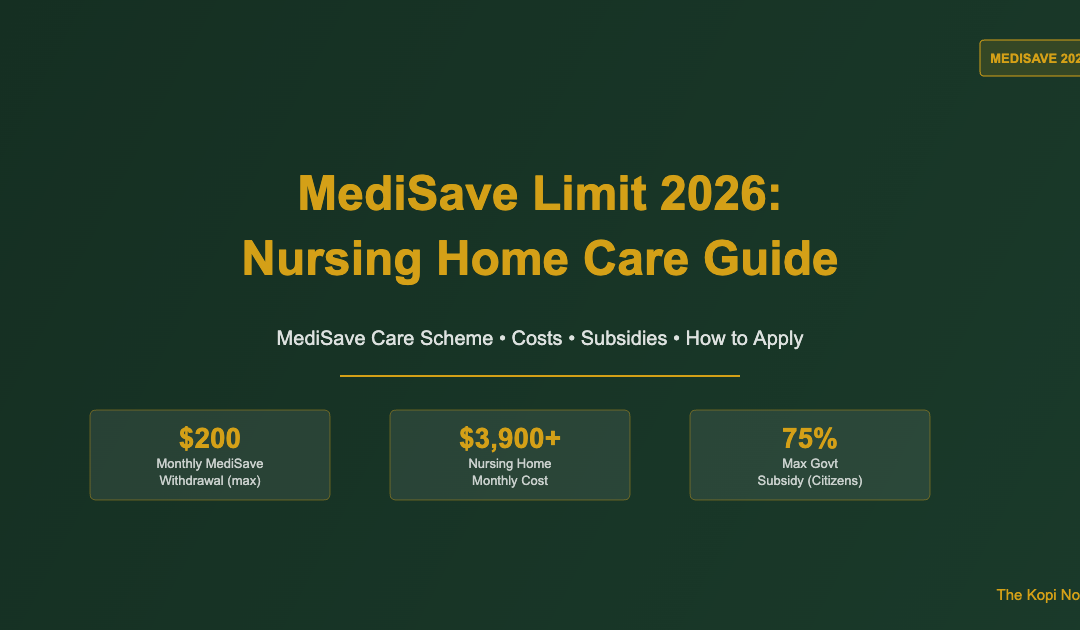
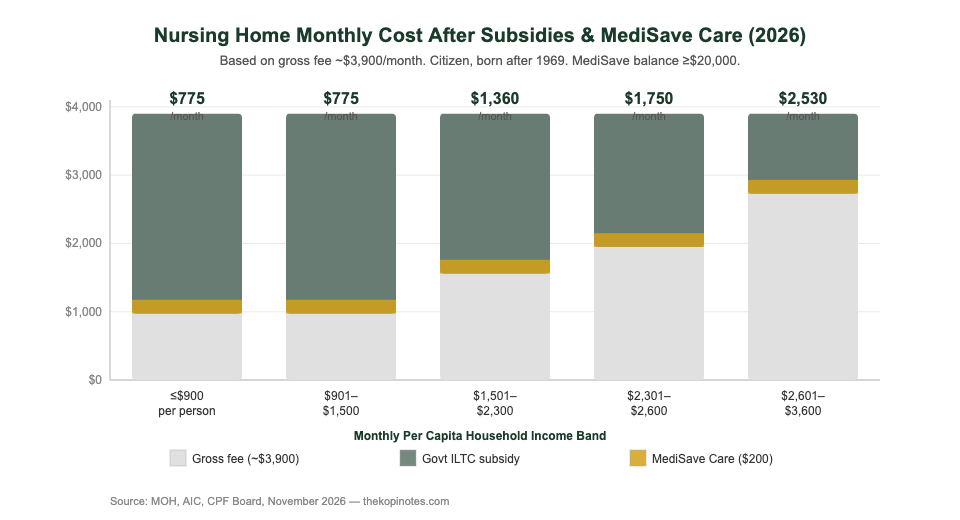
Under the MediSave limit 2026 rules, Singaporeans and PRs who are severely disabled can withdraw up to $200 per month from their MediSave Account to help pay for nursing home care through the MediSave Care scheme. Combined with government ILTC subsidies of up to 75% and CareShield Life payouts starting at $600 per month, a nursing home bill of $3,900 per month can be reduced to as little as $775 per month for a qualifying citizen.
Not financial advice. All figures are for educational reference only. Data as at November 2026 unless otherwise noted.
Table of Contents
Contents — Click to expand
What Does Nursing Home Care Cost in Singapore in 2026?
Nursing homes in Singapore — also called residential long-term care institutions — provide round-the-clock care for the elderly and those who are severely disabled. Before any subsidies are applied, the base monthly fee typically starts from around $3,900 per month, according to data from the Agency for Integrated Care (AIC).
Most Singapore Citizens and Permanent Residents are eligible for significant government subsidies, known as the Residential Long-Term Care (ILTC) subsidy. These are means-tested based on your household’s monthly per capita income (MPCI).
| Monthly Per Capita Income | Citizen (born after 1969) | Citizen (born ≤1969) | Permanent Resident |
|---|---|---|---|
| $900 and below | 75% | 80% | 50% |
| $901 – $1,500 | 75% | 80% | 50% |
| $1,501 – $2,300 | 60% | 65% | 40% |
| $2,301 – $2,600 | 50% | 55% | 30% |
| $2,601 – $3,600 | 30% | 35% | 15% |
| $3,601 – $4,800 | 10% | 15% | 5% |
| $4,801 and above | 0% | 0% | 0% |
Source: Ministry of Health (MOH), effective 1 July 2026. For no-income households, annual property value ≤$21,000 qualifies for the highest subsidy tier.
At 75% subsidy on a $3,900 monthly bill, a citizen from the lowest income band pays $975 per month before MediSave Care. With MediSave Care contributing $200 per month, this reduces further to $775 per month.
If you are researching care options beyond institutional care, our home nursing care guide covers how MediSave works for nurses and therapists who visit at home instead.
What Is the MediSave Care Scheme?
MediSave Care is a government scheme administered by the Agency for Integrated Care (AIC) on behalf of CPF Board. It allows Singaporeans and PRs who are severely disabled to make monthly cash withdrawals from their own and their spouse’s MediSave Accounts. These withdrawals can be used for any long-term care need — including nursing home fees, hiring a foreign domestic worker, paying for community care services, or covering daily living expenses.
The scheme was specifically designed to give severely disabled individuals financial flexibility in meeting their ongoing care costs. Unlike MediShield Life and your Integrated Shield Plan claims, which pay out when you are hospitalised, MediSave Care addresses the long-term care costs that occur after discharge from hospital — the kind of daily care that may continue for years or even decades.
Key things MediSave Care is NOT:
- It is not a lump-sum benefit — it pays out monthly as long as you remain eligible
- It is not automatically triggered by admission to a nursing home — you need to apply
- It does not replace the government ILTC subsidy — both apply separately and stack together
- It is not the same as CareShield Life (a mandatory long-term care insurance, explained in Section 6 below)
The payout can be credited to a nominated bank account, or the recipient can nominate the nursing home to receive the payout directly — a convenient option to offset monthly nursing home charges. For context on what else MediSave can be used for, see our broader MediSave withdrawal limit guide.
MediSave Care Withdrawal Limits 2026
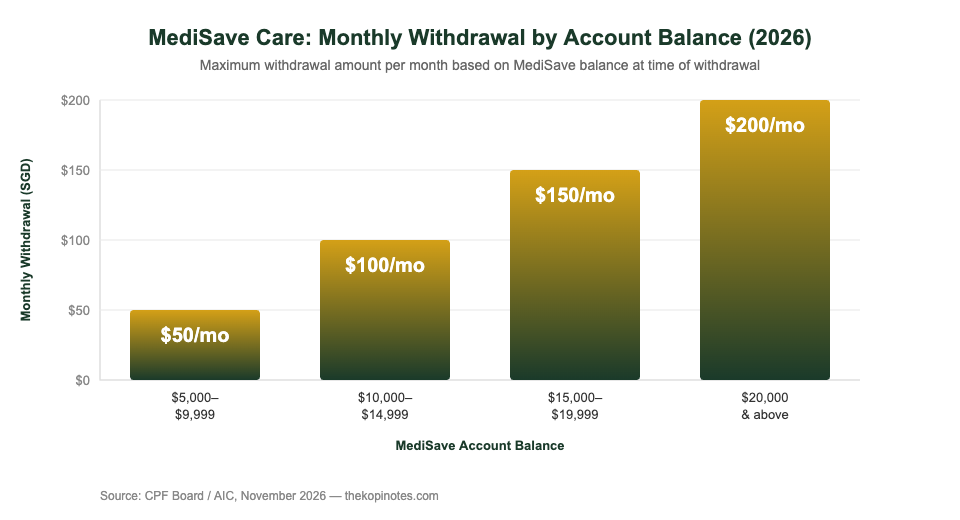
The amount you can withdraw each month under MediSave Care depends on the balance in your MediSave Account at the time of each monthly withdrawal. CPF Board maintains a minimum balance of $5,000 that must remain in the account to cover future hospitalisation and MediShield Life premiums — this floor cannot be drawn down by MediSave Care.
| MediSave Balance at Point of Withdrawal | Maximum Monthly Withdrawal |
|---|---|
| $20,000 and above | $200 / month |
| $15,000 and above | $150 / month |
| $10,000 and above | $100 / month |
| $5,000 and above | $50 / month |
| Below $5,000 | $0 (ineligible) |
Source: CPF Board / AIC, November 2026. The minimum $5,000 balance cannot be withdrawn for MediSave Care.
If the care recipient’s own MediSave balance is insufficient, they can tap on their spouse’s MediSave Account to supplement the withdrawal up to a combined maximum of $200 per month. For example: if you can withdraw $150 from your own account, and your spouse has a balance above $5,000, you can draw another $50 from your spouse’s account to reach the $200 maximum.
Over a full year, $200/month equates to $2,400 per year applied toward nursing home fees. Over a 10-year stay, that amounts to $24,000 — a meaningful contribution when stacked with the ILTC subsidy and CareShield Life payouts.
How to Qualify for MediSave Care
To be eligible for MediSave Care, the care recipient must meet all of the following criteria simultaneously:
| Criterion | Requirement |
|---|---|
| Nationality | Singapore Citizen or Permanent Resident |
| Age | Aged 30 and above |
| MediSave Balance | At least $5,000 in own MediSave Account (or spouse’s, if drawing from both) |
| Disability Level | Severe disability — full assistance required with at least 3 of 6 Activities of Daily Living (ADLs) |
Source: AIC, November 2026.
The six Activities of Daily Living (ADLs) assessed are: washing, dressing, feeding, toileting, transferring (e.g. moving from bed to wheelchair), and walking or moving around indoors. A person must require full assistance (not just partial) with at least three of these six to qualify.
The Severe Disability Assessment
To confirm severe disability, the care recipient must undergo a formal assessment by an MOH-accredited Severe Disability Assessor. The assessment fee ranges from $100 (clinic visit) to $250 (home visit), inclusive of GST. If the person is assessed as severely disabled, the full fee is reimbursed with the first MediSave Care payout.
If your loved one is already residing in a nursing home, the facility can submit a Resident’s Assessment Form (RAF) on their behalf — which simplifies the process considerably. If the assessment finds only mild or moderate disability, MediSave Care does not apply, but other schemes like the Home Caregiving Grant or MDW Levy Concession may be available depending on living arrangements.
How to Apply for MediSave Care
AIC recommends applying online through e-FASS (AIC’s e-Services for Financing Schemes) using your Singpass login — this method has the shortest approval time. After submission, AIC typically takes up to four weeks to process the application and notify you by mail.
Three application routes are available:
- Online via eFASS with Singpass (recommended) — fastest processing, can apply on behalf of someone who lacks mental capacity if you are their appointed Donee or Deputy under LPA or MCA
- Through the nursing home — if your loved one is already a nursing home resident, ask the home to assist; they can also nominate themselves as the payout recipient for seamless billing
- Hard copy via AIC Link — email apply@aic.sg to obtain the form or visit any AIC Link centre; hardcopy applications take longer to process
Once approved, the payout is credited to the nominated bank account each month, described as “MediSave Care” in bank statements. If you nominated the nursing home as payee, the payment goes directly to the home and reduces your invoice. Payouts may include backdated amounts from the month of application submission. Periodic reassessments may be required unless the care recipient has been assessed as permanently severely disabled.
Combining MediSave Care with Other Schemes
MediSave Care is most effective when combined with the other financial assistance schemes designed to work alongside it. Here is an overview of the key schemes that apply to nursing home residents in 2026:
1. ILTC Subsidy (Government Nursing Home Subsidy)
This is the largest source of financial assistance for most nursing home residents. The subsidy is means-tested and can be as high as 75–80% of the base nursing home fee for citizens. It is applied directly to the nursing home’s billing, so you only receive the invoice for the remaining portion. MediSave Care can then be used to offset part of that residual amount.
2. CareShield Life
All Singapore Citizens and PRs born in 1980 or later are automatically enrolled in CareShield Life, a mandatory long-term care insurance scheme. For those who become severely disabled (3/6 ADLs) and make a successful claim, CareShield Life pays a monthly cash benefit for life (or until recovery). The payout started at $600 per month in 2020 and increases annually — a person born in 1980 claiming in 2026 would receive approximately $689 per month. CareShield Life payouts do not reduce your ILTC subsidy, and you can receive CareShield Life payouts simultaneously with MediSave Care.
3. ElderFund
ElderFund is supplementary cash assistance for severely disabled Singapore Citizens with little or no CareShield Life / ElderShield coverage and limited MediSave. It pays up to $250 per month. Eligibility requires: household MPCI of $1,500 or less, MediSave balance below $10,000, aged 30 or above, and confirmed severe disability. ElderFund can be received even after the person has been admitted to a nursing home.
4. MediSave-Approved Outpatient Treatments
Some medical procedures and consultations conducted at a nursing home — or at polyclinics and specialist outpatient clinics — may still be claimable under the standard MediSave withdrawal limits. These are separate from MediSave Care and fall under the standard MediSave-approved treatments framework. Keep MediSave Care and regular MediSave withdrawals conceptually separate: MediSave Care is specifically for long-term care cash, while standard MediSave is for specific medical procedures with their own annual caps.
Planning your finances around long-term care is a significant part of retirement planning. Our Singapore retirement calculator can help you model how much to set aside for healthcare in your later years, while our CPF investment strategy guide covers how to grow your CPF savings to build a larger MediSave buffer for care needs.
Worked Example: Mrs Lim’s Nursing Home Bill in 2026
Mrs Lim is a 72-year-old Singapore Citizen, born in 1954. She was admitted to a nursing home after a stroke left her requiring assistance with four of the six ADLs. Her MPCI (Monthly Per Capita Household Income) is $1,200 and her MediSave balance is $22,000. Here is how her monthly nursing home bill works out after all applicable schemes:
| Stage | Amount | Notes |
|---|---|---|
| Gross nursing home fee | $3,900/month | Typical government-approved nursing home, single/double room |
| Less: ILTC subsidy (80% for citizen, MPCI ≤ $1,200) | −$3,120 | Applied directly to nursing home bill; MPCI below $1,201 tier qualifies for 80% |
| After ILTC subsidy | $780/month | Co-payment to nursing home before MediSave |
| Less: MediSave Care (MediSave balance $22,000 → Tier 4: $200/month) | −$200 | Monthly MediSave withdrawal, credited to nursing home’s bank account |
| After MediSave Care | $580/month | Out-of-pocket before CareShield Life claim |
| Less: CareShield Life payout (born 1954 — not covered*) | $0 | *Mrs Lim was born in 1954. CareShield Life is mandatory only for those born 1980 or later. Older cohorts were on ElderShield (opt-in). |
| ElderFund (if eligible: MPCI ≤ $1,500, MediSave ≤ $10,000 — not applicable here) | $0 | Mrs Lim’s MediSave is $22,000, exceeding the $10,000 threshold. If it falls below, she could claim up to $250/month from ElderFund. |
| Final out-of-pocket cost | ~$580/month | From $3,900 gross to $580 net — an 85% reduction in cost through government schemes |
*Figures are illustrative. Source: AIC, CPF Board, MOH, November 2026. Actual subsidy rates depend on current MPCI assessment; nursing home fees vary.
For comparison: a Singapore Citizen born in 1980 (fully covered by mandatory CareShield Life) in the same situation would additionally receive approximately $689/month from CareShield Life, bringing the out-of-pocket cost to effectively $0 and even generating a surplus. This illustrates the generational gap in long-term care insurance coverage and why understanding these schemes early matters for retirement planning. See our Integrated Shield Plan claims guide and our MediSave withdrawal limit guide for broader context on what MediSave can and cannot cover.
Frequently Asked Questions
What is the MediSave Care scheme and how is it different from MediShield Life?
MediSave Care (formerly the Flexi-MediSave scheme) is a monthly cash withdrawal from your CPF MediSave Account to help pay for long-term care services — specifically nursing home fees — when you are severely disabled. MediShield Life, by contrast, is a hospitalisation insurance plan that covers large one-off hospital bills such as surgeries, ICU stays, and inpatient treatment. MediShield Life pays insurers directly for hospital bills; MediSave Care pays out monthly cash that reduces your ongoing nursing home invoice. Both come from your CPF but serve completely different purposes: acute hospital care vs. chronic long-term care.
What is the MediSave limit 2026 for nursing home care specifically?
The MediSave Care withdrawal limit for nursing home care in 2026 is up to $200 per month, depending on your CPF MediSave balance. The exact amount depends on how much you have in your MediSave Account: if your balance is between $5,000 and $9,999 you can withdraw $30/month; $10,000–$14,999 gives $60/month; $15,000–$19,999 gives $120/month; and $20,000 or above gives the maximum $200/month. These limits apply specifically to the MediSave Care scheme for long-term care settings; the limits for surgical procedures, outpatient treatments, and hospitalisation under MediShield Life are entirely separate and have their own withdrawal caps.
Does my loved one need to already be in a nursing home to apply for MediSave Care?
No. You can apply for MediSave Care before or after nursing home admission, as long as the care recipient meets the eligibility criteria: Singapore Citizen or PR, aged 30 or above, MediSave balance of at least $5,000, and confirmed severe disability (requiring full assistance with at least 3 of 6 ADLs). AIC recommends applying as early as eligibility is confirmed to avoid delays in the first payout. If approved before admission, payouts begin from the application month once the nursing home placement is confirmed and the nursing home has been registered as the payout recipient with AIC.
Can I use MediSave to pay nursing home fees directly?
Not through the standard MediSave withdrawal mechanism — nursing home fees are not classified as medical treatment eligible under the standard MediSave withdrawal framework. The MediSave Care scheme is the specific pathway that allows monthly MediSave withdrawals to offset nursing home costs. Standard MediSave can still be used at nursing homes for specific medical services provided on-site, such as physiotherapy at a MediSave-approved rate or outpatient specialist consultations, but these are separate claims from the MediSave Care monthly cash payout. For the full list of what MediSave covers, see our MediSave-approved treatments guide.
What happens to MediSave Care if the care recipient's condition improves?
MediSave Care payouts will stop if the care recipient is reassessed and no longer qualifies as severely disabled (i.e. they no longer require full assistance with 3 or more ADLs). AIC periodically reviews cases unless the person has been assessed as permanently severely disabled. If the condition fluctuates — for instance, after rehabilitation — there may be a gap in payouts while a re-assessment is processed. Payouts also stop if the care recipient passes away, recovers and leaves the nursing home, or if their MediSave balance falls below $5,000.
Can a Singapore PR also receive MediSave Care for nursing home fees?
Yes, Singapore Permanent Residents can receive MediSave Care, but the ILTC subsidy rates for PRs are lower than for Singapore Citizens. For the same MPCI band, a PR typically receives a subsidy rate approximately 10–15 percentage points lower than a Citizen. For example, at the MPCI ≤ $1,200 band, a Citizen might receive 80% subsidy while a PR receives 65–70%. The MediSave Care withdrawal limits (up to $200/month) are the same for both Citizens and PRs. ElderFund, however, is available only to Singapore Citizens.
Is MediSave Care the same as the Home Caregiving Grant?
No, these are two separate schemes. MediSave Care is a MediSave withdrawal (from your CPF) that provides a monthly cash amount specifically for nursing home or home care fees. The Home Caregiving Grant (HCG) is a government cash grant — not a CPF withdrawal — paid to the family caregiver of a severely disabled person living at home (not in a nursing home). HCG pays $400 or $200 per month in cash depending on care arrangements. You cannot receive both HCG and MediSave Care at the same time for the same person: HCG is for home-based care, MediSave Care applies when the person is in an approved long-term care institution such as a nursing home.
The Kopi Notes provides general information only. This is not financial, legal, or medical advice. MediSave Care eligibility and payout amounts are subject to change — always verify with CPF Board and AIC before making care decisions. Data as at November 2026.
Get Free Insurance Advice
Speak with a licensed insurance advisor. No obligation, no cost.
By submitting this form, you agree to our Privacy Policy.
This article was researched with the help of AI. While we strive to keep all information accurate and up to date, there may be errors. If you notice any discrepancies, please contact us.