Medisave Limit 2026: When Does Your Integrated Shield Plan Actually Pay Out?
Singapore’s MediShield Life & ISP hospitalisation guide — deductibles, co-insurance, and payout triggers explained
Your Integrated Shield Plan only pays out under specific conditions — and many Singaporeans discover this too late. While MediShield Life covers all Singapore Citizens and PRs automatically, your ISP kicks in only when you are admitted as an inpatient, undergo an approved day surgery, or face a covered outpatient treatment under the 2026 framework. GP visits, polyclinic consultations, and routine outpatient care are not covered by any ISP, regardless of how generous your plan is or how much you pay in premiums.
Not financial or medical advice. All figures refer to MediShield Life and ISP guidelines as at November 2026 unless noted. Consult your insurer or a licensed financial adviser before making insurance decisions.
In This Guide
What MediShield Life and ISP Actually Cover
MediShield Life is Singapore’s mandatory base insurance, administered by the CPF Board, which provides foundational coverage for large hospitalisation bills and selected outpatient treatments for all Singapore Citizens and Permanent Residents. Premiums are automatically deducted from your Medisave account each year.
An Integrated Shield Plan (ISP) is a private insurance policy from one of seven approved insurers — AIA, AXA, Great Eastern, Income Insurance, Prudential, NTUC Income, or Singlife — that layers on top of MediShield Life. While MediShield Life covers treatment at Class B2 and C wards in public hospitals, your ISP determines whether you receive coverage for a Class A or B1 ward, or a private hospital stay, depending on the tier of ISP you hold.
The critical point: your ISP does not replace MediShield Life — it extends it. Both work together, and both use the same payout trigger: an approved hospitalisation admission or an approved surgical procedure. Without a qualifying trigger event, neither MediShield Life nor your ISP pays out anything.
MediShield Life also provides limited coverage for specific outpatient treatments through its Outpatient Serious Chronic Disease (OSCD) framework — conditions like dialysis, cancer chemotherapy, and immunosuppressants for organ transplant patients. This outpatient coverage uses a separate annual deductible of $500 (from 1 June 2026) and is not part of standard ISP coverage. For the purposes of this guide, we focus on the more common inpatient and day surgery scenarios.
The 4 Scenarios When ISP Pays (and When It Doesn’t)
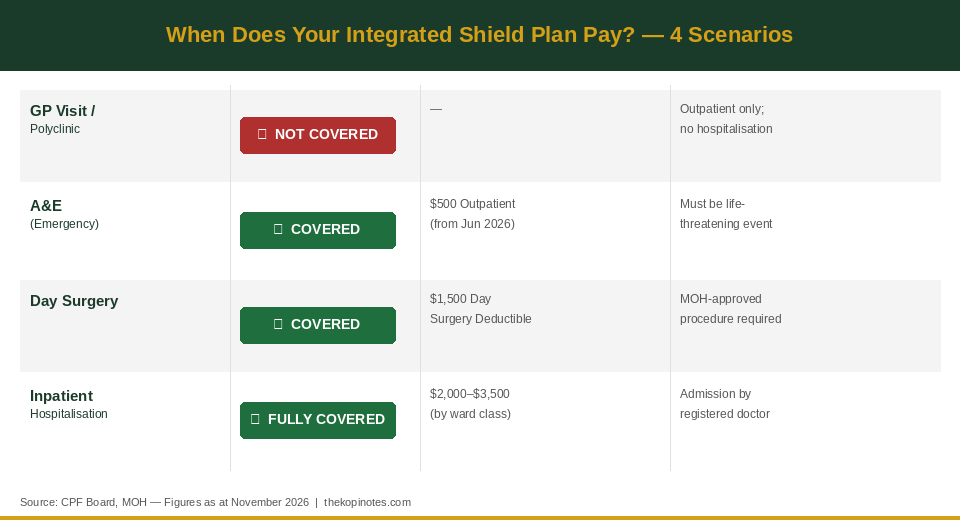
Scenario 1 — GP Visit or Polyclinic (ISP Does NOT Pay)
If you visit a general practitioner, polyclinic, or specialist clinic without being admitted as an inpatient, neither MediShield Life nor your ISP covers the bill. This holds true even when the visit is for a serious or chronic condition. Many Singaporeans are surprised to learn this — especially when they’re paying significant ISP premiums each year — but ISP is strictly a hospitalisation product.
The only exception at this level is the OSCD outpatient scheme mentioned above, which covers a narrow list of serious conditions (dialysis, cancer treatment) under MediShield Life specifically — not the ISP itself.
Scenario 2 — A&E Visit (ISP Pays Only If You Are Admitted)
Visiting the Accident & Emergency department does not automatically trigger ISP coverage. If you are assessed at A&E and sent home the same day, the visit is treated as outpatient and is not claimable under your ISP. However, if you are admitted as an inpatient following your A&E attendance — the most common outcome for a genuine medical emergency — your MediShield Life and ISP will activate for the inpatient portion of your bill from the point of admission.
The A&E charges themselves (triage, stabilisation) may or may not be separately reimbursable depending on your ISP plan terms. Check your policy schedule for A&E benefit clauses if this matters to you.
Scenario 3 — Approved Day Surgery (ISP Pays, Lower Deductible Applies)
Day surgeries trigger ISP coverage, but with a separate and lower deductible than inpatient hospitalisation. For 2026:
- Age 80 and below: $1,500 day surgery deductible
- Age 81 and above: $2,000 day surgery deductible
The surgery must appear on the Ministry of Health’s Table of Surgical Procedures (TOSP). Commonly covered day surgeries include cataract surgery, hernia repair, selected orthopaedic procedures, upper and lower GI endoscopies, and certain plastic surgical reconstructions. If a procedure is unlisted on the TOSP, it may still be claimable but at a reduced benefit amount or with pre-authorisation from your insurer.
Scenario 4 — Inpatient Hospitalisation (Full ISP Coverage)
This is the core scenario your ISP is designed for. When a licensed medical practitioner admits you as an inpatient to a hospital registered with MOH, MediShield Life and your ISP both activate. This covers:
- Daily ward charges (bed, nursing, hospital meals)
- Attending doctor’s visit fees and specialist consultation during the stay
- Surgical fees and operating theatre charges
- Intensive Care Unit (ICU) and High Dependency Unit (HDU) charges
- Implants and prostheses (up to claim limits)
- Selected physiotherapy within the hospital stay
An important point about the deductible: it is applied per policy year, not per admission. If you are hospitalised twice in the same policy year, only the first admission needs to meet the deductible. The second hospitalisation within the same policy year would go straight to co-insurance, potentially resulting in much lower out-of-pocket costs for the second stay.
For a full comparison of ISP plans by tier and insurer, see our best Integrated Shield Plans in Singapore 2026 guide.
Source: CPF Board, Ministry of Health Singapore — Figures as at November 2026
How the Deductible and Co-Insurance Work With Your Medisave
Once your ISP is triggered by an inpatient admission or day surgery, two things happen before your insurer pays out: the deductible is applied, and then co-insurance is calculated on the balance.
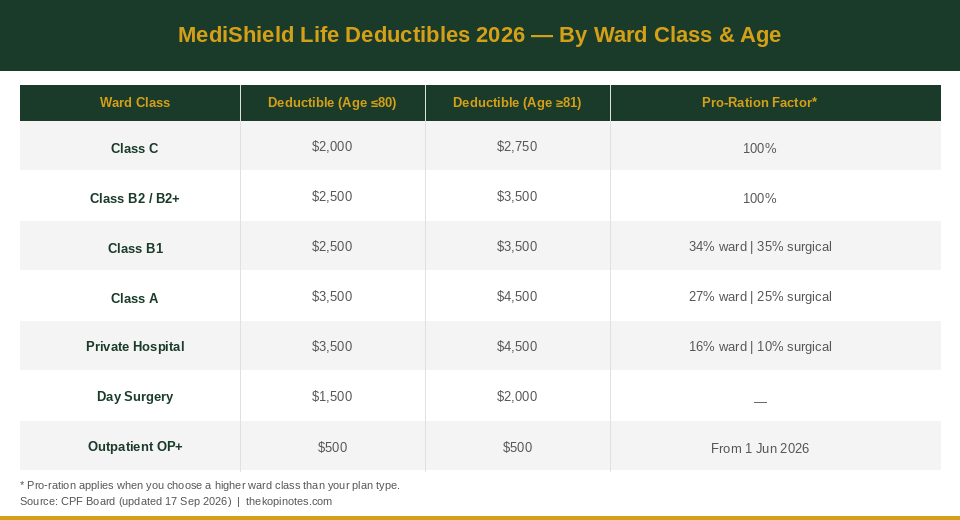
The deductible is the fixed amount you pay first — typically from your Medisave — before any insurance coverage begins. For 2026, MediShield Life deductibles are set by ward class and age:
| Ward Class | Deductible (Age ≤80) | Deductible (Age ≥81) | Pro-Ration Factor |
|---|---|---|---|
| Class C | $2,000 | $2,750 | 100% |
| Class B2 / B2+ | $2,500 | $3,500 | 100% |
| Class B1 | $2,500 | $3,500 | 34% (ward) / 35% (surgical) |
| Class A | $3,500 | $4,500 | 27% (ward) / 25% (surgical) |
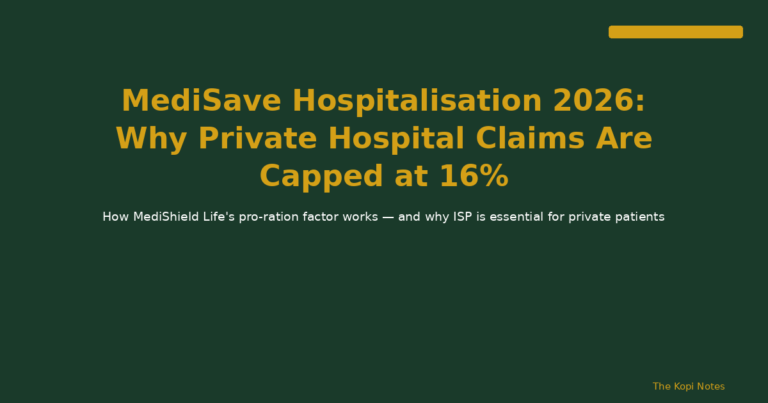
| Private Hospital | $3,500 | $4,500 | 16% (ward) / 10% (surgical) |
| Day Surgery | $1,500 | $2,000 | Varies |
| Outpatient (OSCD) * | $500 | $500 | From 1 Jun 2026 |
* OSCD = Outpatient Serious Chronic Disease framework. Source: CPF Board (last updated 17 Sep 2026).
Co-insurance is applied after the deductible is met. You pay a percentage of the remaining bill, as follows:
- First $5,000 of the insured bill (including the deductible amount): 10%
- Next $5,000: 5%
- Anything above $10,000: 3%
Quick example (Class C ward, bill of $8,000, age ≤80):
- Deductible paid from Medisave: $2,000
- Co-insurance on first $3,000 (to reach $5,000 total): $3,000 × 10% = $300
- Co-insurance on next $3,000: $3,000 × 5% = $150
- Total co-insurance: $450
- MediShield Life pays: $8,000 − $2,000 − $450 = $5,550
- Your out-of-pocket: $2,450 (deductible + co-insurance)
An ISP with a co-insurance rider reduces or eliminates that $450 co-insurance portion. The deductible is typically also coverable via a rider, subject to new 2026 minimum co-payment rules (see below).
To understand the full real cost of hospitalisation with these mechanics applied to typical Singapore procedures, see our real cost of hospitalisation in Singapore 2026 guide.
New ISP Rider Rules (April 2026): What Changes When Your ISP Pays Out
From 1 April 2026, all new ISP riders must comply with updated MOH guidelines. These changes directly affect how much you pay out of pocket when your ISP pays out.
Key changes under the 2026 rider rules:
- Lower premiums: New 2026-compliant riders are approximately 35–40% cheaper on average than legacy full-cover riders sold before the transition. This is because the new riders carry a mandatory minimum co-payment clause, reducing the insurer’s exposure and therefore the premium charged.
- Mandatory minimum co-payment: Even with the most comprehensive new rider, you must pay a minimum share of the bill (at least 5% for in-hospital treatment). This is a structural change — there is no longer a “zero out-of-pocket” option for most scenarios under the 2026 regime.
- Rider premiums in cash only: From 1 April 2026, ISP rider premiums must be paid fully in cash. Medisave cannot be used to pay rider premiums (though it can still be used for the base ISP premium). Budget for this additional cash outflow separately when planning your insurance expenses.
- Legacy rider holders: If you already hold an ISP rider purchased before the transition, you may keep it on its current terms until renewal. Upon the first renewal after the transition date, your insurer may only offer you a 2026-compliant version at the lower premium but with the new minimum co-payment.
The practical impact: Singaporeans with the new 2026 riders will pay lower premiums but will face a small guaranteed out-of-pocket on each claim. For a typical hospitalisation, this might be a few hundred dollars — significantly less than the full deductible and co-insurance without any rider at all.
See our full new ISP rider 2026 co-payment breakdown for the exact co-payment percentages and worked examples by insurer.
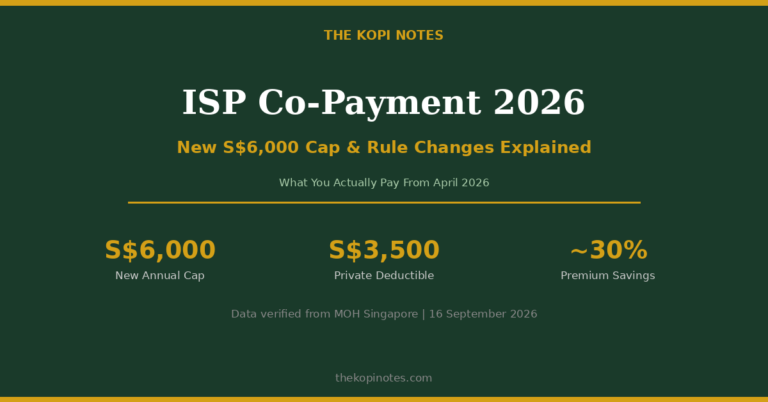
For context on how ISP copayments interact with the Medisave limit for your plan, read our ISP copayment 2026 guide.
Worked Example: Hip Replacement Surgery in a Class B1 Ward (2026)
Let’s walk through a realistic example to see exactly how the Medisave limit, deductible, pro-ration, and ISP interact. The patient is a 60-year-old Singaporean admitted to a public hospital Class B1 ward for hip replacement surgery. Total inpatient bill: $20,000.
Step 1: Pro-Ration
Class B1 ward uses a 35% pro-ration factor for surgical cases. MediShield Life calculates its benefits based on a pro-rated eligible claim rather than the full bill.
- Eligible claim (pro-rated): $20,000 × 35% = $7,000
Step 2: MediShield Life Deductible
The deductible for Class B1 / B2 ward, age ≤80, is $2,500 (paid from Medisave).
- Amount after deductible: $7,000 − $2,500 = $4,500
Step 3: Co-Insurance on the Eligible Balance
Co-insurance on $4,500 (all within the 10% band, since $2,500 deductible + $4,500 = $7,000, within the first $5,000 of the insured balance):
- Co-insurance: $4,500 × 10% = $450
- MediShield Life pays: $4,500 − $450 = $4,050
Summary: Who Pays What?
| Payment Component | No Rider | With ISP (B1) + 2026 Rider |
|---|---|---|
| Deductible (from Medisave) | $2,500 | Covered by ISP (rider) |
| Co-insurance (cash) | $450 | Min. 5% (~$225) |
| Ward gap (above pro-ration) | $13,000 | Covered by ISP (B1 tier) |
| Total Out-of-Pocket | $15,950 | ~$225–$500 |
Figures are illustrative for a Class B1 public hospital surgical admission, bill of $20,000. Actual amounts depend on insurer, specific ISP plan, and rider terms.
The ward gap — the $13,000 that falls outside the pro-rated eligible claim — is the most important reason to hold an ISP if you plan to use a B1 or above ward. Without an ISP, you would pay that entire gap out of pocket, even though MediShield Life is active.
Source: CPF Board (updated 17 Sep 2026) — The Kopi Notes
Pre- and Post-Hospitalisation Coverage
Most ISPs extend coverage beyond the hospital walls to include selected outpatient expenses before and after a qualifying hospitalisation. These are called pre-hospitalisation and post-hospitalisation benefits.
Pre-hospitalisation typically covers specialist consultation fees, X-rays, blood tests, MRI scans, and other diagnostic procedures incurred in the period leading up to an approved inpatient admission — usually within 90 days before the date of hospitalisation. The key requirement is that the outpatient investigations must be directly related to the condition that led to the hospital admission.
Post-hospitalisation covers follow-up treatment after discharge: specialist visits, physiotherapy, medication, and selected diagnostic tests carried out within a defined window (commonly 90–180 days) after leaving hospital. Again, these must be related to the same condition for which you were admitted.
These benefits are especially valuable for planned procedures. If you know you’ll be having surgery — for instance, a knee replacement or cataract removal — your pre-operative specialist consultations and imaging could be claimable under your ISP, provided the hospitalisation itself is covered. Many policyholders are unaware of this benefit and end up paying for pre-surgical appointments that would have been covered.
Pre- and post-hospitalisation benefit windows and caps vary significantly by insurer and plan tier, so check your specific policy schedule. Some plans use a 90-day window; others extend to 180 days. The benefit cap may be expressed as a dollar limit or as a percentage of the inpatient claim.
Common Mistakes When Filing an ISP Claim
1. Assuming outpatient bills are covered. The most frequent misconception. ISP does not cover routine GP, polyclinic, or specialist outpatient visits unless they fall under the OSCD framework or are within the pre/post-hospitalisation window of an approved admission. If your insurer or agent hasn’t made this clear, re-read your policy document or call your insurer’s claims hotline before assuming coverage.
2. Forgetting the annual deductible resets by policy year, not calendar year. Your deductible resets on your policy anniversary date. A December hospitalisation and a January one in the same calendar year may each attract a full deductible if they fall in different policy years. Plan accordingly if you’re scheduling an elective procedure.
3. Upgrading your ward without knowing the pro-ration impact. If you hold a B2 ISP but choose a Class A ward during your hospital stay, you will face the Class A pro-ration factor (27% ward / 25% surgical) — not the B2 rate of 100%. This can result in a very large out-of-pocket bill. Always check your ISP tier before consenting to a ward upgrade.
4. Paying ISP rider premiums from Medisave. Since 1 April 2026, rider premiums must be paid in cash. Some older policyholders may have GIRO arrangements that previously drew from Medisave for the full premium. Confirm with your insurer how your premium is currently structured and that the rider portion is set to draw from your bank account, not your CPF Medisave.
5. Missing the claims submission window. Most ISPs require you to submit your hospitalisation claim within 90–180 days of the final date of discharge (or the last post-hospitalisation treatment date, depending on your insurer). Keep all original hospital bills, receipts, discharge summaries, and specialist letters. Submit these promptly — late claims are typically not accepted.
6. Not notifying your insurer of an elective admission in advance. Some ISPs (particularly those with “as-charged” benefits) require pre-authorisation for elective procedures. Even when pre-authorisation is not mandatory, calling your insurer’s pre-admission hotline before an elective hospitalisation can help you avoid surprises and confirm that your planned treatment and ward class are covered under your policy.
For more on how choosing the right Integrated Shield Plan affects your hospitalisation costs, see our complete ISP guide.
Frequently Asked Questions
Does my ISP cover GP visits or polyclinic fees?
No. Neither MediShield Life nor any Integrated Shield Plan covers routine outpatient GP, polyclinic, or specialist clinic visits. ISP and MediShield Life are designed exclusively for inpatient hospitalisation and approved day surgery. The only outpatient exceptions under MediShield Life are covered through the Outpatient Serious Chronic Disease (OSCD) framework — which is a MediShield Life benefit, not an ISP benefit — for a narrow list of serious conditions such as dialysis and cancer chemotherapy. For general outpatient coverage, you would need a separate outpatient health insurance product or company medical benefits.
What is the deductible for a day surgery in 2026?
The MediShield Life deductible for approved day surgery in 2026 is $1,500 for patients aged 80 and below, and $2,000 for patients aged 81 and above. This deductible is applied per policy year (not per procedure), so if you undergo two separate day surgeries within the same policy year, only the first attracts the full deductible. The second would go straight to co-insurance. The day surgery must be an MOH-approved procedure on the Table of Surgical Procedures (TOSP) to qualify.
How does the pro-ration factor affect my ISP payout?
The pro-ration factor is a percentage that determines what portion of your hospital bill is eligible for MediShield Life and ISP benefits. It applies when you stay in a ward that is above your plan’s cover tier. For example, if you hold a B2-tier ISP but stay in a Class B1 ward, MediShield Life and your ISP calculate benefits based on only 34% (ward) or 35% (surgical) of your bill — not the full amount. The remaining 65%+ of your bill is not covered by either plan and must be paid out of pocket. Pro-ration factors for 2026 are: Class C 100%, Class B2/B2+ 100%, Class B1 34%/35%, Class A 27%/25%, Private 16%/10%.
When did the new ISP rider rules take effect in 2026?
The new ISP rider rules took effect on 1 April 2026. Under the updated MOH guidelines, all new ISP riders sold from that date must include a mandatory minimum co-payment by the policyholder (at least 5% for in-hospital treatment), and rider premiums must be paid entirely in cash — Medisave can no longer be used to pay rider premiums. The upside is that new 2026-compliant riders carry premiums that are approximately 35–40% lower on average than legacy full-cover riders. If you already hold an ISP rider purchased before April 2026, you may keep it on current terms until renewal, after which your insurer may only offer you a 2026-compliant version.
Can I use Medisave to pay my ISP premium in 2026?
Yes — but only for the base ISP premium, which covers the MediShield Life component and the ISP base layer. The rider premium must now be paid in cash (from 1 April 2026). Your Medisave can still be used to pay the base ISP premium up to your annual Medisave contribution ceiling, subject to the Additional Withdrawal Limits (AWL) set by CPF Board. Each year, CPF Board publishes the allowable Medisave withdrawal amounts for each ISP tier by insurer — ensure your Medisave balance is sufficient for the base premium deduction while also covering potential hospitalisation deductibles.
Does the ISP deductible reset every year?
Yes — but it resets at the start of each policy year (your policy anniversary date), not at the start of each calendar year. If your policy renews on 1 July, then a June hospitalisation and a July hospitalisation in the same calendar year would each attract a full deductible (one in each policy year). If you plan to have elective surgery, check your policy anniversary date and try to schedule procedures within the same policy year as any earlier hospitalisations, to avoid paying the deductible twice.
Ready to Choose the Right ISP?
Now that you understand when your ISP pays out, the next step is ensuring you have the right plan for your needs and budget. Compare all seven Singapore insurers side-by-side.
Get Free Insurance Advice
Speak with a licensed insurance advisor. No obligation, no cost.
By submitting this form, you agree to our Privacy Policy.
This article was researched with the help of AI. While we strive to keep all information accurate and up to date, there may be errors. If you notice any discrepancies, please contact us.