MediSave Limit 2026: Why 128,200 Singaporeans Downgraded Their ISP — And Whether You Should Too
Last updated: 9 November 2026 | Data verified as at 9 November 2026
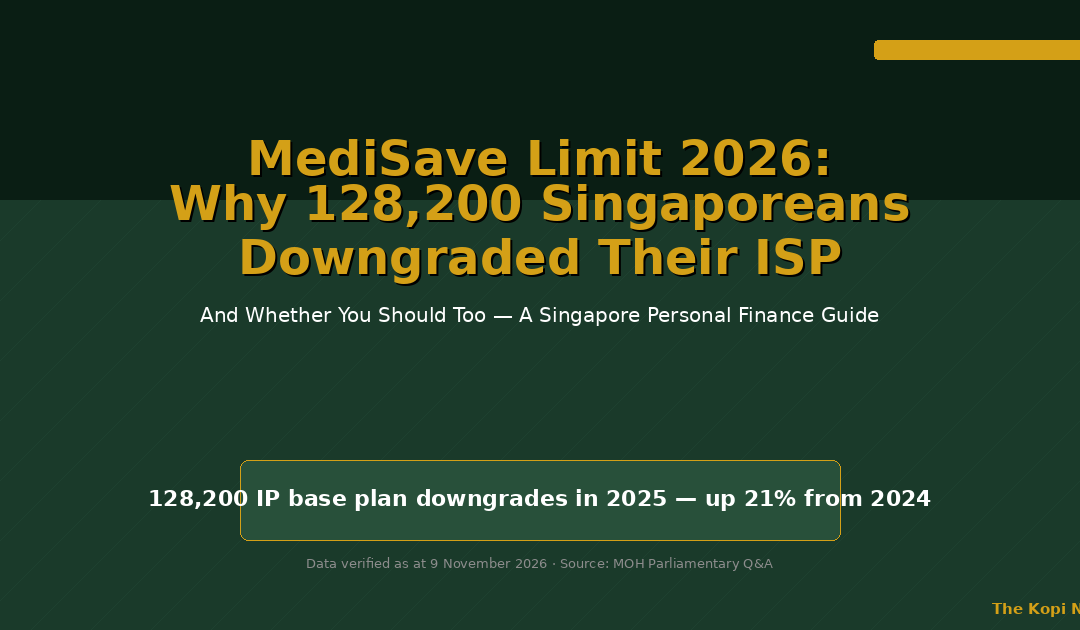
In 2025, 128,200 Singaporeans downgraded their Integrated Shield Plan (ISP) base coverage — a 21% jump from 105,900 in 2024. The trigger is clear: private hospital ISP premiums have climbed 8.6% per year on average since 2021, and rider premiums have soared even faster at 17.2% annually. With the MediSave BHS at S$79,000 in 2026 and premiums eating deeper into CPF balances, the question isn’t just why so many are downgrading — it’s whether you should too.
Not financial advice. All figures are for educational reference only. Data as at November 2026 unless noted.
In This Article
What Is Driving the ISP Downgrade Trend?
Singapore’s Ministry of Health (MOH) confirmed in a September 2026 Parliamentary reply that IP base plan downgrades — where policyholders switch from a higher ward class plan (such as a private hospital plan) to a lower one (such as a Class A or B1 plan) — have risen sharply over three consecutive years. The same Parliamentary reply also showed that the number of Singaporeans who downgraded their IP rider or cancelled it entirely has surged even more dramatically.
The root cause is affordability. Integrated Shield Plans are layered on top of MediShield Life and are paid primarily from your MediSave account. For younger policyholders, the annual MediSave contribution is usually enough to cover premiums. But as you age, the age-banded premium tiers climb faster than your MediSave top-up, forcing many to draw from cash savings to maintain coverage.
By the time you reach your mid-60s holding a private hospital ISP with a full-cover rider, your combined annual outlay can reach S$12,700 to S$22,700 — a figure that is simply unsustainable for most retirees living on CPF LIFE payouts. For a 70-year-old, the rider alone can cost up to S$9,000 per year. The MediSave BHS of S$79,000 in 2026 is a cap, not a runway — once your MediSave hits BHS, additional CPF contributions spill to your Special Account (or Retirement Account), so you cannot simply let your MediSave grow indefinitely to pay future premiums.
A secondary factor is the mandated rider reform introduced in April 2026. MOH required all insurers to discontinue legacy full-coverage riders and replace them with co-payment riders. This created a natural “reset” moment — policyholders who were reviewing their coverage anyway took the opportunity to downgrade the base plan too, not just switch riders.
The Numbers at a Glance
All figures below are sourced from MOH Parliamentary replies and official spokespersons. Data verified as at 9 November 2026.
| Metric | CY2023 | CY2024 | CY2025 | Change (’24→’25) |
|---|---|---|---|---|
| IP Base Plan Downgrades | 99,000 | 105,900 | 128,200 | +21% |
| IP Rider Downgrades | 84,800 | 103,400 | 181,800 | +76% |
| Rider Discontinuations (cancellations) | 66,100 | 65,000 | 112,300 | +73% |
| % of IP Policyholders Who Dropped Rider (2025) | — | — | ~5.6% | of ~2 million |
Source: MOH Parliamentary Q&A, September 9, 2026 · Data verified as at 9 November 2026
To put these numbers in context: approximately 71% of Singapore residents — around 3 million people — hold Integrated Shield Plans as of end-2024. The 128,200 base plan downgrades in 2025 represent roughly 1 in 23 IP holders choosing to reduce their ward class entitlement. That’s not a niche phenomenon; it’s a structural shift in how Singaporeans are managing healthcare costs.
Why ISP Premiums Keep Rising
The premium trajectory for Integrated Shield Plans covering private hospitals has been steep. According to MOH data, between December 2021 and December 2024:
- Private hospital IP base plan premiums increased at an average of 8.6% per year
- Private hospital IP rider premiums increased at an average of 17.2% per year
These are compounding increases. A rider that cost S$2,000 per year in 2021 would have risen to roughly S$3,100 by 2024 at 17.2% annual growth — a 55% increase in three years. At that trajectory, the same rider approaches S$4,000 per year by 2027.
Several factors are driving this inflation. First, medical inflation in Singapore has consistently outpaced CPI — specialist fees, drug costs, and technology-intensive treatments all carry premium pricing at private facilities. Second, the utilisation pattern for IP policyholders skews heavily toward private hospitals: when your plan covers it fully (or near-fully with a rider), there is less cost-consciousness at the point of care, which drives up claims. Third, the legacy full-coverage riders — where you paid nothing out of pocket even at private hospitals — created a claims environment that became financially unsustainable for insurers.
MOH’s April 2026 rider reform addressed the last point by mandating co-payment features in all new riders. But the base plan premium inflation reflects the underlying cost of private hospital care, which has not decelerated.
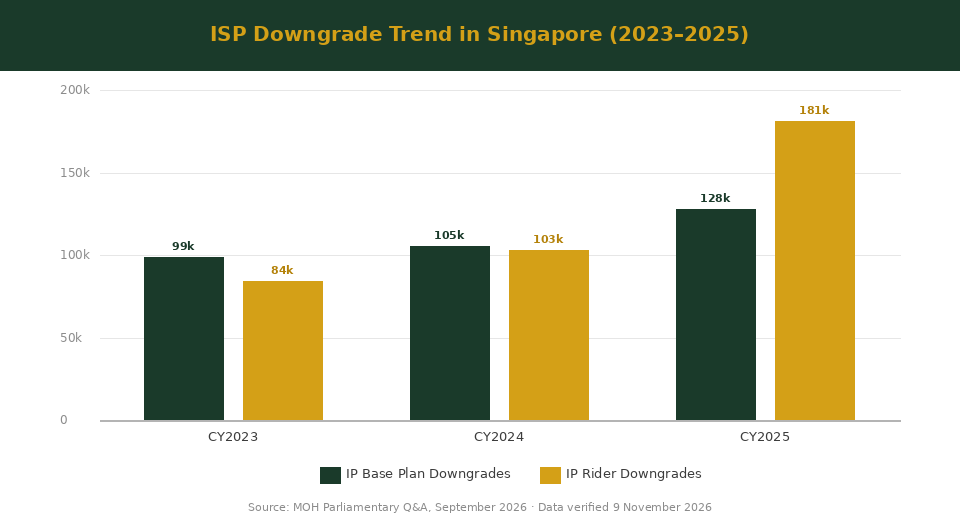
Chart: Annual IP base plan and rider downgrades in Singapore, 2023–2025. Source: MOH Parliamentary Q&A, Sep 2026.
What Actually Happens When You Downgrade Your ISP
Downgrading your Integrated Shield Plan means switching from a plan that covers a higher ward class to one that covers a lower class. Here’s what changes — and what doesn’t.
What you lose when downgrading from a private hospital plan to a Class A plan:
- Access to private hospital wards as the default coverage tier
- Free choice of private specialists without referral (if your previous rider included this)
- Coverage for single-bedded private rooms at private facilities under the base plan
What you retain:
- MediShield Life coverage as the base layer (this cannot be removed)
- Your new lower-tier ISP coverage for Class A wards at restructured hospitals
- The ability to pay the difference and still access private hospitals — you just pay more out of pocket
- The option to add a rider to your lower-tier plan (subject to insurer approval and health underwriting)
One important point that many Singaporeans miss: downgrading your base plan does not mean you can never use a private hospital. It means your insurance coverage is pegged to a lower ward class — typically Class A at a restructured hospital. If you choose to stay at a private hospital, you pay the difference. How large that difference is depends on your condition, the procedure, and whether you have a rider. Our guide to ISP hospital bills without a rider gives real examples of what this means in dollar terms.
There is also a health underwriting consideration. If your health has deteriorated since you first took out your plan, downgrading and later trying to upgrade again may require fresh underwriting — meaning pre-existing conditions could be excluded or attract higher loadings. This asymmetry is a key reason financial planners advise against downgrading if you have chronic conditions.
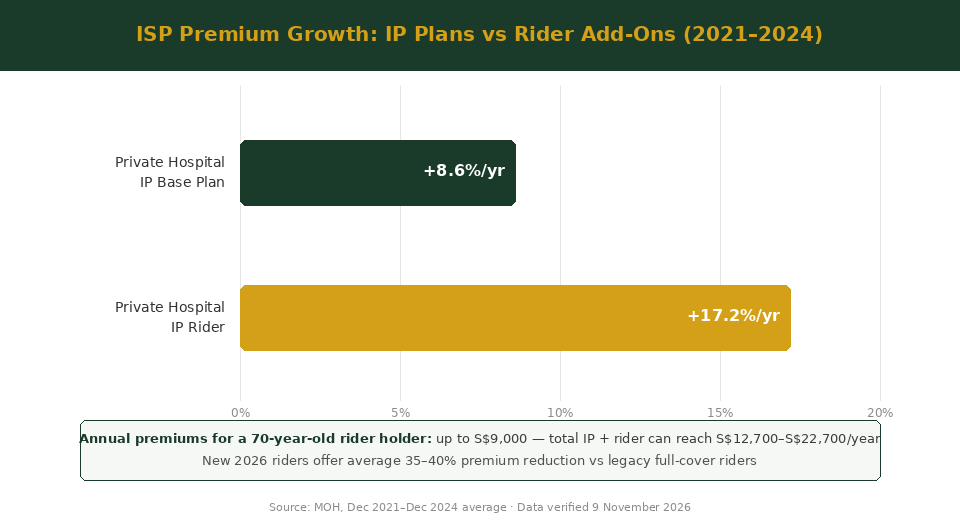
Chart: Annual average premium growth for private hospital ISP base plans vs riders, Dec 2021–Dec 2024. Source: MOH.
Three Questions to Ask Before Downgrading Your ISP
Not everyone who is considering downgrading should. And not everyone who is on the fence should stay put. These three questions help clarify your position.
1. Can you realistically afford the current premium for the next 10 years?
Project your premium forward. If your current annual premium is S$3,500 at age 50 and it grows at 8% per year, by age 60 you will be paying around S$7,500. By age 65, roughly S$11,000. If your MediSave balance is well above the BHS (S$79,000 in 2026) and you have healthy CPF contributions, this may be sustainable. If you are self-employed with irregular MediSave contributions or approaching retirement, the numbers may not work. Use our Singapore retirement calculator to stress-test your CPF projections against rising insurance costs.
2. How often do you actually use private hospitals — and would you pay out of pocket if needed?
Many Singaporeans hold private hospital ISPs but have never actually been admitted to a private hospital. If you are generally healthy and have been admitted to a restructured hospital’s Class A ward on the rare occasion you needed care, your private hospital plan is providing coverage you are not using. That doesn’t automatically mean downgrading is correct — emergencies are unpredictable — but it’s worth asking honestly whether you’re paying for a form of access you wouldn’t use even if it were fully paid.
Conversely, if you have a specialist at a private hospital whom you trust and have been seeing for years, losing that relationship matters. Our ISP rider cancellation guide walks through what happens to your specialist relationships if you change plans.
3. Have you reviewed the new co-payment riders introduced in April 2026?
Before deciding to downgrade the base plan entirely, check whether the new riders introduced in April 2026 have made the premium equation more manageable. These new riders offer an average 35–40% reduction in premiums compared to the legacy full-coverage riders, in exchange for a mandatory co-payment of between 5% and 10% of your hospital bill. For some policyholders — particularly those in their 40s and 50s who had full-cover legacy riders — the savings on the rider alone may be enough to make retaining a private hospital base plan affordable. See our detailed guide to the best ISP for Singapore retirees in 2026 for a breakdown of which new riders offer the best value across insurer and age band.
What the New 2026 ISP Riders Mean for You
From 1 April 2026, all IP insurers were required to transition policyholders from legacy full-coverage riders to new co-payment-based riders. The mandatory transition deadline for existing legacy rider holders is April 2028. If you have not yet transitioned, you are likely to receive correspondence from your insurer in the coming months.
The key features of the new riders:
- Co-payment requirement: You pay 5–10% of the remaining bill after MediShield Life and your base plan payout. This is capped at a specified annual limit per insurer.
- Premium reduction: New riders cost on average 35–40% less than the legacy full-coverage equivalent at the same age band and insurer.
- No change to base plan coverage: The base plan itself is unaffected. You can retain a private hospital base plan and add a co-payment rider.
- No fresh underwriting for transitions: Policyholders transitioning from their existing legacy rider to the new rider from the same insurer do not need to undergo fresh health underwriting. This protection disappears if you cancel and try to buy a new rider later — especially important if your health has changed.
For policyholders who had a legacy full-cover rider and were considering dropping it entirely due to cost, the new co-payment riders are worth evaluating carefully before cancellation. The premium reduction is real. The residual co-payment exposure (5–10% of a capped bill) is manageable for most working-age adults. Cancelling now and trying to re-enter later would require fresh underwriting.
If you are still unsure whether the downgrade makes sense for you specifically, the ISP downgrade checklist gives a step-by-step decision framework with worked examples across different age and income profiles.
ISP Downgrade Decision Framework
Use this table as a starting point. These are general indicators — not personalised financial advice. Your specific health history, MediSave balance, retirement income and risk tolerance should inform your final decision.
| Factor | Stay with Private Hospital Plan | Consider Downgrading |
|---|---|---|
| Annual premium vs income / CPF flow | Below 3% of annual income | Regularly draws from cash savings |
| Health status | Chronic conditions; specialist at private hospital | Generally healthy; no major ongoing conditions |
| Age bracket | 55+ with elevated medical risk | Under 45 with good health |
| Ward class preference | Private hospital single room important | Class A restructured hospital acceptable |
| Rider status | New co-pay rider affordable; no fresh underwriting needed | No rider; legacy rider too expensive; not using private hospitals |
| MediSave balance | Well above BHS (S$79,000 in 2026); sustainable | Near or below BHS; premium drawing from cash |
This framework is for educational reference only. Consult a licensed financial advisor for personalised advice. Data as at November 2026.
Frequently Asked Questions
What is the MediSave limit (BHS) for 2026?
Can I downgrade my ISP at any time?
If I downgrade my ISP, can I still go to a private hospital?
What happened to the 182,000 policyholders who downgraded before the new riders launched?
Is it worth keeping an ISP if I am young and healthy?
How does the ISP downgrade trend affect Singapore's healthcare system?
Make Your ISP Decision With Confidence
Whether you are considering a downgrade, evaluating the new 2026 co-payment riders, or just trying to understand your current coverage, the right next step depends on your specific health profile, age, and financial situation.
Explore our related guides:
- ISP Downgrade Checklist — step-by-step decision guide
- ISP Rider Cancellation Guide 2025/2026
- Best ISP for Singapore Retirees in 2026
- Singapore Retirement Calculator — model your CPF projections
Data verified as at 9 November 2026. The Kopi Notes provides personal finance education for Singapore readers. This article is not financial advice.
Get Free Insurance Advice
Speak with a licensed insurance advisor. No obligation, no cost.
By submitting this form, you agree to our Privacy Policy.
This article was researched with the help of AI. While we strive to keep all information accurate and up to date, there may be errors. If you notice any discrepancies, please contact us.