Medisave Limit 2026: If You’re Retrenched — How to Keep Your ISP Active When CPF Contributions Stop
What happens to your Integrated Shield Plan coverage when your employer stops making CPF contributions — and what you need to do immediately.
If you’re retrenched in Singapore, your CPF contributions stop immediately — but your Integrated Shield Plan (ISP) base plan premiums continue to be auto-deducted from your Medisave account, which stays yours. Your rider premiums, however, now require full cash payment via GIRO after the April 2026 rule change. Understanding which part of your ISP is protected and which needs active attention could save your coverage during the most financially vulnerable period of your life.
Not financial advice. All premium figures are illustrative examples based on published CPF Board and MOH data. Data as at November 2026 unless noted. Always confirm premium amounts with your insurer or CPF Board.
Table of Contents
Contents — Click to expand
What Happens to Your CPF and Medisave When You’re Retrenched
Singapore saw its highest retrenchment numbers in years in 2026, with Q1 alone recording over 3,800 retrenchments — the highest since the pandemic period. When you lose your job, the financial shock is immediate: no salary, no employer CPF contributions, and suddenly every standing payment becomes a question mark.
Your CPF accounts don’t disappear. What stops is the monthly flow of contributions from both you and your employer. Your existing balances stay intact, continue to earn CPF interest (up to 4% per annum on your Ordinary Account, 4% on your Medisave balance), and remain fully under your name. The medisave limit 2026, known as the Basic Healthcare Sum (BHS), is $79,000 — this is the amount CPF targets for Medisave before excess contributions flow into your Special or Ordinary Account. This figure was last confirmed and updated by CPF Board on 22 May 2026.
Here is what actually changes for each CPF account when you stop working:
| CPF Account | What Stops | What Continues |
|---|---|---|
| Ordinary Account | Monthly contributions | 2.5% p.a. interest; existing balance |
| Special Account | Monthly contributions | 4% p.a. interest; existing balance |
| Medisave | Monthly contributions | 4% p.a. interest; ISP base plan premiums auto-deducted |
| ISP Base Plan | Nothing — it continues | Annual premium deduction from Medisave |
Source: CPF Board, 2026. BHS verified from CPF official page, last updated 22 May 2026.
The critical takeaway: your ISP base plan does not automatically lapse when you lose your job. As long as your Medisave has sufficient funds, CPF will continue to deduct your annual ISP base plan premiums on schedule. What you must actively manage is your rider — and that is where most retrenched Singaporeans run into trouble.
Your ISP Premium Structure: What Medisave Covers and What Needs Cash
To understand your exposure during retrenchment, you first need to understand how ISP premiums are split. Your total ISP cost has two distinct components that are treated very differently by CPF rules.
The base plan consists of two layers: the MediShield Life component (which covers basic public hospital stays in Class B2 and C wards) and the insurer’s additional Integrated Plan component (which upgrades your coverage to Class A wards or private hospitals). Both of these are payable from your Medisave account, subject to the Additional Withdrawal Limit (AWL) set by CPF Board. For more detail on AWL amounts and how they vary by plan tier, see our guide on Medisave AWL 2026 and ISP premiums.
The rider is a separate insurance policy sold alongside the base plan that reduces or eliminates the co-payment you would otherwise make when you make a claim. As of 1 April 2026, all ISP riders must be paid entirely in cash — Medisave can no longer be used to fund rider premiums. This was the final phase of MAS’ ISP rider reform, and it means retrenched Singaporeans now face a hard choice: pay the rider premium from their cash savings, or let the rider lapse.
| ISP Component | Payment Source | What Happens if You’re Retrenched |
|---|---|---|
| MediShield Life (base) | Medisave | Auto-deducted; continues as long as Medisave has funds |
| Insurer’s IP component (base, within AWL) | Medisave | Auto-deducted from Medisave; continues as long as Medisave has funds |
| ISP Rider | Cash only (since Apr 2026) | Requires active GIRO/cash payment; at risk during retrenchment |
Source: MAS ISP guidelines, CPF Board, April 2026.
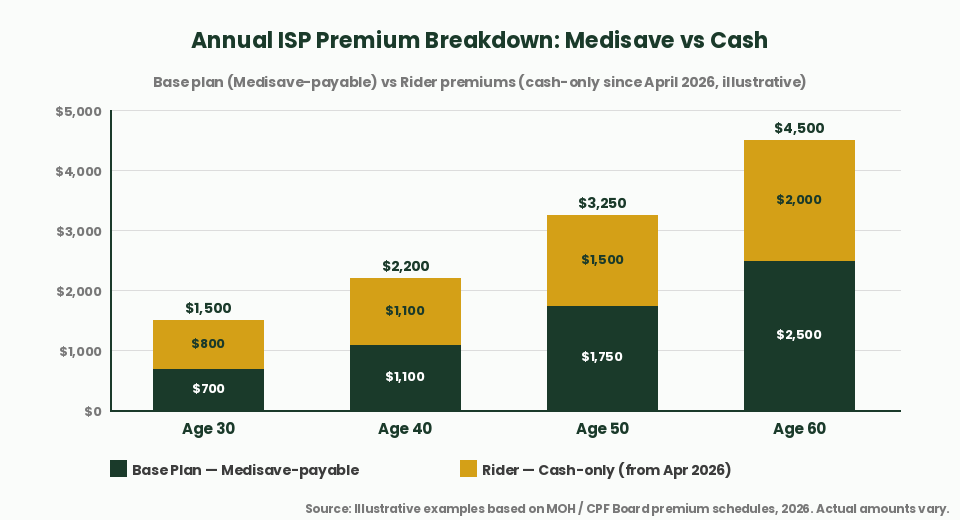
The chart below shows how annual ISP premiums break down between Medisave-payable and cash-only components across different age groups. As you get older, both components rise sharply — and the cash-only rider becomes an increasingly large outgoing during the period you can least afford it.
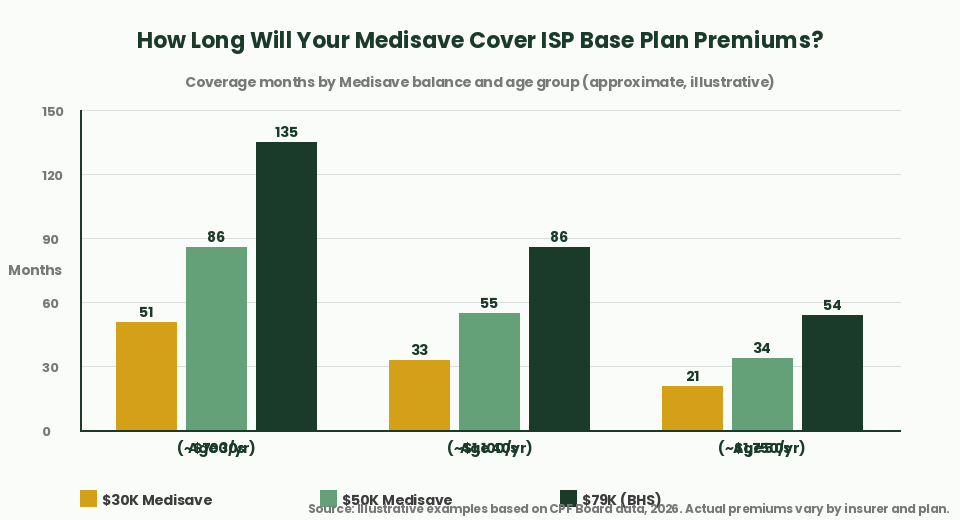
How Long Will Your Medisave Cover ISP Premiums During Retrenchment?
The good news for most Singaporeans is that Medisave balances accumulate steadily over a working life, and ISP base plan premiums are deducted only once a year. This means even without any new CPF contributions coming in, your Medisave can cover ISP premiums for years, not months.
Here is a worked example for a 42-year-old retrenched professional:
- Medisave balance at time of retrenchment: $52,000
- Annual ISP base plan premium (Medisave-payable portion): approximately $1,100
- Coverage period without new contributions: approximately 47 months (nearly 4 years)
- Average retrenchment duration in Singapore: typically 3 to 9 months
For the vast majority of retrenched Singaporeans, Medisave will outlast the period of unemployment by a wide margin. The real risk is for those who have depleted their Medisave through major hospitalisation episodes, or for older Singaporeans whose annual premiums are significantly higher. If you are curious about how this plays out further into retirement, our article on how ISP premiums work after retirement covers the longer-term picture in detail.
The chart above uses illustrative annual premium figures based on CPF Board and MOH published data. Actual premiums vary depending on your insurer, plan tier, and health status. The key pattern holds across all scenarios: the base plan is well-protected by Medisave, even for older policyholders. It is the rider that creates the cash pressure.
One scenario where your ISP base plan is at risk: if your Medisave balance has fallen below the amount needed to pay the annual premium (for example, because of a recent hospitalisation or prior withdrawals), CPF will attempt to deduct but may not be able to cover the full amount. In that case, CPF sends a letter asking you to top up your Medisave or pay the shortfall in cash. Ignoring this will eventually lead to your base plan lapsing. Our guide on what happens when your ISP lapses explains the grace period, reinstatement process, and what coverage you lose in the interim.
The Rider Problem: Why Cash Payments Are Your Biggest Risk
Before April 2026, ISP riders could still be partially funded through Medisave. The gradual reform introduced by MAS over several years ended with the April 2026 rule: all rider premiums are now 100% cash-only. This was designed to increase cost-consciousness among policyholders but it creates a specific vulnerability for the retrenched.
When you lose your job and your salary stops, your GIRO account for the rider premium still tries to deduct on the scheduled date. If there is no money in the linked bank account, the insurer will typically send a notification and begin a grace period — usually 30 to 60 days, depending on your insurer. If payment is still not received within the grace period, the rider lapses.
What does it mean to lose your rider? Under the April 2026 rules, ISP policyholders without a rider face a co-payment of at least 5% of their hospital bill (and potentially a deductible of $3,500 for Class A wards). On a $80,000 hospital bill, that could mean an out-of-pocket cost of over $4,000 even with your base plan in place.
The rider decision is not straightforward when retrenched. If you have the cash reserves, maintaining the rider during a short retrenchment period is usually advisable. If your retrenchment is prolonged, you may need to weigh the annual rider cost against your cash runway. For a detailed breakdown of the numbers, see our analysis on whether to keep your ISP rider in 2026.
If you decide to let the rider lapse, do it deliberately — contact your insurer to avoid being classified as a missed payment rather than a voluntary lapse, which could affect reinstatement terms when you rejoin the workforce. Many insurers have hardship deferment arrangements for policyholders facing temporary income disruption.
What to Do When Your Medisave Runs Low (or Is Already Depleted)
If your Medisave has been partially depleted by a recent hospitalisation or if you are in your 50s or 60s and facing higher annual premiums, you may be closer to the edge than you think. Here are the options available to you.
1. Cash payment for MediShield Life premiums. If your Medisave cannot cover the MediShield Life component of your base plan, CPF will notify you that a cash payment is required. You can pay via PayNow, AXS, or SAM kiosks. Failure to pay will eventually lead to your MediShield Life coverage lapsing, which means you lose the base layer of hospitalisation protection entirely.
2. Additional Premium Support (APS). The Singapore government offers APS, a subsidy that helps lower-income Singaporeans pay their MediShield Life premiums. APS is automatically assessed when CPF processes your premiums — you do not need to apply separately. Eligibility is based on your Annual Value of property and household income. During retrenchment, your household income may drop enough to qualify.
3. Voluntary Medisave top-up. You are allowed to make voluntary cash contributions to your Medisave account at any time, up to the BHS of $79,000. These contributions earn 4% per annum, reduce your taxable income (subject to caps), and go directly toward future ISP premium deductions. If you have cash savings that you do not need immediately, topping up Medisave during retrenchment is one of the more efficient uses of that cash. You can also check your financial trajectory with the Singapore retirement calculator.
4. Contact your insurer. Every major ISP insurer in Singapore has customer support channels for policyholders in financial difficulty. Some offer temporary premium deferment, instalment payment arrangements, or a brief suspension of the rider while keeping the base plan active. Contact your insurer as soon as you receive your retrenchment notice — do not wait until a payment is missed. For background on how ISP premiums have been changing, see our overview of rising ISP premiums in 2026.
6-Step ISP Checklist After Retrenchment
Do these six things in the first week after receiving your retrenchment notice.
Step 1: Check your Medisave balance. Log in to the CPF website or myPF app. Note your current Medisave balance and your annual ISP base plan premium amount (found on your most recent CPF premium deduction notice). Divide to get your coverage runway in years.
Step 2: Identify your rider premium amount. Check your ISP policy documents or your insurer’s app for the annual rider premium. This is the cash amount that will continue to be charged via GIRO regardless of your employment status.
Step 3: Set aside your rider premium from your severance package. Most Singaporeans receive some form of retrenchment benefit. Ring-fence the annual rider premium amount in a separate account or at least note it in your budget. Missing this single payment is one of the most avoidable causes of ISP coverage gaps.
Step 4: Call your insurer within the first week. Inform them of your employment status and ask specifically about hardship deferment options, grace period policies, and what documentation they need. This is recorded and can be referenced if a payment timing issue arises later.
Step 5: Check your APS eligibility. Contact CPF Board or visit their website to check whether you qualify for Additional Premium Support given your reduced household income during retrenchment. For those on the edge of eligibility, this can make a meaningful difference to your MediShield Life premium cost.
Step 6: Review your rider coverage needs. Retrenchment is also a good moment to reassess whether your existing rider tier still matches your situation. If you have downsized your lifestyle and can live with more co-payment exposure temporarily, some policyholders choose to downgrade to a lower rider tier (if available from their insurer) rather than lapsing entirely. This costs less while keeping some rider protection in place.
Frequently Asked Questions
Will my Integrated Shield Plan lapse automatically if I lose my job?
No. Your ISP base plan will not automatically lapse when you are retrenched. The annual base plan premium (MediShield Life component plus the insurer’s IP component within the AWL) continues to be automatically deducted from your Medisave account as long as there are sufficient funds. Since Medisave balances accumulate over your working life and are only reduced by medical withdrawals, most retrenched Singaporeans have enough Medisave to cover ISP premiums for many years without new contributions.
What is the Medisave limit 2026 and does it affect my ISP premiums?
The Medisave limit 2026 — officially called the Basic Healthcare Sum (BHS) — is $79,000 as confirmed by CPF Board (last updated 22 May 2026). This is the targeted Medisave balance CPF uses to ensure Singaporeans have enough funds for healthcare in old age. It does not cap how much you can use from Medisave for ISP premiums. Rather, Medisave contributions above the BHS flow into your Special or Ordinary Account instead. During retrenchment, the BHS figure matters because it sets the ceiling for voluntary Medisave top-ups that remain tax-deductible.
Can I use Medisave to pay my ISP rider premium if I am retrenched?
No. As of 1 April 2026, all ISP rider premiums must be paid entirely in cash. This is the final phase of the MAS ISP rider reform. Medisave can only be used for the base plan’s MediShield Life component and the insurer’s IP component within the Additional Withdrawal Limit (AWL). The rider is a separate policy that sits on top of the base plan, and rider premiums are charged to your linked bank account via GIRO. If GIRO fails during retrenchment, your insurer will notify you and a grace period — typically 30 to 60 days — applies before the rider lapses.
What happens to my ISP if my Medisave runs out?
If your Medisave balance is insufficient to cover your annual ISP base plan premium, CPF Board will contact you to arrange a cash payment for the shortfall. If you do not pay within the given timeframe, your MediShield Life coverage (the base layer within the ISP) will eventually lapse. At that point you would lose all ISP hospital cover. To avoid this, you can make a voluntary cash top-up to your Medisave account, apply for Additional Premium Support (APS) if you are eligible, or contact your insurer to discuss options. MediShield Life can also be paid entirely in cash via AXS, SAM kiosks, or PayNow if Medisave is depleted.
Is there government help available for ISP premiums during retrenchment?
Yes. The CPF Additional Premium Support (APS) scheme provides government subsidies for MediShield Life premiums for lower-income Singaporeans and Permanent Residents. APS eligibility is assessed automatically by CPF Board based on the Annual Value of your residential property and your household income. During a period of retrenchment, your reduced household income may bring you within the qualifying range. APS covers only the MediShield Life portion of your premium, not the insurer’s IP component or rider premiums. Contact CPF Board or visit the CPF website to check your APS status.
Should I cancel my ISP rider during retrenchment to save money?
This depends on your cash position and the expected duration of your retrenchment. The average retrenchment period in Singapore is 3 to 9 months — short enough that most financial planners recommend maintaining rider coverage if you can afford it, since the period of maximum income stress is also the period when an unexpected hospitalisation would be most financially damaging. If you must reduce costs, contact your insurer first about deferment or a temporary downgrade to a lower rider tier rather than a full lapse, as reinstatement after lapse can require underwriting and may exclude pre-existing conditions.
Review Your ISP Coverage Today
Whether you are currently retrenched or preparing for uncertainty, understanding your ISP structure is essential. Use the links below to explore related TKN guides.
Not financial advice. Verify all premium figures with your ISP insurer and CPF Board. The Kopi Notes does not receive commissions for ISP referrals.
Get Free Insurance Advice
Speak with a licensed insurance advisor. No obligation, no cost.
By submitting this form, you agree to our Privacy Policy.
This article was researched with the help of AI. While we strive to keep all information accurate and up to date, there may be errors. If you notice any discrepancies, please contact us.