MediSave Limit 2026: How Much Can You Claim for Gallbladder Removal in Singapore?
Integrated Shield Plans · 18 November 2026 · 10 min read
Table of Contents
- What Is Gallbladder Removal Surgery?
- How Much Does Gallbladder Surgery Cost in Singapore?
- MediSave Withdrawal Limits for Cholecystectomy (2026)
- What MediShield Life Pays Towards Gallbladder Surgery
- How Your Integrated Shield Plan Covers the Gap
- Day Surgery vs Inpatient: Which Applies to You?
- 5 Questions to Ask Before the Bill Arrives
- Frequently Asked Questions
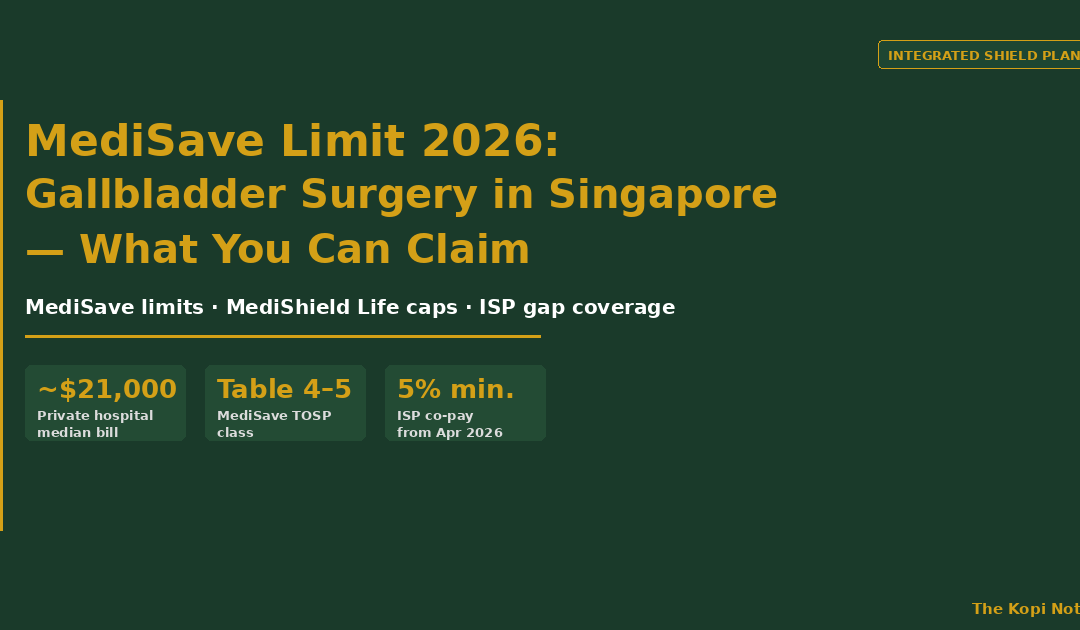
A laparoscopic cholecystectomy — gallbladder removal — is one of Singapore’s most common elective surgeries. At a private hospital, the total bill typically runs $19,000–$24,000. MediSave, MediShield Life, and your Integrated Shield Plan can together cover most of this cost, but the exact amount each scheme pays depends on your TOSP surgical table, ward class, and ISP rider type. This guide covers every 2026 limit.
Not financial advice. All figures are for educational reference only. Data as at November 2026 unless otherwise noted. Always verify current limits with CPF Board, MOH, and your insurer before making healthcare decisions.
What Is Gallbladder Removal Surgery?
A cholecystectomy is the surgical removal of the gallbladder — a small organ beneath the liver that stores bile. The most common reasons for removal are gallstones (cholelithiasis) and gallbladder inflammation (cholecystitis). The Ministry of Health reports that gallstone disease is among the top gastrointestinal conditions treated in Singapore hospitals.
There are two main surgical approaches:
- Laparoscopic (keyhole) cholecystectomy — 3–5 small incisions; most common, shorter recovery. This is TOSP code SF801G for a standard case.
- Open cholecystectomy — a single larger incision; used when laparoscopic is not feasible or complications arise. Generally assigned a higher TOSP complexity table.
- Complicated cholecystectomy (e.g. gangrenous gallbladder, Mirizzi syndrome) — TOSP code SF706G; billed at a higher table, with correspondingly higher hospital costs.
Most elective gallbladder removals in Singapore are performed laparoscopically and can be done as a day surgery or overnight stay, depending on patient fitness and surgeon preference. See our MediSave day surgery Singapore 2026 guide for details on day-surgery billing rules.
How Much Does Gallbladder Surgery Cost in Singapore?
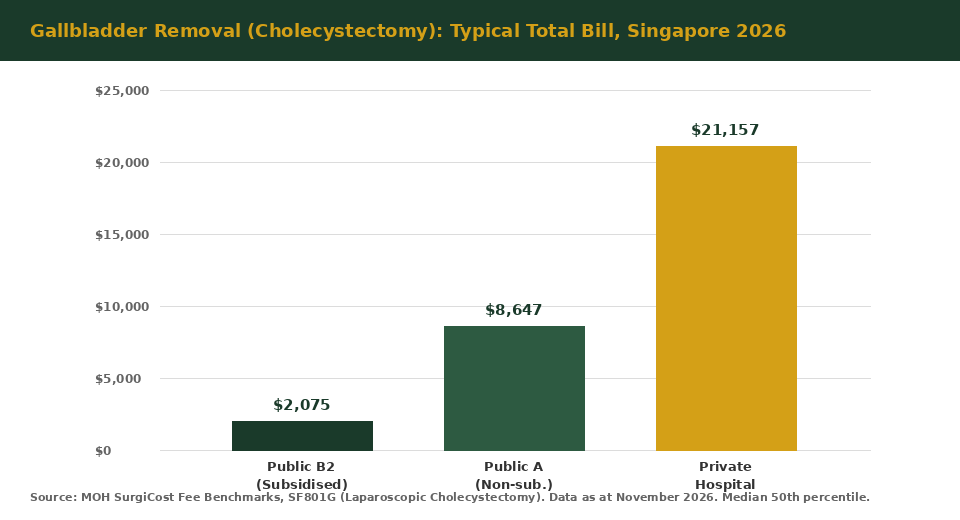
The MOH SurgiCost Fee Benchmarks publish median and range data for surgical procedures at different ward classes. The figures below are for SF801G (Laparoscopic Cholecystectomy — Standard), last updated 16 November 2026, and reflect the total inpatient bill (excluding professional fees billed separately by some specialists).
Table 1: SF801G Laparoscopic Cholecystectomy — Total Bill Benchmarks (November 2026)
| Ward / Setting | Median Bill (50th pct) | Range (25th–75th pct) | Notes |
|---|---|---|---|
| Public B2 (Subsidised) | $2,075 | $1,526 – $3,179 | After government subsidy; MediSave covers most |
| Public A (Non-subsidised) | $8,647 | $5,580 – $10,584 | Single-bedded, full amenities |
| Private Hospital | $21,157 | $19,363 – $23,802 | Where ISP gap coverage matters most |
Source: MOH SurgiCost Fee Benchmarks, SF801G Laparoscopic Cholecystectomy. Data as at 16 November 2026.
For complicated cholecystectomy (SF706G) — involving a gangrenous gallbladder, dense adhesions, or concurrent common bile duct exploration — the median private hospital bill rises to approximately $26,437–$29,265 (MOH data as at 5 November 2026). Complexity is determined by the operating surgeon at the time of the procedure, not in advance.
MediSave Withdrawal Limits for Cholecystectomy (2026)
MediSave — your CPF medical savings — contributes to two parts of the hospital bill: the daily hospitalisation charge and the surgical procedure fee. Both are capped, and the surgical cap depends on the TOSP (Table of Surgical Procedures) complexity class assigned to your operation.
Laparoscopic cholecystectomy (SF801G) is typically classified as Table 4 or Table 5, depending on complexity and the billing specialist. As at 2026, the MediSave surgical withdrawal limits for these tables are:
Table 2: MediSave Surgical Withdrawal Limits — TOSP Tables 4 and 5 (2026)
| TOSP Table | Applies to | MediSave Limit (Class A ward) | MediSave Limit (Class B1 ward) | MediSave Limit (Class B2/C ward) |
|---|---|---|---|---|
| Table 4 | Standard laparoscopic cholecystectomy (SF801G) | $2,380 | $2,440 | $2,540 |
| Table 5 | Complex laparoscopic cholecystectomy; some complicated cases | $2,610 | $2,660 | $2,770 |
Source: CPF Board MediSave Withdrawal Limits (MediSave Withdrawal Limits Schedule, effective April 2025). Verify at cpf.gov.sg.
MediSave hospitalisation charge limits (2026): Separate from the surgical limit, MediSave also covers daily ward charges:
- Days 1 and 2: Up to $1,130 per day
- Day 3 onwards: Up to $400 per day
- Day surgery (no overnight stay): Up to $830 (day surgery rate)
A typical laparoscopic cholecystectomy requiring a 2-night inpatient stay would see MediSave contribute up to $1,130 + $1,130 + $2,380 = $4,640 from MediSave alone against a private hospital bill of around $21,000. This leaves a large gap — which is where MediShield Life and your ISP come in. For the full picture of all MediSave withdrawal types, see our complete 2026 MediSave limit guide.
What MediShield Life Pays Towards Gallbladder Surgery
MediShield Life is the base insurance layer covering all Singapore Citizens and Permanent Residents. It pays a portion of large inpatient bills above the MediSave withdrawal, subject to per-procedure claim limits and an annual deductible.
For laparoscopic cholecystectomy, MediShield Life’s surgical claim limit is currently $1,920. This is paid on top of MediSave — meaning MediShield Life’s $1,920 surgical claim and MediSave’s $2,380 surgical withdrawal are separate entitlements that stack together against the total specialist/surgeon fee component of your bill.
MediShield Life also pays towards the daily ward component (the “room and board” charge), subject to per-day limits. For public wards, MediShield Life can effectively reduce the remaining out-of-pocket to near zero before any ISP kicks in. For private hospital bills of $20,000+, MediShield Life’s contribution is proportionally smaller — which is precisely the coverage gap an Integrated Shield Plan is designed to fill.
Key MediShield Life rules for inpatient claims:
- An annual deductible of $3,000 (Class A/B1) or $1,500 (B2/C) applies before MediShield Life pays. This resets every January.
- A co-insurance percentage (10%) applies on amounts above the deductible.
- MediShield Life claim limits assume Class B2 ward equivalent as the benchmark. At a private hospital, MediShield Life pays as if you were in a B2 ward, and your ISP covers the difference.
How Your Integrated Shield Plan Covers the Gap
An Integrated Shield Plan (ISP) is offered by private insurers — AIA, Great Eastern, Income, Prudential, and HSBC Life — on top of MediShield Life. It covers the large gap between what MediSave and MediShield Life pay and the actual private hospital bill.
Since April 2026, ISP riders (the optional add-on that reduces your out-of-pocket to near zero) must require a minimum 5% co-payment from the insured, with a cap of $3,000 per policy year. For most elective surgeries like cholecystectomy, this means your personal contribution from a $21,000 private hospital bill is capped at a few hundred to a few thousand dollars — depending on your deductible and whether you’ve already claimed in that policy year.
The chart below illustrates a typical coverage breakdown for a private hospital laparoscopic cholecystectomy (illustrative; exact amounts vary by insurer and rider):
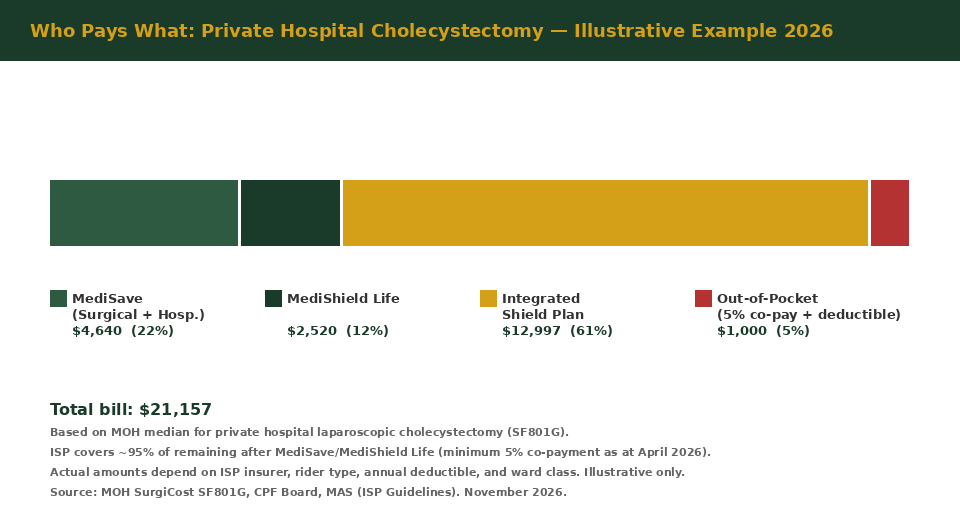
Table 3: Illustrative Coverage Breakdown — Private Hospital Laparoscopic Cholecystectomy 2026
| Coverage Layer | Approximate Amount | Notes |
|---|---|---|
| MediSave (surgical + 2-night hosp.) | ~$4,640 | $2,380 surgical + $1,130 × 2 nights |
| MediShield Life (surgical + hosp.) | ~$2,520 | $1,920 surgical claim + hosp. component |
| Integrated Shield Plan (95% of remainder) | ~$12,997 | After 5% co-payment (min from Apr 2026) |
| Your out-of-pocket (5% co-pay + deductible) | ~$1,000–$3,500 | Depends on annual deductible met, rider type |
| Total bill (MOH median, private) | ~$21,157 | SF801G, MOH SurgiCost, Nov 2026 |
Illustrative only. Actual amounts depend on ISP insurer, rider type, annual deductible, and ward class. Consult your insurer for exact entitlements.
What happens if you do NOT have an ISP? Without an ISP, you are covered only by MediShield Life. At a private hospital with a $21,000 bill, your personal out-of-pocket after MediSave and MediShield Life could exceed $10,000–$14,000. This is why many Singaporeans opt for a private hospital ISP — the premium is typically $500–$2,000/year for a working-age adult with a standard rider, covering the bulk of a surgery like this. See our guide on what your ISP covers without a rider for a full breakdown.
Day Surgery vs Inpatient Stay: Which Applies to You?
Laparoscopic cholecystectomy can be performed as either a day surgery (discharged same day) or an inpatient procedure (at least one overnight stay). The billing differences are material:
- Day surgery: MediSave hospitalisation rate applies at $830 (not the $1,130/day inpatient rate). The surgical MediSave limit ($2,380 for Table 4) still applies. Total MediSave contribution ≈ $3,210.
- Inpatient (2 nights): MediSave covers $1,130 × 2 = $2,260 for hospitalisation plus $2,380 for surgery = $4,640 total.
Whether your procedure qualifies as day surgery depends on your clinical condition and your surgeon’s recommendation. Patients with certain comorbidities, a high BMI, or anticipated complications will typically be admitted as inpatients. If your surgeon recommends a day surgery, the lower MediSave hospitalisation rate ($830 vs $2,260 for 2 nights inpatient) means you retain more MediSave in your CPF account — but you also receive less cover from that buffer towards the total bill.
The MediShield Life surgical claim limit ($1,920) applies in both scenarios. Your ISP’s coverage of the gap above MediSave + MediShield Life also applies in both scenarios, subject to your rider’s terms.
For more detail on how day surgery billing rules differ from inpatient, see our complete day surgery MediSave guide.
5 Questions to Ask Before the Bill Arrives
Knowing the limits is one thing; getting the most out of your coverage requires asking the right questions before you are admitted. Here are five questions every Singapore patient should ask before a planned cholecystectomy:
1. Which TOSP table will the surgeon bill this under — Table 4 or Table 5?
The difference matters: Table 4 gives you a $2,380 MediSave surgical withdrawal vs. Table 5’s $2,610. More importantly, your ISP may price the claim differently. Ask your surgeon’s billing coordinator for the TOSP code before admission, not after.
2. Is this being done as a day surgery or inpatient?
The hospitalisation MediSave rate and insurance trigger points differ. If you have a good ISP, being admitted overnight generally means more of your bill is covered. If you are on MediShield Life only, day surgery means a lower total bill and a lower out-of-pocket.
3. Does my ISP panel require pre-authorisation for planned surgeries?
Most ISPs require a Letter of Guarantee (LOG) or pre-authorisation for planned inpatient surgery. Failing to get this may result in a reduced claim or rejection. Call your insurer at least 48 hours before admission. For seniors aged 65 and above, additional ISP top-up rules may apply — see our guide for seniors’ MediSave hospitalisation limits 2026.
4. Is the specialist fee included in the hospital bill, or billed separately?
Some specialists issue a separate invoice for their professional fee, which is not included in the MOH SurgiCost benchmark. These specialist fees are typically covered by your ISP’s surgical benefit, but check your policy’s section on “professional/specialist charges” before assuming full coverage.
5. Have I met my annual ISP deductible yet this year?
Your ISP’s annual deductible (often $1,500–$3,500 depending on tier) resets every policy year. If you have already been hospitalised this year and met the deductible, your out-of-pocket for this surgery could be lower. If this is your first claim, budget for the deductible amount on top of the 5% co-payment.
For a full pre-admission checklist, see our MediSave planned surgery checklist 2026.
Frequently Asked Questions
How much can I use from MediSave for gallbladder removal surgery in 2026?
For a standard laparoscopic cholecystectomy (TOSP Table 4, inpatient 2-night stay), MediSave covers up to $2,380 for the surgical procedure and up to $1,130/day for the first two days of hospitalisation. That is a maximum of $4,640 from MediSave for a typical 2-night admission. For a day surgery, the hospitalisation rate is $830 instead, bringing the total MediSave contribution to around $3,210. These limits apply as at 2026 — always verify the latest figures at cpf.gov.sg.
Does MediShield Life cover gallbladder surgery fully?
MediShield Life covers a portion, not the full cost. Its surgical claim limit for laparoscopic cholecystectomy is $1,920. It also covers the ward charge component, subject to per-day limits. For a public B2 subsidised ward, MediShield Life combined with MediSave can cover the majority of a $2,000–$3,000 bill. For a private hospital bill of $21,000+, MediShield Life covers only a fraction — which is why an Integrated Shield Plan is essential for private hospital coverage.
What is the minimum co-payment for gallbladder surgery under an ISP in 2026?
Since April 2026, all ISP riders must require a minimum 5% co-payment (capped at $3,000 per policy year) for inpatient claims. This applies to gallbladder surgery. On a private hospital bill of $21,000, after MediSave and MediShield Life have paid their portions, your 5% co-payment on the remaining ~$14,000 would be approximately $700. However, if your annual deductible has not yet been met, you will also pay that amount out-of-pocket before the ISP starts paying its 95% share.
What TOSP table is a laparoscopic cholecystectomy billed under?
A standard laparoscopic cholecystectomy (SF801G) is typically billed under TOSP Table 4, though complicated cases may be upgraded to Table 5. A complicated cholecystectomy (SF706G) — involving a gangrenous gallbladder, Mirizzi syndrome, or concurrent common bile duct exploration — is typically Table 5 or higher. Confirm the TOSP code with your surgeon’s billing coordinator before admission, as the TOSP class determines your MediSave surgical withdrawal limit.
Is gallbladder removal covered under MediSave as a day surgery?
Yes, if performed as a day surgery (no overnight stay), gallbladder removal is covered under MediSave’s day surgery rate of $830 for the hospitalisation component, plus the standard surgical withdrawal limit ($2,380 for Table 4). The total MediSave contribution for a day surgery cholecystectomy would be approximately $3,210. MediShield Life and your ISP continue to apply even for day surgery, though the ward charge component is lower.
What happens if complications arise during gallbladder removal, increasing the TOSP table?
If the surgeon encounters complications — a gangrenous gallbladder, dense adhesions, or a concurrent common bile duct exploration — the TOSP code may be upgraded from SF801G (Table 4) to SF706G (Table 5 or higher). This increases both your MediSave surgical withdrawal limit and MediShield Life claim limit, but also significantly increases the total bill (median private hospital bill for complicated cholecystectomy: $26,437–$29,265 vs ~$21,157 for standard). Your ISP covers the larger bill in proportion to your rider’s terms.
Which ISP gives the best coverage for gallbladder surgery in Singapore?
All five Singapore ISP insurers — AIA HealthShield Gold Max, Great Eastern Supreme Health, Income Enhanced IncomeShield, Prudential PRUShield, and HSBC Life Shield — cover planned inpatient surgeries like cholecystectomy at private hospitals. The key differences lie in annual limits, panel hospital access, pre-authorisation requirements, and rider pricing. This article focuses on the government scheme limits (MediSave and MediShield Life) rather than recommending a specific insurer, as the best ISP depends on your age, health status, and budget. We recommend comparing directly on the MOH ISP comparison page.
Get Free Insurance Advice
Speak with a licensed insurance advisor. No obligation, no cost.
By submitting this form, you agree to our Privacy Policy.
This article was researched with the help of AI. While we strive to keep all information accurate and up to date, there may be errors. If you notice any discrepancies, please contact us.