MediSave Limit 2026: Physiotherapy and Rehabilitation After Surgery — What Your ISP Covers
Table of Contents
- What is the MediSave Limit in 2026?
- Can You Use MediSave for Physiotherapy?
- What Does Your ISP Cover for Inpatient Rehabilitation?
- MediShield Life 2026 Rehabilitation Benefit Rates
- After Discharge: Where ISP Ends and Out-of-Pocket Costs Begin
- How ISPs Cover Post-Surgery Rehabilitation in Practice
- How to Claim Physiotherapy Under Your ISP
- Where to Buy an Integrated Shield Plan
The MediSave limit in 2026 — anchored by a Basic Healthcare Sum (BHS) of $79,000 — is not a spending cap but a minimum balance requirement. After major surgery, your Integrated Shield Plan (ISP) covers inpatient physiotherapy and community hospital rehabilitation as part of your hospitalisation claim; however, MediSave cannot be used for standalone outpatient physiotherapy, leaving a coverage gap many Singaporeans only discover after discharge.
Not financial advice. All figures are for educational reference only. Data verified as at November 2026.
What is the MediSave Limit in 2026?
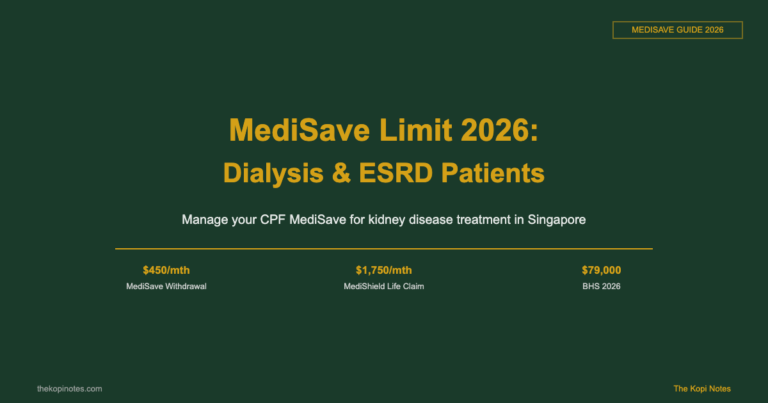
The MediSave limit most Singaporeans hear about is the Basic Healthcare Sum (BHS). For 2026, the BHS is set at $79,000. This is the minimum balance CPF requires you to keep in your MediSave Account; any excess above the BHS that flows into your MediSave is redirected to your Special or Retirement Account instead.
It is important to understand what this limit is not: it is not a cap on how much you can spend on healthcare. Rather, it protects a minimum healthcare reserve. You can use your MediSave above the BHS for approved expenses at any time, and the BHS threshold itself rises each year in line with healthcare cost inflation.
For inpatient hospitalisation, MediSave can be used to pay:
- Your share of hospital bills (after MediShield Life/ISP pays out)
- Up to daily MediSave withdrawal limits (which vary by ward class)
- MediShield Life and ISP premiums (annual)
Your ISP premium can be paid in full from MediSave, up to the Additional Withdrawal Limits (AWLs) set by CPF. These AWLs increase as ISP coverage improves, so a Plan B policy at a private hospital will draw more from MediSave than a standard ward ISP.
Can You Use MediSave for Physiotherapy?
This is the question that catches many Singaporeans off-guard. The short answer: MediSave cannot be used for standalone outpatient physiotherapy, regardless of whether you have a referral letter from your doctor.
Physiotherapy is not on the CPF Board’s approved outpatient treatment list, which covers chronic disease management programmes (CDMP), vaccinations, and specific screening procedures. Because physiotherapy is considered a rehabilitative therapy rather than a direct treatment for a condition, it falls outside the MediSave outpatient scheme.
When MediSave CAN help with physiotherapy:
- During an inpatient stay: If you are admitted to a hospital or community hospital and physiotherapy is ordered as part of your treatment, it is billed as part of your hospitalisation. MediSave (and your ISP) covers it as part of the overall inpatient bill.
- As part of a day surgery package: Some rehabilitation-related day procedures may be bundled into an approved day surgery package. Check with your hospital whether post-operative physio during a day stay qualifies.
For everything else — the community physio clinic down the road, outpatient hospital physio after discharge, or private physiotherapy centres — you will need to pay out of pocket or rely on your ISP’s post-discharge benefits (where offered).
What Does Your ISP Cover for Inpatient Rehabilitation?
Your Integrated Shield Plan works on top of MediShield Life to cover a larger portion of your inpatient bills — including physiotherapy and occupational therapy ordered during your stay. When a hospital physiotherapist visits you after knee replacement or spinal surgery, that is part of your inpatient care and your ISP’s hospitalisation benefit covers it.
Community hospitals are where most rehabilitation after major surgery takes place. After acute care at the main hospital, patients are often transferred to a community hospital such as Bright Vision, St Andrew’s Community Hospital, or Ren Ci Community Hospital for intensive rehabilitation over days or weeks. MediShield Life and your ISP cover these stays under the community hospital benefit tier.
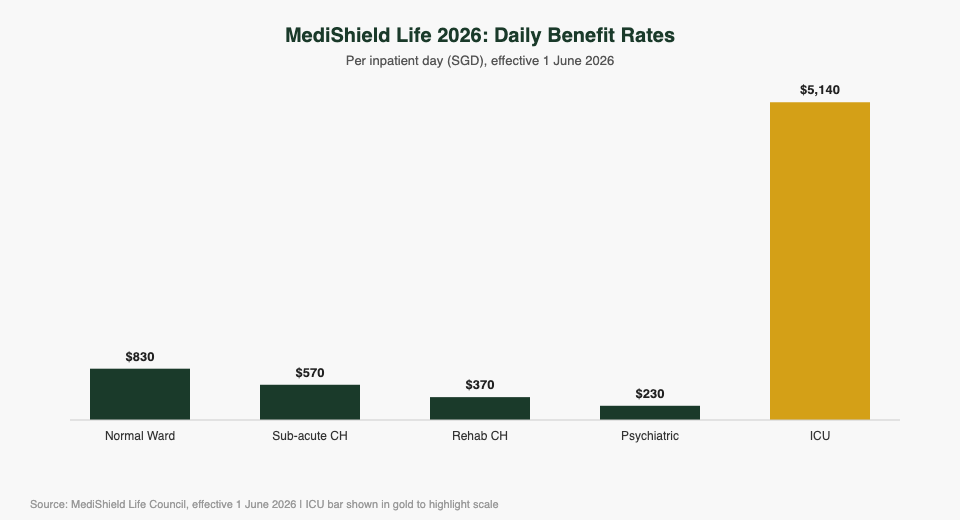
Source: MediShield Life Council, effective 1 June 2026
Community hospital stays for rehabilitation fall into two categories under MediShield Life 2026:
- Rehabilitative: $370 per day (physiotherapy, occupational therapy, speech therapy focused on regaining function)
- Sub-acute: $570 per day (less intensive, for patients who need longer monitoring before home discharge)
Your ISP adds on top of these MediShield Life base limits, covering a higher percentage of the actual bill or upgrading you to a better ward class. If you have a Plan A or Plan B ISP, your insurer typically covers community hospital stays at private or restructured hospital community wards, with little or no co-payment on your part.
MediShield Life 2026 Rehabilitation Benefit Rates
The following table sets out all inpatient daily benefit rates under MediShield Life effective from 1 June 2026. These are the base rates before your ISP tops up the coverage.
| Ward / Setting | MediShield Life 2026 Rate | Notes |
|---|---|---|
| Normal Ward (B2 and above) | $830/day | + $800 extra for each of first 2 inpatient days |
| Intensive Care Unit (ICU) | $5,140/day | No daily limit on days |
| Community Hospital — Rehabilitative | $370/day | Physio, OT, speech therapy focus |
| Community Hospital — Sub-acute | $570/day | Medical monitoring before discharge |
| Psychiatric Ward | $230/day | Up to 60 days per policy year |
Source: Ministry of Health / MediShield Life Council, effective 1 June 2026
Note that MediShield Life has an annual claim limit of $200,000 per policy year across all claims. For most patients recovering from surgery, annual bills are well below this. Your ISP may have its own higher or unlimited annual benefit — check your policy schedule.
After Discharge: Where ISP Ends and Out-of-Pocket Costs Begin
Once you are discharged — whether from an acute hospital after three days or from a community hospital after three weeks of rehab — the coverage picture changes dramatically. Outpatient physiotherapy after discharge is not covered by MediSave, and ISPs do not automatically cover outpatient physio either.
Post-discharge physiotherapy at a private physiotherapy clinic typically costs $80 to $120 per session in Singapore in 2026. After major orthopaedic surgery (hip replacement, ACL reconstruction, spinal fusion), physiotherapists typically recommend 2–4 sessions per week for 4–8 weeks — a course of 10 to 20 or more sessions.
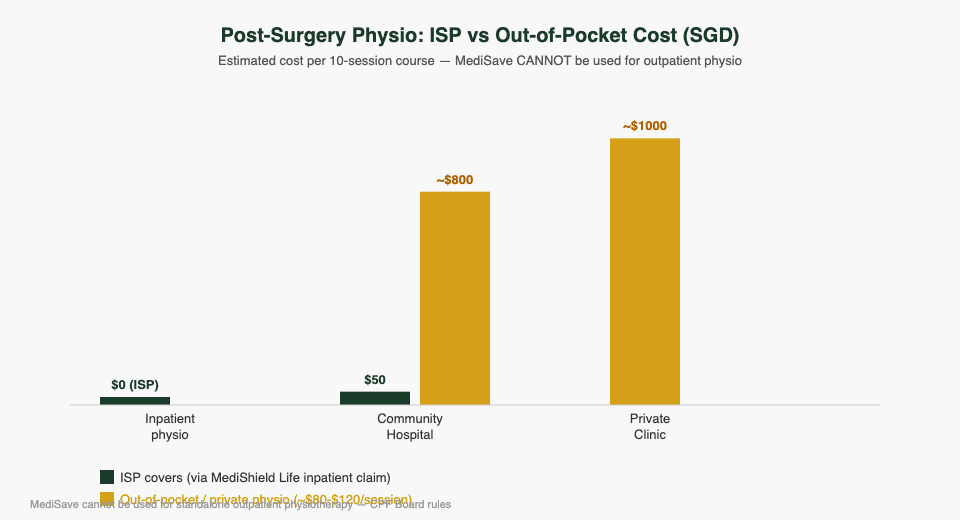
Private physio estimated at $80–$120/session. MediSave cannot be used for outpatient physiotherapy — CPF Board rules.
A 10-session course at a private clinic costs roughly $800–$1,200 out of pocket, with no MediSave available to offset this. If your recovery needs 20 sessions, the cost doubles. Some restructured hospital outpatient physiotherapy departments charge less ($40–$70/session at subsidised rates for Singaporean citizens), but waiting times are longer.
What ISPs Offer for Post-Discharge Physio
Some ISPs include riders or add-ons that cover a limited course of outpatient physiotherapy after a qualifying hospitalisation. These typically have conditions:
| Coverage Type | What to Check in Your Policy |
|---|---|
| Post-hospitalisation physiotherapy benefit | Number of sessions covered, waiting period, need for a referral from treating doctor |
| Day rehabilitation | Some plans cover day rehab programmes at community hospitals — check if your insurer recognises the facility |
| Outpatient cancer care / chronic disease physio | Some newer plans cover physio linked to cancer treatment or stroke recovery as a rider |
Source: MOH ISP comparison guidelines; individual policy terms vary — check your insurer’s benefit table
If in-plan post-discharge physio coverage matters to you, compare policies using the MOH’s ISP comparison tool before you are admitted — not after, when switching is harder.
How ISPs Cover Post-Surgery Rehabilitation in Practice
Understanding what your ISP actually pays requires reading the benefit table in your policy schedule — not just the marketing summary. Here are the key benefit headings to look for:
Inpatient daily room-and-board benefit: Your ISP tops up MediShield Life’s daily benefit to cover the actual ward charge. At a private hospital, the daily ward rate can be $500–$2,000; your ISP covers the gap so your co-payment is typically 10% or a small fixed amount.
Community hospital benefit: This is where most rehabilitation happens. A Plan A ISP typically covers community hospital stays at private community wards with low co-payment, while a Plan B ISP covers restructured community hospital ward B1/A stays. If you are in a Plan C ISP (B2 ward equivalent), your community hospital coverage follows MediShield Life rates more closely.
Post-hospitalisation outpatient care: Read this section carefully. Some insurers define this narrowly (hospital follow-up appointments only) while others extend it to physiotherapy or day rehab if initiated within a specified window (e.g., within 90 days of discharge). The number of covered sessions varies from 0 to 20 depending on the plan.
If you are planning a major elective procedure — joint replacement, spinal surgery, heart bypass — speak to your ISP insurer in advance to understand what your plan covers for rehabilitation and whether a letter of guarantee (LOG) or pre-authorisation is needed for the community hospital transfer.
For a broader view of your retirement healthcare planning and how your ISP fits in, our Singapore retirement calculator can help you model future healthcare costs, including physiotherapy expenses that fall outside MediSave coverage.
How to Claim Physiotherapy and Rehabilitation Under Your ISP
Claiming for inpatient physiotherapy is generally seamless — the hospital bills your ISP directly and the therapist’s charges are included in your consolidated bill. What requires more attention is the transition to community hospital rehabilitation and any post-discharge claims.
Inpatient physiotherapy (at the acute hospital): No separate claim is needed. Physiotherapy fees appear as a line item on your hospital bill. The hospital’s billing team will apply your MediShield Life and ISP coverage automatically. Your co-payment is whatever your policy schedule specifies.
Community hospital transfer: When your doctor recommends a community hospital stay for rehabilitation, the acute hospital social worker or medical team will coordinate the transfer. Your ISP insurer may require a letter of guarantee before or at admission. If this is planned surgery, call your insurer’s pre-authorisation line in advance. If it is unplanned (emergency surgery followed by rehab), call your insurer on Day 2 or 3 of your hospital stay to notify them of the impending transfer.
Post-discharge physiotherapy: If your ISP includes post-hospitalisation physio, claims typically require a referral letter from your treating specialist, sessions at an approved panel provider, claims submitted within the specified window (commonly 90–180 days post-discharge), and receipts from each session. Keep all receipts and referral letters. Some ISPs allow direct billing at panel physiotherapy clinics; others require you to pay first and submit for reimbursement.
Reviewing your CPF and MediSave positions regularly is part of sound health financial planning. Our guide to CPF investment strategy covers how to grow your CPF savings to build a healthcare buffer alongside your ISP.
Where to Buy an Integrated Shield Plan in Singapore
ISPs are sold by seven approved insurers in Singapore. You can apply directly with an insurer, through a financial adviser, or via robo-advisory platforms that make it easier to compare plans and handle the paperwork online.
If you prefer a guided approach with access to multiple insurers, consider Endowus (referral code: 2V343) or Syfe (referral code: SRPRFFFCD), both of which offer insurance planning services alongside their investment products. These platforms can help you match your ISP to your healthcare needs and budget — including coverage for rehabilitation after surgery — without commission pressure.
When comparing ISPs, focus on three things for rehabilitation coverage specifically: the community hospital benefit tier, whether post-hospitalisation physiotherapy is included (and for how many sessions), and what co-payment structure applies at the community hospital ward class you would actually choose.
Frequently Asked Questions
Can I use MediSave to pay for physiotherapy after surgery?
What is the MediSave Basic Healthcare Sum (BHS) for 2026?
Does my ISP cover physiotherapy at a community hospital after surgery?
How much does private physiotherapy cost in Singapore in 2026?
Does my ISP cover outpatient physiotherapy after discharge?
Do I need pre-authorisation to transfer to a community hospital for rehab?
Get Free Insurance Advice
Speak with a licensed insurance advisor. No obligation, no cost.
By submitting this form, you agree to our Privacy Policy.
This article was researched with the help of AI. While we strive to keep all information accurate and up to date, there may be errors. If you notice any discrepancies, please contact us.