MediSave Limit 2026: How Much Can You Claim for Spine Surgery in Singapore?
TOSP 6B surgical limit, bill breakdowns, and ISP co-payment rules — everything you need before your spine operation.
The MediSave limit 2026 for spine surgery depends on the TOSP table assigned to your procedure. Most common spine operations — discectomy, decompression and single-level spinal fusion — fall under TOSP Table 6B, giving you a MediSave surgical withdrawal limit of S$3,610, plus up to S$1,130 per day for the first two days of hospitalisation. At a private hospital where the typical bill for a spine decompression runs to S$50,640, an Integrated Shield Plan (ISP) is what keeps your out-of-pocket cost manageable.
Not financial or medical advice. All figures are for educational reference only. Cost data sourced from MOH as at November 2026 unless noted.
Table of Contents
Which TOSP Table Covers Spine Surgery?
Singapore’s Ministry of Health classifies every inpatient surgical procedure under the Table of Surgical Procedures (TOSP), which runs from Table 1A (simplest) to Table 7C (most complex). The TOSP category determines how much MediSave you can withdraw for the surgery itself.
The vast majority of spine surgeries in Singapore fall under TOSP Table 6B. This includes the two most common procedures:
- SB726S — Decompression and/or Discectomy (without instrumentation): Used for slipped discs (herniated nucleus pulposus), spinal stenosis and nerve compression. Involves removing part of the disc or bone pressing on the nerves.
- SB731S — Interbody Fusion, Single Segment (without instrumentation): Fuses two vertebrae together, often performed alongside a discectomy when instability is present.
More complex procedures — multi-level fusions or operations with metal instrumentation (screws, rods, cages) — may be classified under TOSP Table 7A or 7B, which carry higher MediSave surgical limits. Always confirm your TOSP code with your surgeon before admission.
MediSave Limits for Spine Surgery 2026
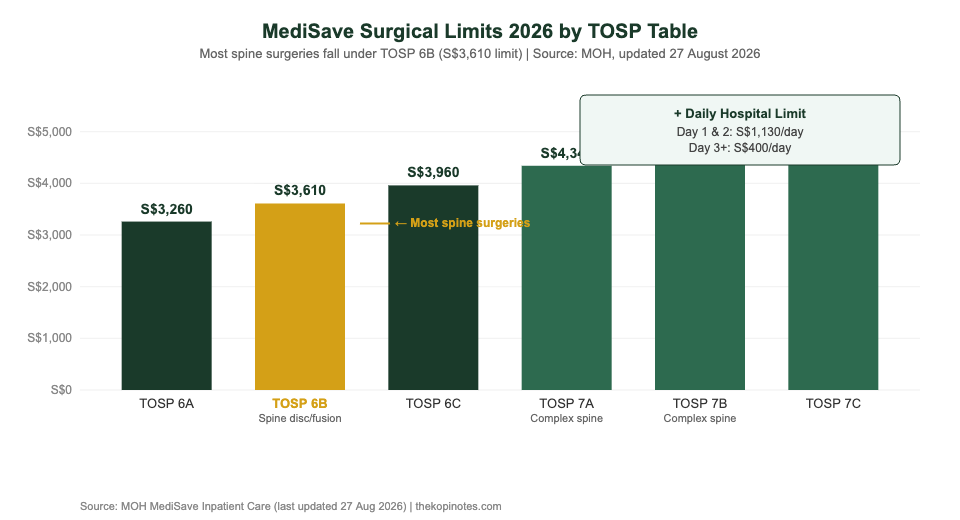
Your total MediSave claim for a spine surgery admission is the sum of two components: the daily hospital charge limit and the surgical limit. Both figures were verified from MOH’s MediSave inpatient care page (last updated 27 August 2026).
| Component | Limit (S$) | Notes |
|---|---|---|
| Inpatient daily charge — Day 1 & 2 | $1,130/day | Applies if admitted for ≥ 8 hours |
| Inpatient daily charge — Day 3+ | $400/day | From the third day onward |
| Surgical limit — TOSP 6B | $3,610 | Most spine decompression & single-segment fusion |
| Surgical limit — TOSP 7A | $4,340 | Complex / multi-level fusion with instrumentation |
| Surgical limit — TOSP 7B | $4,830 | Most complex spine instrumentation procedures |
| Maximum MediSave for 3-day stay (TOSP 6B) | $6,270 | ($1,130 × 2) + $400 + $3,610 surgical |
Source: MOH MediSave Inpatient Care page, updated 27 August 2026. Figures are MediSave withdrawal limits, not actual hospital charges.
As a worked example: a typical spine decompression with a 3-night stay allows withdrawal of up to S$6,270 from MediSave — S$2,660 in daily charges (S$1,130 × 2 + S$400) plus S$3,610 for the surgery. For a 4-night stay, add S$400, bringing the total to S$6,670. MediSave can also be used across immediate family members if your own balance is insufficient.
How Much Does Spine Surgery Cost in Singapore?
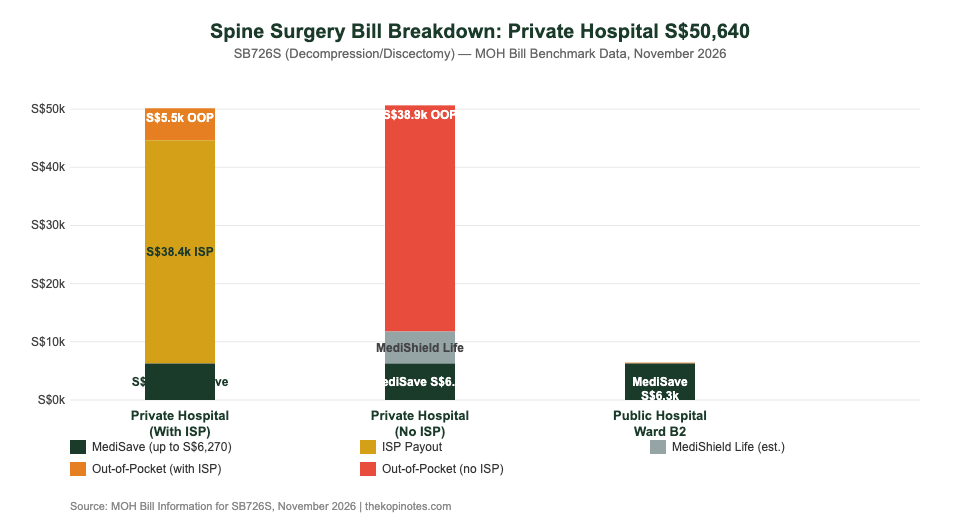
The cost gap between public and private hospitals for spine surgery is substantial. MOH publishes bill benchmarks for common procedures on its Cost Financing page. The figures below are for SB726S (Spine Decompression/Discectomy without instrumentation) — the most common spine procedure in Singapore.
| Hospital Type / Ward | Typical Bill (S$) | Range (S$) |
|---|---|---|
| Public Hospital — Ward C (highest subsidy) | $6,426 | $4,702 – $9,994 |
| Public Hospital — Ward B2 (subsidised) | $6,927 | $5,554 – $8,894 |
| Private Hospital (operation fee only) | $39,398 | n/a |
| Private Hospital (total bill incl. all fees) | $50,640 | $44,677 – $62,779 |
Source: MOH Bill Information for SB726S (Spine, Various Lesions, Decompression/Discectomy Without Instrumentation), retrieved November 2026.
The wide range reflects differences in surgeon experience, implant choice, length of stay and anaesthesia time. Private hospital bills are typically 7–8× higher than public Ward B2 bills for the same procedure — primarily because private hospitals do not receive government operating subsidies and surgeon fees are unregulated.
For more complex cases involving instrumentation (screws and rods), private hospital bills can exceed S$80,000–100,000. Those procedures typically fall under TOSP 7A or 7B with the higher MediSave surgical limits noted above. We cover a similar breakdown for joint replacements in our MediSave limit 2026: knee and hip replacement guide.
ISP and the 2026 Co-Payment Rules
MediShield Life alone — the basic national insurance scheme — provides meaningful coverage for public hospital bills but leaves a large gap for private hospital spine surgery. This is where Integrated Shield Plans (ISPs), offered by the five private insurers (AIA, Great Eastern, Income, Prudential and Singlife), step in.
From April 2026, all new and renewed ISP riders are subject to mandatory co-payment rules under MOH’s revised framework:
- 5% co-payment on the claimable amount after MediSave and MediShield Life have paid
- Annual co-payment cap of S$3,000 — once you’ve paid S$3,000 out-of-pocket in a policy year, the insurer covers 100% of the rest
- Deductible: typically S$3,500 per policy year for private hospital plans (Plan A or B1)
These changes were introduced to discourage over-treatment and unnecessary hospitalisation. The practical effect for spine surgery patients is that your maximum out-of-pocket in a year — including both the deductible and the 5% co-payment — is capped at approximately S$6,500 (S$3,500 deductible + S$3,000 co-pay cap), regardless of how high your private hospital bill runs.
If you have an older ISP rider issued before April 2026 that includes a “full rider” with no co-payment, check with your insurer whether it will be grandfathered or converted at your next renewal date. See our MediSave limit guide for bariatric surgery for more context on how ISP riders apply to elective procedures.
Worked Example: Public vs Private Hospital
The example below uses the typical MOH bill data for SB726S, a 3-night stay, and assumes the patient is a Singaporean citizen with an ISP (Plan A, private hospital rider). All figures are illustrative — your actual bill will vary.
| Cost Component | Public Hospital (Ward B2) | Private Hospital (with ISP) | Private Hospital (no ISP) |
|---|---|---|---|
| Total hospital bill | $6,927 | $50,640 | $50,640 |
| Less: MediSave (3 nights + 6B surgical) | – $6,270 | – $6,270 | – $6,270 |
| Less: MediShield Life / ISP payout | – $500 (est.) | – $38,370 (ISP) | – $5,500 (MSL, est.) |
| Deductible paid by patient | $0 | $3,500 | $3,500 (MediShield Life) |
| 5% co-payment by patient | n/a | $2,000 (est.) | n/a |
| Estimated out-of-pocket | ~$157 | ~$5,500 | ~$35,370 |
Illustrative example based on MOH SB726S bill data (November 2026). Actual bills vary. MediShield Life payout figures are estimates. Consult your insurer for a personalised projection.
The takeaway is stark: a Singapore patient at a public Ward B2 hospital typically pays under S$200 out-of-pocket for a spine decompression, thanks to MediSave absorbing almost the entire bill. At a private hospital without an ISP, the same operation leaves a S$35,000+ gap. With an ISP in place, that out-of-pocket is capped at around S$5,500. If you’re weighing the value of ISP premiums, our Singapore retirement calculator helps you model healthcare costs in your long-term plan.
How to Claim MediSave After Spine Surgery
For hospitalisation at a MOH-licensed hospital in Singapore, MediSave claims are largely automatic. Here’s what actually happens:
- Admission: Bring your NRIC and present your MediSave account number. The hospital’s billing team assesses your TOSP category based on the planned procedure.
- Pre-authorisation (ISP): If you have an ISP, your insurer must be notified before elective surgery. Most insurers require a Letter of Guarantee (LOG) to the hospital before admission. Failure to notify pre-surgery may reduce your payout.
- Post-surgery: The hospital submits your MediSave claim directly to CPF Board on your behalf — you do not file this yourself.
- ISP claim: Your insurer requests the final itemised bill and discharge summary. Processing time is typically 2–4 weeks after discharge.
- Verify via CPF: Log in to my.cpf.gov.sg within 2 weeks of discharge to confirm the MediSave deduction. If the TOSP table looks wrong, raise a dispute through CPF’s online portal.
For planned surgery, our MediSave planned surgery checklist walks you through every step — from pre-authorisation to post-discharge claim verification.
One important note: MediSave covers inpatient procedures (minimum 8-hour admission) or approved day surgeries only. Outpatient spine physiotherapy is not covered under the inpatient care limit.
All figures sourced from MOH official data. Healthcare costs and claim limits may change. Always verify with MOH, your hospital and your ISP before admission.
Check Your ISP Before Spine Surgery
Spine surgery can cost S$50,000+ at a private hospital. The right Integrated Shield Plan caps your out-of-pocket at around S$5,500. Compare plans and open one before you need it.
Frequently Asked Questions
What is the MediSave limit for spine surgery in 2026?
For most common spine surgeries (TOSP Table 6B, e.g. discectomy and single-segment fusion), the MediSave surgical withdrawal limit is S$3,610 in 2026, as confirmed by MOH (updated 27 August 2026). On top of this, you can withdraw up to S$1,130 per day for the first two days of hospitalisation and S$400 per day from day three. For a typical 3-night admission, your total MediSave claim would be up to S$6,270.
Does MediSave cover a slipped disc operation?
Yes. A slipped disc operation (herniated nucleus pulposus requiring surgical discectomy or decompression) is classified under TOSP Table 6B (procedure code SB726S). This falls within MediSave’s inpatient surgery coverage. You can withdraw up to S$3,610 for the surgical component plus daily hospitalisation charges from your MediSave account. The operation must be performed at a MOH-licensed hospital in Singapore.
How much does spine surgery cost at a private hospital in Singapore?
According to MOH bill benchmark data, the typical total bill for a spine decompression/discectomy (SB726S) at a private hospital is S$50,640, with a range of S$44,677 to S$62,779. The operation fee alone averages around S$39,398. More complex procedures involving instrumentation (spinal fusion with screws and rods) can exceed S$80,000–100,000 at private hospitals.
Will an ISP cover the full cost of private hospital spine surgery?
An ISP covering private hospital stays will pay the bulk of your bill after MediSave and MediShield Life have contributed. Under the 2026 co-payment rules (effective April 2026), you are responsible for a S$3,500 annual deductible plus a 5% co-payment on the remaining claimable amount, with the total co-payment capped at S$3,000 per year. For a S$50,640 spine surgery, your out-of-pocket with an ISP is therefore around S$5,500 — compared with S$35,000+ without one.
What is the TOSP table for spinal fusion surgery?
Single-segment interbody spinal fusion without instrumentation (procedure code SB731S) is classified under TOSP Table 6B, the same as decompression/discectomy. This gives a MediSave surgical limit of S$3,610. Multi-level fusion or fusion with metal instrumentation (screws, cages) may fall under TOSP 7A (S$4,340) or 7B (S$4,830). Your surgeon should confirm your procedure’s TOSP code during your pre-surgery consultation.
Can I use a family member's MediSave for spine surgery?
Yes. CPF Board allows MediSave to be used across immediate family members for hospitalisation expenses. If your own MediSave balance is insufficient, you can draw on the accounts of your spouse, children, parents, grandparents or siblings. Each family member’s account is subject to its own MediSave withdrawal limit for the same episode. This is handled by the hospital’s billing team during the pre-admission process.
What changed about ISP riders in 2026?
Effective April 2026, MOH requires all new and renewed ISP riders to include mandatory co-payment: a 5% co-payment on the claimable amount, with an annual cap of S$3,000. This applies to both new ISP applications and existing policies at their next renewal date. If you have an older “full rider” with no co-payment, check with your insurer whether it has been grandfathered or will be converted. The annual deductible (typically S$3,500 for private hospital plans) remains unchanged.
Get Free Insurance Advice
Speak with a licensed insurance advisor. No obligation, no cost.
By submitting this form, you agree to our Privacy Policy.
This article was researched with the help of AI. While we strive to keep all information accurate and up to date, there may be errors. If you notice any discrepancies, please contact us.