How to Invest in Singapore: Build a Bond Ladder with T-Bills & SSBs for Predictable Cash Flow (2026)
A step-by-step guide to creating government-guaranteed, predictable income — even as T-bill yields fall in 2026.
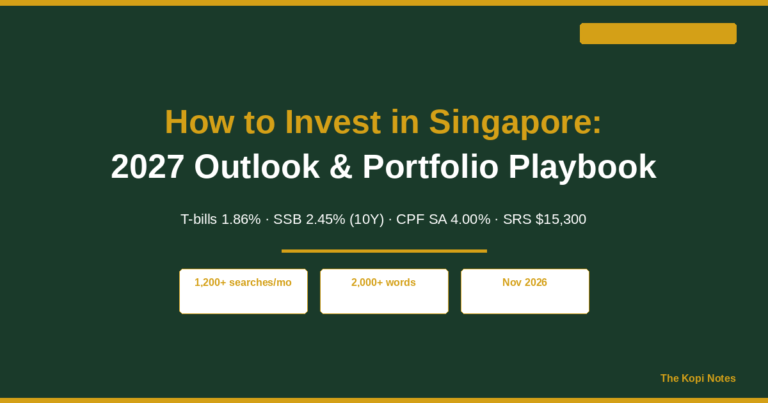
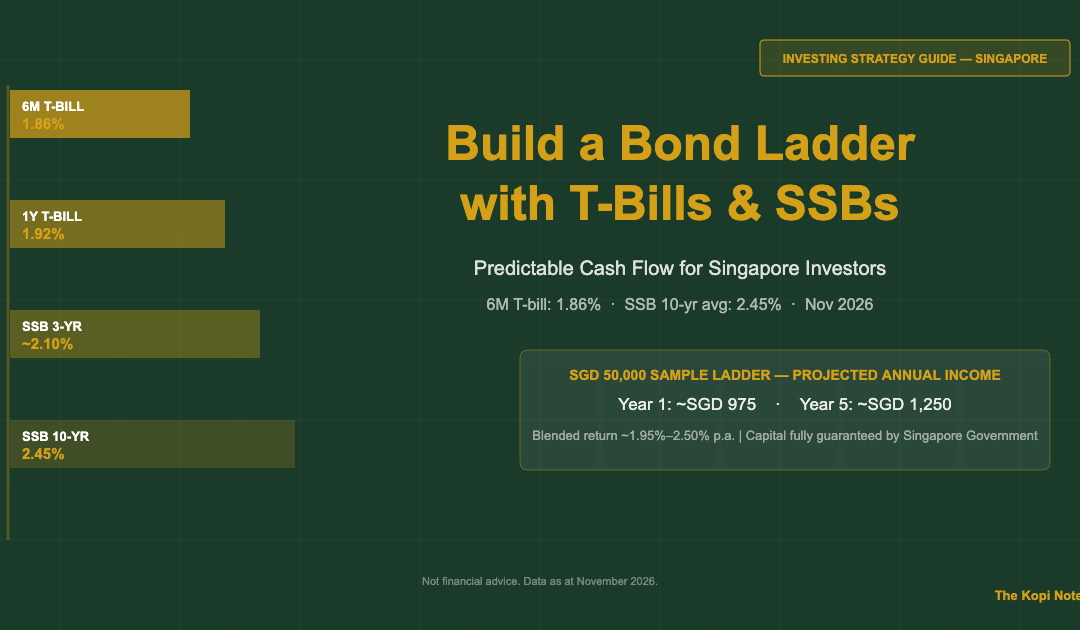
A bond ladder is a fixed-income strategy where you stagger the maturity dates of multiple government instruments, ensuring you always have capital maturing — and available to reinvest or redeem. In Singapore, 6-month T-bills (now yielding 1.86%) and Singapore Savings Bonds (10-year average: 2.45%) are the ideal building blocks: government-guaranteed, low-minimum, and highly complementary. This guide walks you through building one step by step.
Not financial advice. All figures are for educational reference only. Data verified as at 14 November 2026.
Table of Contents
Contents — Click to expand
- Why T-bill Yields Are Falling — But You Still Need Reliable Income
- How a Bond Ladder Works: The Mechanics
- Singapore’s Building Blocks: T-Bills and SSBs Explained
- Bond Ladder vs Savings Accounts vs CPF: Side-by-Side
- How to Build Your First Bond Ladder in Singapore (Step-by-Step)
- Frequently Asked Questions
Why T-Bill Yields Are Falling — But You Still Need Reliable Income
At the 4 November 2026 auction, the 6-month Singapore T-bill cut-off yield fell to 1.86% — down sharply from the 3.5%–4% peaks of 2023. If you have been rolling T-bills every six months since 2023, you have watched your passive income get quietly halved. The next auction on 19 November 2026 is expected to continue this downward trajectory as global interest rates ease.
Yet the problem is not the lower yield per se. The problem is reinvestment risk — the uncertainty of not knowing what rate you will get when your T-bill matures. Roll SGD 100,000 into a T-bill today, earn SGD 930 in six months, then face the same uncertainty all over again. If rates fall further, your income falls with them.
This is where a bond ladder solves a real problem. By locking in some of your fixed-income allocation in longer instruments — specifically Singapore Savings Bonds (SSBs), which offer fixed rates for up to 10 years — you reduce your exposure to falling short-term rates while keeping some capital in T-bills for liquidity and flexibility. You know exactly what you will earn, years in advance.
For Singapore investors, a bond ladder built from T-bills and SSBs is especially powerful because both instruments are:
- Backed by the Singapore Government (zero credit risk)
- Free from capital gains tax and income tax for individual investors
- Available at low minimums (SGD 1,000 for T-bills, SGD 500 for SSBs)
- Accessible through the standard ATM or internet banking application process
How a Bond Ladder Works: The Mechanics
A bond ladder divides your fixed-income capital into equal portions, each invested in an instrument with a different maturity date. As each “rung” matures, you receive your principal back (plus interest) and either redeem it or reinvest in a new instrument at the top of the ladder.
The key insight is this: you never have all your capital maturing at once. This solves two problems simultaneously:
- Reinvestment risk is spread out. You are never forced to reinvest everything at the worst possible time. If rates are low when Rung 1 matures, Rungs 3 and 4 are still compounding at the rates you locked in earlier.
- Liquidity is maintained. You always have capital maturing in the near term. If you need funds unexpectedly, your next maturity is never more than 6 months away.
A Simple Worked Example: SGD 50,000 Ladder
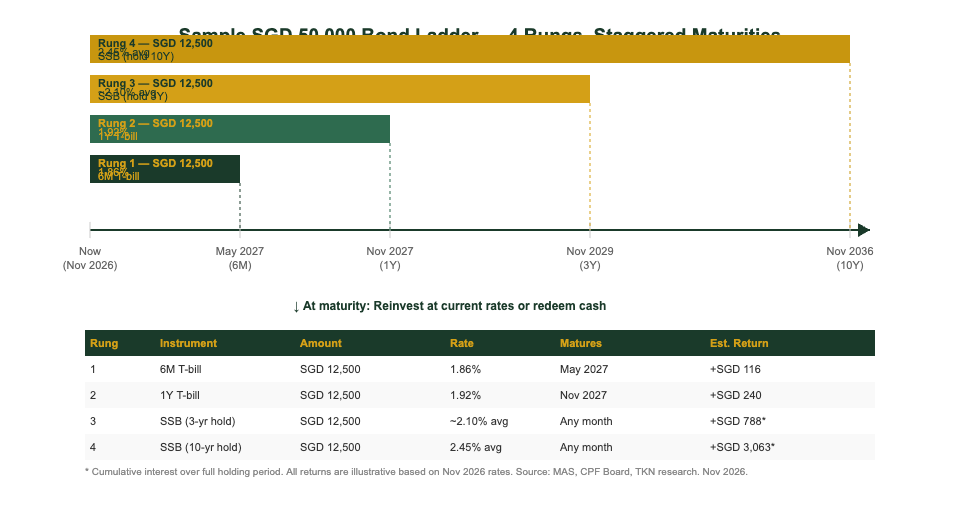
Here is how a Singapore investor might structure a SGD 50,000 bond ladder using T-bills and SSBs at November 2026 rates. Each rung holds SGD 12,500:
| Rung | Instrument | Rate | Matures | Est. Interest |
|---|---|---|---|---|
| 1 | 6M T-bill (Nov 2026) | 1.86% p.a. | May 2027 | ~SGD 116 |
| 2 | 1Y T-bill (Nov 2026) | 1.92% p.a. | Nov 2027 | ~SGD 240 |
| 3 | SSB Nov 2026 (3-yr hold) | ~2.10% avg | Redeem from 2029 | ~SGD 788 over 3 yrs |
| 4 | SSB Nov 2026 (full 10-yr) | 2.45% avg | Nov 2036 (or redeem earlier) | ~SGD 3,063 over 10 yrs |
Source: MAS T-bill auction results (4 Nov 2026); MAS SSB November 2026 issuance. Estimates based on simple interest approximation.
When Rung 1 matures in May 2027, you take the SGD 12,500 (plus interest) and either redeem it for expenses or buy a new 6M or 1Y T-bill — extending the ladder. This is the continuous rotation that gives the bond ladder its name.
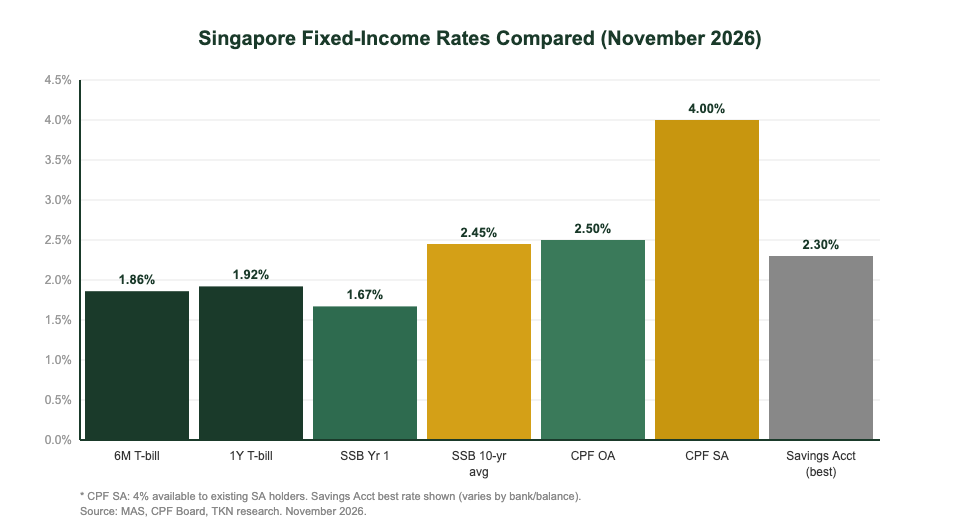
The SSB rungs (3 and 4) function differently: because SSBs allow early redemption at any month (with no penalty), you are not locked in. But the longer you hold, the higher the effective rate. The SSB step-up structure rewards patience — the 10-year average of 2.45% is meaningfully higher than the Year 1 rate of 1.67%.
Singapore’s Building Blocks: T-Bills and SSBs Explained
To build a bond ladder in Singapore, you need to understand your two primary instruments and how they fit together.
Singapore T-Bills: The Short Rung
T-bills are issued by the Singapore Government via the Monetary Authority of Singapore (MAS) and are available in two tenors: 6-month and 1-year. At the 4 November 2026 auction, the 6-month T-bill cut-off yield was 1.86% per annum, and the 1-year T-bill was yielding approximately 1.92% per annum.
T-bills are sold at a discount — you pay less than face value and receive the full face value at maturity. For example, to receive SGD 10,000 at a 6M T-bill yield of 1.86%, you would pay approximately SGD 9,907 at auction. The minimum application is SGD 1,000 (in multiples of SGD 1,000), and you can apply via DBS, OCBC, or UOB internet banking (using CPF OA or cash), or through the SGS website. See our detailed Singapore T-bills 2026 guide for step-by-step application instructions.
T-bills are ideal for the short rungs of your ladder: they provide certainty over 6–12 months and roll over frequently, giving you regular opportunities to reinvest or redirect capital.
Singapore Savings Bonds: The Long Rung
SSBs are also issued by the Singapore Government and offer a fixed, step-up interest rate for up to 10 years. The November 2026 SSB pays 1.67% in Year 1 and averages 2.45% over the full 10-year holding period. The longer you hold, the higher your effective return.
What makes SSBs uniquely valuable for a bond ladder is their redemption flexibility: you can redeem at any month, receiving your full principal plus accrued interest, with no early exit penalty. This means your SSB rungs are never truly illiquid — but the financial incentive is to hold them as long as possible to earn the higher step-up rates. The minimum investment is SGD 500, and the individual limit is SGD 200,000 total across all SSBs. Applications close every month around the 25th — check our Singapore Savings Bonds guide for the current issuance calendar.
For the long rungs of your ladder, SSBs are ideal: they lock in a known rate for years, reducing your exposure to reinvestment risk as short-term rates fall.
How CPF and SRS Fit In
Your CPF Ordinary Account (OA) already earns a guaranteed 2.5% per annum — currently above both the 6M T-bill (1.86%) and SSB Year 1 (1.67%). This means your CPF OA is effectively the foundation of your fixed-income ladder for funds you have in CPF. For funds you want to invest actively, T-bills and SSBs are the natural complements. See our CPF investment strategy guide for the full CPF ladder logic.
If you have a Supplementary Retirement Scheme (SRS) account, SSBs purchased with SRS funds earn the same rates tax-deferred — a useful combination for retirement planning. SRS contributions are capped at SGD 15,300 per year for Singapore citizens and PRs.
Bond Ladder vs Savings Accounts vs CPF: Side-by-Side
Many Singapore investors default to high-yield savings accounts for their fixed-income allocation. Here is how the options compare at November 2026 rates. Note that savings account rates are promotional and subject to change without notice, while T-bill and SSB rates are locked in at the time of application.
| Option | Rate | Term | Liquidity | Rate Risk | Min. Amount |
|---|---|---|---|---|---|
| 6M T-bill | 1.86% p.a. | 6 months | Liquid at maturity | High (reinvestment) | SGD 1,000 |
| 1Y T-bill | 1.92% p.a. | 1 year | Liquid at maturity | Medium | SGD 1,000 |
| SSB (hold to 10Y) | 2.45% avg | Up to 10 years | Redeem any month | None (rate locked) | SGD 500 |
| CPF OA | 2.5% p.a. | Indefinite | Restricted (CPF purposes) | Low (legislated floor) | N/A |
| High-yield savings | Up to 2.3% | None (variable) | Fully liquid | High (rate can change) | None |
Source: MAS (T-bill auction 4 Nov 2026), MAS (SSB November 2026 issuance), CPF Board (OA rate confirmed unchanged Jul–Sep 2026). Savings account rate is indicative maximum for qualifying balances as at November 2026.
The key takeaway: a savings account gives you full liquidity but zero rate certainty. T-bills give you certainty for 6–12 months. SSBs give you certainty for up to 10 years — and earn more the longer you hold. A ladder combines all three advantages. For a comparison of the bond ladder approach against endowment plans, see our endowment plan vs bond ladder comparison.
How to Build Your First Bond Ladder in Singapore (Step-by-Step)
Step 1: Decide Your Total Allocation and Number of Rungs
Start by deciding how much of your savings you want in a “predictable income” allocation — typically separate from your emergency fund (keep 3–6 months of expenses in a savings account) and your growth portfolio (equities, REITs, etc.). A bond ladder works best with SGD 20,000 or more, so each rung is meaningful in size. Four to six rungs is a good starting point.
Use our Singapore retirement calculator to estimate how much fixed-income income you will need by your target date, then work backwards to size your ladder.
Step 2: Assign Rungs to Short and Long Instruments
A practical split for November 2026: allocate roughly half to T-bills (for liquidity and regular rollover) and half to SSBs (for locking in higher long-term rates).
- T-bill rungs (short): Apply at the next auction (19 November 2026 for 6M; 1Y auctions are monthly). Set calendar reminders for each maturity date.
- SSB rungs (long): Apply before the 25th of each month for the following month’s issuance. Consider spreading SSB purchases across 2–3 months to slightly diversify your rate-lock dates.
Step 3: Apply via Internet Banking or ATM
For T-bills: Apply via DBS/POSB iBanking, OCBC iBanking, or UOB iBanking by 9pm on the closing date. You can use cash (from your bank account) or CPF OA funds. The minimum is SGD 1,000 per application.
For SSBs: Apply via DBS/POSB ATM, internet banking, or the SGS website (using SingPass). You can also apply using SRS funds via DBS, OCBC, or UOB SRS accounts. The minimum is SGD 500 per application, and the monthly application window typically closes around the 25th.
For hands-off investors who prefer a managed fixed-income portfolio, platforms like Endowus (referral code 2V343) or Syfe Cash+ (referral code SRPRFFFCD) offer an alternative investing in short-duration bond funds with daily liquidity.
Step 4: Track Maturity Dates and Rotate
When a T-bill rung matures, you have a decision: redeem the cash (if you need it) or reinvest it at the top of the ladder. If rates have risen, your reinvestment buys you more income. If rates have fallen, your SSB rungs are protecting you with their locked-in higher rates.
For SSBs, you generally do not need to do anything — interest is paid directly to your bank account every six months. The principal stays invested unless you actively request a redemption through the same bank that processed your original application.
Step 5: Review Annually
Once a year, review whether your ladder allocation still fits your financial goals. As rates fall and your SSB rungs become more valuable (relative to new T-bills), you may choose to shift a larger share of new capital into SSBs. As your circumstances change — approaching retirement, funding a property, changing income — adjust the number of rungs and the total allocation accordingly.
Disclaimer: Bond ladders using Singapore T-bills and SSBs provide capital protection and predictable returns, but carry opportunity costs relative to higher-risk instruments. All rates cited are correct as at 14 November 2026 and subject to change at subsequent auctions. This article is for educational purposes and does not constitute financial advice.
Frequently Asked Questions
What is a bond ladder and how does it work for Singapore investors?
A bond ladder is a fixed-income investment strategy where you divide your capital across multiple government instruments with different maturity dates — creating a “ladder” of rungs. As each rung matures, you either redeem the cash or reinvest it at the top of the ladder. For Singapore investors, T-bills (6-month and 1-year) form the short rungs and SSBs (up to 10 years) form the long rungs. Both instruments are backed by the Singapore Government and are tax-free for individual investors.
Is a bond ladder with T-bills and SSBs safe in Singapore?
Yes — both Singapore T-bills and Singapore Savings Bonds are issued and guaranteed by the Singapore Government, backed by the full faith and credit of one of the world’s strongest AAA-rated sovereigns. There is effectively zero credit risk. Your capital is fully protected, and you receive the stated interest at maturity (T-bills) or twice yearly (SSBs). The main risk is opportunity cost — if inflation rises sharply above your locked-in rate, your real return decreases.
What is the current T-bill yield in Singapore (November 2026)?
At the 4 November 2026 auction, the 6-month Singapore T-bill cut-off yield was 1.86% per annum, and the 1-year T-bill was yielding approximately 1.92% per annum. The next 6-month T-bill auction is on 19 November 2026. Rates are set by competitive bidding and change with each auction — the trend since late 2024 has been downward as global interest rates ease.
How do Singapore Savings Bonds (SSBs) compare to T-bills for a bond ladder?
T-bills and SSBs serve different rungs in your ladder. T-bills are short (6M or 1Y), highly liquid (can be sold on the secondary market), and roll over frequently — good for the short rungs where you want regular access to capital. SSBs are long (up to 10 years), offer step-up rates (the November 2026 SSB averages 2.45% over 10 years, vs 1.67% in Year 1), and allow free early redemption at any month — good for the long rungs where you want to lock in higher rates. Used together, they create a balanced ladder that is both liquid and rate-protected.
Can I build a bond ladder using my CPF or SRS funds?
Yes, with important distinctions. CPF OA funds can be used to apply for T-bills, though you should compare carefully: CPF OA earns a guaranteed 2.5% per annum — currently higher than the 6M T-bill rate of 1.86%. Unless T-bill yields rise above 2.5%, there is little financial incentive to shift CPF OA funds into T-bills. CPF OA funds cannot be used for SSBs. For SRS funds, you can purchase SSBs through your SRS account (via DBS, OCBC, or UOB), which lets you lock in SSB rates tax-deferred within the annual SRS contribution cap of SGD 15,300 for citizens and PRs.
How much money do I need to start a bond ladder in Singapore?
The minimum investments are SGD 1,000 for a T-bill application and SGD 500 for an SSB application, so technically you could start with as little as SGD 1,500. In practice, a meaningful 4-rung ladder makes more sense with SGD 20,000–SGD 50,000, so each rung generates noticeable income. At SGD 50,000 split across 4 equal rungs at November 2026 rates, you would earn approximately SGD 975–SGD 1,250 per year in combined interest — equivalent to a blended yield of roughly 1.95%–2.50% p.a. — with no credit risk and capital fully guaranteed.
Ready to Build Your Bond Ladder?
T-bills and SSBs form the foundation — but for a managed, hands-off fixed-income approach, these platforms can help.
This article was researched with the help of AI. While we strive to keep all information accurate and up to date, there may be errors. If you notice any discrepancies, please contact us.