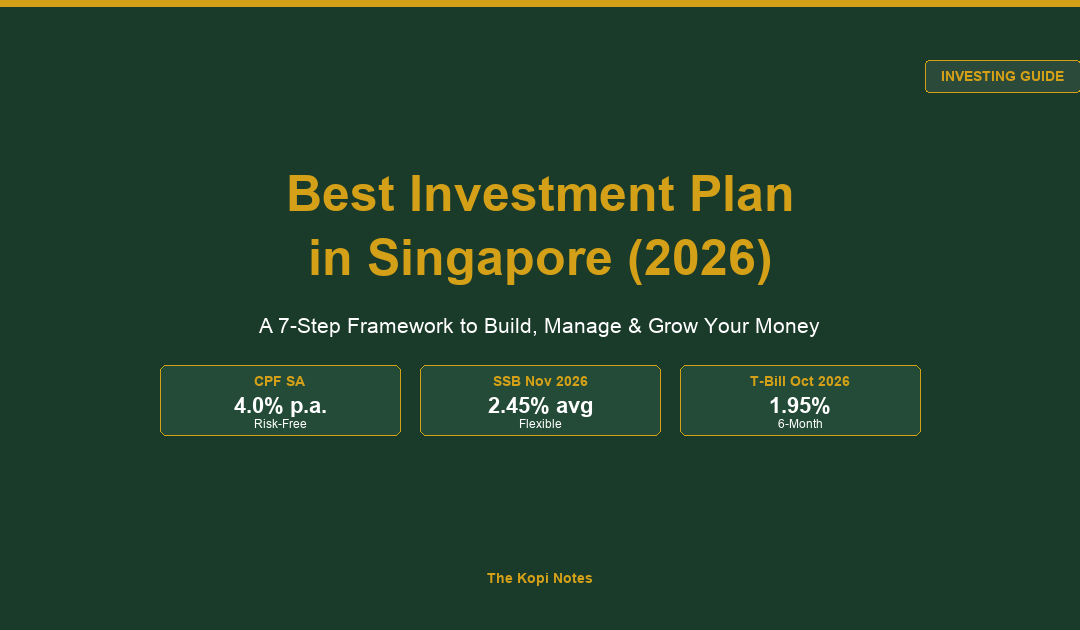
How to Build the Best Investment Plan in Singapore (2026): A 7-Step Framework
Building the best investment plan in Singapore starts with one rule: use the government-guaranteed high rates first. That means maximising CPF SA top-ups (4% guaranteed) and SRS contributions (up to $15,300/year with tax relief) before putting cash into the market. After those buckets are full, a low-cost global ETF through IBKR or FSMOne handles long-term growth. This 7-step framework walks you through the entire process.
Not financial advice. All figures are for educational reference only. Data verified as at November 2026 unless noted.
What This Guide Covers
- Why Most Singaporeans Invest Without a Plan (And Why That’s Costly)
- Step 1: Eliminate High-Interest Debt First
- Step 2: Build Your Emergency Fund in SSBs
- Step 3: Maximise CPF SA and SRS Before Investing Outside
- Step 4: Set Clear Goals by Time Horizon
- Step 5: Understand Your Risk Tolerance
- Step 6: Choose Investment Vehicles by Goal
- Step 7: Pick Your Platform and Automate
- Sample Investment Plans by Life Stage
- Common Mistakes to Avoid
- Frequently Asked Questions
Why Most Singaporeans Invest Without a Plan (And Why That’s Costly)
A survey by the MAS Financial Capability Research found that fewer than 40% of Singapore residents have a written financial plan. The majority make investment decisions reactively — buying when markets are rising, selling when they fall, and skipping the structured accounts (CPF SA, SRS) that offer the most valuable guaranteed returns in the country.
The cost is significant. Consider two 35-year-old Singaporeans with the same $50,000 to invest:
- Person A invests without a plan: puts $50,000 into a managed unit trust with a 1.5% annual fee. After 20 years at a 7% gross return, they have approximately $168,000.
- Person B follows the 7-step framework: tops up CPF SA ($8,000, earning 4% tax-free) + SRS ($15,300, reducing tax by ~$3,000+) + invests the remaining $26,700 in a low-cost global ETF at 0.07% TER. After 20 years, Person B has approximately $198,000 — plus they saved $3,000+ in taxes each year from SRS contributions.
The difference isn’t skill or timing — it’s knowing the sequence. Singapore’s investment planning framework is unique because of CPF and SRS. If you don’t use them in the right order, you’re leaving guaranteed high returns unclaimed.
Use the Singapore retirement calculator to see how different allocation choices affect your projected retirement income.
Step 1: Eliminate High-Interest Debt First
No investment plan in Singapore — or anywhere — makes sense while you are carrying high-interest debt. Credit card interest in Singapore runs at 25–28% per annum. No investment reliably returns more than that net of risk. Any “investment” you make while carrying a credit card balance is effectively a loan at 25–28% to fund your portfolio.
What counts as high-interest debt:
- Credit card balances (25–28% p.a.) → pay off in full every month, without exception
- Personal loans above 10% p.a. → prioritise paydown before investing
- Buy-now-pay-later (BNPL) facilities with instalment fees → these are often 24–30% annualised
What counts as acceptable debt while investing:
- HDB home loans (currently ~2.60% p.a.) — lower than CPF SA’s 4%, so it makes sense to invest simultaneously
- Bank home loans (variable, typically 3–4%) — borderline; evaluate case by case
- Student loans at below 4% — same logic as HDB; can invest alongside repayment
The practical test: if your borrowing rate is lower than what CPF SA earns (4%), you can invest in CPF SA while servicing that debt. If your borrowing rate is higher, pay off debt first.
Step 2: Build Your Emergency Fund in SSBs
Your emergency fund should cover 3–6 months of essential expenses — typically $10,000–$30,000 for most Singapore households. The mistake most people make is leaving this in a savings account earning 0.05–0.5% when Singapore Savings Bonds (SSBs) offer 2.45% (November 2026 10-year average) with full flexibility: you can redeem SSBs every month with no penalty and receive full accrued interest.
Why SSBs are the perfect emergency fund vehicle:
- Fully redeemable with one month’s notice — apply for redemption by the 25th of the month, receive funds by the 2nd of the following month
- Government-guaranteed — issued by the Singapore Government, zero credit risk
- No transaction costs — no brokerage fees, no early redemption penalties
- Up to $200,000 per individual — covers any realistic emergency fund size
- Step-up interest — the first year yields around 2.3–2.5%, rising each year if you hold longer
Apply via DBS/POSB, OCBC, or UOB internet banking before the 25th of each month. The minimum is $500. Set a reminder to check the monthly SSB interest rate and apply if the rate is attractive relative to your bank’s current savings offers.
Read the full application walkthrough in the Singapore T-bills 2026 guide (the SSB and T-bill application processes are very similar).
Step 3: Maximise CPF SA and SRS Before Investing Outside
This is the most underused step in Singapore investment planning. Before you open a brokerage account and buy ETFs, there are two government-backed accounts that offer extraordinary returns for the same effective risk level — and most people are not using them to their full potential.
CPF Special Account (SA) Cash Top-Ups
The CPF SA earns 4.0% p.a. guaranteed (floor extended through 31 December 2027, confirmed by CPF Board). The first $60,000 across all CPF accounts earns an additional 1% extra interest, so the first dollars in your SA effectively earn 5%. You can make voluntary cash top-ups to your own SA under the Retirement Sum Topping-Up (RSTU) scheme and receive up to $8,000 in tax relief per year (combined with top-ups for family members).
If your marginal tax rate is 15%, an $8,000 SA top-up saves you $1,200 in tax immediately — that’s an instant 15% return before the 4% interest starts compounding. The full CPF investment strategy Singapore guide covers all the angles including CPFIS-OA and the CPF investment scheme.
Supplementary Retirement Scheme (SRS)
SRS is a voluntary account offered by DBS, OCBC, and UOB specifically for retirement savings with a tax incentive. Singapore Citizens and PRs can contribute up to $15,300 per year. Each dollar contributed reduces your chargeable income by $1. If you’re in the 15% tax bracket, $15,300 saves you $2,295 in tax immediately.
Withdrawals at or after retirement age are taxed at 50% of the amount withdrawn — so if you withdraw $40,000, you pay tax on $20,000. With a low withdrawal rate and the standard tax relief, most retirees pay very little or no tax on SRS withdrawals.
Your SRS funds don’t have to sit in cash. You can invest them in approved products including ETFs, REITs, unit trusts, and endowment plans via platforms like Endowus (referral code: 2V343) which offers a flat 0.40% platform fee for SRS investing into globally diversified portfolios. Endowus manages both CPF OA and SRS funds, making it one of the cleanest ways to invest both government-backed pools in one place.
The sequence before opening a brokerage account:
- Top up SA with the annual $8,000 allowable top-up for tax relief
- Open an SRS account and contribute up to $15,300 annually
- Invest SRS funds into a diversified portfolio (not leaving them as cash)
- Only then open a cash brokerage for additional cash investments
Step 4: Set Clear Investment Goals by Time Horizon
Every investment decision flows from one question: when do you need this money? The Singapore investment landscape has clean, well-defined products for every time horizon, and matching them correctly is what separates an effective plan from a random collection of products.
| Goal | Time Horizon | Best Vehicle | Expected Return |
|---|---|---|---|
| Emergency fund | Immediate to 1 year | SSBs + High-yield savings | 2.45% (SSB, Nov 2026) |
| House down payment (1–5 years) | 1–5 years | T-bills + SSBs | 1.95–2.45% |
| Children’s education (10–15 years) | 10–15 years | STI ETF + Endowment | 4–7% p.a. historical |
| Retirement (20+ years) | 20+ years | CPF SA + SRS + Global ETF | 4–10% (blended) |
| Passive income (ongoing) | 5+ years | S-REITs via SGX or Syfe | ~5–6% distribution yield |
Source: MAS (T-bill Oct 22 2026), CPF Board, SGS.gov.sg (SSB Nov 2026). Historical ETF/REIT returns are indicative, not guaranteed.
One common mistake in Singapore is mixing time horizons. Never put money in an equity ETF or REIT that you might need within 3 years. Markets can and do fall 30–50% over a 1–2 year period (the STI fell 40% in the 2008–2009 financial crisis). The guaranteed buckets (CPF, SSBs, T-bills) exist precisely for money you can’t afford to see fall in value.
Step 5: Understand Your Risk Tolerance
Risk tolerance has two dimensions that most people conflate: emotional tolerance (how well you sleep when your portfolio drops 20%) and financial capacity (whether a 20% drop would actually damage your financial situation). Your plan needs to satisfy both.
Emotional Risk Tolerance
Ask yourself honestly: if your portfolio dropped 30% over 6 months, would you:
- (A) Sleep fine — you understand market cycles and would see it as a buying opportunity
- (B) Feel uncomfortable — you’d be anxious but stick to the plan
- (C) Panic-sell — you’d move to cash to stop the bleeding
If your honest answer is (C), a 100% equity portfolio is not right for you — not because you’re wrong, but because a plan you will abandon in a downturn is worse than a lower-returning plan you will stick to. A 60/40 split (60% equities, 40% SSBs/CPF) with a lower average return but consistent behaviour will outperform a 100% equity portfolio that you liquidate at the bottom.
Financial Risk Capacity
Even if you’re emotionally comfortable with volatility, ask: can you afford a 30% drawdown without selling? This requires:
- At least 3–6 months’ expenses sitting outside the investment portfolio (emergency fund — Step 2)
- No near-term large expenses (house down payment, medical, school fees) in the next 3 years that you’ve allocated to equities
- Stable employment income that continues to cover living expenses even if the portfolio falls
If you’re close to retirement, your capacity for a drawdown is lower — a 30% fall at age 65 is vastly more damaging than the same fall at age 35, because you have far less time to recover and you may need to liquidate at a loss to fund living expenses.
For passive income Singapore seekers nearing retirement, moving a larger portion into CPF LIFE and dividend-yielding REITs makes sense precisely because those cash flows are more predictable than equity capital gains.
Step 6: Choose Investment Vehicles by Goal
With your goals, time horizon, and risk tolerance defined, here is how the major Singapore investment vehicles map to each situation.
For Guaranteed Returns (Low Risk)
- CPF Voluntary Top-Ups: SA at 4%, OA at 2.5%. Best risk-adjusted return in Singapore for retirement savings. No market risk. Use RSTU for SA top-ups ($8,000/year tax relief) and voluntary CPF contributions for OA (covered under the $37,740 annual CPF contribution ceiling).
- Singapore Savings Bonds (SSBs): 2.45% 10-year average (November 2026 issue). Flexible, government-backed. Best for emergency fund overflow and medium-term savings.
- T-bills: 1.95% (October 22 2026 auction). Best for 6-month cash parking. Apply via bank internet banking or CPF OA.
For Passive Income (Medium Risk)
- S-REITs: Average yield ~5–6% across the SGX REIT index. Zero withholding tax on distributions for Singapore individual investors. Best for investors with 5+ year horizon seeking regular income. Blue-chip options include CapitaLand Integrated Commercial Trust (CICT), Mapletree Industrial Trust, and Frasers Centrepoint Trust. Best S-REITs in Singapore 2026 ranks the top options by yield and stability.
- Syfe Income+ (referral code: SRPRFFFCD): A managed portfolio of bonds and REITs targeting a 5–6% annualised distribution yield. Minimum $1. No brokerage fee. Good for investors who want REIT-like income without picking individual stocks. Syfe referral code and sign-up bonus details are covered in the full review.
For Long-Term Growth (Medium-High Risk, 10+ Years)
- CSPX (S&P 500, TER 0.07%) or VWRA (Global All-World, TER 0.22%): Ireland-domiciled UCITS ETFs listed on the London Stock Exchange. Historical returns of 8–10% p.a. over long periods (not guaranteed). Singapore investors prefer these over US-domiciled ETFs to avoid 30% US dividend withholding tax (reduced to 15% for UCITS) and US estate tax (USD 60,000 threshold for non-residents).
- STI ETF (ES3): SGX-listed ETF tracking the top 30 Singapore companies. Historical return ~7% p.a. including dividends reinvested. Zero withholding tax on Singapore-sourced dividends. Good for investors who want Singapore equity exposure with a local broker and CDP account.
For Robo-Advisor Convenience
| Platform | Annual Fee | CPF/SRS | Min. Amount | Best For |
|---|---|---|---|---|
| Endowus (2V343) | 0.40% CPF/0.30% SRS/0.25% cash | Yes (both CPF OA & SRS) | $1,000 / $100 subsequent | CPF/SRS investors |
| Syfe (SRPRFFFCD) | 0.35% (<$100k) tiered down | SRS only | $1 | REIT+ and Cash portfolios |
| FSMOne (P0544985) | 0.08% RSP / 0.35% platform | SRS only | $50/month RSP | Small regular ETF purchases |
| IBKR (jianxiong368) | ~USD 0.35–1.70/trade | No | No minimum | Lump sum LSE ETF buys >$10k |
Source: Platform websites, November 2026. Fees subject to change. Referral codes valid as at time of publishing.
Step 7: Pick Your Platform and Automate
The best investment plan is one you will actually execute consistently. Automation is the most powerful tool for ensuring that — removing the temptation to market-time, skip a month, or second-guess the strategy during volatility.
Setting Up Automation
- CPF top-ups: Set a standing GIRO from your DBS/OCBC/UOB account to your CPF SA under the RSTU scheme. Automate a monthly or annual contribution up to your $8,000 tax relief cap.
- SRS contributions: Many banks allow automated monthly transfers to your SRS account. Set this up for $1,275/month ($15,300 annually) so you hit the annual cap without a year-end lump sum scramble.
- ETF purchases via RSP: FSMOne’s regular savings plan accepts $50/month minimum and automatically purchases your chosen ETF (e.g., CSPX, ES3) on the 18th of every month. IBKR requires manual orders but their low commissions make lump-sum purchases quarterly cost-effective above $10,000.
- SSB applications: Set a calendar reminder for the 20th of each month to check if the upcoming SSB rate is attractive relative to your savings. The window opens the 1st and closes the 25th.
When Not to Automate
Automation works for systematic investing — regular fixed amounts into broad index products. It is not right for individual stock picking, speculative positions, or leveraged products. If you find yourself wanting to invest in individual REITs, check the fundamentals manually each time rather than automating into a single name.
Tracking Your Progress
Review your plan quarterly, not weekly. Weekly portfolio checking breeds anxiety and encourages the two most common errors: panic-selling on red days and chasing performance on green ones. What to review quarterly:
- Has your emergency fund (SSBs) been drawn down? Replenish first.
- Have you made your CPF SA top-up for the year?
- Have you contributed to SRS for the year?
- Has your asset allocation drifted more than 10 percentage points from target? Rebalance.
- Have there been life changes (new job, new dependent, pay rise) that change your allocation?
Sample Investment Plans by Life Stage
The chart below illustrates how a Singapore investor might allocate their investment budget across different stages of life. These are illustrative frameworks — not personalised advice. Your actual allocation should reflect your specific goals, CPF balance, risk tolerance, and income.
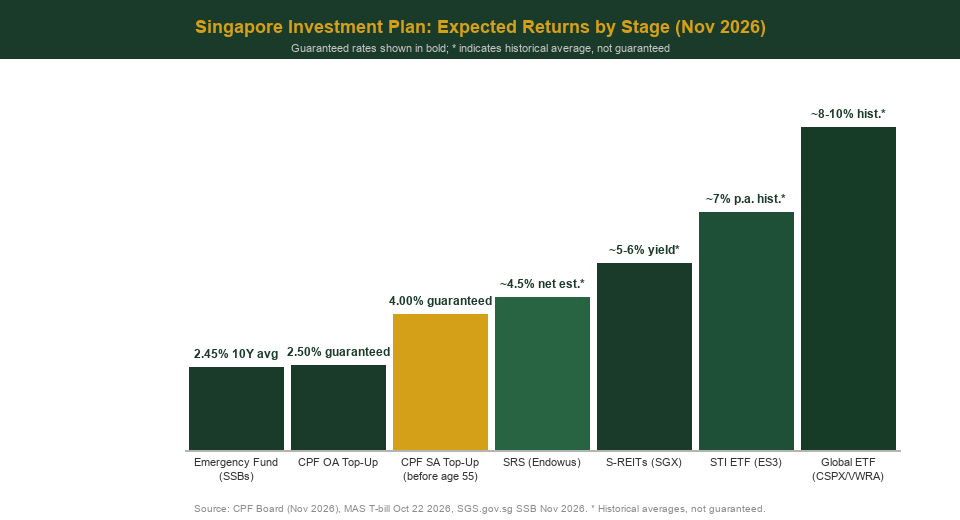
The allocation chart above shows the logical order: start with the guaranteed high-yielding buckets (CPF SA at 4%), then move outward to income-generating assets (REITs at ~5–6%) and finally to long-term growth assets (global ETFs at ~8–10% historical).
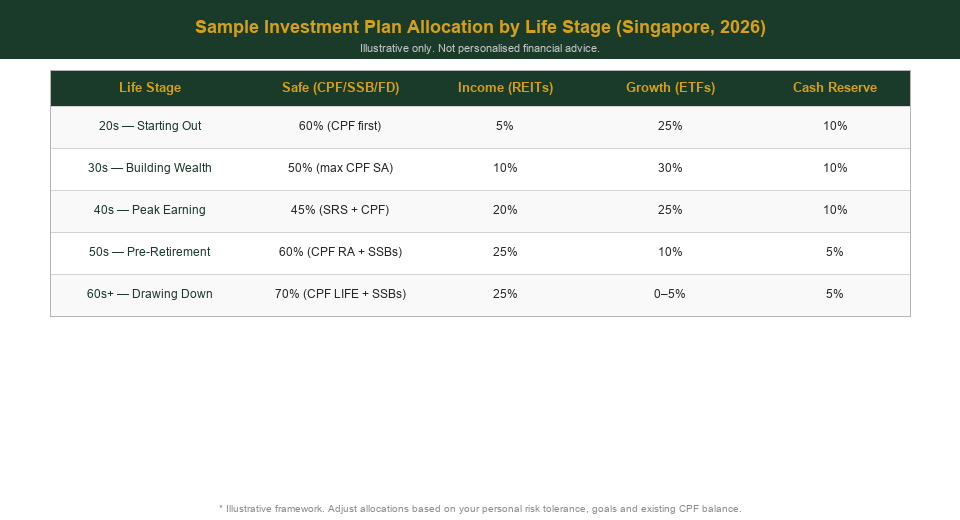
Key observations from the sample allocation table:
- In your 20s, keeping 60% in safe/CPF means you are capturing the guaranteed 4% SA rate from day one while building the habit of risk-taking in a small equity allocation.
- In your 40s, the peak earning years are when SRS contributions become most valuable — higher income means higher marginal tax rates and therefore bigger tax savings from each SRS dollar.
- By your 50s and 60s, shifting the equity allocation toward REITs and CPF LIFE provides predictable income streams that do not require selling assets during volatile markets.
Your actual target numbers depend on your retirement income goal. The Singapore retirement calculator can run this calculation with your specific numbers.
Common Mistakes to Avoid in Your Singapore Investment Plan
Mistake 1: Skipping CPF and SRS to invest “in the market” first
The 4% guaranteed CPF SA return is better than the return on many equity portfolios after fees and risk adjustment. SRS contributions save you tax immediately. These should be exhausted first.
Mistake 2: Leaving emergency fund in savings accounts
SSBs earn 2.45% with the same effective liquidity as a savings account for most practical purposes. There is almost no reason to keep more than 1 month’s expenses in a standard bank savings account.
Mistake 3: Investing for a 2-year goal in equities
If you plan to use the money for a house down payment in 24 months, it should be in T-bills or SSBs — not in REITs or ETFs. Market timing is unpredictable; your house purchase date is not.
Mistake 4: Chasing yield in high-fee products
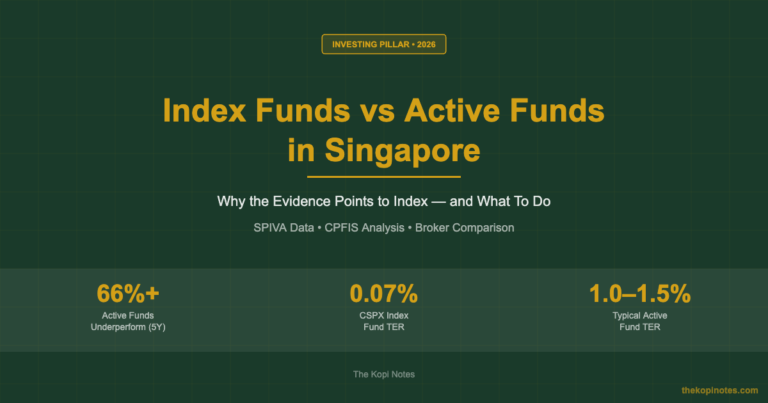
Investment-linked policies (ILPs) and high-fee managed funds often promise strong returns but charge 1.5–2.5% annually in combined fees. At that fee level, you need to outperform the market by 1.5–2.5% every year just to break even with a low-cost index ETF. Historically, almost no actively managed fund does this consistently.
Mistake 5: Not rebalancing
After a strong equity bull market, your 60/40 portfolio may have drifted to 80/20. Without rebalancing, you have more risk than you planned for — and when the correction comes, the drawdown will exceed what your plan was designed for. Review and rebalance once a year or when any asset class drifts more than 10 percentage points from target.
Frequently Asked Questions
What is the best investment plan for a 30-year-old in Singapore?
At 30, the best investment plan in Singapore follows this order: (1) Max out CPF SA voluntary top-ups ($8,000/year, earns 4% guaranteed with tax relief), (2) Open an SRS account and contribute up to $15,300/year for tax savings, (3) Invest SRS in a low-cost global ETF via Endowus or Syfe, (4) Build a 3-6 month emergency fund in SSBs (2.45%, flexible), (5) Invest remaining cash savings in CSPX or VWRA via IBKR for long-term growth. At 30 with 30+ years to retirement, equities form the natural core of a growth-oriented plan.
How much money do I need to start an investment plan in Singapore?
You can start with as little as $500 for a Singapore Savings Bond (SSB) as your emergency fund, $50/month via FSMOne’s regular savings plan for ETF exposure, and a $0 upfront CPF SA top-up if you automate a monthly contribution. There is no minimum to open an SRS account, and you can contribute any amount up to $15,300/year. The important thing is starting with the right sequence, not waiting until you have a large lump sum.
Is robo-advisor better than DIY ETF investing in Singapore?
It depends on your situation. Robo-advisors like Endowus and Syfe add convenience and automatic rebalancing, but charge an additional platform fee (0.30–0.40% p.a.) on top of the underlying ETF’s expense ratio. For CPF OA and SRS funds, Endowus is often worth the platform fee since it is one of the very few platforms that handles CPF OA investing cleanly. For pure cash investing, DIY via IBKR with CSPX or VWRA (combined ~0.07–0.22% TER, plus about USD 1 per trade) is cheaper over the long term for lump sums above $10,000.
How do I include CPF in my investment plan?
Treat CPF as the foundation of your Singapore investment plan, not an afterthought. Specifically: (1) Your CPF SA earns 4% guaranteed — this is better than most bonds on a risk-adjusted basis; never cash out your SA unless you are legally required to for housing or medical. (2) Make voluntary SA top-ups under the RSTU scheme — up to $8,000/year of cash top-ups qualify for personal tax relief. (3) Consider investing CPF OA in CPFIS-approved products only after the minimum $20,000 set-aside, and only in low-cost funds (avoid high-fee unit trusts within CPFIS). (4) At 55, maximise the Enhanced Retirement Sum (ERS) in your RA to get the highest CPF LIFE payout.
What is SRS and should I open an account?
SRS (Supplementary Retirement Scheme) is a voluntary account for Singapore Citizens, PRs, and certain pass holders that allows you to contribute up to $15,300/year (citizens/PRs) with every dollar reducing your taxable income. If your marginal tax rate is 15%, $15,300 saves you $2,295 in tax immediately. Withdrawals at retirement age are taxed at 50% of the amount drawn — meaning even a $40,000/year SRS withdrawal results in just $20,000 of taxable income, which is below the basic tax rate for most retirees. Opening an SRS account is recommended for any working Singaporean or PR earning above $40,000 per year (the threshold where tax savings become meaningful).
How often should I review my investment plan?
Review your Singapore investment plan quarterly — not weekly or daily. The key quarterly checkpoints are: (1) Has your emergency fund been used? Replenish SSBs first. (2) Have you made your annual CPF SA top-up? (3) Have you contributed to SRS for the year? (4) Has your allocation drifted more than 10 percentage points from target? (5) Any major life changes — new child, new job, house purchase — that change your time horizon or risk capacity? Beyond these quarterly checks, your investment plan should largely run on autopilot via automated contributions.
Start Your Investment Plan Today
Open an account through our referral links for sign-up bonuses and fee waivers on the platforms in this guide.
This article was researched with the help of AI. While we strive to keep all information accurate and up to date, there may be errors. If you notice any discrepancies, please contact us.