Critical Illness Insurance for Seniors in Singapore 2026: Is It Worth It After 60?
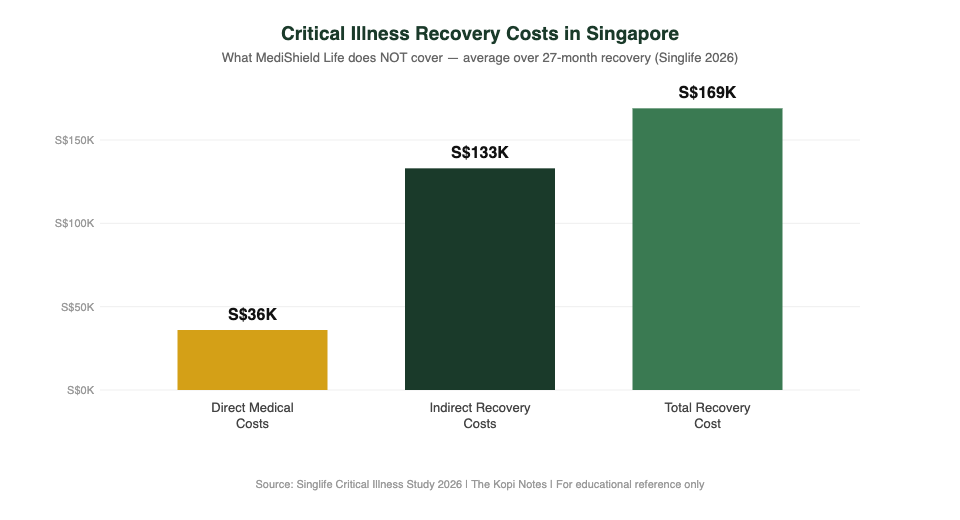
Critical illness insurance for seniors in Singapore is still available after 60, though premiums rise sharply and most new plan applications are capped around age 65. If you already hold a CI policy, you can typically renew into retirement. For retirees, CI cover shifts from income replacement to protecting savings against recovery costs — which Singlife’s 2026 study estimates at up to S$169,000 over a 27-month average recovery period, well beyond what MediShield Life covers.
Not financial advice. All figures are for educational reference only. Data verified as at November 2026 unless noted.
Why Seniors Still Need Critical Illness Insurance
Many Singaporeans assume that once they retire and no longer earn an income, critical illness insurance becomes unnecessary. This is a costly misconception. MediShield Life covers hospitalisation and selected outpatient treatments — it does not pay for the months of recovery at home, the professional caregiver you hire, or the home modifications needed after a stroke.
According to Singlife’s Critical Illness Study 2026, the total cost of a critical illness recovery in Singapore can reach S$169,000. This breaks down into roughly S$36,000 in direct out-of-pocket medical expenses and an additional S$133,000 in indirect costs — caregiver fees, home modifications, and other non-hospitalisation expenses over a 27-month average recovery period.
For a retiree, the concern is not income replacement but preservation of retirement savings. A single health event can drain CPF Life payouts, liquidate investment assets, and leave a family financially exposed.
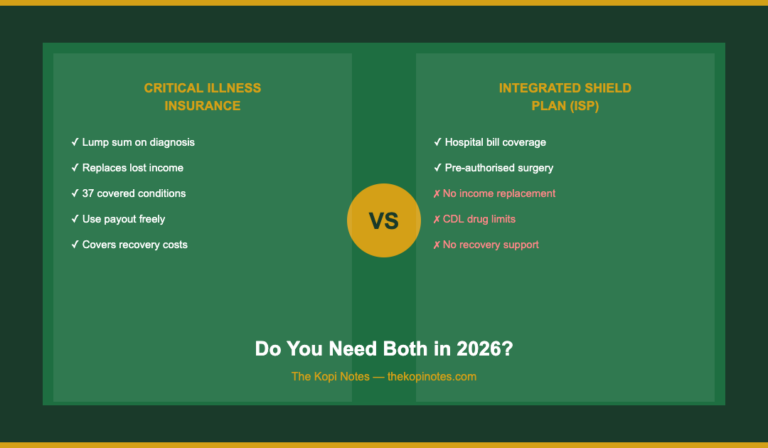
What MediShield Life Covers vs What CI Insurance Covers
| Expense Type | MediShield Life | CI Insurance (Lump Sum) |
|---|---|---|
| Hospital stay & surgery | Yes (B2/C ward subsidy) | Covered from lump sum |
| Chemo / radiotherapy | Partial (limits apply) | Covered from lump sum |
| Home recovery & caregiver costs | Not covered | From lump sum payout |
| Home modifications post-stroke | Not covered | From lump sum payout |
| Complementary / alternative treatment | Not covered | Policyholder’s discretion |
Source: CPF Board, MAS; The Kopi Notes analysis, November 2026.
The Reality of Getting CI After 60
If you do not currently hold a CI policy and are approaching or past 60, your options narrow — but they do not disappear entirely.
Entry Age Limits
Most standalone critical illness plans in Singapore set a maximum new application age around 60 to 65. This is a commercial decision by insurers, not a regulatory requirement from MAS or the LIA. Some newer products extend further. AIA’s Protect 3 plan, launched in May 2026, offers coverage up to age 85 and positions itself specifically for retirement-age applicants.
Underwriting Gets Stricter
Even within the entry age window, underwriting at 60+ typically involves a more detailed medical questionnaire. Pre-existing conditions such as hypertension, elevated cholesterol, or Type 2 diabetes — common among Singaporeans in their sixties — may lead to exclusions, premium loadings, or outright declines.
Premiums Rise Sharply With Age
Critical illness premiums are structured to reflect your age and health risk. A 40-year-old non-smoker male paying around S$150 per month for S$300,000 CI coverage may see the equivalent coverage cost two to four times more at age 60. If you purchased CI in your thirties and forties, your most cost-effective move is to maintain that policy through retirement rather than lapsing and reapplying later.
| Age at Application | Relative Premium Cost | Underwriting | Plan Availability |
|---|---|---|---|
| 30 to 40 | Low (baseline) | Standard | All plans available |
| 40 to 55 | Medium (1.5–2x) | Standard + blood test | Most plans available |
| 55 to 65 | High (2.5–4x) | Medical check required | Select plans only |
| 65 to 75 | Very high (4–6x) | Full medical underwriting | Very limited options |
Source: Industry indicative ranges. Actual premiums vary by insurer, sum assured, and health history. November 2026.
How Much CI Coverage Do Seniors Actually Need?
The standard rule of thumb for working adults — 3.9 to 5 times annual income — does not apply to retirees. If you are no longer drawing a salary, there is no income to replace. The right coverage amount for a senior Singaporean is calibrated around recovery costs and lifestyle protection.
The Recovery Cost Benchmark
Singlife’s 2026 Critical Illness Study found that the cumulative cost of treatment and recovery averages around S$169,000 in Singapore. For a retiree, a sum assured of S$150,000 to S$200,000 gives a reasonable buffer to cover this recovery window without touching CPF Life payouts or liquidating investment assets during a vulnerable period.
To model how different CI coverage amounts affect your retirement planning, the Singapore retirement calculator can help you stress-test different scenarios against projected CPF and investment income.
| Retirement Profile | Suggested CI Sum Assured | Rationale |
|---|---|---|
| HDB flat, CPF Life payout only | S$100,000 to S$150,000 | Cover recovery costs; protect CPF from depletion |
| Private property, mixed income sources | S$150,000 to S$200,000 | Higher lifestyle costs; protect investment portfolio |
| Semi-retired (still earning income) | 2 to 3x remaining annual income plus S$80,000 | Partial income replacement plus recovery buffer |
| Sole breadwinner supporting elderly parents | S$200,000 or more | Own recovery plus dependant support |
Source: The Kopi Notes analysis based on Singlife Critical Illness Study 2026 recovery cost estimates.
Best CI Options for Seniors in Singapore 2026
If you are over 60 and looking to secure or maintain critical illness coverage, here are the main routes available today.
1. Keep Your Existing CI Policy Active
If you bought critical illness insurance in your thirties or forties, the most cost-effective strategy is to maintain it. The original premium you locked in is almost always lower than what a new policy at 60+ would cost. Even if the coverage amount now exceeds your retirement needs, maintaining the policy means you do not have to pass through medical underwriting again.
2. AIA Protect 3 (Launched May 2026)
AIA’s Protect 3 is one of the few plans in Singapore with entry ages extending well past 60, offering coverage up to age 85. Its starting premium is approximately S$0.56 per day for a young non-smoker with S$100,000 coverage, though premiums for a 60-year-old will be considerably higher. The plan includes a 25% cashback on premiums from age 65 or 15 years after entry, whichever is later. Consult an AIA adviser for personalised quotes.
3. Whole Life Policies with CI Rider
If you hold a whole life policy, check whether it has an attached CI rider. These riders typically cover the LIA’s 37 standard critical illness conditions and may already provide meaningful protection — reviewing them before purchasing additional standalone CI cover can avoid duplication. For a full comparison of how CI riders and standalone plans differ, see our guide to CI insurance versus health insurance in Singapore.
4. Direct Purchase Insurance (DPI)
MAS-approved Direct Purchase Insurance products offer CI options with simplified underwriting. Available from participating insurers including Income Insurance and AIA, these plans are bought without a financial adviser. Coverage amounts are generally capped, but they provide a streamlined entry point for older applicants.
Key Considerations When Choosing
Under the LIA Critical Illness Framework (effective October 2025), all standard plans must cover the same 37 defined conditions, ensuring a baseline regardless of insurer. Consider whether you want a multi-pay plan (allows multiple claims across different conditions or stages), which offers broader protection for seniors who face higher cumulative health risk. Also compare whether level premiums (fixed for the policy term) or age-banded premiums (rising annually) better suit your retirement budget.
Buying Critical Illness Insurance for Your Elderly Parents
Many Singaporean adult children are asking: can I buy CI insurance for my parents? Yes — you can be the policy owner and premium payer while a parent is the insured. Timing is critical.
The Golden Window: Before Age 60 to 62
Once a parent crosses 65 and develops chronic conditions common in older Singaporeans — hypertension, elevated cholesterol, diabetes — they may no longer qualify for a new standard CI plan. If your parents are currently between 55 and 62 and in reasonable health, reviewing their CI coverage should be a priority in your financial planning now. If you have already purchased CI for yourself and are evaluating what to do next, our guide on when to buy critical illness insurance in Singapore explains the broader planning framework.
Tax Relief on Premiums
Singapore’s income tax rules allow you to claim relief on insurance premiums paid for a parent under the Insurance Relief scheme, subject to conditions. As of YA 2026, this relief is S$5,000 per year if you do not claim for yourself and your spouse combined. Check the IRAS Life Insurance Relief page for the latest eligibility criteria.
Related Planning Resources
If you are building a comprehensive retirement plan for your parents, our article on how to make a CI insurance claim in Singapore prepares you for the process should it ever arise. For broader passive income strategies to supplement retirement payouts, our passive income Singapore guide covers S-REITs and dividend strategies.
The Verdict: Should You Get CI After 60?
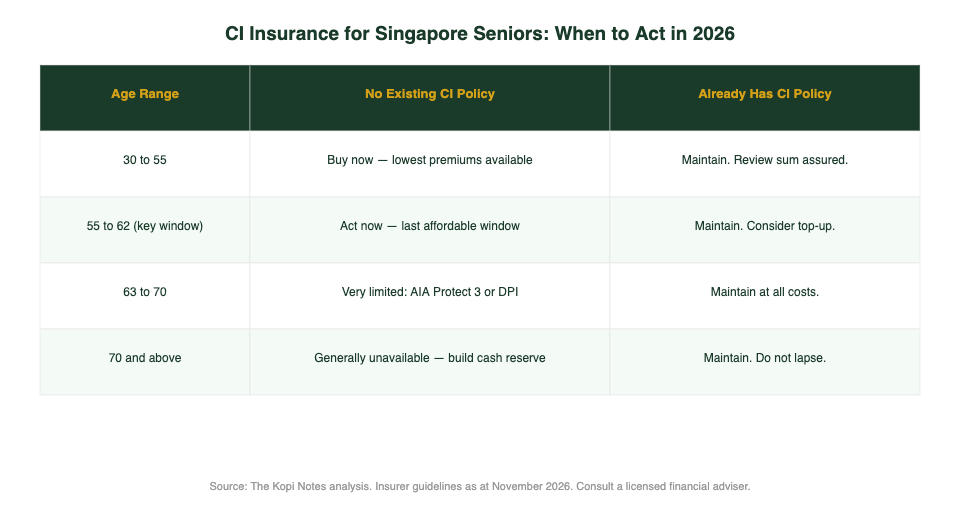
Critical illness insurance after 60 is not a one-size-fits-all decision. The calculus depends on whether you hold an existing policy, your current health status, and your retirement income profile.
| Your Situation | Recommendation |
|---|---|
| You have an existing CI policy | Keep it active. Do not lapse. |
| No CI, aged 55 to 62, in good health | Apply now — this is your window. |
| No CI, aged 63 to 70, good health | Consider AIA Protect 3 or limited DPI options. Compare cost versus self-insuring. |
| Age 70 or above with pre-existing conditions | New CI cover is likely unavailable or prohibitively expensive. Build a dedicated healthcare cash reserve instead. |
| Want CI for elderly parents | Act before they turn 62. Apply while they are still insurable. |
Source: The Kopi Notes analysis based on insurer guidelines and LIA framework, November 2026.
For seniors who already have a policy and want to understand what to do when a claim arises, our step-by-step CI claim guide walks through the full process. If you are still weighing whether CI or health insurance better fills the gap in your protection, see our early-stage versus late-stage CI comparison for how the payout trigger affects coverage value at different health stages.
Frequently Asked Questions
Can I still get critical illness insurance after age 65 in Singapore?
Is critical illness insurance worth it if I am already retired?
Does MediShield Life cover critical illness conditions?
What are the 37 critical illness conditions covered in Singapore?
Can I buy critical illness insurance for my elderly parents in Singapore?
How do CI insurance premiums change with age in Singapore?
This article is for general educational purposes only and does not constitute financial advice. Insurance products mentioned are illustrative only. Always consult a licensed financial adviser before purchasing any insurance product. The Kopi Notes may earn referral fees from links on this page.
Get Free Insurance Advice
Speak with a licensed insurance advisor. No obligation, no cost.
By submitting this form, you agree to our Privacy Policy.
This article was researched with the help of AI. While we strive to keep all information accurate and up to date, there may be errors. If you notice any discrepancies, please contact us.