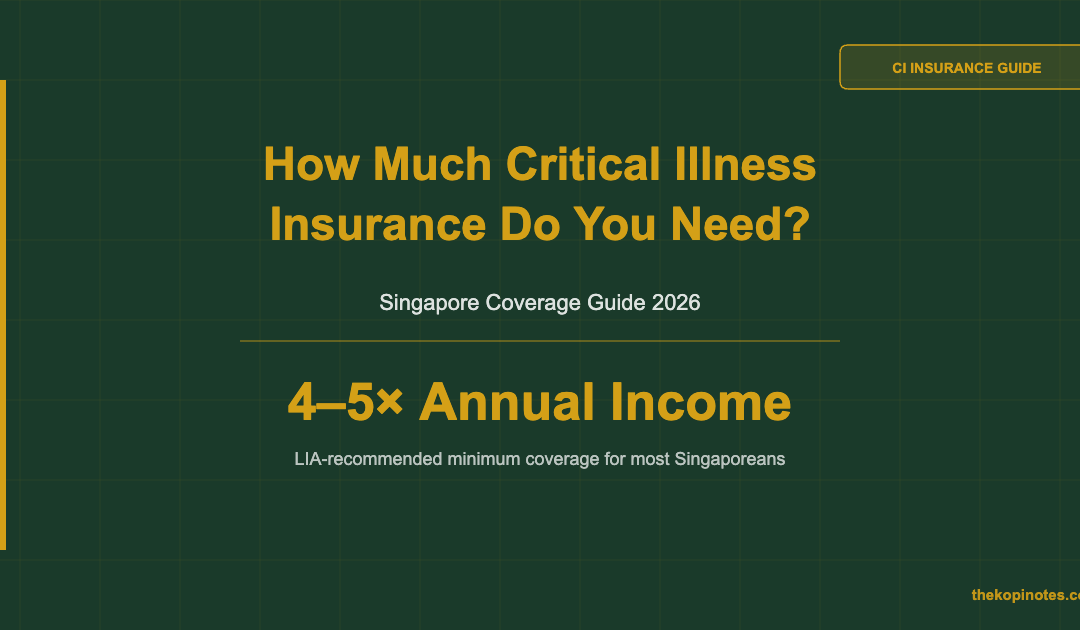
How Much Critical Illness Insurance Do You Need in Singapore? (2026 Guide)
A step-by-step formula to calculate your ideal CI sum assured — income replacement, medical costs, and the LIA framework explained.
Critical illness insurance in Singapore should cover at least 4–5 times your annual income — roughly S$200,000–S$400,000 for most working adults. This lump-sum payout replaces lost income during recovery (typically 3–5 years), funds out-of-pocket medical costs not covered by MediShield Life or your Integrated Shield Plan, and keeps your household financially stable while you focus on getting well. Below is a step-by-step formula to calculate your exact coverage need.
Not financial advice. All figures are for educational reference only. Data verified as at October 2026.
Table of Contents
Contents — Click to expand
What Does Critical Illness Insurance Cover?
Critical illness (CI) insurance pays a tax-free lump sum upon diagnosis of any one of the 37 critical illnesses standardised by the Life Insurance Association Singapore (LIA) under its CI Framework (Version 2024, effective 26 August 2024). This standardisation means every Singapore insurer — AIA, Great Eastern, Prudential, FWD, Singlife, Income, Manulife — uses the same definitions for the same 37 conditions, so you can compare plans on an apples-to-apples basis.
The 37 conditions are grouped into five major categories:
| Category | Key Conditions Covered |
|---|---|
| Cancer | Cancer of specified severity (covering most solid tumours, leukaemia, lymphoma) |
| Heart & Vascular | Heart attack, coronary artery bypass surgery, heart valve surgery, aorta surgery |
| Nervous System | Stroke with permanent neurological deficit, Parkinson’s disease, motor neuron disease, multiple sclerosis |
| Organ Failure | Kidney failure, end-stage lung disease, end-stage liver failure, aplastic anaemia |
| Other Major Conditions | Major burns, blindness, deafness, loss of limbs, coma, major organ transplant |
Source: LIA Critical Illness Framework Version 2024. Full list of 37 conditions available at lia.org.sg.
Importantly, the CI payout is independent of your hospitalisation claim. Your Integrated Shield Plan covers hospital bills; your CI payout is a separate lump sum to replace income and cover everything else — mortgage, school fees, daily living, caregiver costs, and rehabilitation that insurance does not reimburse.
The 4–5× Annual Income Rule Explained
The LIA’s Protection Gap Study established that the average Singaporean needs CI coverage of approximately 4–5 times annual income as a minimum baseline. Here is the reasoning behind the multiplier:
Recovery period (3–5 years): Most major critical illnesses — particularly cancer, stroke, and heart attack — require between 3 and 5 years before a patient can return to full or meaningful employment. Some never fully return. Your CI payout must cover your household’s expenses during this period without drawing down savings or liquidating investments.
Out-of-pocket medical costs: Even with a good Integrated Shield Plan, out-of-pocket expenses add up. Cancer treatment at a private or restructured hospital can cost S$20,000–S$50,000 per year in co-insurance, deductibles, and non-claimable items such as consumables, certain drugs, and complementary therapies. Over a 3–5 year recovery, this alone adds S$60,000–S$250,000 to your exposure.
The formula:
CI Coverage Need = (Annual Income × 5) + Outstanding Debts + Estimated Out-of-Pocket Medical Costs
For a Singapore resident earning S$5,000 per month (S$60,000 per year):
| Component | Amount |
|---|---|
| 5 × annual income (S$60,000 × 5) | S$300,000 |
| Medical out-of-pocket buffer | S$50,000 |
| Outstanding mortgage (example) | S$0 (adjust for your situation) |
| Recommended CI sum assured | S$350,000 |
Source: LIA framework adapted with standard medical cost estimates, October 2026. This is an illustration, not a personalised financial recommendation.
To plan your broader retirement and income needs alongside your CI coverage, our Singapore retirement calculator can help you model different scenarios.
Coverage Calculator: How Much by Income Level
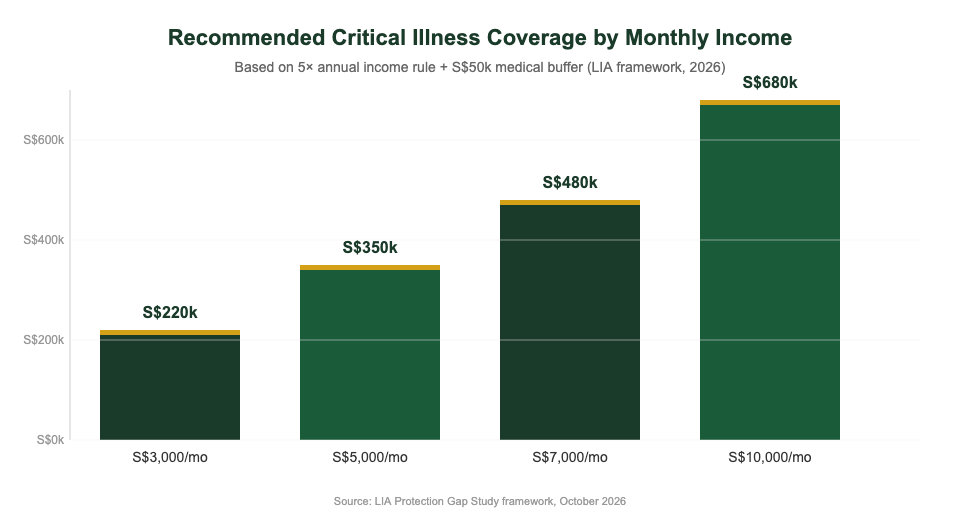
The table below applies the formula across the most common income tiers in Singapore. Use your gross monthly income to find your baseline. Then adjust upward if you have dependants, outstanding debts, or a family history of serious illness.
| Monthly Income | Annual Income | 5× Base | + Medical Buffer | Recommended CI Sum |
|---|---|---|---|---|
| S$3,000 | S$36,000 | S$180,000 | +S$40,000 | S$220,000 |
| S$5,000 | S$60,000 | S$300,000 | +S$50,000 | S$350,000 |
| S$7,000 | S$84,000 | S$420,000 | +S$60,000 | S$480,000 |
| S$10,000 | S$120,000 | S$600,000 | +S$80,000 | S$680,000 |
| S$15,000+ | S$180,000+ | S$900,000+ | +S$100,000 | S$1,000,000+ |
Source: LIA 5× income framework. Medical buffer estimates based on average out-of-pocket CI treatment costs (co-insurance, deductibles, non-claimable items) over a 3-year recovery, October 2026. Add outstanding mortgage balances to your personal calculation.
Singapore’s Critical Illness Protection Gap
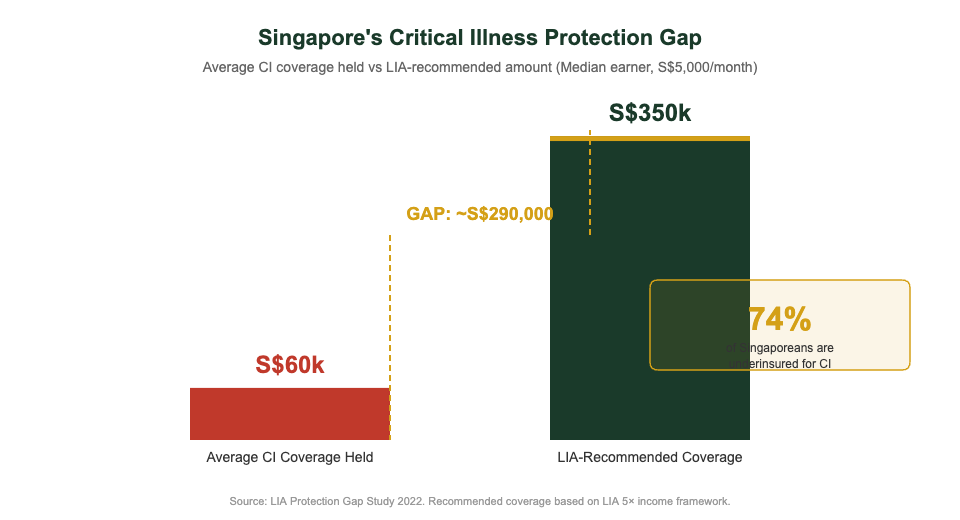
Despite the clear need, the LIA’s Protection Gap Study 2022 found that 74% of economically active Singaporeans do not have sufficient critical illness coverage. The average CI sum assured held is only approximately S$60,000 — a fraction of the S$316,000 the LIA considers adequate for a median-income earner.
Why does this gap exist? The most common reasons are:
- Relying on employer group insurance: Group CI coverage through employers typically provides S$50,000–S$100,000 — well below the recommended amount, and it disappears the moment you leave the job.
- Confusing CI with hospitalisation insurance: Many Singaporeans believe their MediShield Life and Integrated Shield Plan cover everything. They cover bills; CI insurance covers the income and living costs you lose while recovering.
- Underestimating recovery duration: Most people assume recovery takes 6–12 months. For cancer, stroke, or heart failure, 3–5 years is more realistic — and that dramatically increases the coverage need.
The three most-claimed critical illnesses in Singapore are cancer, heart attack, and stroke, which together account for over 80% of all CI claims. Late-stage cancer treatment at a restructured hospital can cost S$100,000–S$200,000 per year, even after MediShield Life subsidies. Over a 3-year course of treatment, that is S$300,000–S$600,000 in medical costs alone — before accounting for a single day of lost income.
| Metric | Figure |
|---|---|
| Singaporeans underinsured for CI | 74% |
| Average CI sum assured held | ~S$60,000 |
| LIA-recommended average coverage | ~S$316,000 |
| Average CI protection gap | ~S$256,000 per person |
| Most common CI claims (% of total) | Cancer + Heart attack + Stroke = 80%+ |
Source: LIA Protection Gap Study 2022. Figures are averages across all economically active Singaporeans.
Factors That Adjust Your Coverage Need
The 5× income formula is your starting point. Several personal factors should push your final figure higher — or, in rare cases, allow you to adjust it slightly downward.
Factors That Increase Your Need
- Dependants (children or elderly parents): Add at least S$50,000–S$100,000 if others rely entirely on your income. This ensures their needs are covered during your recovery without compromising their education or care.
- Outstanding mortgage or loans: A CI diagnosis does not pause your mortgage. Add 2–3 years of annual mortgage repayments to your sum assured to give yourself a financial runway.
- Self-employment or business ownership: There is no employer-paid sick leave or salary continuation. Self-employed Singaporeans typically need at least 6× annual income in CI coverage.
- Family history of critical illness: A family history of cancer, heart disease, or Type 2 diabetes significantly increases your statistical risk. This is the strongest argument for securing CI coverage while you are young and premiums are affordable.
- Sedentary lifestyle or high-stress profession: Research consistently links chronic stress and a sedentary lifestyle to elevated cardiovascular and cancer risk. Treat this as an upward adjustment to your baseline.
Factors That May Allow a Lower Baseline
- Substantial liquid savings: If you have S$200,000+ in liquid assets (not CPF, not property equity), you may reduce your CI sum assured slightly — but do not eliminate coverage entirely, as recovery costs can quickly erode savings.
- No dependants and no mortgage: A single renter with no dependants and significant savings may need only 3–4× annual income rather than 5×.
- Premium IP coverage: An IP with low co-insurance and broad coverage reduces your out-of-pocket medical costs — adjust your medical buffer downward accordingly.
For a deeper look at protecting your income in case of disability (a different risk), read our guide on critical illness standalone plan vs rider in Singapore to understand which structure delivers better value for your coverage need.
Which Critical Illness Plan Type Suits You?
Once you know how much coverage you need, the next decision is which plan type to buy. There are two key choices in the Singapore market.
1. Standalone Plan vs CI Rider
A standalone CI plan provides fixed coverage independent of any life insurance policy. A CI rider is attached to a life or whole life plan — it is cheaper initially, but coverage may reduce if the base policy is claimed or surrendered. For pure CI protection, a standalone plan is generally preferable because your coverage does not move around.
Our dedicated article on how much term life insurance you need also covers how CI and term life work together in a complete protection plan.
2. Traditional Single-Pay vs Multi-Pay CI
A traditional CI plan pays your full sum assured once — the policy then ends. A multi-pay (or multi-claim) CI plan allows you to claim multiple times across different illness categories, subject to a lifetime cap typically set at 300–500% of the sum assured. For example, a S$200,000 multi-pay plan with a 300% cap pays up to S$600,000 across all claims over your life.
| Feature | Traditional CI | Multi-Pay CI |
|---|---|---|
| Number of claims | Once | Multiple (lifetime cap) |
| Premium (for same sum assured) | Lower | Higher |
| Policy continues after claim? | No | Yes |
| Best for | Budget-conscious; max sum assured per dollar | Family history of multiple conditions; long-term peace of mind |
| Covers early-stage CI? | Only if early CI rider attached | Often included for some conditions |
Source: General comparison of Singapore CI plan structures, October 2026. Specific features vary by insurer and plan. Consult a licensed financial adviser for personalised recommendations.
SRS and CPF Eligibility
Most standalone CI plans in Singapore are not eligible for CPF investment under the CPF Investment Scheme (CPFIS). However, certain endowment-type CI plans may qualify. CI premiums paid in cash are also not SRS-eligible directly — but if you are building a passive income stream to fund retirement and insurance costs, consider using Endowus (referral code 2V343) or Syfe (code SRPRFFFCD) to grow your SRS funds for future premium support.
Building sufficient CI coverage is one pillar of a complete financial protection plan. Alongside CI insurance, a well-structured passive income Singapore strategy — through REITs, ETFs, or dividend stocks — helps maintain household cash flow during a recovery period when earned income may stop entirely.
Frequently Asked Questions
How much critical illness insurance do I need in Singapore?
The LIA recommends a minimum of 4–5 times your annual income in CI coverage. For a median earner in Singapore (S$5,000/month), this works out to approximately S$350,000 in total CI sum assured — that is S$300,000 as the income replacement base (5 × S$60,000) plus a S$50,000 buffer for out-of-pocket medical costs not covered by MediShield Life or your Integrated Shield Plan.
What are the 37 critical illnesses covered in Singapore?
All Singapore-licensed insurers cover the same 37 critical illnesses standardised by the Life Insurance Association (LIA) under its Critical Illness Framework Version 2024. The three most commonly claimed are cancer, heart attack, and stroke — together accounting for over 80% of all CI claims. Other covered conditions include kidney failure, coronary artery bypass surgery, stroke with permanent neurological deficit, end-stage organ failure, loss of limbs, and major burns, among others.
Is critical illness insurance necessary if I already have MediShield Life?
Yes — MediShield Life and Integrated Shield Plans cover your hospital bills. They do not replace your lost income during recovery. If cancer treatment sidelines you for 3 years, your mortgage, children’s school fees, and household expenses continue regardless of whether the hospital bill is covered. Critical illness insurance provides the lump-sum cash flow to keep your household financially stable while you recover.
Can I buy critical illness insurance with my CPF or SRS funds?
Most standalone CI plans are not CPF-investable under the CPF Investment Scheme (CPFIS). However, certain endowment-CI hybrid plans may qualify — check the CPF Board’s approved investment list at cpf.gov.sg for current eligibility. CI premiums paid from SRS are also not directly eligible for SRS tax deduction. Your SRS funds are better deployed in investment products (unit trusts, ETFs, endowments) that compound during your working years and supplement income in retirement.
Should I get a multi-pay CI plan or a traditional CI plan?
For most Singaporeans, a traditional CI plan with the highest possible sum assured per premium dollar is the better starting point. Multi-pay plans allow multiple claims but cost significantly more — and most people’s primary concern is having enough coverage for their most likely risk (a single major illness). If you have a family history of multiple serious conditions or want lifelong coverage with ongoing protection after a claim, a multi-pay plan is worth the higher premium. Compare both options with a licensed financial adviser.
What happens to my CI coverage if I leave my employer?
Employer-provided group CI coverage ends the day you leave the company. This is one of the most overlooked insurance gaps in Singapore — people discover they are uninsured only after they have already been diagnosed. Always maintain a personal standalone CI policy independent of your employment. Group policies are a supplement, not a substitute. The portability and certainty of a personal plan make it far more reliable for long-term financial protection.
At what age should I buy critical illness insurance in Singapore?
The earlier, the better — primarily because CI premiums increase significantly with age. A 30-year-old can secure S$300,000 in CI coverage for roughly S$100–S$200 per month (depending on plan type and insurer); the same coverage at 45 may cost S$300–S$600 per month. Beyond premiums, younger applicants are also more likely to pass underwriting without exclusions — pre-existing conditions flagged at medical underwriting can result in exclusions or loading. Ideally, secure your CI plan before age 35.
Build Your Complete Protection Plan
Critical illness insurance is one piece of the puzzle. Grow your investments with SRS or CPF to support your premiums long-term.
Get Free Insurance Advice
Speak with a licensed insurance advisor. No obligation, no cost.
By submitting this form, you agree to our Privacy Policy.
This article was researched with the help of AI. While we strive to keep all information accurate and up to date, there may be errors. If you notice any discrepancies, please contact us.