How Much Term Life Insurance Do You Need in Singapore? (2026 Guide)
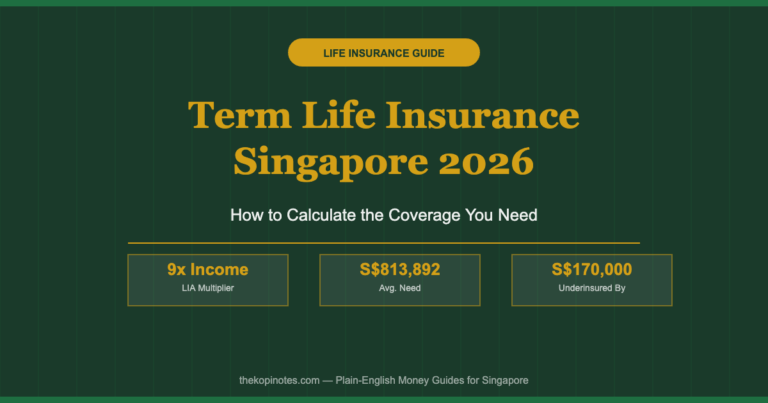
MoneySense and the LIA recommend at least 9× your annual income — here is how to calculate your exact coverage target.
Term life insurance pays a lump-sum death benefit to your dependants if you pass away within the policy term. MoneySense and the Life Insurance Association (LIA) recommend coverage of at least 9 times your annual income for death and total permanent disability (TPD). On top of that, add your outstanding mortgage, children’s education costs, and any debts — then subtract your existing savings. That final figure is your minimum coverage target.
Not financial advice. All figures are for educational reference only. Data verified as at October 2026.
Table of Contents
Contents — Click to expand
- What Is Term Life Insurance?
- The 9× Income Rule: Singapore’s Official Guideline
- How to Calculate Your Exact Coverage Need
- Recommended Coverage by Life Stage
- How Much Does Term Life Insurance Cost in Singapore?
- How to Choose a Term Life Insurance Plan
- Who Needs More — or Less — Coverage?
- Frequently Asked Questions
What Is Term Life Insurance?
Term life insurance is the simplest and most affordable form of life insurance in Singapore. You pay a fixed annual or monthly premium for a set policy term — typically 20 to 30 years — and if you pass away within that term, your beneficiaries receive the full insured sum. Unlike whole life insurance, term life has no savings or investment component: premiums are lower precisely because you are paying purely for protection.
In Singapore, term life insurance is regulated by the Monetary Authority of Singapore (MAS) and sold by licensed insurers including AIA, Great Eastern, Prudential, Manulife, Singlife, FWD, Tokio Marine, and HSBC Life. All policies must comply with MAS regulations and the Life Insurance Association’s minimum standards.
Most working adults in Singapore buy term coverage from their mid-twenties to mid-fifties, timing the policy to expire around retirement when financial obligations — mortgages, dependent children, income replacement — become less pressing. You can also opt for term policies that cover you to age 65 or 99, depending on your insurer and needs.
| Feature | Term Life Insurance | Whole Life Insurance |
|---|---|---|
| Coverage Duration | Fixed term (e.g. 20 or 30 years) | Lifelong |
| Premium Level | Lower | Higher |
| Cash Value | None | Yes (grows over time) |
| Best For | Income replacement & debt coverage | Legacy planning & estate needs |
| Flexibility | Renew, convert, or let lapse | Long-term commitment |
Source: Life Insurance Association Singapore (LIA); MoneySense financial planning guide.
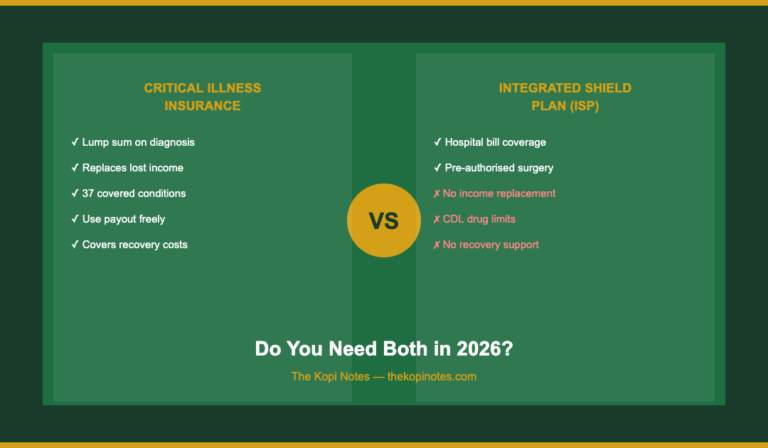
For most Singaporeans, term life insurance is the recommended starting point for protection. It delivers the largest death benefit per premium dollar, allowing you to maximise coverage during the years when your family is most financially exposed. Once you have adequate term coverage in place, you can explore whether a critical illness insurance standalone plan or rider is appropriate for your situation.
The 9× Income Rule: Singapore’s Official Coverage Guideline
The MoneySense basic financial planning guide — co-produced with the Life Insurance Association of Singapore (LIA) — recommends a minimum death and total permanent disability (TPD) coverage of 9 times your annual income. This multiple is designed to replace your income for approximately 9 years, giving your surviving dependants time to adjust financially, retrain if necessary, and manage their transition without crisis.
This is a floor, not a ceiling. Families with large mortgages, multiple children, or a single income earner will typically need significantly more. MoneySense also recommends spending no more than 15% of your take-home pay on total insurance premiums across all policies.
Here is how the 9× rule plays out across different income levels:
| Annual Income | 9× Coverage Target | With S$400K Mortgage Added |
|---|---|---|
| S$40,000 | S$360,000 | S$760,000 |
| S$60,000 | S$540,000 | S$940,000 |
| S$80,000 | S$720,000 | S$1,120,000 |
| S$100,000 | S$900,000 | S$1,300,000 |
| S$120,000 | S$1,080,000 | S$1,480,000 |
Source: MoneySense Basic Financial Planning Guide (co-produced with LIA). Mortgage column assumes a remaining balance of S$400,000 added to 9× income target. Does not account for children’s education costs or existing savings offsets.
These numbers explain why many Singaporeans who believe they are adequately covered — with a S$200,000 or S$300,000 policy — are in fact severely under-insured. A family with a S$60,000 annual household income, a S$400,000 HDB mortgage, and two school-age children needs coverage well above S$1 million once education costs are factored in.
This is also why the Home Protection Scheme Singapore — which covers only your HDB mortgage — should not be confused with comprehensive life insurance. HPS handles your mortgage; term life covers your family’s income.
How to Calculate Your Exact Coverage Need
The 9× rule is a starting point. For a more precise figure, use this four-step formula:
Step 1 — Income replacement: Multiply your annual income by 9. If you have more than two dependants, use 10 or 11 as your multiplier.
Step 2 — Outstanding debts: Add the current balance of your mortgage, car loan, any personal loans, and business debts. Your family should not be forced to sell the home or liquidate assets to cover debt.
Step 3 — Future obligations: Estimate your children’s education costs. A local university degree costs approximately S$30,000–S$60,000; an overseas degree in the UK, US, or Australia typically runs S$250,000–S$500,000 including living expenses. Add these costs in today’s dollars.
Step 4 — Subtract liquid assets: Deduct your current savings, investments, and any cash CPF amounts that are nominated to pass to your beneficiaries. Note that CPF balances are generally earmarked for retirement and should not be counted as life insurance, but CPF Nomination ensures they reach the right people quickly.
A worked example for a 35-year-old earning S$80,000/year with a S$500,000 mortgage, two young children, and S$100,000 in savings:
- 9× income: S$720,000
- + Outstanding mortgage: S$500,000
- + Two children’s local university costs (est.): S$100,000
- − Existing savings: S$100,000
- Total coverage target: S$1,220,000
This family needs coverage of approximately S$1.2 million — not the S$500,000 most people default to. Use our Singapore retirement calculator to model your longer-term financial plan alongside your protection needs.
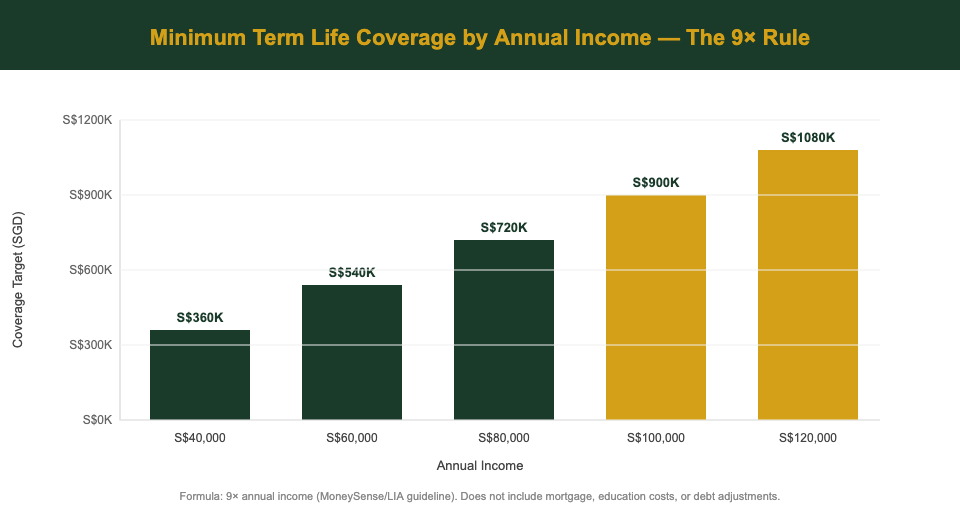
Coverage targets based on 9× annual income guideline (MoneySense/LIA). Mortgage column adds a representative S$400,000 balance. Actual coverage needs vary by family situation.
Recommended Coverage by Life Stage
Your optimal coverage amount shifts with your life stage. The table below gives a general guide — adjust upward if you are a single-income household or have significant debt, and downward as your obligations reduce closer to retirement.
| Life Stage | Recommended Coverage | Primary Rationale |
|---|---|---|
| Single, age 25–30 | S$250,000–S$500,000 | Elderly parents as dependants; student debt; lower income |
| Married, no children | S$500,000–S$900,000 | New mortgage; partner income replacement; joint liabilities |
| Married with young children | S$900,000–S$1,500,000+ | Peak exposure: mortgage + education + income replacement |
| Children in secondary/JC | S$700,000–S$1,200,000 | Declining education horizon; mortgage reducing |
| Children independent (50s) | Review & reduce | Obligations reducing; retirement savings building |
| Pre-retirement (55+) | Convert or let lapse | CPF LIFE and retirement savings cover ongoing needs |
Source: LIA guidelines; MoneySense financial planning stages. Table is illustrative — consult a licensed financial adviser for personalised advice.
Business owners should note that the numbers above cover personal family needs only. If you have key person exposure — where the business would suffer financial loss if you were absent — additional key person insurance coverage is appropriate and calculated separately based on the business’s revenue and your role.
How Much Does Term Life Insurance Cost in Singapore?
Singapore has some of the most competitive term life premiums in Asia. Premiums are primarily driven by your entry age, gender, smoking status, and health condition. The table below shows indicative annual premiums for S$500,000 coverage on a 20-year term from major insurers in Singapore, based on publicly available rates in mid-2026.
| Entry Age | Male Non-Smoker (Indicative Range) | Female Non-Smoker (Indicative Range) |
|---|---|---|
| Age 25 | S$220 – S$320 / year | S$170 – S$260 / year |
| Age 30 | S$280 – S$400 / year | S$220 – S$320 / year |
| Age 35 | S$388 – S$600 / year | S$300 – S$460 / year |
| Age 40 | S$560 – S$850 / year | S$420 – S$640 / year |
| Age 45 | S$850 – S$1,300 / year | S$640 – S$950 / year |
Source: Publicly available indicative rates from FWD, Singlife, Great Eastern, AIA, and Manulife, mid-2026. Premiums are for standard health underwriting. Smokers typically pay 50–100% more. Get personalised quotes via CompareFIRST (MAS-endorsed comparison portal).
The takeaway is stark: a 35-year-old can secure S$500,000 coverage for as little as S$388/year from the most competitive insurer. Wait until 40 and the same coverage costs 40–120% more. Buying early locks in your premium rate and typically means less stringent health requirements.
For context, if your gross monthly income is S$5,000 (S$60,000/year) and take-home pay is S$4,200, MoneySense recommends spending no more than S$630/month on all insurance premiums combined (15% of take-home). A S$400–S$600/year term policy represents only S$33–S$50/month — a very manageable commitment for the protection level it delivers.
Planning your insurance alongside long-term wealth building? Read about CPF investment strategy to see how CPF savings and protection work together in your retirement plan.
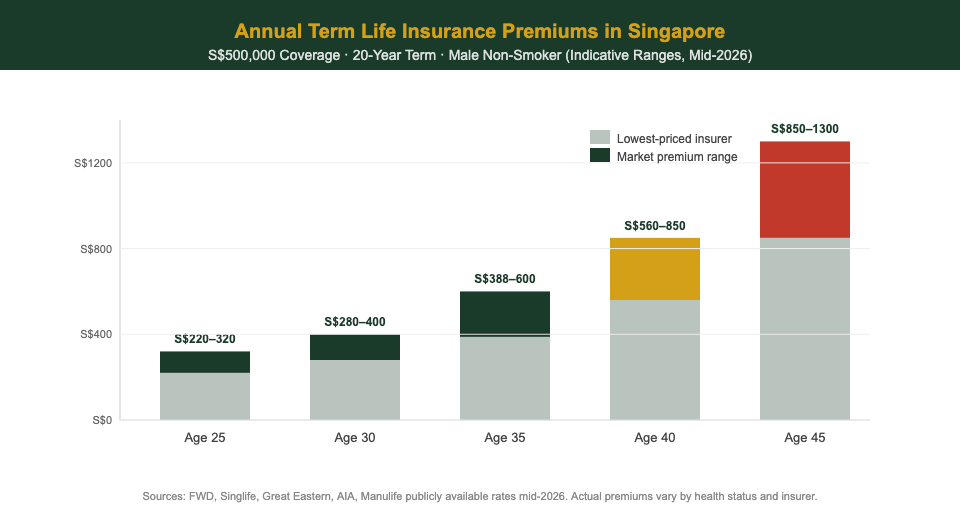
Annual premiums for S$500,000 term life insurance, 20-year term, male non-smoker. Indicative ranges from publicly available rates mid-2026.
How to Choose a Term Life Insurance Plan in Singapore
With more than a dozen licensed term life insurers in Singapore, choosing the right plan involves more than price comparison. Here are the key criteria to evaluate:
1. Coverage amount: Use the formula in this guide to determine your target. Do not default to a round number like S$500,000 without checking whether it actually meets your family’s needs.
2. Policy term: Your term should cover the years of peak financial obligation. A common rule of thumb: cover until your youngest child graduates university and your mortgage is paid off. For most 30-year-old buyers, a 25–30 year term is appropriate.
3. Renewable vs convertible: Some policies allow you to convert to whole life without further medical underwriting — useful if your health deteriorates. Check whether renewal is guaranteed and at what premium.
4. Riders: Consider adding a critical illness rider or total permanent disability (TPD) rider to your term policy. Our guide on whether a critical illness standalone plan vs rider suits you better is worth reading before deciding.
5. Comparison tools: Use CompareFIRST, the MAS-endorsed life insurance comparison portal, to view standardised premiums across all licensed insurers. This removes adviser bias and gives you a transparent baseline.
6. Direct purchase: All major insurers in Singapore offer direct purchase insurance (DPI) — simplified policies you can buy without a financial adviser. These have lower premiums but are typically capped at S$400,000 for death/TPD. If your coverage need exceeds S$400,000, you will need a full policy through an adviser or aggregator.
Who Needs More — or Less — Coverage?
You likely need more than 9× income if:
- You are the sole income earner in a family with young children
- You have a large mortgage (above S$600,000 outstanding)
- You plan to fund overseas university education for your children
- You run a business with personal loan guarantees
- Your surviving spouse has limited or no employment income
You may need less if:
- You are a dual high-income couple with no children and no mortgage
- You have significant liquid savings above S$300,000
- Your surviving spouse has a high and stable income
- You are 50+ and your children are financially independent
Remember that life insurance is not a static decision. Review your coverage every 3–5 years or after major life events: marriage, the birth of a child, a new mortgage, a career change, or a significant increase in income. Building towards passive income Singapore through investing can also reduce your dependence on life insurance over time, as your investment portfolio gradually takes on the income-replacement role.
Frequently Asked Questions
How much term life insurance do I need in Singapore?
MoneySense and the Life Insurance Association (LIA) recommend at least 9 times your annual income for death and total permanent disability (TPD) coverage. Add your outstanding mortgage balance and children’s estimated education costs, then subtract your existing savings. The resulting figure is your minimum coverage target. Most families with a mortgage and two children need coverage of S$900,000 to S$1,500,000 or more.
Is S$500,000 term life insurance enough in Singapore?
For most families with a mortgage and children, S$500,000 is not sufficient. Using the 9× rule: a household earning S$60,000 per year needs at least S$540,000 in income replacement alone. Add a S$400,000 mortgage and two children’s education costs and the total coverage target exceeds S$1 million. S$500,000 may be adequate only for single earners with minimal debt and no young dependants.
How much does term life insurance cost in Singapore?
A healthy 35-year-old male non-smoker can secure S$500,000 of term life coverage for approximately S$388–S$600 per year (S$32–S$50 per month) depending on the insurer. Female premiums are typically 20–30% lower. Premiums rise steeply after age 40 — buying early delivers significantly better value. Compare plans via CompareFIRST, the MAS-endorsed comparison portal.
What is the MoneySense 9× rule for life insurance?
The MoneySense basic financial planning guide — co-produced with the Life Insurance Association of Singapore — recommends death and total permanent disability coverage equal to 9 times your annual income. This multiple is designed to replace your income stream for roughly 9 years, giving your family time to stabilise financially. MoneySense also recommends that total insurance premiums (across all policies) should not exceed 15% of your take-home pay.
Should I get term life or whole life insurance in Singapore?
For income protection and debt coverage, term life delivers more coverage per premium dollar. A S$1,000,000 term policy typically costs S$600–S$1,200/year for a 35-year-old, whereas the equivalent whole life policy would cost several thousand dollars per year. Most financial planners in Singapore recommend starting with term life to address your protection gap, and considering whole life only if you have surplus budget and specific estate planning objectives.
Does CPF count toward my life insurance coverage?
Not directly. CPF Ordinary Account and Special Account savings can be nominated to pass to beneficiaries under CPF Nomination, and CPF LIFE pays monthly retirement income to you. However, CPF balances are earmarked for retirement and medically-related needs — it is generally safer not to count them as life insurance coverage in your calculation. Think of CPF and term life as complementary pillars that serve different purposes in your financial plan.
Get Free Insurance Advice
Speak with a licensed insurance advisor. No obligation, no cost.
By submitting this form, you agree to our Privacy Policy.
This article was researched with the help of AI. While we strive to keep all information accurate and up to date, there may be errors. If you notice any discrepancies, please contact us.