How to Invest in Singapore: Dollar-Cost Averaging vs Lump Sum — Which Strategy Wins? (2026)
Dollar-cost averaging (DCA) and lump sum investing are the two core approaches to deploying capital in Singapore. Research from Vanguard shows lump sum investing outperforms DCA in roughly 67% of historical market periods — but DCA wins in bear markets, suits monthly salary investors naturally, and reduces the psychological cost of timing decisions. This guide explains both strategies, what the data says, and which approach makes sense for your situation as a Singapore investor in 2026.
Not financial advice. All figures are for educational reference only. Data verified as at November 2026.
📋 Table of Contents
- What Is Dollar-Cost Averaging (DCA)?
- What Is Lump Sum Investing?
- DCA vs Lump Sum: What the Research Says
- When DCA Makes Sense for Singapore Investors
- When Lump Sum Makes Sense
- Singapore DCA Platforms (RSP Options)
- How to Start DCA in Singapore — Step by Step
- The Verdict: Which Strategy Should You Use?
- Frequently Asked Questions
What Is Dollar-Cost Averaging (DCA)?
Dollar-cost averaging means investing a fixed dollar amount at regular intervals — monthly, quarterly, or on any consistent schedule — regardless of what the market is doing. Because you invest the same amount each time, you buy more units when prices are low and fewer units when prices are high. Over time, this naturally averages out your cost per unit below the market’s arithmetic average price.
DCA in Singapore — A Worked Example
Say you have S$12,000 to invest over 12 months. You invest S$1,000 each month into a global ETF such as CSPX. Here is what a simplified scenario looks like:
- Month 3 — market dips to S$80/unit: your S$1,000 buys 12.5 units
- Month 6 — market at S$100/unit: your S$1,000 buys 10 units
- Month 9 — market recovers to S$110/unit: your S$1,000 buys 9 units
By deploying capital across different price levels, your average cost per unit ends below the market’s average price during the period — a mathematical benefit that is especially powerful in volatile or declining markets.
Who Uses DCA in Singapore?
DCA is the natural strategy for anyone investing from a monthly salary. In Singapore’s context:
- Salary investors — Setting up a Regular Savings Plan (RSP) to invest S$300–1,000/month from your GIRO account
- CPF-IS investors via Endowus — Investing a fixed monthly amount from CPF OA into diversified funds
- SRS contributors — Topping up SRS monthly or at year-end, then investing the balance
- Young starters — Beginning with S$100–200/month via moomoo RSP or FSMOne RSP
Understanding your CPF investment strategy is key — your CPF OA pays 2.5% p.a. guaranteed, which sets a meaningful hurdle rate for any DCA investment to beat.
What Is Lump Sum Investing?
Lump sum investing means deploying your entire available capital into the market at once — immediately, rather than spreading it over time. The idea is simple: since markets generally trend upward over the long run, the sooner your capital is invested, the more time it has to compound.
Lump Sum — A Worked Example
You receive a year-end bonus of S$30,000. With lump sum investing, you transfer the full S$30,000 into your IBKR account and purchase CSPX on Monday. If CSPX delivers its long-run average return of approximately 10% per year, that S$30,000 becomes:
- After 10 years: ~S$77,800
- After 20 years: ~S$201,800
- After 30 years: ~S$523,500
Every month of delay costs you roughly one month of compounding — equivalent to leaving S$250–400 on the table per month at a 10% annual return on a S$30,000 position.
Who Uses Lump Sum Investing in Singapore?
- Windfall recipients — Property sale proceeds, inheritance, or large bonuses
- CPF OA overflow investors — When CPF OA exceeds housing needs and emergency reserve, deploying the excess via CPFIS or Endowus
- Post-correction investors — Deploying accumulated cash after a significant market drawdown (20%+)
- Cash-heavy savers — Those who have been accumulating cash in savings accounts and decide the opportunity cost of staying in cash is too high
Use our Singapore retirement planning calculator to see how lump sum vs DCA starting ages affect your projected retirement corpus.
DCA vs Lump Sum: What the Research Says (2026)
The most comprehensive research on this question comes from Vanguard’s 2012 study (updated 2023), which analysed historical market data across the US, UK, and Australian markets. The key findings are clear — and might surprise many Singapore investors who default to DCA out of habit rather than analysis.
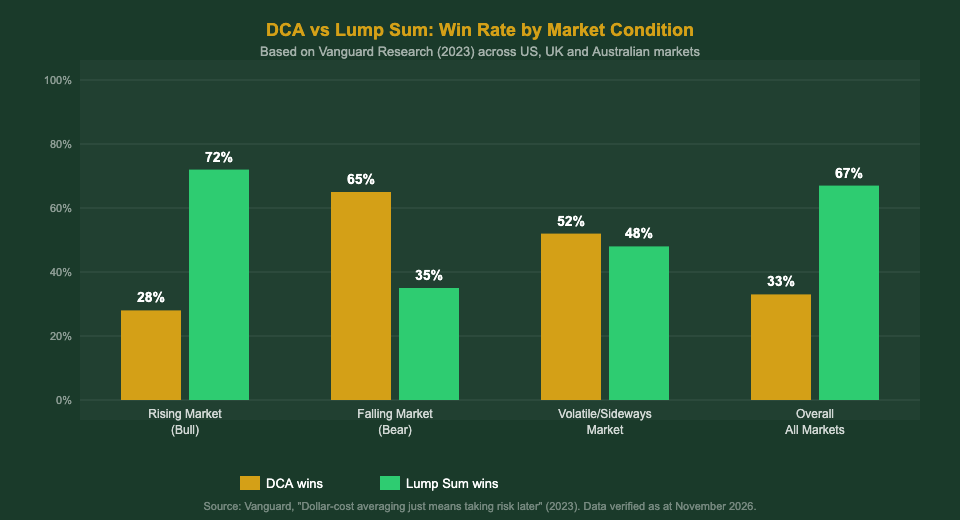
Key finding: Lump sum investing outperformed DCA in approximately 67% of all 12-month periods studied across all three markets. The average outperformance was approximately 2.3 percentage points over the deployment window.
Why? Because markets rise more than they fall over time. The probability that the market is higher in 12 months than it is today is about 73% historically. If you expect the market to be higher in the future (which is a reasonable baseline assumption for long-term investors), deploying capital sooner — lump sum — captures more of that upside.
When DCA Wins (the Other 33%)
DCA beats lump sum in approximately one-third of historical periods — specifically:
- Bear markets — when markets fall after your deployment date, DCA means you bought progressively cheaper units rather than committing your full capital at the top
- High-volatility periods — markets that swing sharply up and down give DCA an advantage, as you buy more units during dips
- Near market peaks — if you happen to invest a lump sum right before a major correction, DCA would have been significantly better
The challenge is that you cannot reliably identify market peaks in advance. Research on market timing consistently shows that even professional fund managers struggle to time the market successfully over the long term — which is a core reason why passive index investing via ETFs is widely recommended by regulators like MoneySense Singapore.
DCA vs Lump Sum: Head-to-Head Comparison
| Factor | Dollar-Cost Averaging | Lump Sum Investing |
|---|---|---|
| Historical win rate | ~33% of periods | ~67% of periods ✓ |
| Avg 12-month advantage | — | +2.3% over DCA ✓ |
| Bear market performance | Better ✓ | Worse |
| Psychological comfort | Higher ✓ | Lower (one big decision) |
| Suits monthly salary? | Yes — natural ✓ | Requires cash accumulation |
| Works with CPF/SRS? | Yes (Endowus monthly) ✓ | Yes (annual SRS contribution) |
Source: Vanguard, “Dollar-cost averaging just means taking risk later” (2023). Data verified as at November 2026.
When DCA Makes Sense for Singapore Investors
Despite lump sum winning more often historically, DCA is the right choice in several very common Singapore scenarios:
1. You Invest From Your Monthly Salary
This is the most common situation for Singapore investors in their 20s and 30s. If you earn S$4,000–8,000 per month and can set aside S$300–1,500 for investing, you are naturally a DCA investor. Setting up a Regular Savings Plan (RSP) or automated transfer into a robo-advisor is the ideal solution.
2. You Are a First-Time Investor
Starting with S$100–300/month via moomoo RSP or FSMOne RSP is a proven, low-stress entry point. The discipline of monthly investing builds the habit that matters far more than strategy nuance at this stage.
3. Market Valuations Are Historically Stretched
When global equity valuations (measured by cyclically-adjusted P/E or Shiller CAPE) are well above their long-run averages, DCA reduces the risk of deploying a large sum at the peak. This is not “timing the market” in the traditional sense; it is a risk-management response to objectively elevated valuations.
4. You Have Income Uncertainty
Freelancers, business owners, or commission-based earners in Singapore often face income variability. Committing to smaller regular DCA amounts is more sustainable than a lump sum commitment that creates financial stress.
5. You Want to Invest Your CPF OA Monthly via Endowus
Your CPF Ordinary Account earns a guaranteed 2.5% p.a. Many Singapore investors use Endowus (referral code: 2V343) to invest a portion of their CPF OA into globally-diversified funds monthly — this is structurally DCA.
When Lump Sum Investing Makes Sense
1. You Receive a Windfall
Property sale proceeds, inheritance, an employer buyout, or a large year-end bonus. If you believe markets are fairly valued, deploy the lump sum. Every month of cash-sitting costs you compounding — at a 7% average annual return, S$100,000 sitting in cash for 12 months costs approximately S$7,000 in foregone growth. If psychologically uncomfortable, consider the “hybrid” approach: invest 50% immediately, then DCA the remaining 50% over 6 months.
2. Your CPF OA Exceeds Your Housing and Emergency Needs
Your CPF Ordinary Account pays 2.5% p.a. This is guaranteed and risk-free. However, global equities have historically delivered 7–10% annually over long periods. If your CPF OA balance exceeds what you need for housing loan payments and emergency reserves, deploying the excess via CPFIS or Endowus as a lump sum has historically been beneficial for time horizons of 10+ years.
3. After a Sharp Market Correction (20%+)
Lump sum investing is most compelling when it feels most uncomfortable — after a significant drawdown. When markets fall 20% or more, every historical analysis shows that deploying a lump sum at or near the trough significantly outperforms DCA over the following 3–5 years.
4. You Have Been Holding Cash for Over 12 Months
If you have been accumulating cash waiting for “the right time to invest,” the data strongly suggests you should stop waiting and deploy. Singapore savings accounts pay 0.05–3.0% p.a. while inflation erodes purchasing power by approximately 2–4% annually. Cash is not risk-free — it has inflation risk. For long-term wealth building, being invested is generally better than waiting for a perfect entry point.
Singapore DCA Platforms: Your RSP Toolkit (2026)
If DCA is your chosen strategy, Singapore offers several excellent platforms for automating monthly investments:
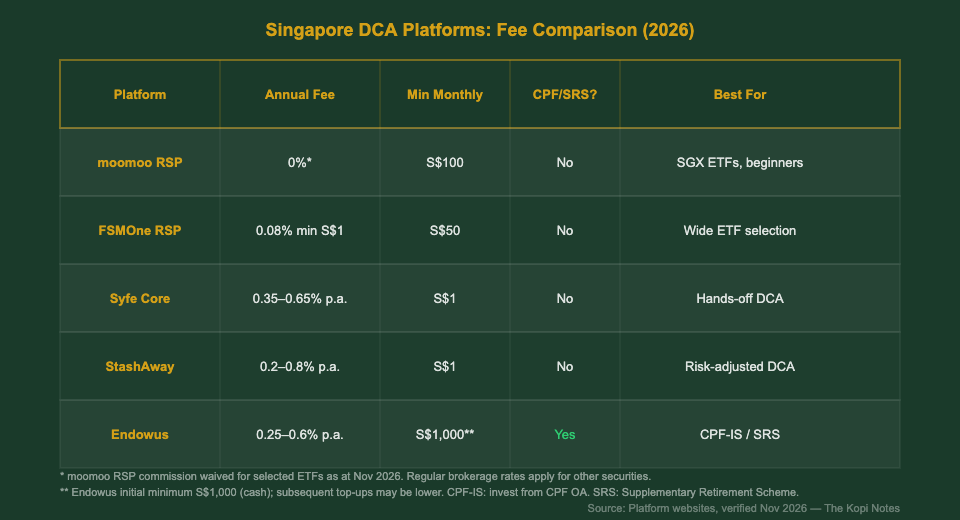
| Platform | Annual Fee | Min Monthly | CPF / SRS | Best For |
|---|---|---|---|---|
| moomoo RSP | 0%* | S$100 | No | SGX ETFs, beginners |
| FSMOne RSP | 0.08%, min S$1 | S$50 | No | Global ETFs (CSPX) |
| Syfe Core | 0.35–0.65% p.a. | S$1 | No | Automated, hands-off |
| StashAway | 0.2–0.8% p.a. | S$1 | No | Risk-adjusted portfolios |
| Endowus | 0.25–0.6% p.a. | S$1,000** | Yes ✓ | CPF OA, SRS investors |
* moomoo RSP commission waived for selected SGX ETFs as at November 2026. ** Endowus initial minimum S$1,000 (cash). Source: Platform websites, verified November 2026.
moomoo RSP is ideal for direct ETF ownership without an annual fee. Supported SGX ETFs include Nikko AM STI ETF (G3B). Read our full moomoo Singapore review for the complete fee schedule.
FSMOne RSP (use FSMOne referral code P0544985) supports both SGX-listed and LSE-listed ETFs including CSPX. The 0.08% commission is very low for the breadth of access offered. Minimum S$50/month.
Syfe Core Portfolios (use Syfe referral code SRPRFFFCD) is a fully automated DCA solution. Management fee 0.35–0.65% p.a. based on portfolio type. No minimum monthly investment. Their Core Equity100 tracks MSCI World/ACWI.
Endowus (use Endowus referral code 2V343) is the only platform that lets you invest CPF OA savings and SRS funds into globally-diversified index portfolios. This is a major differentiator — your CPF contributions arrive monthly, making it structurally a DCA product.
How to Start DCA in Singapore — Step by Step
- Decide your monthly investment amount — A common starting point is 10–20% of your monthly take-home pay. If you earn S$5,000/month, that is S$500–1,000. Start with what you can sustain without lifestyle disruption.
- Choose your platform — For SGX ETF DCA at zero cost: moomoo RSP. For global ETF DCA: FSMOne RSP. For fully automated, hands-off: Syfe or StashAway. For CPF/SRS: Endowus.
- Pick your index fund or portfolio — For global diversification, consider CSPX (S&P 500 via FSMOne) or Syfe’s Core Equity100. For Singapore-focused: Nikko AM STI ETF (G3B).
- Set up automatic monthly debit (GIRO) — All major RSP platforms support GIRO debit from your bank account on a fixed date each month. Set it, forget it. Automation is what makes DCA work.
- Review quarterly, not daily — Checking your portfolio daily is counterproductive. Market fluctuations are normal. DCA works best when you stay the course through volatility.
- Increase your DCA amount as your income grows — The difference between investing S$500/month and S$800/month over 20 years at 7% annual return is approximately S$460,000.
Use our Singapore retirement planning calculator to see how your monthly DCA amount translates into projected retirement wealth.
The Verdict: Which Strategy Should Singapore Investors Use?
If you are investing from monthly income → DCA via RSP. This is the natural, optimal strategy for most Singapore salary earners. Automate it, and do not overthink it.
If you have a windfall or large lump sum → Lump sum immediately. The research is clear: waiting and averaging in costs you expected return over 67% of historical periods. If psychologically unable to go all-in, deploy 50–70% as a lump sum now and DCA the remainder over 3–6 months.
If markets just had a sharp correction → Lump sum at the dip. Post-correction lump sum investing historically produces outstanding long-term outcomes.
If you are unsure → Start with DCA. The worst decision is paralysis. Beginning with S$100–200/month via moomoo RSP or FSMOne RSP is infinitely better than waiting for a perfect entry point that may never come.
“The best time to invest was 10 years ago. The second best time is today.” — Whether you choose DCA or lump sum, the act of starting is what matters most.
Frequently Asked Questions
Is DCA or lump sum better for a Singapore investor?
What is the best DCA platform in Singapore in 2026?
How much should I invest each month via DCA in Singapore?
Can I do DCA using my CPF in Singapore?
Does lump sum investing require a large minimum amount in Singapore?
What is the difference between DCA and RSP in Singapore?
Start Your DCA Journey in Singapore
Whether you choose DCA or lump sum investing, the most important step is to start. Here are the best platforms to get going in 2026:
- FSMOne — Best for global ETF RSP (CSPX) | Referral code P0544985
- Syfe — Best for automated, hands-off DCA | Referral code SRPRFFFCD
- Endowus — Best for CPF-IS and SRS DCA | Referral code 2V343
Not financial advice. All investment decisions carry risk. Past performance does not guarantee future results. Data verified as at November 2026.
This article was researched with the help of AI. While we strive to keep all information accurate and up to date, there may be errors. If you notice any discrepancies, please contact us.