How to Invest in Singapore Tax-Efficiently: SRS, CPF-IS and LSE ETF Strategies (2026)
A comprehensive guide to the three tax shelters every Singapore investor should know — updated for 2026.
Singapore investors can keep more of their returns through three proven tax shelters: the Supplementary Retirement Scheme (SRS) gives a dollar-for-dollar income tax deduction of up to $15,300 per year; CPF-IS lets OA savings above $20,000 grow tax-free in approved funds; and Irish-domiciled LSE ETFs like CSPX cut withholding tax on US dividends from 30% to 15%. Used together, these strategies can save a mid-income earner over $5,000 a year in tax.
Not financial advice. All figures are for educational reference only. Data as at November 2026 unless noted.
Why Tax Drag Silently Kills Your Returns
Singapore is often praised as a tax-friendly country for investors. There is no capital gains tax, no inheritance tax, and domestic dividends are largely tax-exempt. This is true — but it creates a false sense of security. Two taxes still quietly erode the returns of Singapore investors who are not careful: withholding tax on US-sourced dividends and income tax on earnings that could have been deferred.
Consider a Singapore resident earning $150,000 a year in chargeable income. At the 15% marginal tax bracket, every $1 of additional income costs $0.15 in tax. If they invest $15,300 of that income in a typical brokerage account rather than through the SRS, IRAS taxes it before it ever reaches their portfolio. That is $2,295 in tax paid upfront that could instead be compounding inside their investments for decades.
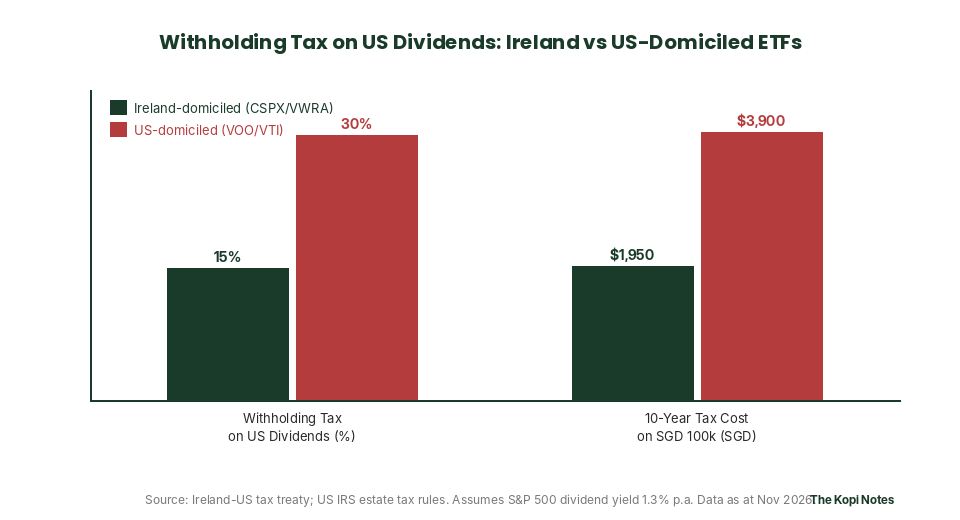
At the same time, an investor who buys a US-listed S&P 500 ETF like VOO sees 30% of every dividend payment withheld at source by the IRS before it reaches their account. An investor who buys the equivalent Irish-domiciled ETF (CSPX on the London Stock Exchange) pays just 15% — the preferential rate under the Ireland-US double tax treaty. On a $200,000 portfolio with a 1.3% dividend yield, that is a difference of $390 per year, every year, completely legally.
The good news is that both leakages are preventable. This guide walks through three layers of tax-efficient investing for Singapore residents in 2026: SRS, CPF-IS, and Irish-domiciled LSE ETFs.
Layer 1: SRS — Your Annual Tax Deduction
The Supplementary Retirement Scheme (SRS) is a voluntary government scheme that lets you contribute a portion of your income to a dedicated SRS account at DBS, OCBC, or UOB. Every dollar you contribute reduces your chargeable income by exactly one dollar — the deduction appears on your IRAS Notice of Assessment for that year of assessment.
2026 Contribution Limits
| Residency Status | Annual SRS Cap (2026) | Maximum Upfront Tax Saving |
|---|---|---|
| Singapore Citizens & PRs | $15,300 | $1,071 to $3,366 (depends on bracket) |
| Foreigners on Employment Pass | $35,700 | Up to $7,854 at 22% rate |
Source: IRAS Supplementary Retirement Scheme (SRS) Relief, 2026.
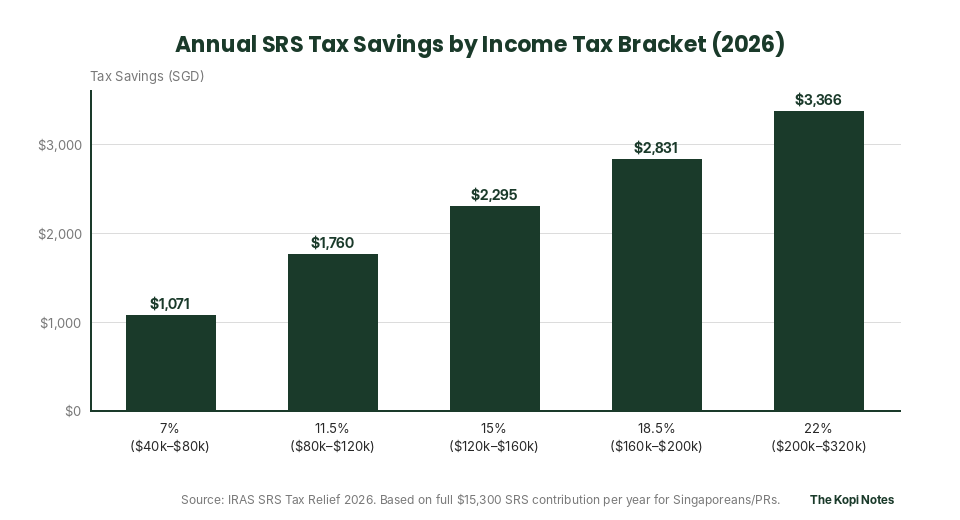
The tax saving is calculated by multiplying your marginal income tax rate by the amount you contribute. If you are in the 11.5% bracket (chargeable income $80,001–$120,000), contributing the full $15,300 saves you exactly $1,760 in income tax this year.
How SRS Tax Savings Stack Up
Use the table below to find your bracket and calculate your personal saving. If you are unsure of your chargeable income, subtract earned income relief, CPF relief, and any other relief items from your gross employment income.
| Chargeable Income | Marginal Tax Rate | SRS Tax Saving (Full $15,300) |
|---|---|---|
| $40,001 – $80,000 | 7% | $1,071 |
| $80,001 – $120,000 | 11.5% | $1,760 |
| $120,001 – $160,000 | 15% | $2,295 |
| $160,001 – $200,000 | 18.5% | $2,831 |
| $200,001 – $320,000 | 22% | $3,366 |
Source: IRAS Individual Income Tax Rates, Year of Assessment 2026.
What to Invest Your SRS Funds In
Funds sitting idle in your SRS account earn a mere 0.05% per year — the same as a basic bank account. The key is to invest those SRS funds so they grow before you draw them down in retirement. SRS funds can be invested in a wide range of IRAS-approved products including shares listed on the SGX, unit trusts, ETFs, government bonds, and endowment plans.
Two platforms stand out for SRS investing in 2026. Endowus referral code gives access to low-cost, globally diversified fund portfolios specifically designed for SRS and CPF investors — including their flagship 100% Equities portfolio built from Dimensional and Vanguard funds. FSMOne referral code gives direct access to a wide range of unit trusts and ETFs with no platform fee for SRS transactions.
How SRS Works at Retirement
At the statutory retirement age (currently 63 for new entrants from 2022, with a grace window for existing account holders), you can begin withdrawals over up to 10 years. Only 50% of each withdrawal is taxable — the other 50% is tax-free. Because most retirees have significantly lower chargeable income than during their working years, the effective tax at withdrawal is usually far below the upfront saving. This is the core SRS advantage: pay tax at a lower rate later, not a higher rate now.
If you withdraw before the statutory retirement age, a 5% penalty applies and the full withdrawal amount becomes taxable. For a comprehensive breakdown of the year-end SRS deadline and optimal timing, see our year-end Singapore tax optimisation guide.
Layer 2: CPF-IS — Putting Idle OA to Work
Your CPF Ordinary Account (OA) earns a guaranteed 2.5% per annum (the first $20,000 earns 3.5%). For many Singapore residents, particularly those in their 30s and 40s, significant OA balances sit idle earning this relatively modest rate when they could be invested for potentially higher long-term returns through the CPF Investment Scheme (CPFIS-OA).
The $20,000 Basic Investment Sum Rule
Before you can invest any OA money, the first $20,000 must remain in your OA to earn the guaranteed interest. Only OA funds above this $20,000 Basic Investment Sum (BIS) are eligible for CPFIS investment. This is an important threshold — if your OA balance is $60,000, only $40,000 is investable via CPFIS.
What about the Special Account (SA)? The CPF SA was closed for most members under 55 from January 2025 as part of CPF restructuring under the Enhanced Retirement Sum framework. SA balances were transferred to the Retirement Account upon turning 55, and new CPFIS-SA investments are no longer possible. For tax-efficient CPF investing, CPFIS-OA is now the primary vehicle.
What You Can Invest In via CPFIS-OA
CPFIS-approved products include unit trusts managed by licensed fund managers, shares and ETFs listed on the SGX, Singapore Government Securities, and investment-grade bonds. The key point for tax efficiency is that all returns within your CPF account grow tax-free. CPF interest income is exempt from income tax, and capital gains within the CPF are not taxable.
Two platforms make it straightforward to invest CPF-OA in globally diversified portfolios. For a detailed explanation of how to get started with CPF investing, see our CPF investment strategy Singapore guide which covers approved fund lists, risk profiling, and step-by-step instructions.
CPFIS-OA vs Keeping OA at 2.5%
The decision to invest your OA is not automatic. The 2.5% guaranteed return has zero volatility — it cannot lose value. By investing in equities through CPFIS, you take on market risk. CPFIS data shows that a significant proportion of CPFIS investors have historically underperformed the OA’s risk-free rate, largely due to poor fund selection and market timing. The case for investing OA is strongest over long time horizons (15+ years) with low-cost, globally diversified index funds accessed through platforms like Endowus.
| Factor | Keep in OA at 2.5% | Invest via CPFIS-OA |
|---|---|---|
| Return potential | Guaranteed 2.5% (3.5% first $20k) | Market-dependent (0% to 10%+ p.a.) |
| Risk | Zero | Market risk applies |
| Tax on gains | Tax-free | Tax-free |
| Liquidity | Locked until age 55/CPF drawdown | Locked until age 55/CPF drawdown |
| Best suited for | Those within 10 years of 55 or risk-averse | Those with 15+ years horizon, risk tolerance |
Source: CPF Board CPFIS overview, as at November 2026.
Use our Singapore retirement calculator to model how different CPF-OA investment returns might affect your retirement income projections.
Layer 3: Irish-Domiciled LSE ETFs — Cutting Dividend Tax
Even with no capital gains tax and no dividend tax in Singapore itself, the tax authority you cannot ignore is the US Internal Revenue Service (IRS). The United States imposes a withholding tax at source on dividends paid by US companies to foreign investors. For non-residents with no tax treaty, this rate is a flat 30%. The specific rate depends entirely on the domicile of the fund holding those US stocks — not the nationality of the Singapore investor.
Why ETF Domicile Determines Your Dividend Tax Rate
A Singapore investor buying shares in a US-listed ETF such as VOO (Vanguard S&P 500 ETF, domiciled in the United States) has 30% of every dividend payment withheld before the money reaches their account. This cannot be reclaimed because Singapore has no double-taxation agreement with the US that covers portfolio investors directly.
However, the same S&P 500 exposure held through an Irish-domiciled ETF like CSPX (iShares Core S&P 500 UCITS ETF, listed on the London Stock Exchange) is treated differently. Ireland has a tax treaty with the United States that reduces withholding tax on dividends paid to Irish-resident funds to just 15%. Because the ETF is the entity receiving the dividends (not the Singapore investor directly), it benefits from Ireland’s treaty rate. The Singapore investor effectively pays only 15% — a saving of 15 percentage points.
The Dollar Impact for Singapore Investors
To illustrate: the S&P 500 currently yields approximately 1.3% per annum in dividends. On a SGD 100,000 position:
- US-domiciled ETF (e.g. VOO): Dividends of ~$1,300. After 30% WHT: $910 received. WHT paid: $390.
- Irish-domiciled ETF (e.g. CSPX, accumulating): Dividends of ~$1,300 accrue inside the fund. After 15% WHT paid by the fund: $1,105 compounds internally. WHT effectively paid: $195.
- Annual saving: $195 on a SGD 100,000 position, compounding annually.
Over 20 years, assuming a 7% gross annual return, the lower WHT drag compounds to a difference of over SGD 8,000 on the same SGD 100,000 starting portfolio.
The US Estate Tax Advantage
There is a second, often overlooked benefit: US estate tax. The US imposes estate tax on “US situs assets” held by non-US persons at death. The exemption for non-US residents is only USD 60,000 — a threshold easily breached by any serious investor. For a Singapore investor with $500,000 in a US-listed ETF, this is a material planning risk.
Irish-domiciled ETFs are not US situs assets. They are Irish corporate entities. A Singapore investor who dies holding CSPX faces zero US estate tax exposure, regardless of the portfolio size. This protection is permanent — it does not require any estate planning, trust structure, or legal advice to implement. It is simply a consequence of using an Irish vehicle.
Key Irish-Domiciled ETFs for Singapore Investors (2026)
| ETF | Index | TER | Structure | Exchange | WHT |
|---|---|---|---|---|---|
| CSPX | S&P 500 | 0.07% | Accumulating | LSE (USD) | 15% |
| VWRA | FTSE All-World | 0.22% | Accumulating | LSE (USD) | 15% (US portion) |
| VOO | S&P 500 | 0.03% | Distributing | NYSE (USD) | 30% |
| VTI | US Total Market | 0.03% | Distributing | NYSE (USD) | 30% |
Source: iShares CSPX factsheet; Vanguard fund pages; IRS WHT rules. Data as at November 2026. VWRA WHT applies to the US equity portion (~65% of the fund as at Nov 2026).
For a full deep-dive on VWRA, see our VWRA ETF Singapore guide.
How to Buy LSE ETFs in Singapore
LSE-listed ETFs are priced in GBP or USD and require a brokerage account with access to international exchanges. The two most cost-effective options for Singapore investors in 2026 are:
Interactive Brokers (IBKR) — The lowest-commission broker for LSE ETFs. Commission is USD 1.70–3.00 per trade for most lots, with no custody fee for accounts above USD 100,000. The platform is feature-rich but has a steeper learning curve. Use the IBKR referral code (code: jianxiong368) for a cash bonus on first deposit.
Syfe Trade — A Singapore-native brokerage that offers LSE access with a simple, mobile-friendly interface. Well-suited for investors who prefer a local platform with SGD-denominated onboarding. Use our Syfe referral code (code: SRPRFFFCD) for a sign-up bonus.
Neither of these platforms is eligible for direct CPF or SRS investment — LSE ETFs must be purchased with cash. SRS funds can be invested in ETFs through SRS-compatible investment platforms, but these typically offer SGX-listed or unit-trust products rather than direct LSE access.
Your 2026 Tax-Efficient Investing Action Plan
The three layers described above are most powerful when implemented together. Here is a practical action plan for a Singapore resident in the accumulation phase of their investing journey.
Step 1 — Contribute to SRS Before 31 December 2026
Open an SRS account at DBS, OCBC, or UOB if you do not already have one. The process takes 15–20 minutes online. Then contribute up to $15,300 (Singaporean or PR) before 31 December 2026 to claim the deduction on your YA2027 Notice of Assessment. Even contributing in December counts for the full year’s relief.
Once your SRS funds are sitting in the account, invest them immediately — idle SRS earns only 0.05%. Consider using Endowus (referral code: 2V343) for a diversified SRS investment portfolio using institutional-class funds at low fees. Alternatively, FSMOne (referral code: P0544985) provides SRS investment in unit trusts with no platform fee.
Step 2 — Check Your CPF OA Balance
Log into CPF Online Services and check your OA balance. If you have more than $20,000, the excess is eligible for CPFIS investment. Consider your time horizon carefully: if you are more than 15 years from age 55, investing via Endowus (which supports CPF-OA) in a globally diversified equity portfolio may be appropriate. If you are closer to 55, the guaranteed 2.5% with zero risk may be preferable.
Step 3 — Buy Irish-Domiciled ETFs with Cash Savings
For investable cash savings outside CPF and SRS, structure your equity exposure through Irish-domiciled LSE ETFs. Open an IBKR or Syfe Trade account, then purchase CSPX (S&P 500) or VWRA (global equities) on the London Stock Exchange. Both are accumulating ETFs — dividends reinvest automatically, so there is no annual distribution to manage or tax event in Singapore.
The Tax-Efficient Portfolio at a Glance
| Layer | Vehicle | Tax Benefit | 2026 Platform |
|---|---|---|---|
| 1 — SRS | SRS account + unit trusts/ETFs | Income tax deduction ($1,071–$3,366/yr) | Endowus, FSMOne |
| 2 — CPF-IS | CPFIS-OA (above $20k BIS) | Tax-free growth on OA funds | Endowus, FSMOne |
| 3 — LSE ETFs | CSPX / VWRA (Irish-domiciled) | 15% WHT vs 30%; no US estate tax | IBKR, Syfe Trade |
Source: IRAS, CPF Board, iShares CSPX factsheet. As at November 2026.
Not financial advice. The above is for educational reference only. Consult a licensed financial adviser before making investment decisions based on your personal circumstances.
Frequently Asked Questions
How do I invest in Singapore tax-efficiently if I earn $100,000 a year?
At $100,000 chargeable income, your marginal tax rate is 11.5%. Contributing the full SRS cap of $15,300 saves you $1,760 in income tax this year. For your CPF OA, any balance above $20,000 can be invested via CPFIS-OA through Endowus or FSMOne for potentially higher returns than the 2.5% OA rate. For cash savings, buy CSPX or VWRA on the LSE through IBKR or Syfe Trade to reduce withholding tax on US dividends from 30% to 15%.
Can I invest my SRS funds in ETFs like CSPX?
You cannot directly buy LSE-listed ETFs like CSPX using your SRS funds, because SRS investments must go through IRAS-approved products and platforms. However, you can invest your SRS funds through Endowus or FSMOne in globally diversified index-linked unit trusts that offer similar exposure to global markets at low cost. These unit trusts are CPFIS and SRS-approved and can be purchased through your SRS account.
Is CSPX better than VOO for Singapore investors?
For most Singapore investors, CSPX (Irish-domiciled, LSE-listed) is more tax-efficient than VOO (US-domiciled, NYSE-listed) because it benefits from a 15% withholding tax rate on US dividends versus VOO’s 30%. While VOO has a slightly lower TER (0.03% vs 0.07%), the 15 percentage point WHT difference on the S&P 500’s ~1.3% dividend yield translates to approximately $195 extra per year on a SGD 100,000 portfolio in favour of CSPX. CSPX also carries no US estate tax risk.
What happens to my SRS account when I retire?
At the statutory retirement age (63 for most members), you can begin drawing down your SRS account over up to 10 years. Only 50% of each withdrawal is taxable — the other 50% is exempt. This 50% exemption, combined with lower retirement income, typically means the effective tax at withdrawal is well below the tax saved on contribution. If you withdraw before the statutory retirement age, a 5% penalty applies and the full withdrawal amount becomes taxable income.
Can I invest my CPF into overseas ETFs like CSPX or VWRA?
No. CPF-IS (CPFIS) restricts investments to CPF-approved products, which are predominantly unit trusts, Singapore Government Securities, and SGX-listed products. LSE-listed ETFs like CSPX and VWRA are not on the CPFIS-approved list and cannot be purchased directly with CPF funds. To gain similar global exposure using CPF-OA, you can invest through Endowus (a CPF Investment Management Scheme, or CPFIMS, manager) which uses institutional-class funds tracking global indices.
Is there a risk I will pay more tax by investing through SRS?
The SRS is designed so that you almost always pay less tax overall. You save at your current marginal rate now (which could be 7%–22%) and pay at 50% of your retirement marginal rate later (which is typically much lower, since retirement income is usually below $40,000 — potentially attracting a 0%–3.5% rate). The only scenario where SRS loses its advantage is if your retirement income is significantly higher than your working income, which is uncommon. Withdrawing before the statutory retirement age should always be avoided due to the 5% penalty and full taxability of withdrawals.
Start Investing Tax-Efficiently Today
Open an SRS account, deploy idle CPF-OA, and buy Irish-domiciled ETFs — use our referral links for exclusive bonuses.
This article was researched with the help of AI. While we strive to keep all information accurate and up to date, there may be errors. If you notice any discrepancies, please contact us.