FSMOne vs moomoo Singapore 2026: Fund Supermarket or Self-Directed Broker?
Fees, CPF/SRS access, and which platform actually fits your investing style.
FSMOne is a fund supermarket and brokerage charging 0% unit trust sales charge and zero platform fee on CPF-held unit trusts, built for investors who want broad fund access through CPF, SRS or cash. moomoo is a self-directed broker with no advice and no AUM fee, built for investors who want to trade stocks and ETFs directly and cheaply — but it only supports limited CPFIA access and does not offer CPF-held unit trusts at all. Fund investors and CPF users generally do better on FSMOne; cost-conscious direct stock traders usually come out ahead on moomoo.
Not financial advice. All figures are for educational reference only. Data as at November 2026 unless noted.
- FSMOne is a fund supermarket + brokerage with 0% unit trust sales charge and zero platform fee on CPF-held unit trusts — strongest for CPF/SRS fund investing.
- moomoo is a self-directed broker with no advice and no AUM fee — cheapest for direct stock/ETF trading, but only limited CPFIA access (select CPFIS-approved ETFs/shares) and no CPF-held unit trust support at all.
- Neither platform manages or rebalances a portfolio for you — both require you to pick your own funds, stocks or ETFs.
FSMOne vs moomoo: Quick Overview
FSMOne (operated by iFAST Financial) and moomoo (operated by Moomoo Financial Singapore, part of Futu Holdings) solve different problems. FSMOne started as a unit trust fund supermarket and added direct stock/ETF brokerage over time — its core strength is still funds, especially for CPF and SRS money. moomoo started as a stock and ETF broker and has no unit trust shelf at all — its core strength is low-cost direct trading of shares and ETFs across multiple exchanges.
That difference in design shapes everything else: fee structure, what you can hold in CPF, and who each platform actually suits. A Singapore investor topping up CPF-SA with a diversified bond fund has a very different need from one buying individual US tech stocks with cash — and the platform that fits one job badly fits the other well.
Fee Structure Compared
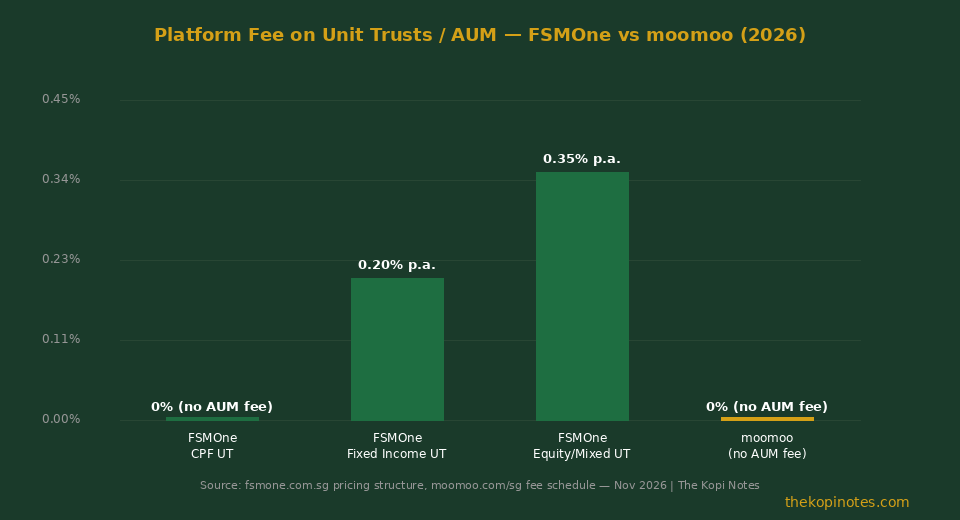
FSMOne’s headline fee is 0% sales charge on every one of its 1,500+ unit trusts — a genuine structural advantage over the 3–5% up-front sales charges many bank-distributed funds still carry elsewhere. In exchange, FSMOne charges a small recurring platform fee on cash and SRS-held equity and mixed unit trusts (around 0.35% p.a., billed quarterly), dropping to roughly 0.20% p.a. for fixed income funds. CPF-held unit trusts pay no platform fee at all — a detail that matters a lot if you are investing CPF-OA or CPF-SA money through FSMOne’s CPFIS-approved fund list.
moomoo has no fund shelf, so none of that applies. Its cost structure instead runs through per-trade commission and platform fees: SG stocks and ETFs cost roughly 0.03% commission plus 0.03% platform fee with a combined minimum around S$1.98 per trade, while US stocks and ETFs are commission-free with a flat US$0.99 platform fee per order. There is no AUM-based or annual account fee on either platform — the entire cost difference comes down to whether you’re paying a recurring platform fee on fund holdings (FSMOne) or a per-trade fee on direct positions (moomoo).
| Fee Type | FSMOne | moomoo |
|---|---|---|
| Unit trust sales charge | 0% (permanent, all 1,500+ funds) | N/A — no unit trusts offered |
| Platform fee — cash/SRS equity & mixed UT | ~0.35% p.a. (0.0875%/quarter) | N/A |
| Platform fee — cash/SRS fixed income UT | ~0.20% p.a. | N/A |
| Platform fee — CPF-held unit trusts | 0% — no platform fee at all | N/A — CPF unit trusts not offered |
| SG stock/ETF commission | 0.08% (ETF trades), min S$8.80 | 0.03% commission + 0.03% platform fee, min S$1.98 combined* |
| US stock/ETF commission | Available via FSM Trade; contact for current schedule | US$0 commission + US$0.99 platform fee per order |
| Annual/AUM account fee | None (platform fee above is the only recurring cost) | None |
Source: fsmone.com.sg pricing structure and moomoo.com/sg fee schedule, Nov 2026. *moomoo SG stock fee reflects standard post-promo rate confirmed via TKN’s own live moomoo Singapore review (PostID 14387, Oct 2026); introductory promos may apply for new accounts — check the moomoo app for your current rate.
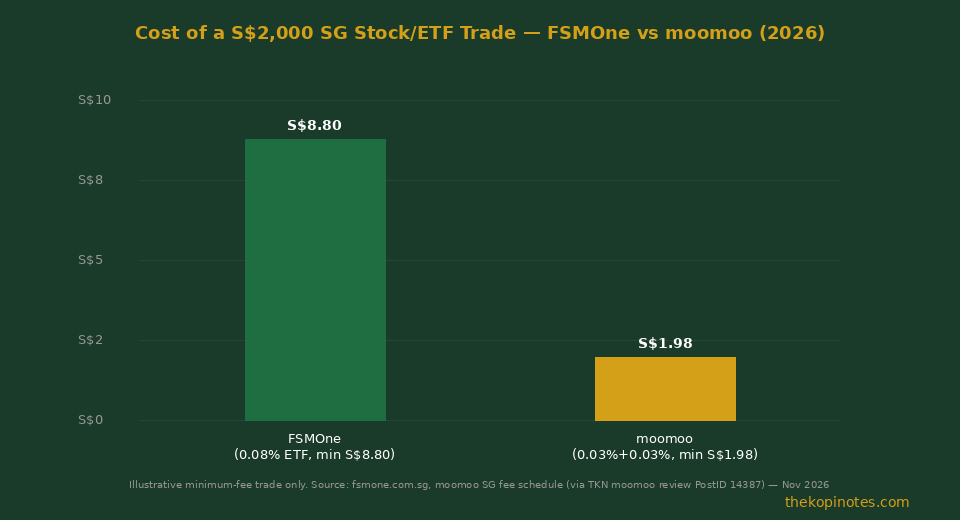
Run the numbers on a small SG stock or ETF trade and the gap is stark: an S$8.80 minimum fee on FSMOne versus roughly S$1.98 on moomoo for the same trade size. But that comparison only applies if you’re trading stocks and ETFs directly — it says nothing about unit trust fund investing, which moomoo does not offer at all.
CPF and SRS Access Compared
This is where the two platforms diverge most sharply for Singapore investors. FSMOne is a long-standing CPFIS-approved platform with a deep list of CPF-OA and CPF-SA eligible unit trusts, bonds and selected ETFs — and as noted above, CPF-held unit trusts pay zero platform fee. For an investor who wants to actively manage CPF money across a wide fund universe, FSMOne’s CPF support is considerably broader than moomoo’s.
moomoo’s CPF access is narrower: through its CPFIA (CPF Investment Account) integration, CPF-OA funds can only buy a short list of CPFIS-approved ETFs and shares (such as the SPDR STI ETF), at the same per-trade commission and platform fee structure as a cash trade. SRS money fares a little better on moomoo — it can be invested in select SGX-listed products through a linked SRS account — but the product list is still narrower than FSMOne’s SRS-eligible universe of unit trusts, bonds and stocks.
| Feature | FSMOne | moomoo |
|---|---|---|
| CPF Ordinary/Special Account | Supported — CPFIS-approved, 1,500+ unit trusts, 0% platform fee | Limited — CPFIA, select CPFIS-approved ETFs/shares only |
| SRS investing | Supported — unit trusts, bonds, SG/US/HK stocks & ETFs | Supported — linked SRS account, select SGX-listed products only |
| Product range | 1,500+ unit trusts, bonds, SG/US/HK/China stocks & ETFs | SG, US, HK, China & other global stocks and ETFs — no unit trusts |
| Robo-advice / auto-rebalancing | Not included — fully self-directed fund picking | Not included — fully self-directed stock/ETF picking |
| Best for | CPF/SRS unit trust investors wanting 0% sales charge & 0% CPF platform fee | Cost-conscious direct stock/ETF traders, mostly cash accounts |
Source: fsmone.com.sg and moomoo.com/sg official product pages, cross-checked against TKN’s own live syfe-vs-moomoo-singapore-2026 (PostID 16423) and endowus-vs-moomoo-2026 (PostID 16182) CPFIA/SRS figures, Nov 2026.
If your CPF or SRS strategy leans on diversified funds rather than individual ETFs or shares, FSMOne’s broader CPFIS approval list makes it the more flexible choice. If you only want a handful of SG-listed ETFs inside your CPFIA, moomoo’s limited list may still cover what you need at a lower per-trade cost.
Product Range & What You Can Actually Buy
FSMOne gives you unit trusts (over 1,500, across equity, bond, balanced and money market categories), bonds, and direct stock/ETF brokerage covering Singapore, the US, Hong Kong and China via its FSM Trade arm. This breadth is why FSMOne remains a common first stop for investors who want a single CPFIS/SRS-approved platform covering both managed funds and direct securities.
moomoo covers direct stocks, ETFs and options across Singapore, the US, Hong Kong, China and several other markets, plus a cash management feature (Cash Plus) for idle balances. There is no unit trust offering on moomoo at all — if a specific fund strategy only exists as a unit trust (common for bond and money market strategies), moomoo simply cannot hold it.
For investors who want advice and automatic rebalancing rather than picking funds or stocks themselves, neither platform delivers that — see our Endowus vs FSMOne comparison or Syfe vs moomoo comparison for how managed robo-advisor options stack up against each of these two platforms individually.
Who Actually Wins?
FSMOne is the better fit if:
- You want to invest CPF-OA or CPF-SA money across a wide range of CPFIS-approved unit trusts, bonds or ETFs with zero platform fee on CPF holdings
- You prefer 0% sales charge fund investing over picking individual stocks
- You want SRS flexibility across unit trusts, bonds and direct securities, not just a short list of SGX products
moomoo is the better fit if:
- You want to trade SG, US, HK or China stocks and ETFs directly at a low per-trade cost with no AUM fee
- Your CPF strategy only needs a narrow set of SGX ETFs or shares already on moomoo’s CPFIA-approved list
- You don’t need unit trusts or bonds at all, and prefer picking your own securities over fund investing
Many Singapore investors end up using both: FSMOne for CPF/SRS fund exposure and bond allocations, moomoo (or a similar broker) for cash-account direct stock and ETF trading. See our CPF investment strategy guide for how to split CPF money across platforms and products.
How to Get Started
Opening a FSMOne account: Sign up online with Singpass/NRIC verification, link your CPF Investment Account (CPFIA) if you plan to invest CPF-OA funds, and fund via PayNow, bank transfer or GIRO. Use our FSMOne referral code when signing up.
Opening a moomoo account: Sign up via the moomoo app, complete KYC verification, and fund your cash account via FAST transfer or linked bank account. To add CPFIA access for the limited ETF/share list, link your existing CPFIA during or after onboarding. Use our moomoo referral code for the current sign-up bonus.
Whichever platform — or combination — you choose, run your numbers through our Singapore retirement calculator to see how fund versus direct-stock allocations affect your long-term retirement plan, and check our passive income Singapore guide for how CPF, SRS and cash allocations typically fit together.
Not financial advice. For educational purposes only. Always consider your own financial situation and consult a licensed financial adviser before investing. Fee data as at November 2026, sourced from fsmone.com.sg and moomoo.com/sg official fee schedules.
Frequently Asked Questions
Is FSMOne or moomoo better for CPF investing?
FSMOne offers broader CPF-OA and CPF-SA access through its CPFIS-approved unit trust, bond and ETF list, with zero platform fee on CPF-held unit trusts. moomoo’s CPF access is limited to a short list of CPFIS-approved ETFs and shares through its CPFIA integration, at the same per-trade fee as a cash trade. If you want to invest CPF money across diversified funds, FSMOne has the wider product range.
Does moomoo charge a sales charge like FSMOne?
No — the comparison doesn’t apply directly. FSMOne’s 0% sales charge applies to unit trusts, a product moomoo does not offer at all. moomoo instead charges a per-trade commission and platform fee on stock and ETF orders (roughly 0.03%+0.03% for SG trades, US$0.99 flat platform fee for US trades), with no sales charge concept since there are no funds involved.
Can I invest SRS funds on both FSMOne and moomoo?
Yes, both support SRS investing, but the product range differs. FSMOne’s SRS-eligible universe spans unit trusts, bonds and direct stocks/ETFs across several markets. moomoo’s SRS support works through a linked SRS account limited to select SGX-listed products, so it is narrower than FSMOne’s fund-inclusive SRS list.
Which platform is cheaper for buying an SG-listed ETF?
For a direct ETF trade, moomoo is typically cheaper on a small trade size — its combined commission and platform fee minimum sits around S$1.98 versus FSMOne’s 0.08% commission with an S$8.80 minimum. On larger trade sizes the percentage-based fees converge, so check both fee schedules against your typical trade size before deciding.
Does either FSMOne or moomoo offer robo-advice or auto-rebalancing?
No. Both platforms are self-directed — you choose your own funds (FSMOne) or stocks/ETFs (moomoo) and manage rebalancing yourself. If you want a managed, auto-rebalanced portfolio instead, compare robo-advisors like Endowus or Syfe, covered in our Endowus vs FSMOne and Syfe vs moomoo comparisons.
Can I use both FSMOne and moomoo at the same time?
Yes, and many Singapore investors do — using FSMOne for CPF/SRS unit trust and bond exposure (where its zero CPF platform fee and 0% sales charge matter most), while using moomoo for direct cash-account stock and ETF trading at a lower per-trade cost. There is no restriction on holding accounts with both platforms simultaneously.
Ready to Open an Account?
Whether you need broad CPF/SRS fund access or low-cost direct stock trading, pick the platform that matches how you actually invest.
This article was researched with the help of AI. While we strive to keep all information accurate and up to date, there may be errors. If you notice any discrepancies, please contact us.