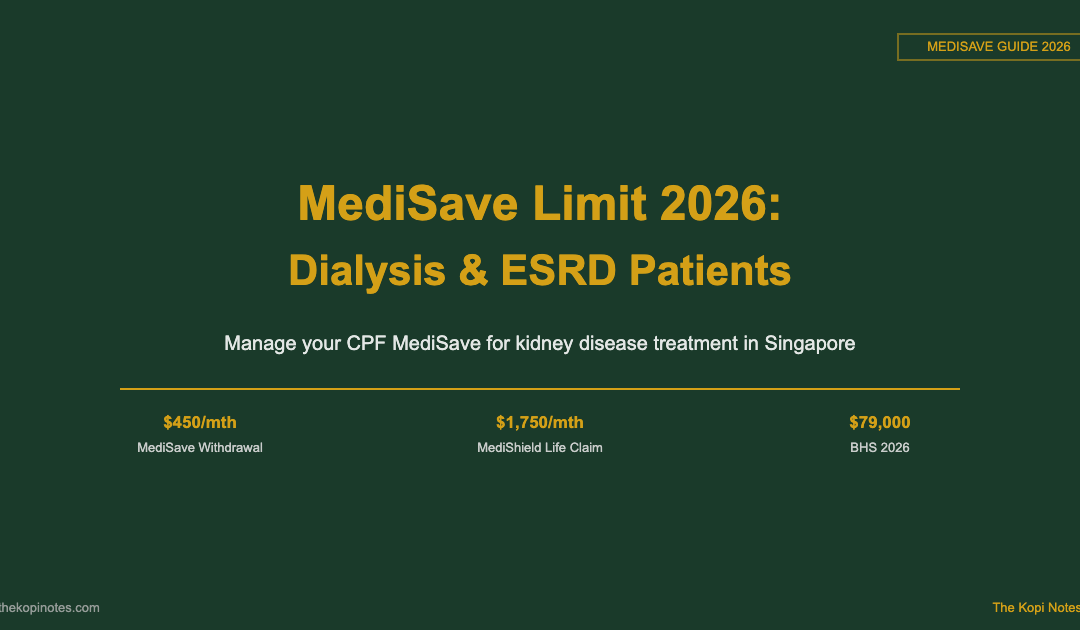
MediSave Limit 2026: Dialysis and Kidney Disease Treatment — What ISP Covers in Singapore
What Singapore’s MediShield Life and Integrated Shield Plans actually pay for dialysis — and how much you’ll owe out of pocket.
The MediSave limit for kidney dialysis in Singapore was raised to $1,750 per month in April 2025 — a 59% jump from the previous $1,100 cap. If you or a family member relies on dialysis, MediShield Life now covers more of the monthly bill, and an Integrated Shield Plan (ISP) rider can push that coverage even further, potentially reducing your out-of-pocket cost to near zero at subsidised centres.
Not financial advice. All figures are for educational reference only. Data verified as at 14 November 2026.
Table of Contents
Contents — Click to expand
- MediSave Limits for Dialysis 2026
- What Does Dialysis Cost in Singapore?
- What MediShield Life Covers for Kidney Dialysis
- How ISP Riders Extend Your Dialysis Coverage
- Out-of-Pocket Scenarios — What You Actually Pay
- Government Subsidies and Medifund for Dialysis
- Choosing the Right ISP If You Have Kidney Disease
- Frequently Asked Questions
MediSave Limits for Dialysis 2026
Singapore uses a tiered system to fund chronic kidney disease treatment. MediSave — your personal CPF medical savings account — can be used for outpatient kidney dialysis under the MediSave 500/700 Scheme. The withdrawal limits were enhanced twice in recent years to keep pace with treatment costs.
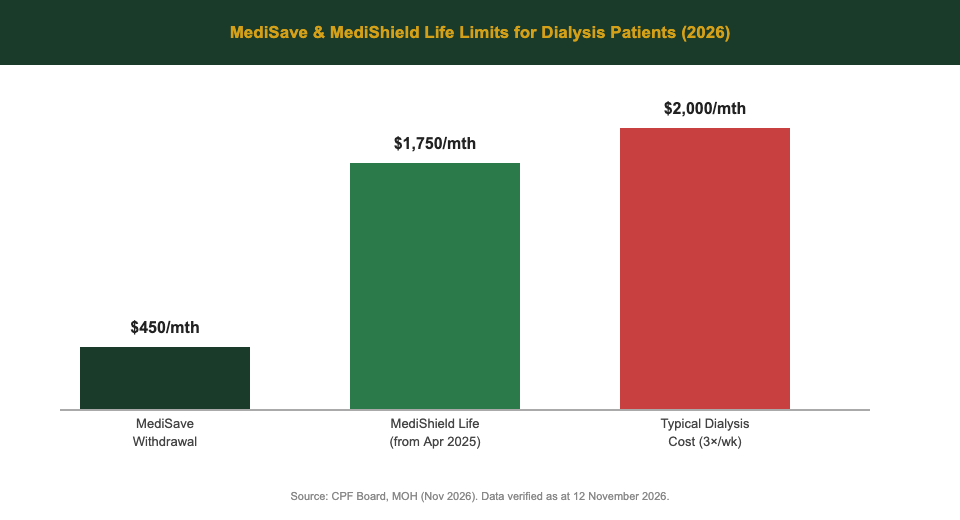
As of April 2025, the MediShield Life claim limit for kidney dialysis was raised to $1,750 per month. This replaced the previous cap of $1,100 per month that had been in place since earlier revisions. The increase was confirmed by MOH in Parliament on 3 February 2026 and reflected in the MOH MediShield Life Benefits Table (updated June 2026). For MediSave outpatient withdrawals specifically, patients can claim up to $450 per month under the MediSave 500/700 Scheme for dialysis at ESRD Treatment Centres — this is separate from MediShield Life inpatient claims.
| Benefit / Limit | 2024 (Before) | 2025–2026 (Current) |
|---|---|---|
| MediShield Life dialysis claim limit | $1,100/month | $1,750/month |
| MediSave 500 outpatient withdrawal | $400/month | $450/month |
| Increase in MSL coverage | — | +$650/month (+59%) |
| Effective date | — | 1 April 2025 |
Source: MOH MediShield Life Benefits Table (updated 3 June 2026, applicable 1 June 2026); MOH Parliamentary QA, 3 February 2026.
These limits apply to both haemodialysis (HD) and peritoneal dialysis (PD). Haemodialysis is the more common form in Singapore — typically three sessions per week at a dialysis centre — while peritoneal dialysis is done at home and may have a different cost structure. If you’re managing long-term care costs in Singapore, understanding these limits is a critical planning step.
What Does Dialysis Cost in Singapore?
The full, unsubsidised cost of haemodialysis in Singapore runs between $1,500 and $2,500 per month, depending on the type of centre and session frequency. At subsidised voluntary welfare organisation (VWO) dialysis centres — such as the National Kidney Foundation (NKF) and Kidney Dialysis Foundation (KDF) — government subsidies dramatically reduce what you pay.
For Singapore Citizens and Permanent Residents receiving outpatient dialysis at an accredited ESRD Treatment Centre, government subsidies can cover 75–85% of the treatment cost. After subsidies, the typical out-of-pocket range before MediSave and ISP kicks in is:
- Subsidised haemodialysis at NKF/KDF: approximately $550–$850 per month before MediSave
- Restructured hospital haemodialysis (Class B2/C): approximately $800–$1,200 per month before MediSave
- Private hospital dialysis (Class A/B1): $3,500–$6,500 per month before insurance
For patients who require hospitalisation for acute kidney complications — such as acute kidney injury (AKI) or complications from chronic kidney disease (CKD) — a standard inpatient admission can cost $3,000–$12,000+ before the MediShield Life and ISP claims process begins. This is where understanding when your ISP actually pays out becomes critical.
What MediShield Life Covers for Kidney Dialysis
MediShield Life is Singapore’s mandatory basic health insurance — it covers every resident and cannot be opted out of. For kidney dialysis, MediShield Life provides a monthly outpatient claim limit rather than the per-admission structure used for inpatient bills.
From April 2025, the MediShield Life monthly claim limit for kidney dialysis is $1,750. This is applied after the government subsidy has been deducted from the total dialysis bill. Here’s how the claim flows:
- You receive dialysis at an accredited centre (NKF, KDF, or restructured hospital)
- Government subsidies reduce the total bill (75–85% for citizens at VWO centres)
- MediShield Life pays up to $1,750 of the remaining subsidised bill per month
- Your MediSave (up to $450/month) can then be used to cover any remaining balance
- If there is still a remaining balance, you pay cash — or your ISP covers it
For most Singaporeans receiving dialysis at subsidised VWO centres, the combination of government subsidies + MediShield Life claim + MediSave withdrawal means their monthly cash outlay is minimal or zero. Medifund (for those who qualify financially) can bridge any remaining gap. The challenge arises for patients who opt for higher ward classes or private hospitals — the subsidies disappear, and the $1,750 MediShield Life cap becomes the full extent of basic coverage.
It’s worth noting that pre-existing conditions matter here. If your kidney disease was diagnosed before you joined an ISP, it may be excluded under pre-existing condition exclusions in your ISP. MediShield Life, however, cannot exclude pre-existing conditions — coverage is guaranteed regardless of health history.
How ISP Riders Extend Your Dialysis Coverage
An Integrated Shield Plan (ISP) is a private health insurance plan that sits on top of MediShield Life. Five insurers offer ISPs in Singapore: AIA, Great Eastern, Income (NTUC), Prudential, and Singlife. Each offers Base Plan coverage plus optional riders — and it’s the riders that make a substantial difference for dialysis costs.
Without a rider, most ISP Base Plans follow the same benefit structure as MediShield Life but with higher claim limits. With a Standard Co-payment Rider (now capped at 5% co-payment under MOH’s October 2021 rider rules), your insurer absorbs 95% of the bill above MediShield Life’s claim. With a full rider — if you bought one before the rule change took effect — you may still have zero co-payment on covered treatments.
| Coverage Tier | Monthly Coverage | Co-pay | Best For |
|---|---|---|---|
| MediShield Life only | Up to $1,750/month | 100% above limit | Subsidised centres (Class B2/C) |
| ISP Base Plan (no rider) | $1,750–$3,250/month | Deductible + co-insurance | Class B1 restructured hospitals |
| ISP with Standard Co-pay Rider | Up to $6,500/month | 5% co-payment | Class A / Private hospitals |
| ISP Full Rider (pre-2021) | As per plan limit | 0% (fully covered) | Class A / Private hospitals |
Source: MOH ISP Base Plan Benefit Table; insurer prospectuses (2026). Figures are indicative — actual benefit limits vary by insurer and plan tier.
One important consideration: some ISPs have specific inpatient dialysis day-surgery limits that apply when you’re hospitalised for a procedure related to kidney disease. These are separate from the outpatient dialysis monthly limits. If you’re evaluating whether your current ISP is adequate for a potential kidney condition, checking both the outpatient and inpatient dialysis benefit schedules is essential. You can read about the broader question of what your ISP pays without a rider in our detailed worked-example guide.
Out-of-Pocket Scenarios — What You Actually Pay
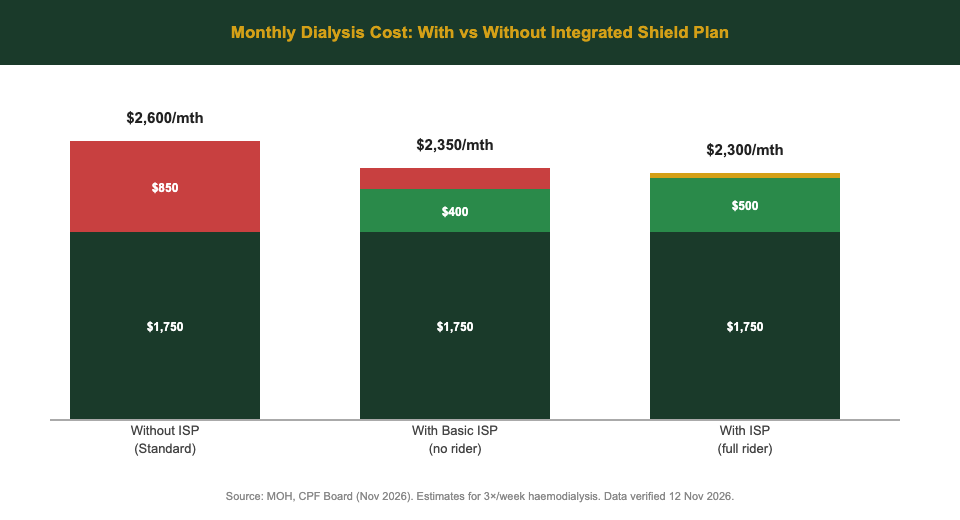
To make these numbers concrete, here are three worked scenarios for a Singapore Citizen receiving haemodialysis three times a week (approximately 13 sessions per month). We assume a total unsubsidised monthly cost of $6,500.
Scenario A — Subsidised VWO Centre (NKF/KDF), no ISP rider:
Government subsidy (75%): −$4,875 → Bill = $1,625
MediShield Life claim: −$1,625 (within $1,750 limit)
MediSave withdrawal: $0 needed
Cash out-of-pocket: $0
Scenario B — Class B1 Restructured Hospital, ISP Base Plan (no rider):
No government subsidy for Class B1 → Bill = $6,500
MediShield Life claim: −$1,750
ISP Base Plan covers deductible + co-insurance above MSL
Estimated net after ISP base: ~$1,200–$1,800/month depending on plan
MediSave withdrawal: −$450
Cash out-of-pocket: ~$750–$1,350/month
Scenario C — Class A / Private Hospital, ISP with Standard Co-pay Rider:
No government subsidy → Bill = $6,500
ISP covers 95% of the bill above MediShield Life’s base
5% co-payment applies
Cash out-of-pocket: ~$0–$325/month
The difference between Scenarios B and C is significant. If you are managing a family member’s chronic kidney disease long-term — dialysis is a lifelong commitment for end-stage renal disease (ESRD) patients — the annual difference between having a rider and not having one can amount to $9,000–$16,000 per year. This is why healthcare financial planning is inseparable from ISP decisions. Our Singapore retirement calculator includes healthcare cost modelling for exactly this kind of ongoing expense.
Government Subsidies and Medifund for Dialysis
Singapore’s approach to dialysis costs combines multiple layers of support beyond MediShield Life and ISP:
MOH Subsidies for ESRD Treatment Centres (ETC): From 1 July 2025, the government enhanced subsidies at accredited ETCs. Singapore Citizens receiving dialysis at NKF, KDF, or other accredited ETCs receive tiered subsidies based on household per capita income (PCI). Citizens in the lowest income tiers receive up to 85% subsidy on the total dialysis bill, while those in higher income brackets receive 50–70%.
MediFund for Patients Who Cannot Pay: Medifund is Singapore’s safety-net endowment fund for patients who have exhausted their MediSave and face difficulty paying residual bills. Dialysis patients who qualify can apply through their dialysis centre’s medical social worker. Medifund applications are assessed based on the patient’s financial situation and are not means-tested in the same way as a means-testing assessment for subsidies — it is a discretionary fund.
MediFund Silver: For patients aged 65 and above, MediFund Silver provides enhanced assistance. Many elderly dialysis patients — kidney disease disproportionately affects those 60 and older — qualify for MediFund Silver, which can cover residual amounts after subsidies, MediShield Life, and MediSave have been applied.
The practical implication: a Singaporean Citizen receiving dialysis at a subsidised VWO centre, with MediShield Life, MediSave, and Medifund support, should face minimal or zero monthly cash outlay. The financial burden is highest for those choosing private hospitals, those without adequate MediSave balances, or Permanent Residents (who receive lower subsidy rates). For more complex questions about managing long-term healthcare costs, the real cost of hospitalisation in Singapore guide covers the full picture with worked examples.
Choosing the Right ISP If You Have Kidney Disease
If you already have chronic kidney disease (CKD) — or a family history of it — the question of ISP selection is more complicated than for healthy applicants. Here’s what to know:
Pre-existing condition exclusions apply at policy inception. If you are diagnosed with CKD before applying for an ISP, insurers may exclude kidney-related conditions from coverage. This means dialysis triggered by your pre-existing kidney disease would not be covered by the ISP — only MediShield Life would apply. The exclusion does not affect MediShield Life itself, which cannot exclude any pre-existing condition. For a detailed explanation of how these exclusions work, read our guide on pre-existing condition exclusions in ISPs.
If you are healthy now, buy ISP coverage early. Kidney disease can develop from diabetes (the leading cause of ESRD in Singapore), hypertension, or other conditions. Getting an ISP with a rider while you’re healthy — before any kidney markers appear in your bloodwork — locks in coverage that cannot be retroactively excluded. This is similar to the advice for spine and joint conditions covered in our medisave limit guide for spine surgery.
ISP premium increases are a long-term consideration. As you age and dialysis costs rise, ISP premiums also increase. Under the current MediSave limit of $3,900 per year (the 2026 MediSave limit for ISP premium payments), you can use MediSave to pay for both your ISP base plan and a standard co-payment rider. Any premium above the MediSave limit must be paid in cash. Planning your CPF MediSave balance — especially through the CPF investment strategy — ensures you don’t face a cash shortfall on premiums when you need coverage most.
Key questions to ask your ISP insurer if you have kidney disease risk:
- Does your plan have a specific outpatient dialysis benefit with a monthly cap?
- Is peritoneal dialysis covered under the outpatient benefit, or only under inpatient?
- Are kidney transplant-related costs — including post-transplant immunosuppressants — covered?
- What is the lifetime benefit limit for dialysis-related claims?
Frequently Asked Questions
What is the MediSave limit 2026 for kidney dialysis?
The MediShield Life claim limit for kidney dialysis in 2026 is $1,750 per month, effective from 1 April 2025. This is a 59% increase from the previous $1,100 monthly cap. Separately, the MediSave outpatient withdrawal limit for dialysis at accredited ESRD Treatment Centres is $450 per month. These two limits stack on top of government subsidies to reduce your out-of-pocket cost.
Does ISP cover dialysis treatment in Singapore?
Yes, Integrated Shield Plans (ISPs) can cover dialysis, but coverage depends on your plan tier and whether you have a rider. The ISP Base Plan provides coverage above MediShield Life’s claim limits, with deductibles and co-insurance applying. If you have a Standard Co-payment Rider, your insurer covers 95% of the dialysis bill above MediShield Life’s base claim, with a 5% co-payment on your side. Dialysis due to a pre-existing kidney condition diagnosed before policy inception may be excluded under your ISP’s pre-existing condition clause — but MediShield Life always covers it regardless.
How much does dialysis cost per month in Singapore with government subsidies?
For Singapore Citizens receiving haemodialysis at a subsidised VWO centre (such as NKF or KDF), the total out-of-pocket cost after government subsidies, MediShield Life claims, and MediSave withdrawals is typically $0 per month for lower-income citizens. The government subsidy alone covers 75–85% of the treatment cost. Those receiving dialysis at Class B1 or Class A hospitals without a rider can expect monthly cash out-of-pocket costs of $750–$1,800 or more.
Can I use MediSave for outpatient kidney dialysis?
Yes. Under the MediSave 500/700 Scheme, you can use MediSave for outpatient kidney dialysis at accredited ESRD Treatment Centres. The withdrawal limit is $450 per month. This is in addition to the MediShield Life monthly claim of $1,750. Both limits apply after government subsidies have been deducted from the total bill.
Will my ISP cover dialysis if I already have kidney disease?
It depends on when your kidney disease was diagnosed. If you were diagnosed before applying for the ISP, your insurer may impose a pre-existing condition exclusion on kidney-related treatments, meaning dialysis would not be covered by the ISP. However, MediShield Life — the base mandatory insurance — cannot apply such exclusions and will still pay up to $1,750 per month for dialysis regardless of pre-existing conditions. If you are applying for an ISP while still healthy (before any kidney diagnosis), dialysis would typically be a covered benefit.
What is Medifund and can dialysis patients apply for it?
Medifund is Singapore’s endowment safety-net fund for patients who have exhausted their MediSave and face difficulty paying residual medical bills. Dialysis patients who qualify — typically those with low household income and limited savings — can apply through their dialysis centre’s medical social worker. Medifund applications are discretionary and assessed case by case. For patients aged 65 and above, MediFund Silver provides enhanced assistance. With Medifund support, most low-income dialysis patients should face zero cash outlay at subsidised centres.
Does ISP cover kidney transplant costs?
Most ISP plans cover kidney transplant surgery as an inpatient procedure, subject to the plan’s surgical benefits schedule. However, long-term post-transplant immunosuppressant medication — which patients must take for life after a transplant — may only be partially covered or not covered as an outpatient drug benefit depending on the plan. If you are on the kidney transplant waitlist, review your ISP’s specific transplant and post-transplant drug benefits carefully and confirm with your insurer in writing before the procedure.
Review Your ISP Coverage for Kidney Disease
If you’re evaluating whether your current ISP provides adequate coverage for dialysis and kidney disease treatment, speaking with a licensed financial adviser is the most effective way to compare the five ISP providers in Singapore side by side.
Disclaimer: This article is for general educational reference only and does not constitute financial, medical, or insurance advice. All figures cited are based on publicly available MOH data as at 14 November 2026. Actual costs and coverage vary by individual circumstances, insurer, and plan selected. Please consult a licensed financial adviser and your treating physician for personalised guidance.
Get Free Insurance Advice
Speak with a licensed insurance advisor. No obligation, no cost.
By submitting this form, you agree to our Privacy Policy.
This article was researched with the help of AI. While we strive to keep all information accurate and up to date, there may be errors. If you notice any discrepancies, please contact us.