Why 112,000 Singaporeans Dropped Their IP Riders in 2025 — And What It Means for Your Medisave Limit 2026
A data-backed breakdown of the 2025 rider cancellation wave, rising premium costs, and what policyholders should do before the 2028 legacy rider transition deadline.
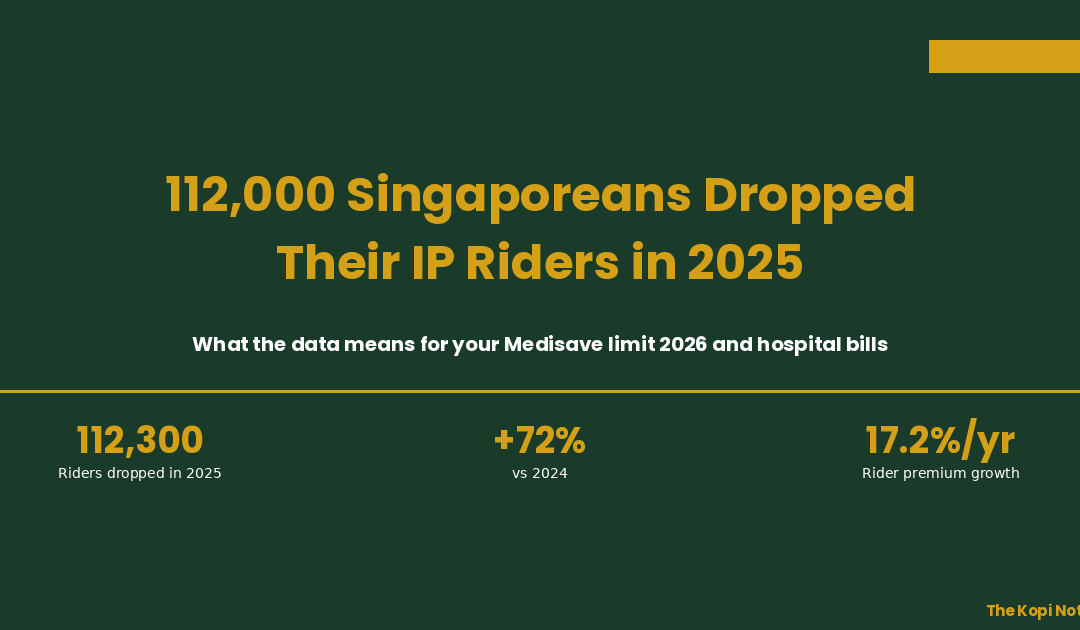
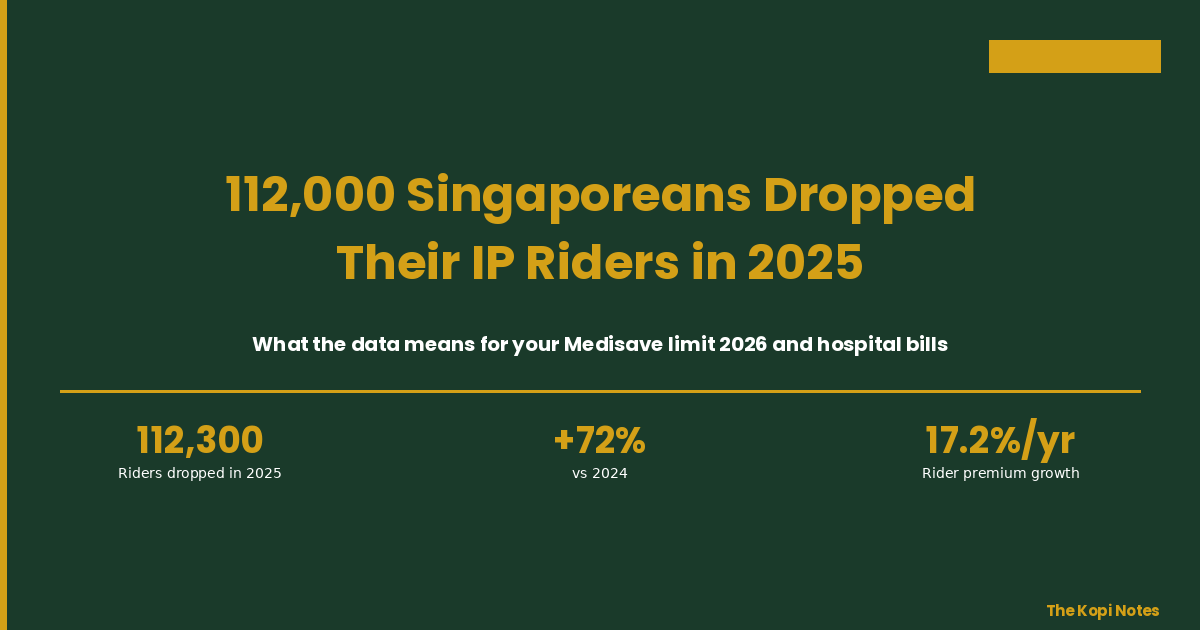
Over 112,000 Singaporeans cancelled their Integrated Shield Plan (IP) riders in 2025 — a 72% jump from the 65,000 who did so in 2024, according to Ministry of Health data. With private hospital rider premiums rising at 17.2% per year (more than double the base plan’s 8.6% rate), the financial pressure is real. Here’s what the latest data tells you about your own medisave limit 2026 strategy and whether keeping your rider still makes sense.
Not financial advice. All figures are for educational reference only. Data verified as at 11 November 2026 against official MOH and CPF sources.
Table of Contents
Contents — Click to expand
The 2025 IP Rider Drop: What the Numbers Show
The numbers are stark. According to data from MOH’s spokesperson — shared with The Straits Times in October 2026 — the number of Singaporeans who ceased their IP riders in 2025 jumped to 112,300. That’s nearly double the 65,000 who cancelled in 2024, and a sharp acceleration from the 66,100 who did so in 2023.
When you add downgrades (policyholders who kept their rider but moved to a lower tier), the picture is even more striking. Total rider-related downgrades and cancellations reached 181,800 in 2025 — up from 103,400 in 2024 and 84,800 in 2023.
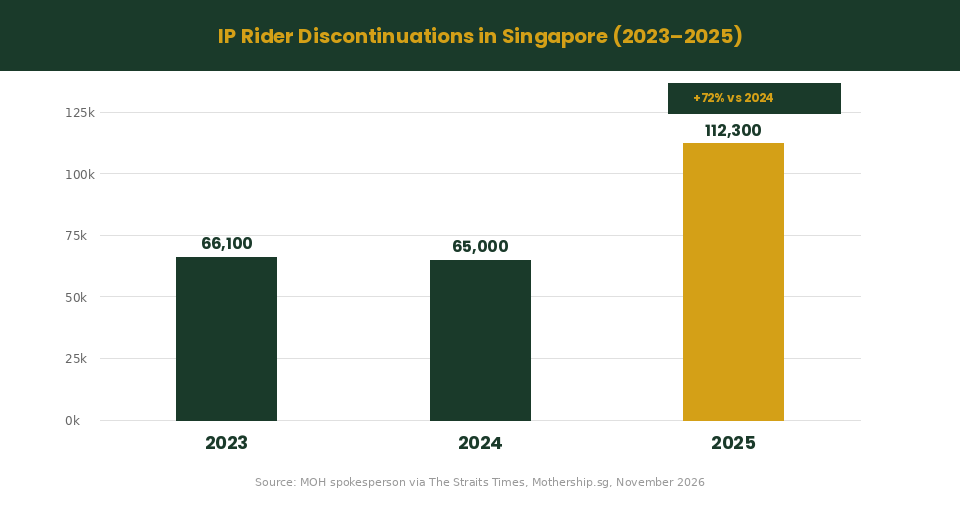
| Year | Rider Cessations | Downgrades | Total Rider Changes |
|---|---|---|---|
| 2023 | 66,100 | 18,700 | 84,800 |
| 2024 | 65,000 | 38,300 | 103,400 |
| 2025 | 112,300 (+72%) | 69,400 | 181,800 |
Source: MOH spokesperson via The Straits Times; Mothership.sg, November 2026. Numbers rounded to nearest hundred.
Among those who reduced coverage in 2025, over 60% stopped their riders entirely, while just under 40% downgraded to a lower tier. This suggests that for many policyholders, the premium burden had reached a point where dropping altogether — rather than trimming — made more financial sense.
As of end-2024, about 71% of Singapore residents (~3 million people) held an Integrated Shield Plan. If you want to understand the fundamentals of how these plans work, our guide to what is an integrated shield plan explains the MediShield Life base layer and how private insurers build on top of it.
Why Rider Premiums Are Rising Twice As Fast As Base Plans
The premium data tells the story. According to a parliamentary answer given by Minister for Health Ong Ye Kung in May 2026, private hospital IP premiums in Singapore rose at an average of 8.6% per year between December 2021 and December 2024. That’s already steep — but private hospital rider premiums grew at 17.2% per year over the same period. Riders are inflating at twice the rate of the underlying plan.
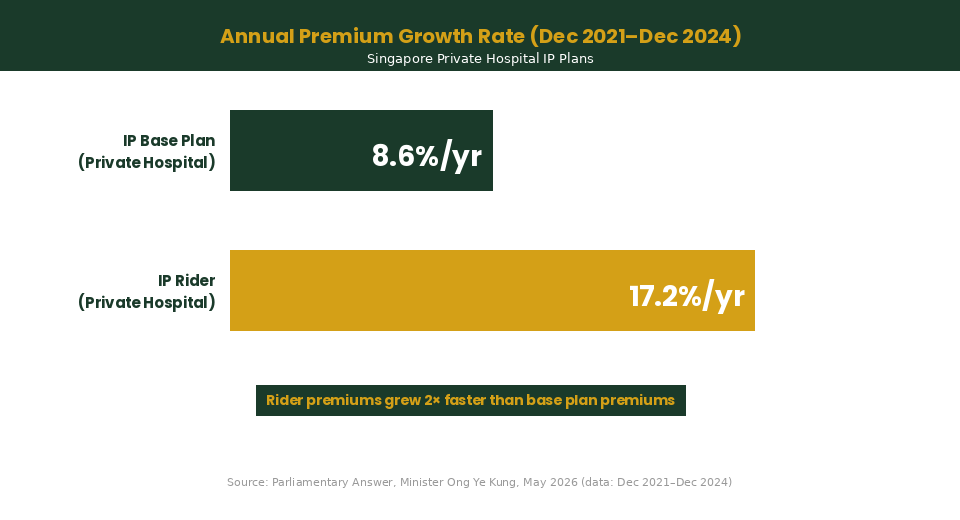
The root cause is structural: IP riders typically cover the deductible and co-payment that the base plan requires the patient to pay. As private hospital bills rise, the amount the rider has to absorb climbs too — and because riders attract policyholders who use private hospitals heavily, the insurer faces concentrated, high-cost claims. The result is a feedback loop of escalating premiums.
MOH has described this dynamic as “over-servicing risk” — when comprehensive rider coverage reduces the patient’s cost sensitivity, leading to higher average claims. The new rider framework launched on 1 April 2026 specifically addresses this by requiring all new riders to include meaningful co-payments, restoring some cost accountability.
The age dimension compounds the problem further. Annual rider premiums for a policyholder aged 70 can reach up to S$9,000 per year — and even more at older ages. According to The Straits Times, rider premiums roughly triple between ages 50 and 70, meaning what costs S$3,000/year at 50 becomes S$9,000/year by 70.
The Real Annual Cost of Your IP Rider in 2026
When you combine the base IP premium and the rider, the total annual outlay can be significant. For IP holders with riders, the combined annual premium (base plan + rider) can range from approximately S$12,700 to S$22,700 per year, depending on insurer, coverage tier, and age. These figures were highlighted in The Straits Times analysis of late 2026.
| Coverage Level | Base IP Premium (est.) | Rider Premium (est.) | Total Annual Cost |
|---|---|---|---|
| Class B1 Private Hospital (lower tier) | ~S$2,000-S$5,000 | ~S$1,500-S$4,000 | ~S$3,500-S$9,000 |
| Private Hospital (higher tier, age 50+) | ~S$4,000-S$8,000 | ~S$3,000-S$6,000 | ~S$7,000-S$14,000 |
| Private Hospital (legacy rider, age 65-70) | ~S$6,000-S$12,000 | ~S$6,000-S$9,000+ | ~S$12,700-S$22,700+ |
Source: The Straits Times, October 2026; MOH forum reply via Mothership.sg, November 2026. Estimates vary by insurer and exact age band. Not a quote or recommendation.
At these levels, many policyholders — particularly retirees on fixed incomes — are facing a painful choice between health security and financial sustainability. The wave of cancellations in 2025 reflects this reality playing out across hundreds of thousands of households.
If you are weighing your options, our detailed guide on what a hospital bill looks like without an IP rider shows real worked examples of out-of-pocket costs at different ward classes and claim sizes.
How the Medisave Limit 2026 Fits Into Your IP Strategy
The Medisave limit 2026 — specifically the Basic Healthcare Sum (BHS) — is set at S$79,000 for 2026, as confirmed by CPF Board. This is the cap on how much can accumulate in your MediSave Account; amounts above this are transferred to your Special or Retirement Account. The BHS rises yearly to reflect increased healthcare costs.
MediSave can pay for IP premiums within certain limits. CPF sets MediSave withdrawal limits for IP base plan premiums by age band. Crucially, rider premiums cannot be paid using MediSave — they must be paid in cash. This is a critical distinction that many policyholders overlook.
What this means in practice: as your base IP premium ages up and exceeds the MediSave withdrawal limit for your age band, the excess must also come from cash. Combined with the cash-only rider premium, the total annual out-of-pocket healthcare insurance expense can become a significant burden — particularly in retirement when regular income stops.
Planning for this is part of a coherent retirement strategy. Our Singapore retirement planning calculator can help you stress-test how rising healthcare premiums affect your retirement runway.
For a full breakdown of the BHS and how it interacts with IP premiums, see our guide to the MediSave cap 2026 and BHS. For the complete withdrawal limit rules, see our MediSave limit 2026 guide.
Legacy Rider vs New 2026 Rider: The 35-40% Premium Gap
On 1 April 2026, MOH’s new IP rider framework took effect. All new riders sold from this date must include mandatory co-payments, replacing the near-cashless model that legacy riders offered. The key question for existing legacy rider holders is: what are you giving up — and what do you save?
According to MOH’s September 2026 parliamentary reply, the average premium reduction under new compliant riders is approximately 35% to 40% compared with legacy riders offering maximum coverage — though the exact saving depends on your age band and insurer.
This is not a small number. For a policyholder paying S$6,000/year for a legacy rider, switching to a new compliant rider could save S$2,100-S$2,400 per year. The trade-off is that you will pay co-payments when you use the plan — the new riders are designed to restore cost accountability rather than eliminating all out-of-pocket exposure at the point of care.
MOH has set the April 2028 deadline for a specific group: policyholders who purchased riders during the 27 November 2025 to 31 March 2026 window must transition to compliant riders by their next policy renewal from April 2028. For those with legacy riders purchased before November 2025, individual insurers are deciding when and how to handle the transition. For a full timeline, see our guide to the ISP legacy rider transition 2028.
MOH noted in September 2026 that it was “too early to assess trends in policyholder movements” since the April 2026 launch, so the voluntary switching rate is not yet publicly available. What is clear is that those who act early — before the 2028 deadline — will have more time to adjust their budgets and healthcare planning accordingly.
Drop, Downgrade, or Switch? A Decision Framework
The right answer depends on your age, health status, income, and how often you use private healthcare. Here is a practical framework — not financial advice, but a structured way to think through your options.
Option 1: Keep Your Legacy Rider
Best for: Policyholders above 60 with existing conditions or high private hospital usage who value near-cashless coverage and can afford the premium. If the premium is within your MediSave-covered portion and cash budget, retaining the legacy rider preserves the most comprehensive coverage until the transition deadline.
Option 2: Downgrade to a New 2026 Compliant Rider
Best for: Policyholders under 55 who are healthy, rarely hospitalised, and want to retain the IP tier but reduce their annual premium. The 35-40% premium saving vs a legacy rider is meaningful, and the new co-payment design means you pay more at the point of care — which is acceptable if you are unlikely to claim often.
Option 3: Drop the Rider, Keep the IP Base Plan
Best for: Younger policyholders (under 45) with minimal health issues and a solid cash emergency fund. Without a rider, your IP base plan still covers the bulk of hospitalisation costs — you just pay the deductible (typically S$1,500-S$3,500) and 10% co-insurance out of pocket. If your deductible and co-insurance exposure is manageable relative to the rider premium, dropping can free up significant cash. See our analysis of the IP rider cancellation and what it means for coverage.
Option 4: Downgrade Your IP Base Plan
Best for: Policyholders who are willing to use public hospitals (Class B1 or A) rather than private hospitals. Dropping from a private hospital tier to Class B1/A coverage reduces both the base plan and rider premiums substantially, and Singapore’s restructured hospitals offer excellent care. For more context on how the current plans compare, see our ISP downgrade statistics 2026.
| Option | Premium Savings | Coverage Impact | Best For |
|---|---|---|---|
| Keep legacy rider | None | Maximum (near-cashless) | Age 60+, frequent private hospital user |
| Switch to new 2026 rider | ~35-40% | Good (with co-payment) | Age 40-59, moderate health risk |
| Drop rider, keep IP | 100% rider cost | IP base still covers bulk | Under 45, healthy, good cash buffer |
| Downgrade IP tier | Significant | Restructured hospital only | Any age, comfortable with public hospitals |
Framework only. Not financial or insurance advice. Consult a licensed financial adviser before making changes to your IP coverage.
Whatever you decide, it is important not to let coverage lapse accidentally. If you choose to cancel your rider or downgrade your IP, understand the best integrated shield plan options for Singapore 2026 before making a final decision.
Key Takeaways
- 112,300 Singaporeans cancelled their IP riders in 2025 — a 72% jump from 2024, driven by rising premiums.
- Private hospital rider premiums rose at 17.2%/year between Dec 2021-Dec 2024, twice the base plan’s growth rate.
- Annual rider premiums can reach up to S$9,000 at age 70 and roughly triple from age 50 to 70.
- The Medisave limit 2026 (BHS: S$79,000) covers only the base IP premium — rider premiums must be paid in cash.
- Switching to a new 2026 compliant rider saves approximately 35-40% on premiums vs legacy riders.
- Legacy rider holders who purchased between 27 Nov 2025 and 31 Mar 2026 must transition by April 2028.
Frequently Asked Questions
Why did 112,000 Singaporeans drop their IP riders in 2025?
Can I use MediSave to pay for my IP rider in 2026?
What is the Medisave limit 2026?
How much cheaper is a new 2026 compliant rider compared to a legacy rider?
If I cancel my IP rider, what happens to my hospital bills?
What is the 2028 legacy rider transition deadline?
Is dropping my IP rider a good idea if I am young and healthy?
Data sources: MOH spokesperson via The Straits Times and Mothership.sg (November 2026); MOH Parliamentary Reply, 8 September 2026; MOH New IP Riders page; CPF Basic Healthcare Sum 2026. Data verified as at 11 November 2026. This article is for educational reference only and does not constitute financial, insurance or medical advice. Consult a licensed financial adviser before making changes to your insurance coverage.
Get Free Insurance Advice
Speak with a licensed insurance advisor. No obligation, no cost.
By submitting this form, you agree to our Privacy Policy.
This article was researched with the help of AI. While we strive to keep all information accurate and up to date, there may be errors. If you notice any discrepancies, please contact us.