Prepaid Credit Card Singapore (2026): How They Work, Fees and Limits Without a Credit Check
YouTrip, Revolut and Wise compared on top-up costs, overseas ATM fees and spending caps, plus when a secured or regular credit card makes more sense.
A prepaid credit card in Singapore is really a prepaid or debit-style card: you top up first and spend only what you loaded, so there is no income check and no credit line. YouTrip, Revolut and Wise are the main options. All three skip the bank FX fee overseas, but they differ on free ATM allowances, card-top-up surcharges and how much you can hold or spend each year.
Not financial advice. All figures are for educational reference only. Data verified as at 21 November 2026 against each provider’s official fee pages; fees can change, so check the app before you transact.
Table of Contents
Contents — Click to expand
- What Is a Prepaid Credit Card in Singapore?
- Who Needs a Prepaid Card Instead of a Credit Card?
- Prepaid Cards Singapore Compared: YouTrip vs Revolut vs Wise
- Overseas ATM Fees: A S$1,000 Worked Example
- Top-Up Costs and Hidden Charges
- Prepaid vs Secured vs Regular Credit Card
- How to Choose (and Use) a Prepaid Card
- Frequently Asked Questions
What Is a Prepaid Credit Card in Singapore?
People search for a “prepaid credit card Singapore” because they want something that looks and works like a credit card at the checkout, online and overseas, without going through a bank’s credit approval. In practice, no Singapore bank sells a true prepaid credit card. What you get instead is a prepaid or debit-style card on the Visa or Mastercard network, linked to an app wallet that you fund before you spend.
The mechanics are simple. You top up the wallet in SGD (by PayNow, bank transfer or a card), optionally convert part of the balance into foreign currencies, and the card draws down whatever is in the wallet. When the balance hits zero, transactions are declined. There is no statement balance, no minimum payment, no interest and no late fee, because you never borrowed anything.
That last point is the whole appeal and the main limitation. A prepaid card cannot overspend, which makes it a budgeting tool and a safe card for travel or online shopping. But it also means no credit limit, no rewards on the scale of a miles card, and none of the purchase protection or travel insurance that some credit cards bundle in.
In Singapore the three names most people compare are YouTrip (a prepaid Mastercard run by You Technologies Pte. Ltd.), Revolut and Wise (both app-based accounts with a linked debit card). All three are free or cheap to open, need only your NRIC or passport details, and avoid the foreign currency fee of roughly 2.8% to 3.5% that YouTrip estimates bank-issued cards typically charge. Our guide to overseas spending credit cards in Singapore shows how that FX fee adds up on bank-issued cards.
Who Needs a Prepaid Card Instead of a Credit Card?
The Monetary Authority of Singapore sets the floor for who can get an unsecured credit card. According to the MAS explainer on issuing credit cards, banks can issue a card to someone aged up to 55 only if they earn at least S$30,000 a year, or have net personal assets above S$2 million, or net financial assets above S$1 million. For those above 55, the income bar drops to S$15,000, or net personal assets above S$750,000, or a guarantor earning at least S$30,000.
| Applicant | Qualifies for an unsecured credit card if they have… |
|---|---|
| Up to 55 years old | Annual income of at least S$30,000, OR net personal assets above S$2 million, OR net financial assets above S$1 million |
| Above 55 years old | Annual income of at least S$15,000, OR net personal assets above S$750,000, OR a guarantor earning at least S$30,000 |
| Prepaid card holder | No income test: you only spend what you top up |
Source: MAS, “Issuing Credit Cards” regulatory explainer, retrieved 21 November 2026. Income can include non-employment income such as rental income.
So a prepaid card fills the gap for several groups:
- Students and fresh graduates below the S$30,000 income line. If you do qualify for a starter card, see our student credit card guide for Singapore.
- Homemakers, retirees and gig workers whose declared income is irregular or below the threshold.
- Foreigners new to Singapore who have no local payslips yet.
- People who want a hard spending cap, for example a separate card for online subscriptions or a teenager’s allowance.
- Travellers who already hold a credit card but want a cheaper way to pay in foreign currency.
If your goal is specifically to build a credit history from scratch, a prepaid card is the wrong tool, because no credit is ever extended. That is the job of a fixed-deposit-backed card, which we cover in our secured credit card Singapore guide.
Prepaid Cards Singapore Compared: YouTrip vs Revolut vs Wise
The table below puts the three main prepaid and debit-style cards side by side on the fees that actually show up for a Singapore user. Every number comes from the provider’s own fee page or support centre, checked on 21 November 2026. Revolut figures are for the free Standard plan.
| Feature | YouTrip | Revolut (Standard) | Wise |
|---|---|---|---|
| Card network | Prepaid Mastercard | Revolut debit card | Wise debit card |
| Account / annual fee | None | Free plan | No subscription fee |
| Physical card | Free | First card free; delivery fee applies | S$8.50 one-time |
| FX on card spending | 0% FX fee, wholesale rate | Revolut rate; 1% fee on weekends and above S$5,000 a month | Mid-market rate plus a conversion fee shown upfront |
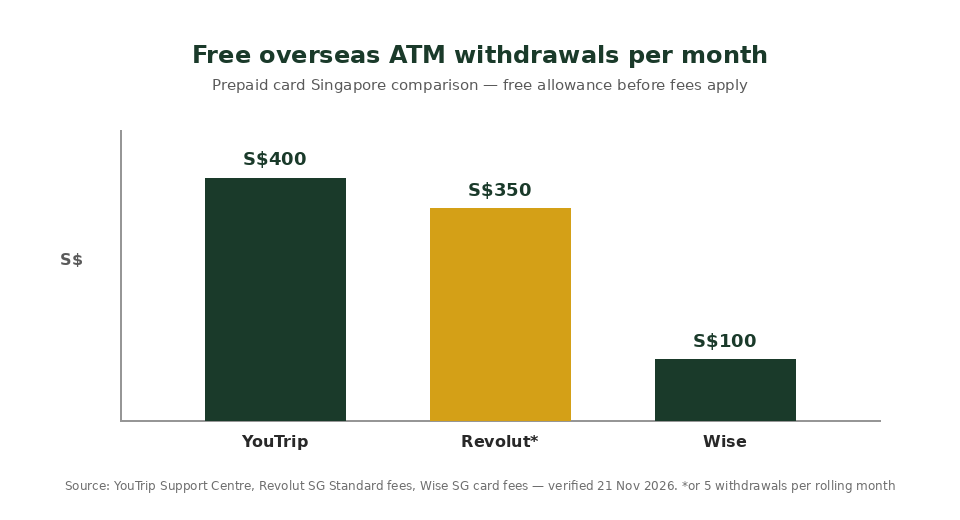
| Free overseas ATM cash | S$400 per calendar month | S$350 or 5 withdrawals per rolling month | S$100 per month |
| ATM fee after free tier | 2% | 2% (min S$1.49) | 1.75% of amount over S$100 |
| Singapore ATM withdrawals | Not supported | Not permitted | Not supported |
| Bank transfer top-up | Free (PayNow, eGIRO) | Free from SG bank accounts | Shown in app |
| Card top-up surcharge | Free, except 1.5% on Visa credit cards | First top-up free; then 0.30% (SG Visa debit) to 2.08% (foreign debit) | Shown in app |
| Holding / spending cap | S$20,000 wallet; S$100,000 annual spend | Per in-app limits | S$100,000 spent or sent per 12 months (SG-issued card) |
Source: YouTrip Support Centre and YouTrip “Everything You Need To Know” (Jan 2026); Revolut Singapore Standard fees (effective 15 Dec 2025); Wise Singapore card fees. All retrieved 21 November 2026.
YouTrip
YouTrip is the closest thing Singapore has to a pure prepaid travel card. You can lock in rates for 12 wallet currencies (including USD, EUR, GBP, JPY, AUD and MYR) and spend in 150+ countries with no FX fee. It is free to sign up and the physical card costs nothing. The main ceilings are the S$20,000 wallet limit and S$100,000 of spending a year, which only matter for heavy users. For a practical walkthrough, read how to use your YouTrip card overseas.
Revolut
Revolut is a broader money app: multi-currency balances, transfers, and add-ons like crypto and precious metals. On the free Standard plan, the catch is the S$5,000 monthly exchange limit, after which a 1% fair-usage fee applies, plus a 1% fee on any exchange made outside foreign-exchange market hours, including weekends. That limit is shared across currency, crypto and metals exchanges. If you travel and pay on a Saturday without pre-converting, factor in that 1%.
Wise
Wise is strongest when you also need to send money abroad. The card itself costs S$8.50 (the digital card is free), spending uses the mid-market rate with a small conversion fee disclosed before you pay, and the free ATM allowance is the smallest of the three at S$100 a month. Wise also charges 2% when the card is used to top up certain e-wallets.
Overseas ATM Fees: A S$1,000 Worked Example
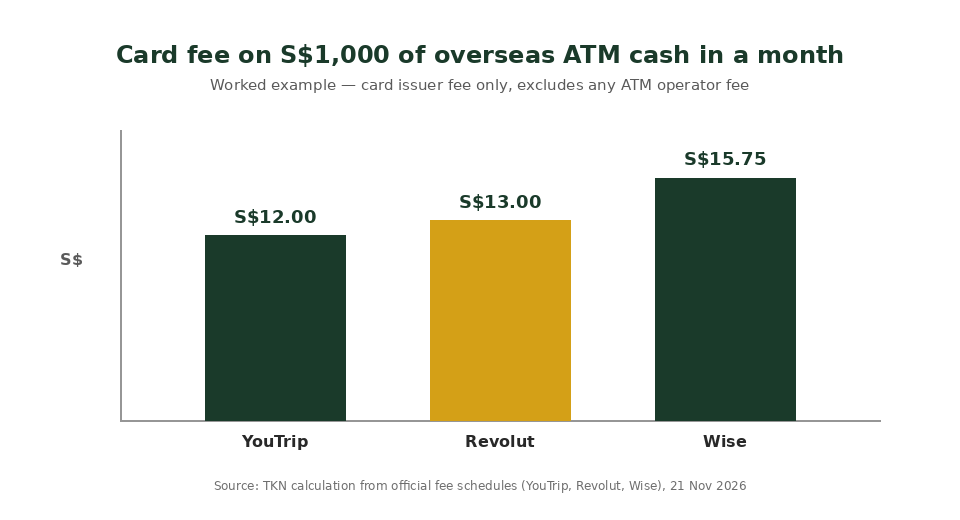
Free ATM allowances sound similar until you take out a realistic amount of cash. Take a Singapore traveller who withdraws the equivalent of S$1,000 overseas in one calendar month, across three or four withdrawals, with no other ATM use that month:
| Card | Free portion | Charged portion | Fee rate | Card fee |
|---|---|---|---|---|
| YouTrip | S$400 | S$600 | 2% | S$12.00 |
| Revolut (Standard) | S$350 | S$650 | 2% (min S$1.49) | S$13.00 |
| Wise | S$100 | S$900 | 1.75% | S$15.75 |
Source: TKN calculation using YouTrip, Revolut and Wise official fee schedules, 21 November 2026. Excludes any fee charged by the overseas ATM operator, which all three providers say may apply on top.
The gap is a few dollars, not a deal-breaker. What matters more is behaviour: splitting cash across two cards (say S$400 on YouTrip and S$350 on Revolut) keeps S$750 of withdrawals free in a month. And on Revolut, more than five withdrawals in a rolling month ends the free tier even if you have taken out less than S$350, so fewer, larger withdrawals work better. Always choose to be charged in the local currency at the ATM screen to avoid dynamic currency conversion.
Top-Up Costs and Hidden Charges on Prepaid Cards
Most prepaid card costs hide in how you put money in, not how you spend it. The cheapest route on all three is a bank transfer: PayNow or eGIRO into YouTrip is free, and Revolut charges nothing for top-ups from Singapore bank accounts.
Card top-ups are where people get caught. YouTrip charges a 1.5% service fee if you top up with a Visa credit card (Mastercard credit and debit cards, Visa debit cards and Apple Pay are free). On Revolut, the first card top-up is free, after which a surcharge applies: 0.51% for Singapore-issued Mastercard debit cards, 0.30% for Singapore-issued Visa debit cards, 2.08% for international consumer debit cards and 1.12% for commercial debit cards. Topping up S$2,000 from a foreign debit card on Revolut would cost S$41.60, which wipes out the FX saving on a short trip.
Other charges worth knowing:
- Weekend FX on Revolut: 1% on exchanges outside market hours. Pre-convert on a weekday before you fly.
- Revolut exchange cap: S$5,000 a month on Standard, then 1% on the excess.
- Revolut transfers out: five free SGD transfers to Singapore bank accounts a month, then S$2.99 each.
- Wise e-wallet top-ups: 2% when the card is used to fund certain e-wallets.
- Wise card replacement: S$4 (expired cards are replaced free).
- Revolut extra cards: S$9 per additional card plus delivery.
None of these are large on their own. The trap is assuming “no FX fee” means “no fees”, then losing 1% to 2% at the top-up stage.
Prepaid vs Secured vs Regular Credit Card
A prepaid card is one of three ways to get a card in your wallet. Here is how they line up for a Singapore user:
- Prepaid card (YouTrip, Revolut, Wise): no income test, no credit line, no interest. You can never owe money, but you also do not earn the miles or cashback that bank cards pay.
- Secured credit card: a real credit card issued against a fixed deposit you pledge with the bank. You repay a monthly bill like any credit card, so it builds a repayment track record. Terms differ by bank, so read the secured card guide linked above before committing a deposit.
- Regular (unsecured) credit card: needs the MAS income or asset criteria above. Offers rewards, interest-free days and sometimes travel insurance, but usually adds a foreign currency fee on overseas spend and high interest if you carry a balance.
Many Singaporeans end up holding both a credit card and a prepaid card: the credit card for local spending and rewards, the prepaid card for overseas and online foreign-currency purchases. If you go that route, our best travel card comparison for Singapore covers which cards pair well together.
Digital banks are another option if you want an app-only account that pays interest on idle cash. Trust Bank, GXS and MariBank are the main names; see our best digital bank in Singapore ranking. New users can sign up with the Trust Bank referral code HTWYQP95, the GXS Bank referral code YONG477 or the MariBank referral code 2DCT80WQ. TKN may earn a referral reward if you use these codes.
How to Choose (and Use) a Prepaid Card in Singapore
Match the card to the job rather than hunting for a single “best” card:
- Mainly travel spending and some cash: YouTrip’s 0% FX fee and S$400 monthly ATM allowance make it the simplest choice.
- Travel plus everyday app features: Revolut, as long as you convert on weekdays and stay under S$5,000 of exchanges a month on the free plan.
- Sending money overseas as well as spending: Wise, accepting the S$8.50 card fee and smaller ATM allowance.
- Hard budget cap for a child, helper or subscriptions: any of the three; load only what you want spent.
Getting started takes minutes for all three. Download the app, verify your identity in the app (YouTrip supports Singpass MyInfo), top up by bank transfer, and use the virtual card while the physical card is in the post (YouTrip’s works with Apple Pay and Google Pay). Turn on transaction alerts, learn where the card-lock button is, and leave only what you need in the wallet.
Finally, remember a prepaid card is a payment tool, not a savings account. Money sitting in a travel wallet typically earns nothing, so park your buffer in a higher-yield account and top up just before you travel. If you are mapping out longer-term savings, the Singapore retirement calculator shows how much your idle cash could grow if invested instead.
Disclaimer: This article is for general information only and is not financial advice. Fees, limits and features are set by each provider and can change without notice. Verify current terms in the provider’s app or website before you apply or transact.
Frequently Asked Questions
Is there a prepaid credit card in Singapore?
Not in the strict sense. Singapore banks do not sell a prepaid credit card; what you can get is a prepaid or debit-style card such as YouTrip (a prepaid Mastercard), Revolut or Wise. You top up first and spend only your own money, so there is no credit check and no bill to repay.
Can I get a prepaid card in Singapore without income?
Yes. Prepaid cards have no income requirement because no credit is extended. By contrast, MAS rules require an annual income of at least S$30,000 (or qualifying assets) for an unsecured credit card if you are 55 or younger, and S$15,000 if you are above 55.
Which prepaid card has the most free overseas ATM withdrawals?
As at 21 November 2026, YouTrip offers the largest free allowance at S$400 per calendar month, then 2%. Revolut’s Standard plan allows S$350 or five withdrawals per rolling month, then 2% (minimum S$1.49). Wise allows S$100 a month, then 1.75% of the amount above that.
Can I withdraw cash in Singapore with YouTrip, Revolut or Wise?
No. All three state that their cards cannot be used at ATMs in Singapore. They are designed for overseas ATM withdrawals and for card payments locally, overseas and online.
Does a prepaid card help build my credit score in Singapore?
Not directly, because you never borrow money, so there is no credit line or repayment to report. If building a repayment record is your goal, a secured credit card backed by a fixed deposit is the usual route.
Is there a limit on how much I can keep on a prepaid card?
Yes. YouTrip caps the wallet at S$20,000 and annual spending at S$100,000. A Singapore-issued Wise card cannot spend or send more than S$100,000 in 12 months. Revolut’s Standard fee schedule does not set a single published cap, so check the limits shown in your app.
What is the cheapest way to top up a prepaid card?
A bank transfer. PayNow and eGIRO top-ups on YouTrip are free, and Revolut does not charge for top-ups from Singapore bank accounts. Card top-ups can cost extra: 1.5% on YouTrip with a Visa credit card, and 0.30% to 2.08% on Revolut after your first card top-up.
Are prepaid cards safe to use overseas?
They limit your exposure because only the wallet balance is at risk. YouTrip, for example, lets you lock the card with one tap, sends a push alert for every payment and uses 3D Secure app approval for online purchases. Keep only what you need for the trip in the wallet.
About this article: This guide was researched and drafted with the help of AI tools, then checked against each provider’s official fee pages and the MAS website on 21 November 2026. It is not financial advice. If you spot an outdated figure, let us know and we will update it.
This article was researched with the help of AI. While we strive to keep all information accurate and up to date, there may be errors. If you notice any discrepancies, please contact us.