HSBC Credit Card Singapore (2026): Every Card Compared by Fees, Income and Earn Rate
Revolution, Live+, Advance, TravelOne, Visa Infinite and Premier Mastercard — what each HSBC card earns, costs and requires.
HSBC Singapore has four credit cards that most people can apply for in November 2026. The Revolution earns up to 4 miles per S$1 on online and contactless spend and currently has no annual fee. The Live+ pays 5% cashback on dining, shopping and entertainment (8% for new customers). The Advance pays 1.5% to 2.5% flat cashback, and the TravelOne earns up to 2.4 miles per S$1 overseas with 4 lounge visits. New customers need an income of S$65,000.
Not financial advice. Data verified as at 19 November 2026 against HSBC Singapore’s official product pages. Card terms, caps and welcome offers change often, so confirm on hsbc.com.sg before applying.
Table of Contents
HSBC Credit Card Singapore Line-Up (November 2026)
HSBC’s Singapore credit-card page currently lists seven cards: Revolution, Live+, Advance, TravelOne, Visa Infinite, Premier Mastercard and Visa Platinum. Two of those are not open to most new applicants. HSBC has stopped issuing new Visa Platinum cards since 21 June 2024, and the Visa Infinite page says applications are “temporarily” paused. The Premier Mastercard is only for HSBC Premier banking customers.
That leaves four cards a typical Singapore applicant can actually get: Revolution (miles on online and contactless spend), Live+ (category cashback), Advance (flat cashback) and TravelOne (miles on overseas spend plus lounge visits). The table below puts the verified headline numbers side by side.
| Card | Type | Headline earn rate | Annual fee | Who can apply |
|---|---|---|---|---|
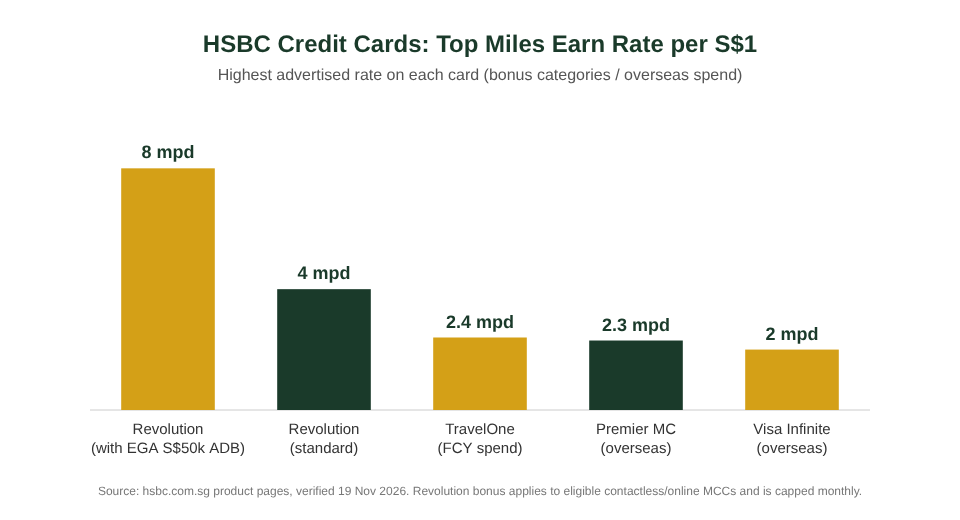
| Revolution | Miles | Up to 4 mpd (10x points) on eligible online/contactless spend; up to 8 mpd (20x) with S$50,000 ADB in Everyday Global Account | HSBC says it is “waiving” the fee | Open |
| Live+ | Cashback | 5% on dining, shopping and entertainment (8% for new-to-HSBC cardholders in first 2 qualifying quarters); 5% petrol; 0.3% other | Waived year 1; waived after if spend > S$12,500/yr | Open |
| Advance | Cashback | 1.5% with no minimum; 2.5% when monthly spend exceeds S$2,000; capped at S$70/month | Waived year 1; waived after if spend > S$12,500/yr | Open |
| TravelOne | Miles | Up to 2.4 mpd on foreign-currency spend; up to 1.2 mpd local | S$196.20 (incl. GST); waived from year 2 if spend > S$25,000/yr | Open |
| Visa Infinite | Premium miles | Up to 1 mpd local; up to 2 mpd overseas | S$662.15 (incl. GST), no waiver | Applications paused |
| Premier Mastercard | Premium miles | Up to 1.4 mpd local; up to 2.3 mpd overseas | S$708.50 (incl. GST); waived with TRB of S$200,000+ | HSBC Premier customers only |
| Visa Platinum | Cash rebate (legacy) | — | — | Closed to new applicants since 21 June 2024 |
Source: HSBC Singapore credit card product pages, verified 19 November 2026. mpd = miles per S$1.
HSBC Revolution: The Free 4 mpd Card
The HSBC Revolution is the card most Singapore miles chasers apply for, because the page says plainly: “We’re waiving your HSBC Revolution Credit Card annual fee.” HSBC does not state an end date or condition next to that line, so check it again before you apply.
How the earn rate works
Every eligible dollar earns 1x Reward point with no cap. On top of that, contactless and online spend in HSBC’s listed merchant categories earns a bonus:
- Standard tier: 10x points in total (9x bonus), which HSBC converts to “up to 4 miles” per S$1. Bonus points are capped at 9,000 per calendar month.
- With an Everyday Global Account: if you keep an average daily balance of at least S$50,000 in a sole-name HSBC Everyday Global Account, you earn 20x points (19x bonus), or “up to 8 miles” per S$1. Bonus points are capped at 22,800 per calendar month.
HSBC describes the bonus categories as “dining, shopping, travel, ride hailing, taxis and memberships – both locally and abroad”. The detailed merchant-code list covers restaurants (excluding fast food and hotel dining), airlines, hotels and car rental (excluding travel agencies), department and retail stores, taxis and limousines, and club or sports memberships. Our reading is that the merchant-code list does not have a separate ride-hailing code, so confirm Grab or Gojek rides with HSBC rather than assuming they qualify.
What the caps mean in dollars
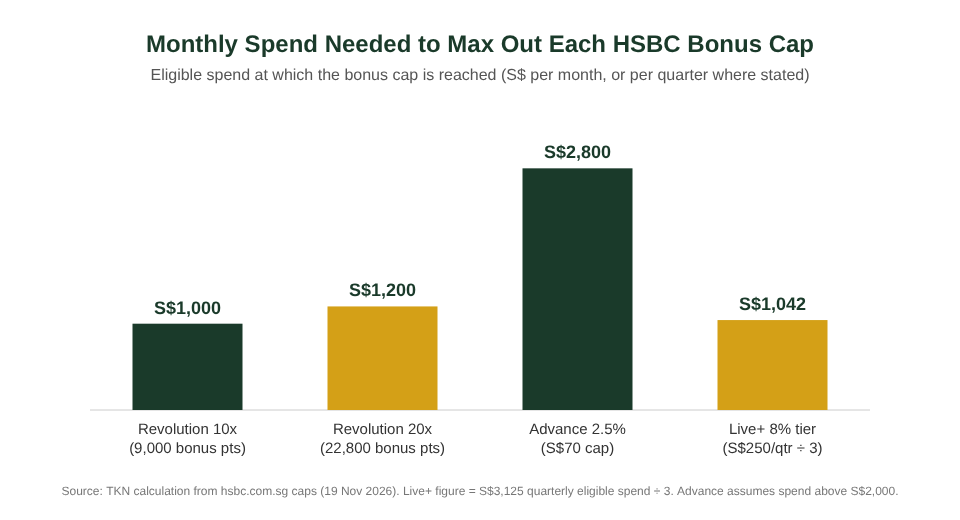
Here is the calculation HSBC does not print. On the standard tier, the 9,000 bonus-point cap at 9x bonus means bonus points stop after about S$1,000 of eligible spend a month. That S$1,000 earns 10,000 points, or about 4,000 miles. On the 20x tier, 22,800 ÷ 19 means the cap kicks in at about S$1,200 a month. At that level you earn 24,000 points, or roughly 9,600 miles. Anything you spend above the cap still earns the uncapped 1x base.
New-to-HSBC customers who apply for Revolution together with an Everyday Global Account can get “up to 112,000 Reward points”, according to the product page. The page shows different figures for existing customers in different places, so read the current terms before you rely on any welcome bonus.
HSBC Live+: Category Cashback With a S$600 Minimum
The HSBC Live+ pays 5% base cashback on dining, shopping and entertainment. New-to-HSBC cardholders get an extra 3%, for 8% in total, during their first two qualifying calendar quarters. Petrol also earns 5%. Everything else earns 0.3%.
The conditions matter more than the headline rate:
- You need at least S$600 of spend per month to earn the bonus cashback. For the first quarter, the page sets a S$1,000 minimum for the quarter instead.
- Total cashback on the 8% tier is capped at S$250 per calendar quarter.
- The 8% promotion covers cards issued between 1 April 2025 and 31 March 2027. If your card was issued between 1 April and 30 June 2026, you moved to 5% from 1 October 2026. If it was issued between 1 July and 30 September 2026, you keep 8% until 31 December 2026.
Worked example: a Singapore household that puts S$600 a month on dining and shopping earns S$30 a month at 5%, or S$90 a quarter. At 8%, the same spend earns S$48 a month (S$144 a quarter), comfortably under the S$250 cap. You would need about S$3,125 of category spend in a quarter, roughly S$1,042 a month, before the 8% cap binds.
The annual fee is waived for the first year. From the second year it is waived if you spend more than S$12,500 a year on the card. The current welcome offer is “up to SGD300 cashback”: spend S$500 to choose a Samsonite VOYA Spinner 68cm or S$200 cashback, then spend another S$500 for S$100 more. Existing HSBC cardholders get S$50.
HSBC Advance: Simple Flat Cashback
The HSBC Advance suits people who don’t want to track categories. It pays 1.5% cashback with no minimum spend. The rate rises to 2.5% in any calendar month when you spend more than S$2,000, on both local and overseas purchases. Base cashback is capped at S$70 per calendar month.
At 2.5%, the S$70 cap is reached at S$2,800 of monthly spend, so the sweet spot is a narrow band between S$2,000 and S$2,800 a month. Spend S$2,500 and you get S$62.50. Spend S$1,500 and you get S$22.50 at the 1.5% rate. Its fee waiver and welcome offer follow the same structure as Live+: waived for year 1, waived after that above S$12,500 a year, and up to S$300 for new cardholders.
If flat cashback is what you want, compare Advance with the other options in our best cashback credit cards Singapore guide before you apply.
HSBC TravelOne: Miles and Lounge Visits for Overseas Spend
The HSBC TravelOne earns up to 2.4 miles (6x points) per S$1 on foreign-currency spend and up to 1.2 miles (3x points) on local spend. It also includes 4 complimentary lounge visits a year at more than 1,300 lounges for the primary cardholder.
The annual fee is S$196.20 including GST, charged from the issue date. From the second year, HSBC waives it if you spend more than S$25,000 a year, but you then forgo the reward points that come with paying the fee. The welcome offer is “up to 30,000 miles” for spending S$1,000, and it requires paying the S$196.20 fee. Existing HSBC cardholders get 20,000 miles.
Example: spending S$2,000 abroad in a month earns about 4,800 miles. S$1,000 of local spend earns about 1,200 miles. For more cards built for travel, see our credit card with lounge access comparison and the overseas spending credit card guide.
Visa Infinite and Premier Mastercard
HSBC’s two premium cards are hard to get right now. The Visa Infinite page says: “We’re temporarily pausing applications.” For existing holders, it charges S$662.15 a year including GST with “strictly no waiver”, and requires an annual income of at least S$120,000. It earns up to 1 mile per S$1 locally and 2 miles overseas, with unlimited lounge visits at more than 1,100 airports. Guests cost USD 35 per visit.
The Premier Mastercard is “available exclusively to HSBC Premier customers”. It earns up to 1.4 KrisFlyer miles per S$1 locally and 2.3 overseas. Its S$708.50 fee (incl. GST) is waived if your total relationship balance is at least S$200,000. Unlimited lounge access for the primary and up to 3 supplementary cardholders is stated as “valid till 31 December 2026”, so check what replaces it in 2027.
Minimum Income to Apply for an HSBC Credit Card
HSBC’s income rules depend on whether you already bank with it. For Revolution, Live+ and TravelOne the product pages show the same table. You must be at least 21.
| Applicant | Existing HSBC customer, TRB ≥ S$50,000 | Existing, TRB < S$50,000 | New to HSBC |
|---|---|---|---|
| Singaporean / PR, salaried | S$30,000 | S$65,000 | S$65,000 |
| Singaporean / PR, self-employed or commission | S$40,000 | S$65,000 | S$65,000 |
| Foreigner | S$65,000 | S$65,000 | S$65,000 |
| Visa Infinite (all applicants) | S$120,000 (applications currently paused) | ||
Source: HSBC Revolution, Live+, TravelOne and Visa Infinite product pages, hsbc.com.sg, verified 19 November 2026. TRB = total relationship balance.
Put simply, a new customer needs S$65,000 a year for any of the open cards. That is more than double the S$30,000 minimum income MAS sets for unsecured credit cards, which is the level many entry-level cards use. If you earn less, building a S$50,000 relationship balance first lowers the bar to S$30,000. Parking that cash in an HSBC fixed deposit could also earn interest while it waits. If you would rather not lock up S$50,000, look at digital-bank cards too. Trust Bank’s card is one option; check its eligibility on our Trust Bank referral code page (code HTWYQP95).
Which HSBC Credit Card Should You Pick?
- You spend about S$1,000 a month online or by tap, and want miles: Revolution. It costs nothing while the fee waiver lasts, and S$1,000 is exactly where the 10x cap sits.
- You spend S$600 to S$1,000 a month on dining and shopping: Live+. It pays 5% (8% if you are new to HSBC) up to the quarterly cap.
- You spend S$2,000 to S$2,800 a month across everything and hate tracking categories: Advance at 2.5%.
- You travel a few times a year and spend a lot in foreign currency: TravelOne. Its 4 lounge visits and 2.4 mpd make up for the S$196.20 fee if you value the welcome miles.
- You are HSBC Premier with S$200,000+ in the bank: Premier Mastercard, which is fee-free at that balance.
One cost to check before travelling is the foreign-currency fee. HSBC’s current card pages do not state it next to the earn rates, and the tariff document linked on its site dates from 2020. Ask HSBC or check your cardholder agreement for the rate that applies today. For the wider market, see our best credit card for miles in Singapore ranking.
Pros and Cons of HSBC Credit Cards
Pros: Revolution’s fee waiver and 4 mpd make it one of the cheapest ways to earn miles on everyday online spend. Live+ pays 5% on everyday categories (8% for new customers), which is a strong rate if you hit the S$600 monthly minimum. TravelOne bundles lounge visits into a sub-S$200 fee.
Cons: monthly caps are tight. Revolution’s bonus stops around S$1,000 and Advance stops at S$2,800. The S$65,000 income hurdle for new customers shuts out many fresh graduates. Two of the seven listed cards are closed to new applicants, and the welcome-offer terms on the Revolution page are not consistent, so you need to read the fine print.
If you are comparing HSBC with digital-bank cards, our best digital bank in Singapore guide covers Trust, GXS and MariBank. MariBank’s Mari Credit Card is linked to Shopee, and you can sign up with our MariBank referral code 2DCT80WQ.
Frequently Asked Questions
Which HSBC credit card is best in Singapore?
It depends on how you spend. The Revolution is the strongest pick for miles on online and contactless spend up to about S$1,000 a month, and HSBC currently waives its annual fee. Live+ suits S$600 to S$1,000 a month of dining and shopping, Advance suits S$2,000 to S$2,800 of general spend, and TravelOne suits frequent overseas spenders.
Does the HSBC Revolution card have an annual fee?
HSBC’s Revolution page says: “We’re waiving your HSBC Revolution Credit Card annual fee.” It does not give an end date or condition next to that statement, so check the page when you apply. The Live+ and Advance fees are waived in the first year and after that if you spend more than S$12,500 a year.
What is the minimum income for an HSBC credit card?
For Revolution, Live+ and TravelOne, new-to-HSBC applicants need S$65,000 a year, whether Singaporean, PR or foreigner. Existing Singaporean or PR customers with a total relationship balance of at least S$50,000 qualify at S$30,000 (salaried) or S$40,000 (self-employed). The Visa Infinite needs S$120,000, but applications are paused.
How many miles does HSBC Revolution earn per dollar?
Up to 4 miles per S$1 (10x Reward points) on eligible contactless and online spend, capped at 9,000 bonus points a month, which is about S$1,000 of spend. With an average daily balance of S$50,000 in an HSBC Everyday Global Account, the rate rises to up to 8 miles per S$1 (20x), capped at 22,800 bonus points a month.
What is the HSBC Live+ minimum spend?
You need at least S$600 of spend per month to earn the bonus cashback (S$1,000 for the first quarter on the 8% new-customer schedule). Without it, you earn the base rates. Total cashback on the 8% tier is capped at S$250 per calendar quarter.
Does HSBC TravelOne give lounge access?
Yes. The primary cardholder gets 4 complimentary lounge visits per year at more than 1,300 lounges. The card costs S$196.20 a year including GST. From the second year, the fee is waived if you spend more than S$25,000 a year, but you then give up the reward points that come with paying it.
Can I still apply for the HSBC Visa Infinite or Visa Platinum?
Not right now. HSBC says it is temporarily pausing Visa Infinite applications, and it stopped issuing new Visa Platinum cards from 21 June 2024. The Premier Mastercard is open only to HSBC Premier customers.
Can foreigners apply for an HSBC credit card in Singapore?
Yes. Foreigners can apply for Revolution, Live+ and TravelOne with a minimum annual income of S$65,000. Unlike Singaporeans and PRs, foreigners do not get a lower threshold for having a S$50,000 relationship balance with HSBC.
Disclaimer: This article was researched and written with the help of AI tools and fact-checked against HSBC Singapore’s official product pages on 19 November 2026. It is general information, not financial advice. The Kopi Notes may earn referral rewards from some links on this page. Always read the bank’s latest terms before applying for a credit card.
Compare More Singapore Cards
See how HSBC stacks up against every other bank and digital bank in Singapore.
This article was researched with the help of AI. While we strive to keep all information accurate and up to date, there may be errors. If you notice any discrepancies, please contact us.