Best Credit Card for Miles in Singapore 2026: KrisFlyer Earn Rate Guide
Which card earns the most KrisFlyer miles per dollar — and when the FX fee quietly eats your reward. Updated October 2026.
There is no single best credit card for miles in Singapore — the right card depends entirely on where your money goes. For online and contactless spend in SGD, a 4-miles-per-dollar (mpd) card like the HSBC Revolution or Citi Rewards wins, but each caps the bonus at roughly S$1,000 a month. For overseas foreign-currency spend, the UOB PRVI Miles (2.4 mpd, or 3 mpd in Malaysia, Indonesia, Thailand and Vietnam) edges ahead even after the ~3.25% FX fee. Most serious miles chasers hold two to three cards to cover each category, and all of them pay their bill in full every month — one month of card interest at Singapore’s 27–29% annual rate erases far more miles than a month of spending earns.
Not financial advice. All figures are for educational reference only. Data verified as at 30 October 2026 against official bank sources unless noted.
Table of Contents
Contents — Click to expand
- How Miles Credit Cards Actually Work
- Best 4 mpd Cards: Online & Contactless Spend
- Best Cards for Overseas & Foreign-Currency Spend
- Full Comparison: 2026 Miles Cards at a Glance
- What Is a KrisFlyer Mile Actually Worth?
- Miles vs Cashback: Which Is Right for You?
- How to Build a Two-Card Miles Setup
- Frequently Asked Questions
How Miles Credit Cards Actually Work
A miles card pays you a fraction of a mile for every Singapore dollar you spend, then lets you transfer those accumulated miles into an airline loyalty programme — for most Singapore cards, that means Singapore Airlines KrisFlyer. The quoted earn rate is expressed in miles per dollar (mpd): at 1.4 mpd, S$1,000 of spend earns 1,400 miles; at 4 mpd it earns 4,000.
Two variables determine which card pays most on any single purchase: the spend category and the currency.
Banks divide spend into a base rate — the plain rate on everything, usually 1.2–1.4 mpd on a proper miles card — and a bonus rate, a higher rate (often 4 mpd) on specific categories like online shopping, contactless payments or dining. Bonus rates almost always carry a monthly cap, commonly around S$1,000 of eligible spend. Once you cross the cap, every additional dollar earns only the base rate, typically 0.4 mpd.
The second variable is currency. Overseas foreign-currency spend usually earns a higher bonus rate, but it also attracts a foreign transaction fee of roughly 3.25–3.50% on most Singapore-issued cards. That fee is real money, so the overseas earn rate must clear it before the card is profitable to use abroad.
Only the airline co-brand cards — the KrisFlyer-branded UOB and American Express cards — credit KrisFlyer miles directly to your account. Every other card earns the bank’s own reward currency first: DBS Points, Citi ThankYou points, UOB UNI$, HSBC Reward points. You hold those, then transfer a block to KrisFlyer when you are ready to book. The transfer is one-way, irreversible, and usually carries a small administrative fee. Once credited to KrisFlyer, miles expire three years after the month they were credited, regardless of whether you fly.
If you do not pay your statement balance in full each month, no miles strategy makes sense. At Singapore’s typical card interest rate of 27–29% per annum, one month of interest on an S$1,000 balance (~S$23) costs more than the miles earned on that spend are worth at almost any KrisFlyer redemption rate. Miles cards only add value to people who clear their bills in full.
Best 4 mpd Cards: Online & Contactless Spend
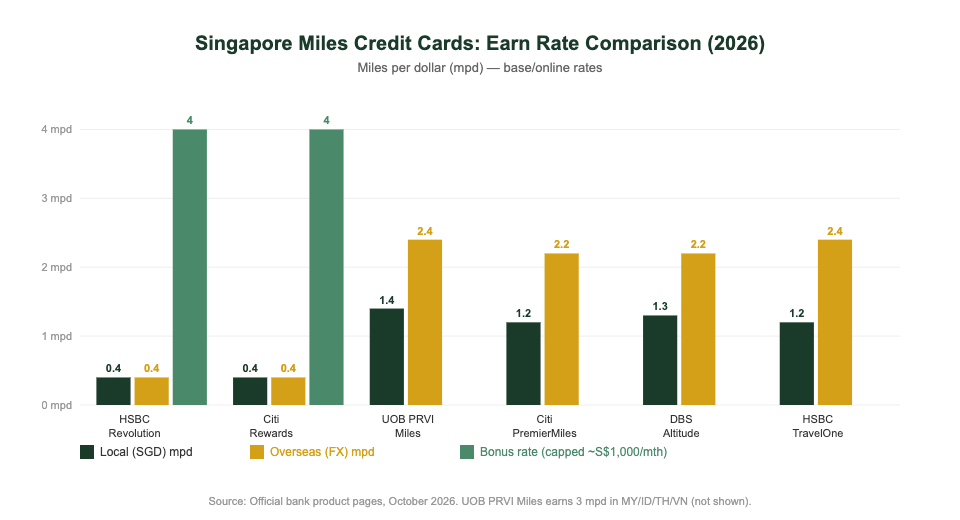
The highest earn rate readily available to Singapore cardholders is 4 miles per dollar, earned on online or contactless payments in Singapore dollars. Three cards compete for this slot in 2026, and their key differentiator is not the rate itself — all three match at 4 mpd — but the annual fee, the income requirement, and which exact transactions qualify.
HSBC Revolution (No Annual Fee)
The HSBC Revolution is the cleanest pick for most people because it has no annual fee and no minimum spend requirement. From 1 April 2026 it pays 4 mpd on contactless and online spend (including most travel bookings) in Singapore dollars, up to a cap of approximately S$1,000 per calendar month, then drops to 0.4 mpd. There is a two-tier income bar: S$30,000 per year if you hold at least S$50,000 in Total Relationship Balance with HSBC, otherwise S$65,000. Cardholders who park S$50,000 in an HSBC Everyday Global Account can unlock up to 8 mpd, capped at around S$1,200 of eligible spend per month.
Citi Rewards (Non-Expiring Miles)
The Citi Rewards card pays 10X ThankYou points — which converts to 4 mpd — on online shopping and department-store spend, capped at 9,000 bonus points (roughly S$1,000 of eligible spend) per statement month. Its annual fee is S$196.20. The key appeal is the points programme: Citi ThankYou points carry a 60-month validity, and when you convert them to Citi Miles, those miles do not expire for as long as the card is open. Minimum annual income for Singapore citizens and PRs: S$30,000.
DBS Woman’s World Card
The DBS Woman’s World Card (open to all genders) pays 4 mpd on all online spend in Singapore dollars, capped at S$1,000 per month — that cap was cut from S$1,500 on 1 August 2025. The annual fee of S$196.20 is currently waivable on S$25,000 of annual spend, but DBS has announced the removal of this spend-based waiver from August 2026. DBS Points do not expire while the card is active. Minimum annual income: S$30,000.
Best Cards for Overseas & Foreign-Currency Spend
When you pay in a foreign currency, the 4 mpd online cards stop being the obvious answer. Their bonus categories typically exclude foreign-currency transactions, and a 3.25–3.50% FX fee changes the maths on every overseas purchase. This is the territory of dedicated miles cards with higher base rates for overseas spend.
UOB PRVI Miles (Best Overseas Earn Rate)
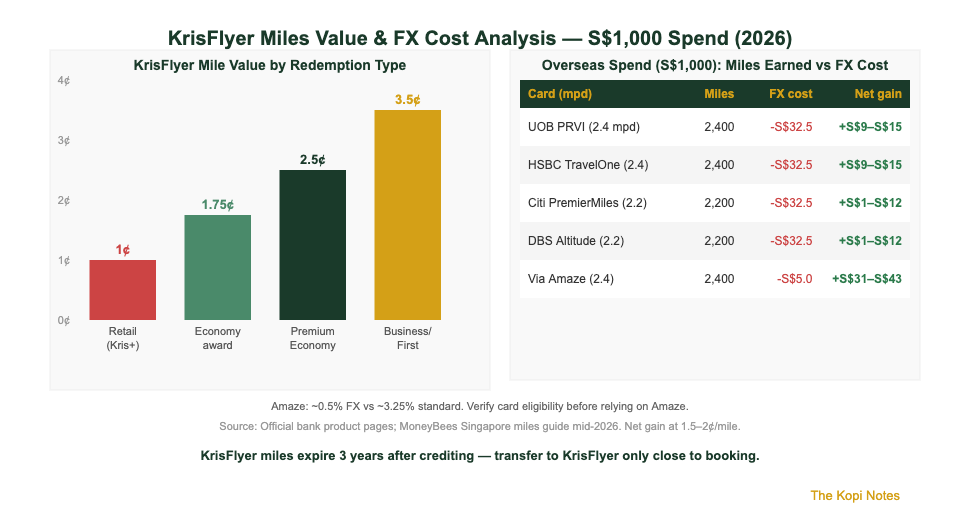
The UOB PRVI Miles earns 1.4 mpd on all local Singapore-dollar spend (uncapped) and 2.4 mpd on general overseas foreign-currency spend, rising to 3 mpd on spend in Indonesia, Malaysia, Thailand and Vietnam. That regional 3 mpd rate is the highest uncapped overseas earn rate among mainstream Singapore miles cards in 2026. The annual fee is S$261.60 with the first year waived; minimum annual income is S$30,000. At 2.4 mpd, S$1,000 of overseas spend earns 2,400 miles (worth approximately S$36–S$48 at 1.5–2 cents per mile), while the 3.25% FX fee costs S$32.50, making the net gain quite thin. Some cardholders route overseas charges through Instarem Amaze — which cuts the FX markup to approximately 0.5% while still earning miles on the linked Mastercard, when eligible — though card eligibility for Amaze miles earning should be verified before travel.
Citi PremierMiles (Miles That Never Expire)
The Citi PremierMiles pays 1.2 mpd locally and 2.2 mpd on overseas foreign-currency spend, with an annual fee of S$196.20. Its standout feature is the expiry policy: Citi Miles do not expire for as long as the card remains open, removing the pressure to book flights on a deadline. Minimum annual income: S$30,000.
DBS Altitude
The DBS Altitude earns 1.3 mpd locally and 2.2 mpd overseas. DBS Points do not expire while the card is active. Annual fee S$196.20, with the spend-based waiver (S$25,000 annual spend) ending from August 2026. Minimum income: S$30,000.
HSBC TravelOne (Flexible Airline Transfers)
The HSBC TravelOne earns 1.2 mpd locally and 2.4 mpd overseas, matching the UOB PRVI Miles’ overseas rate. Annual fee S$196.20, waived in years two and beyond on S$25,000 of annual spend. It earns HSBC Reward points transferable to over 10 airline and hotel programmes — useful for travellers who want flexibility beyond KrisFlyer. Income requirements: S$30,000 with S$50,000 TRB, otherwise S$65,000.
Full Comparison: 2026 Miles Cards at a Glance
| Card | Local mpd | Overseas mpd | Bonus rate & cap | Annual fee | Min income (SC/PR) |
|---|---|---|---|---|---|
| HSBC Revolution | 0.4 base | 0.4 base | 4 mpd online + contactless; ~S$1,000/mth cap | None | S$30k (w/ S$50k TRB) / S$65k |
| Citi Rewards | 0.4 base | 0.4 base | 4 mpd online + dept stores; ~S$1,000/mth cap | S$196.20 | S$30,000 |
| DBS Woman’s World | 0.4 base | 1.2 | 4 mpd all online; ~S$1,000/mth cap (reduced from S$1,500 Aug 2025); fee waiver ends Aug 2026 | S$196.20 | S$30,000 |
| UOB PRVI Miles | 1.4 (uncapped) | 2.4 (3 mpd in ID/MY/TH/VN) | No bonus cap on base rate; 1st yr fee waived | S$261.60 | S$30,000 |
| Citi PremierMiles | 1.2 (uncapped) | 2.2 (uncapped) | Citi Miles never expire while card is active | S$196.20 | S$30,000 |
| DBS Altitude | 1.3 (uncapped) | 2.2 (uncapped) | DBS Points never expire; spend waiver ends Aug 2026 | S$196.20 | S$30,000 |
| HSBC TravelOne | 1.2 (uncapped) | 2.4 (uncapped) | Transfers to 10+ airline/hotel programmes; yr 2+ waived on S$25k spend | S$196.20 | S$30k (w/ S$50k TRB) / S$65k |
| Amex KrisFlyer Ascend | 1.2 (uncapped) | 1.2 (uncapped) | 2 mpd on SIA/Scoot/KrisShop/Pelago; direct KrisFlyer earn (no conversion) | S$397.85 | ~S$50k (not published) |
Source: Official bank product pages and MoneyBees Singapore miles card review (mid-2026). All figures subject to change — verify on each issuer’s page before applying.
What Is a KrisFlyer Mile Actually Worth?
A KrisFlyer mile does not have a fixed value — it depends on how you redeem it. The MileLion, Singapore’s most cited miles resource, benchmarks approximately 1.7 Singapore cents per mile on average. Here is how the value breaks down by redemption type:
| Redemption type | Value per mile (approx.) | Verdict |
|---|---|---|
| Kris+ / KrisShop retail | ~1 cent or less | Worst use — avoid |
| Economy award flight | ~1.5 to 2 cents | Everyday benchmark; good for regular flyers |
| Premium economy long-haul | ~2 to 3 cents | Noticeable step up if you would have paid for the cabin |
| Business / First class long-haul | ~3 cents and above | Best use — miles stretch furthest vs cash fares |
Source: The MileLion (milelion.com), MoneyBees Singapore miles card review, mid-2026. Values are illustrative benchmarks; actual value depends on the specific award and seat availability.
In concrete terms: S$1,000 spent at 4 mpd earns 4,000 miles. At 1.5–2 cents per mile (economy benchmark), that is approximately S$60–S$80 of flight value. The same S$1,000 on a 1.4 mpd uncapped card earns 1,400 miles — worth roughly S$21–S$28. That gap is the reason for filling your 4 mpd bonus cap first, then routing remaining spend to an uncapped card.
KrisFlyer miles expiry: Miles expire three years after the month they are credited, regardless of activity. You can extend expiring miles by six months for 1,200 miles or USD 12 per 10,000 miles; Elite Silver and Gold members get a full-year extension at the same cost. Cards like Citi PremierMiles (Citi Miles) and DBS Altitude (DBS Points) solve the upstream problem: bank points on these cards do not expire while the card is active, so you choose when to start the three-year KrisFlyer clock by converting only when booking.
Thinking about building long-term wealth alongside your miles strategy? The Singapore retirement calculator can help you model how your overall savings and spending plan fits together.
Miles vs Cashback: Which Is Right for You?
Miles cards suit a specific type of cardholder. Before applying for one, run through this checklist honestly:
Miles cards work well when you:
- Pay your statement balance in full, every month, without exception
- Spend enough to fill the monthly bonus cap (~S$1,000/month on online spend)
- Fly at least once a year, enough to burn accumulated miles within three years
- Are comfortable tracking which card to use for each spend category
- Value aspirational redemptions (business class, premium economy) over immediate cash savings
Cashback or high-interest savings likely suits you better when you:
- Sometimes carry a balance month to month
- Fly rarely (fewer than once every two years)
- Prefer simple, certain rewards over optimisation
- Do not want to manage multiple cards or track caps
For a broader view covering cashback and everyday-spend options alongside miles cards, see TKN’s best credit card Singapore 2026 guide. If you bank with Trust Bank, TKN also has a detailed review of the Trust Link Credit Card — one of the few digital-bank-issued credit cards in Singapore. The honest truth: most Singaporeans who are not already flying regularly and spending S$2,000+ per month are better served by maximising savings account interest or investing, rather than optimising miles earn rates. If you are building passive income in Singapore, returns on investments typically outpace the value of miles optimisation for most household spending levels.
How to Build a Two-Card Miles Setup in 2026
The optimal miles strategy for most Singapore cardholders is a two-card setup, not a single card. Here is the standard 2026 framework:
Card 1 — The 4 mpd cap filler: HSBC Revolution (no annual fee) or Citi Rewards. Route all online shopping, subscriptions, streaming services and contactless payments here until you hit the ~S$1,000 monthly cap. The Revolution is the default if you want to avoid an annual fee. The Citi Rewards suits those who want non-expiring Citi Miles and can justify the S$196.20 fee.
Card 2 — The uncapped workhorse: UOB PRVI Miles. Once Card 1 has hit its cap, everything else — utilities, insurance, large-ticket purchases, overseas travel — goes here at 1.4 mpd uncapped locally and 2.4 mpd overseas (3 mpd in four regional markets). The first-year fee waiver makes it low-risk to try. This card eliminates the need for a third card, handling both uncapped local spend and overseas spend in a single product.
Optional enhancement — Instarem Amaze: Link the UOB PRVI Miles to Instarem Amaze when travelling overseas. Amaze processes foreign currency at near-interbank rate (~0.5% markup vs ~3.25% standard FX fee) while the underlying Mastercard still earns miles — if the PRVI Miles remains on Amaze’s eligible card list. Verify eligibility before your trip, as issuers update these lists.
Two habits matter most: track your monthly cap reset date (calendar month versus statement month differs by card), and review every annual fee before it bills. Many banks will waive or reduce the fee on request if you call before renewal. For those building a broader investment strategy alongside card rewards, comparing robo-advisors like Syfe vs Endowus can keep idle cash working harder between redemptions.
Frequently Asked Questions
What is the best credit card for miles in Singapore in 2026?
There is no single best card. For online and contactless spend in SGD, the HSBC Revolution (no annual fee) or Citi Rewards earns 4 mpd up to ~S$1,000 per month. For overseas foreign-currency spend, the UOB PRVI Miles earns 2.4 mpd (3 mpd in Malaysia, Indonesia, Thailand and Vietnam). For uncapped local spend, the UOB PRVI Miles at 1.4 mpd is the standard workhorse. Most serious miles collectors hold two cards to cover all three cases.
How much is one KrisFlyer mile worth in Singapore dollars?
Approximately 1.5 to 2 Singapore cents when redeemed against economy award flights — The MileLion benchmarks an average of about 1.7 cents. Against premium-cabin long-haul flights (business or first class), a mile can stretch to 3 cents or more. Burned on retail through Kris+ or KrisShop, it is worth roughly 1 cent or less. Redeem for flights, not shopping, to get real value from your miles.
Do KrisFlyer miles expire?
Yes. KrisFlyer miles expire three years after the month they are credited to your account, regardless of account activity. You can extend expiring miles by six months at a cost of 1,200 miles or USD 12 per 10,000 miles (KrisFlyer Elite Silver and Gold members get a full year at the same cost). Citi Miles (Citi PremierMiles card) and DBS Points (DBS Altitude and Woman’s World Card) do not expire while the card is active, giving you control over when the three-year KrisFlyer clock starts.
Is the HSBC Revolution truly free with no annual fee?
Yes — no annual fee. The two-tier income requirement: S$30,000 per year if you hold at least S$50,000 in Total Relationship Balance with HSBC, otherwise S$65,000. The 4 mpd rate applies to contactless and online spend in SGD from 1 April 2026, capped at approximately S$1,000 per calendar month. Above the cap, the earn rate drops to 0.4 mpd. Cardholders with S$50,000 in an HSBC Everyday Global Account can unlock up to 8 mpd on eligible spend up to ~S$1,200/month.
What is the UOB PRVI Miles annual fee and is it worth it?
The UOB PRVI Miles annual fee is S$261.60 (inclusive of GST), with the first year waived for all new applicants. Whether it is worth paying from year two depends on your overseas spend. A cardholder who spends S$8,000 per year overseas earns approximately 19,200 miles on that spend alone — worth roughly S$290–S$380 at 1.5–2 cents per mile, which exceeds the S$261.60 annual fee. Light spenders or those who rarely travel may prefer the Citi PremierMiles at S$196.20, with Citi Miles that never expire.
Should I use my miles card overseas or a multi-currency card?
It depends on the net return. At 2.4 mpd, S$1,000 of foreign-currency spend earns 2,400 miles (worth roughly S$36–S$48 at 1.5–2 cents per mile), while a 3.25% FX fee costs S$32.50. The net gain is thin — often under S$15. Routing the charge through Instarem Amaze (if your card is eligible) cuts the FX cost to ~0.5% and improves the economics significantly. For overseas spend where you have no interest in miles, a multi-currency card (Wise, Revolut, YouTrip) at or near mid-market rate almost always beats any miles card’s FX cost.
How do I transfer bank points to KrisFlyer miles?
Log in to your bank’s rewards portal and initiate a points transfer to Singapore Airlines KrisFlyer. Transfers are in fixed blocks (check your bank’s minimum block size) and usually carry a small administrative fee. Miles typically appear in your KrisFlyer account within one to two business days. Key pitfalls: leftover points below the minimum block size are stranded until you accumulate more; some bank points programmes have their own expiry (DBS Points and Citi Miles are exceptions); and once points become KrisFlyer miles, their three-year expiry clock starts immediately. Convert only when you are close to booking.
Are miles cards worth it if I fly less than once a year?
Usually not. If you fly rarely, KrisFlyer miles risk expiring unused three years after they are credited. A cashback card or a high-interest savings account gives certain, immediate value with no expiry risk or complexity. Miles cards suit people who pay in full every month, spend enough to fill bonus caps, and fly often enough to redeem miles within three years. If you are not sure, start with a straightforward cashback card and review again when your travel frequency increases.
Data in this article was verified against official bank product pages and published third-party reviews as at 30 October 2026. Card earn rates, annual fees, bonus categories and monthly caps change frequently without notice — confirm the current terms on each issuer’s official product page before applying. This article is for educational reference only and does not constitute financial advice. The Kopi Notes may earn referral fees when readers click referral links on TKN pages.
This article was researched with the help of AI. While we strive to keep all information accurate and up to date, there may be errors. If you notice any discrepancies, please contact us.