How to Invest in Singapore: Core-Satellite Portfolio Strategy (2026 Guide)
Build a low-cost ETF foundation — then add intentional satellites that improve your risk-return profile without duplicating your core.
The core-satellite portfolio strategy divides your investments into two buckets: a low-cost “core” (60–80% in broad market ETFs like CSPX, IWDA, or XWR) and intentional “satellites” (10–20% in targeted positions such as S-REIT ETFs, gold, or Singapore Savings Bonds). Singapore investors benefit uniquely because CPF already functions as a risk-free core, allowing investable cash to work harder as the equity engine of your portfolio. This guide explains exactly how to invest in Singapore using this institutional-grade framework in 2026.
Not financial advice. All figures are for educational reference only. Data verified as at 17 November 2026.
Table of Contents
What's Wrong With Just Buying One ETF?
The standard advice on how to invest in Singapore — open an account, buy a global ETF, hold forever — is directionally correct. But it leaves out a crucial question: what else are you holding? Most Singapore investors have three separate wealth buckets operating simultaneously without a unifying framework: CPF (a government-guaranteed “bond” earning 2.5–4.0% p.a.), cash savings (largely idle at 0.05–2.5% p.a.), and their investment portfolio (wherever they've deployed investable funds). Without mapping all three together, most investors stumble into one of two costly mistakes.
Invisible over-conservatism. A 35-year-old with SGD 90,000 in CPF (SA earning 4.0% p.a.) who allocates their entire SGD 50,000 investable cash into a balanced 60/40 equity-bond ETF ends up with an overall portfolio allocation closer to 20% equity / 80% bonds — far too conservative for someone three decades from retirement. CPF has already done the defensive work. The cash portfolio is doubling up unnecessarily on safety at the expense of growth.
Hidden ETF duplication. An investor who holds VWRA (FTSE All World), CSPX (S&P 500), and a Nasdaq-100 ETF as “diversification” does not realise that all three are dominated by the same mega-cap US technology companies. Apple, Microsoft, Nvidia, and Alphabet appear as the top holdings in every one. The investor feels diversified; the portfolio is not.
The core-satellite framework solves both problems by forcing you to map your entire financial picture — CPF, savings, and investable assets — before deciding how to structure your investment portfolio. It is the approach used by pension funds and endowments, now accessible to any Singapore retail investor via low-cost ETFs and SGX-listed instruments.
How the Core-Satellite Framework Works
The model divides every portfolio into two clearly defined roles. The core provides broad market exposure at the lowest possible cost and should rarely be changed. The satellites provide targeted, intentional tilts — positions with a specific rationale that add something the core does not already provide.
The Core (60–80% of Investable Portfolio)
The core should be a single, low-cost, broadly diversified index ETF. For Singapore investors buying in November 2026, the best options are:
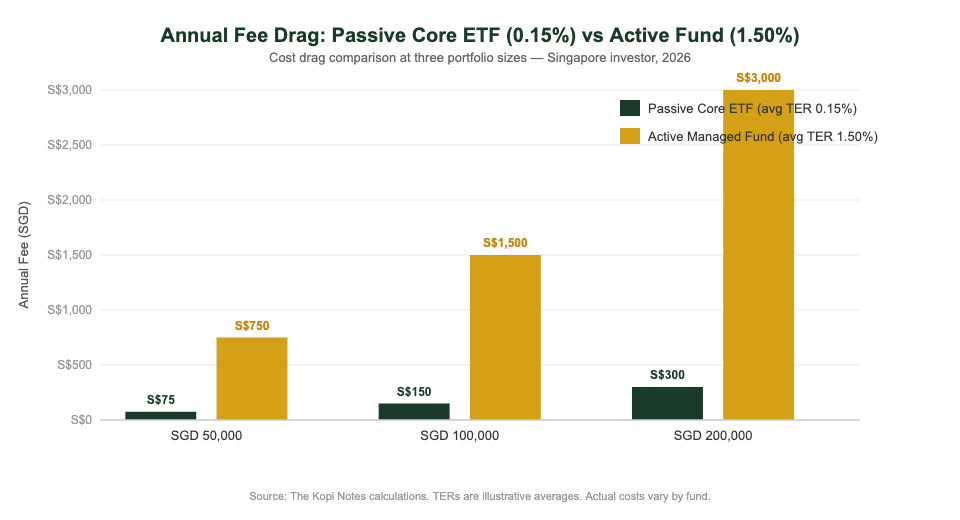
- CSPX — iShares Core S&P 500 UCITS ETF (LSE, TER 0.07% p.a.) — 500 largest US companies; Ireland-domiciled, so Singapore investors pay 15% withholding tax on dividends vs 30% on US-domiciled equivalents.
- IWDA — iShares Core MSCI World UCITS ETF (LSE, TER 0.20% p.a.) — approximately 1,400 large-cap companies across 23 developed markets; roughly 70% US, 30% international.
- XWR — Xtrackers MSCI World UCITS ETF (SGX, TER 0.12% p.a.) — same MSCI World exposure as IWDA but SGD-settled; buyable through any SGX broker without currency conversion.
All three are accumulating (dividends reinvested automatically). Singapore investors pay no dividend tax locally, so accumulation compounds more efficiently than distribution.
The Satellites (10–20% of Investable Portfolio)
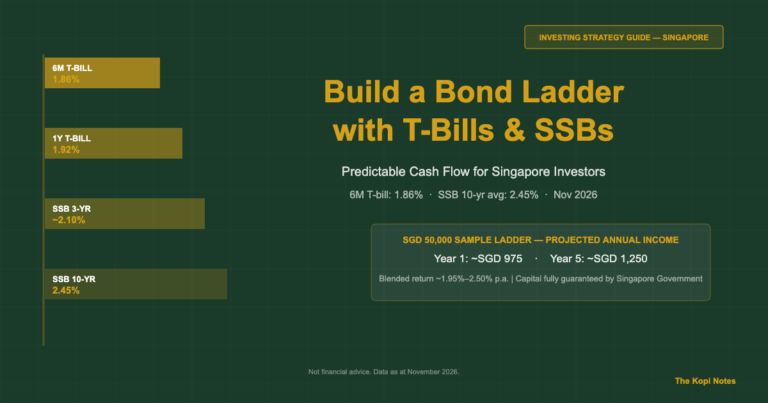
Satellites must complement the core — not duplicate it. Each satellite needs a clear rationale. Good satellite candidates for Singapore investors include S-REIT ETFs for local real estate income (see the Singapore REIT ETF guide for a full comparison of listed options), gold ETFs for inflation hedging and low equity correlation, Singapore Savings Bonds (10Y average ~2.45% p.a. for the November 2026 tranche) or T-bills (~1.86% p.a. for the most recent 6-month auction) for risk-free fixed income, and sector ETFs (healthcare, clean energy) for investors with specific macro conviction — capped at 10% of portfolio.
| Portfolio Role | Target Allocation | Examples (Singapore Context) | Avg TER Range |
|---|---|---|---|
| Core | 60–80% | CSPX, IWDA, XWR, XUS | 0.03–0.22% p.a. |
| Satellites | 10–20% | S-REIT ETF, Gold ETF, SSBs / T-bills, Sector ETF | 0.00–0.55% p.a. |
| Cash / Emergency Buffer | 5–10% | 3–6 months of expenses in a high-yield savings account or money market fund | — |
Source: The Kopi Notes framework, as at November 2026. Allocations shown are of investable cash — CPF is excluded and treated separately in Section 3.
The one rule satellites must follow: each satellite must add something the core does not already provide. If your core is CSPX (S&P 500), adding a Nasdaq-100 ETF as a satellite doubles your US tech concentration — Apple, Microsoft, and Nvidia become an even larger share of your portfolio. A better satellite would be an S-REIT ETF (Singapore real estate income), a gold ETF (non-equity asset class), or SSBs (zero-correlation fixed income).
Core-Satellite in a Singapore Context
Singapore investors have a structural advantage most global investors lack: CPF. Your CPF account is not separate from your investment portfolio — it is part of your portfolio, and often the largest single component. Failing to include it when designing your core-satellite allocation is equivalent to planning a 42-kilometre marathon while ignoring that you have already run the first 20.
CPF as Your Invisible Core
CPF Ordinary Account (OA) earns 2.5% p.a. and CPF Special Account / Retirement Account (SA/RA) earns 4.0% p.a., both government-guaranteed with no market risk. For perspective, a 10-year Singapore government bond yields roughly 2.5–3.0% p.a. in 2026. Your CPF SA is earning a risk-free rate comparable to medium-duration government bonds — without the mark-to-market price volatility a bond ETF would carry. For more on how CPF interacts with your overall investment plan, the CPF investment strategy guide covers CPFIS eligibility and the opportunity cost of investing vs retaining OA funds.
| Age Group | Approximate CPF Balance | Equivalent “Bond” Allocation | What This Means for Your Cash Portfolio |
|---|---|---|---|
| 30s | ~S$50,000–80,000 | ~S$50k–80k in “government bonds” | Can afford to invest cash 100% in equities |
| 40s | ~S$180,000–250,000 | ~S$180k–250k in “government bonds” | CPF likely covers defensive allocation; go equity-heavy with cash |
| 50s | ~S$350,000–500,000+ | ~S$350k+ in “government bonds” | CPF likely 50%+ of total wealth — investable cash can tilt equity-heavy |
Source: CPF Board average balance benchmarks, The Kopi Notes estimates, as at November 2026. Individual CPF balances vary by salary, employment history, and voluntary top-ups. Check your CPF Statement for personal figures.
A Worked Example: SGD 50,000 Portfolio at Age 35
Suppose you are 35 and have: CPF OA SGD 50,000 (2.5% p.a.) + CPF SA SGD 40,000 (4.0% p.a.) + investable cash SGD 50,000. Your total portfolio is SGD 140,000. CPF (SGD 90,000) is already 64% of that — entirely in government-backed, low-volatility holdings. Even before you invest a dollar of cash, your overall allocation is approximately 36% cash / 64% “bonds”.
A conventional financial planner might suggest a 70/30 equity-bond split for a 35-year-old. But you already have a substantial bond allocation via CPF. For your SGD 50,000 investable cash, you could comfortably go 100% equity core — say 85% CSPX + 15% S-REIT ETF — and your overall portfolio allocation would still land at approximately 46% equity / 54% defensive. That is a reasonable profile for someone 30 years from retirement, not an aggressive one.
SRS as a Tax-Sheltered Satellite Layer
Singapore citizens and PRs can contribute up to SGD 15,300 annually to their Supplementary Retirement Scheme (SRS) account and receive full income tax relief on contributions. SRS funds can be invested in ETFs through eligible brokers (Syfe and IBKR support SRS). A smart allocation: use SRS for your satellite positions — your S-REIT ETF or sector tilt — to shelter potential gains via income tax deferral. Use your regular cash account for the core (which you will rarely sell, so the deferral benefit is less critical). To optimise your SRS contribution vs other priorities, run your projection through the Singapore retirement calculator before deciding how much to contribute annually.
Sample Allocations by Life Stage
There is no single correct core-satellite split — the right allocation depends on your CPF balance, time horizon, income stability, and near-term capital needs (BTO downpayment, overseas education). The table below is a starting framework. Adjust toward more equity if your CPF is large relative to your investable cash; adjust toward more satellites if you want income or lower volatility in your investable portfolio.
| Profile | Core | Satellites | Cash Buffer |
|---|---|---|---|
| Early 20s, first job Small CPF, 40-year horizon |
85% (CSPX or XUS) | 10% S-REIT ETF 5% Gold ETF |
10–15% |
| Mid 30s, wealth building Growing CPF, buying property |
75% (IWDA or XWR) | 15% S-REIT ETF 10% SSBs / T-bills |
10–15% |
| Mid 40s, pre-retirement Substantial CPF, peak income |
65% (IWDA or XWR) | 15% S-REIT ETF 10% SSBs 10% Gold ETF |
10% |
| 50s+, income phase CPF as main retirement asset |
50% (dividend or IWDA) | 20% S-REIT ETF 15% SSBs 10% Gold ETF 5% Bond ETF |
10–15% |
Source: The Kopi Notes framework, as at November 2026. Allocations are illustrative starting points, not personalised financial advice. CPF balances are excluded from percentages shown — they are your structural defensive allocation.
Building Your Core-Satellite Portfolio: Step-by-Step
Step 1: Map Your Existing Allocation (Including CPF)
Before investing a single dollar, list: (a) CPF OA balance, (b) CPF SA/RA balance, (c) existing investments at market value, (d) investable cash. Sum these for your total wealth. CPF (a + b) divided by total wealth gives you your existing “defensive” allocation. If this is already above 50%, your cash investments can safely be tilted heavier toward equity than conventional rules suggest.
Step 2: Choose Your Core ETF — One Only
Select one primary core ETF based on your preferred geographic focus. US-focused: CSPX (LSE, TER 0.07%) or XUS (SGX, TER 0.03%). Developed world: IWDA (LSE, TER 0.20%) or XWR (SGX, TER 0.12%). Total world including emerging markets: VWRA (LSE, TER 0.22%) — see the VWRA ETF Singapore guide for a complete analysis of this option. Keep it to one core ETF — two is permissible if they are genuinely complementary (e.g., CSPX + a developed-ex-US ETF); three or more usually signals over-engineering.
Step 3: Select 1–2 Satellites With a Clear Rationale
Ask for each satellite: What does this add that my core does not already provide? Good answers: “S-REIT ETF adds Singapore real estate income and local market exposure my global ETF lacks.” “Gold ETF adds an asset class with near-zero correlation to equities.” Poor answers: “CNDX adds Nasdaq-100 to my CSPX core” (duplicates US tech exposure). Read the recent piece on DCA vs lump sum investing for how to deploy capital into satellites — monthly DCA works particularly well for higher-volatility satellite positions. If you are building a fixed-income satellite, the T-bill and SSB bond ladder guide covers how to structure a rolling SSB and T-bill position.
Step 4: Set Target Percentages and Automate
Target percentages enforce discipline. Without them, most investors naturally add to what has performed well (chasing) and avoid what has fallen (panic). Set your targets — e.g., 75% CSPX / 15% S-REIT ETF / 10% SSBs — and rebalance annually back to those targets. Automate your monthly contributions with a fixed amount per bucket; your brokerage standing instruction or salary crediting can handle this.
Step 5: Review Annually — Not Monthly
Check your allocation once a year. If any position has drifted more than 5 percentage points from target, buy the under-weight bucket (do not sell the over-weight, unless it has grown beyond 10 points off target — selling triggers tax events elsewhere). The goal of the core-satellite framework is to spend less time managing your portfolio, not more.
Where to Buy ETFs in Singapore
Your broker choice affects both costs and ETF access. The right answer depends on whether you prefer LSE-listed ETFs (accessed in GBP/USD via an international broker) or SGX-listed ETFs (bought in SGD through any local broker).
LSE-listed ETFs (CSPX, IWDA, VWRA): Interactive Brokers (IBKR) is the most cost-effective option for Singapore investors at portfolio sizes above SGD 50,000, with commissions as low as USD 1 per trade and near mid-market FX conversion. Use referral code jianxiong368 at account opening. FSMOne (use the FSMOne referral code P0544985) is a Singapore-based alternative with SRS account support.
SGX-listed ETFs (XUS, XWR, S-REIT ETFs): Any SGX broker works — moomoo, Longbridge, and FSMOne all offer competitive commissions. These are convenient for investors who want to invest purely in SGD without currency conversion.
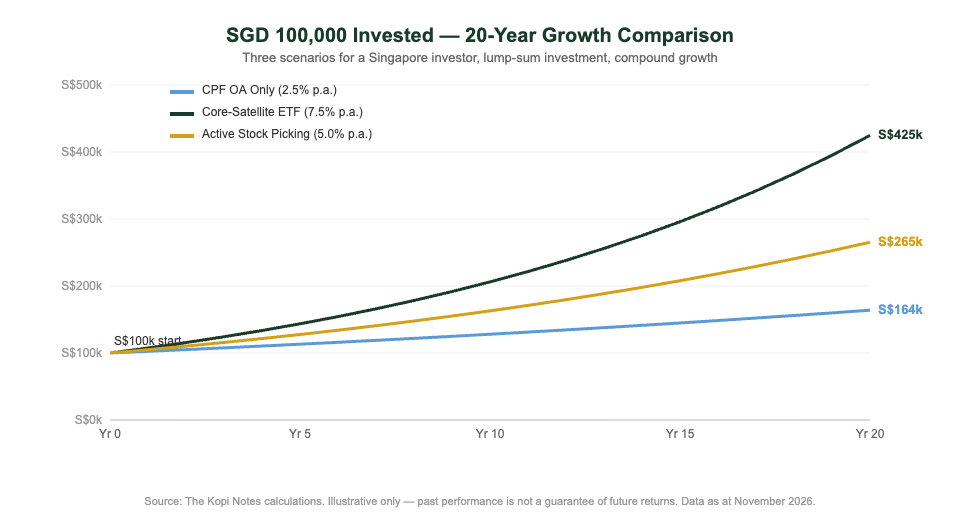
Hands-off robo-advisors: Syfe (referral code SRPRFFFCD) and Endowus (referral code 2V343) offer portfolio options that follow a core-satellite structure. Syfe Core portfolios use globally diversified ETFs; Endowus allows SRS and CPF-OA investing through curated fund selections. The convenience comes at a management fee of 0.35–0.65% p.a. on top of underlying ETF TERs.
Disclaimer: TKN may receive referral compensation when you use these codes. This does not affect our editorial assessments.
Frequently Asked Questions
What is the core-satellite portfolio strategy for Singapore investors?
The core-satellite strategy divides your investable cash into a broad-market “core” (60–80% in a low-cost index ETF like CSPX, IWDA, or XWR) and “satellites” (10–20% in targeted positions with specific rationale, such as S-REIT ETFs, gold, or Singapore Savings Bonds). The framework originated in institutional fund management and is now accessible to any retail investor via low-cost ETFs. For Singapore investors, CPF functions as a natural risk-free core that should be mapped into your overall allocation before deciding how to invest your cash savings — doing so often reveals you have more defensive assets than you realised, and can afford to invest your cash more aggressively in equities.
How much of my investable cash should go into the core vs satellites when investing in Singapore?
A starting allocation for most Singapore investors is 70–80% core and 10–20% satellites, with 5–10% kept as a cash buffer. The right split depends on three factors: your CPF balance relative to total wealth (a large CPF means your cash can tilt more equity), your time horizon (further from retirement means more equity tolerance), and your income stability (variable income warrants a larger cash buffer). Do not over-complicate: one core ETF plus one satellite ETF is better than five core ETFs plus ten satellites. Each satellite position should represent at least 5% of your investable portfolio to have a meaningful impact — below that, it adds complexity without moving the needle on returns.
Can I count my CPF as part of my core portfolio?
Yes — and you should. CPF OA earns 2.5% p.a. and CPF SA earns 4.0% p.a., both government-guaranteed with zero market volatility. These returns are comparable to, or better than, a medium-duration Singapore government bond in 2026 market conditions. When designing your core-satellite portfolio, map your CPF balance first. If your CPF (OA + SA) already exceeds 50–60% of your total wealth, you have a natural defensive buffer in place. Your investable cash can then operate as a pure equity engine — a 100% equity core ETF allocation — without making your overall portfolio dangerously aggressive. The CPF's defensive role is permanent: even if you invest your CPF-OA via CPFIS, the base 2.5% OA rate functions as your floor.
What are the best satellite positions for Singapore investors in 2026?
The best satellites are those that complement your core rather than duplicate it. For a Singapore investor with a global equity ETF as the core, strong satellite candidates in 2026 include: (1) S-REIT ETF — adds Singapore and Asian real estate income, historically low correlation with global equities; (2) Gold ETF — inflation hedge, near-zero equity correlation; (3) Singapore Savings Bonds at ~2.45% 10-year average yield or T-bills at ~1.86% (November 2026) for risk-free fixed income; and (4) a healthcare or clean-energy sector ETF if you have specific macro conviction, capped at 10% of portfolio. Avoid adding a Nasdaq-100 ETF as a satellite if your core is already the S&P 500 — both are dominated by the same mega-cap US technology companies and provide no genuine diversification benefit.
Is the core-satellite strategy suitable for beginners learning how to invest in Singapore?
Yes — the core-satellite framework is arguably more beginner-friendly than pure stock-picking precisely because it limits the number of decisions required. A beginner's core-satellite portfolio can be as simple as: 85% in one core ETF (CSPX or XWR) plus 15% in one satellite (S-REIT ETF). This two-ETF structure is easy to monitor and rebalance annually. The more important skill for beginners is not ETF selection but behavioural discipline — staying invested during drawdowns and not switching strategies every six months. The core-satellite framework enforces this naturally by giving you a target allocation to return to rather than a blank slate each time you feel uncertain. Start simple, increase complexity only when you have held your core position through at least one full market correction.
How is the core-satellite approach different from just buying VWRA?
Buying VWRA (a total world ETF covering ~3,500 equities across developed and emerging markets) is an excellent starting point for how to invest in Singapore, but it is not a complete portfolio strategy on its own. The core-satellite framework adds two things VWRA alone cannot: (1) it explicitly accounts for CPF as part of your overall allocation, which can significantly change how much additional equity exposure you need from your investable cash; and (2) it allows you to add satellites that VWRA does not hold — Singapore government bonds, local REITs, gold, and CPF-equivalent instruments. For a deep analysis of VWRA as a core ETF including its index methodology, TER of 0.22%, and Ireland-domiciled tax advantages for Singapore investors, see the full review. The core-satellite model treats VWRA as one strong core option and supplements it with locally relevant satellite positions.
Ready to Build Your Core-Satellite Portfolio?
Open a brokerage account and start building your low-cost ETF core today. Use our referral links for exclusive sign-up bonuses.
This article was researched with the help of AI. While we strive to keep all information accurate and up to date, there may be errors. If you notice any discrepancies, please contact us.