UOB One Account Interest Rate (November 2026): Every Tier and What S$150,000 Really Earns
The three qualifying routes, the 1.90% p.a. ceiling, and why the last S$25,000 does most of the work.
The UOB One Account pays up to 1.90% p.a. effective interest on S$150,000 if you spend at least S$500 a month on an eligible UOB card and credit a salary of at least S$1,600. Card spend plus three GIRO debits caps out at 1.40% p.a. on S$125,000, and card spend alone gives 0.65% p.a. on S$75,000. Everything above S$150,000 earns 0.05%.
Not financial advice. All figures are for educational reference only. Data verified as at 17 November 2026 against UOB’s official One Account page, its Deposits Fees & Charges schedule (updated 15 May 2026) and its salary credit FAQ (updated 1 April 2026).
Table of Contents
Contents — Click to expand
- How the UOB One Account Interest Rate Works
- UOB One Interest Rate Table (November 2026)
- Maximum Effective Interest Rate by Route
- How Much Interest You Actually Earn
- Salary Credit and GIRO Rules
- Fees, Minimum Balance and Initial Deposit
- Who the UOB One Account Suits
- UOB One vs Other Places to Park Cash
- Frequently Asked Questions
How the UOB One Account Interest Rate Works
The UOB One Account is UOB’s flagship bonus-interest savings account, and it works a little differently from most of its rivals. Instead of stacking separate bonuses for salary, spending, insurance and investments, UOB gives you one rate table with three columns. The column you land in each month depends on which combination of actions you complete. The rate you earn then depends on how much money sits in each balance band.
The three routes are simple to describe:
Route 1: card spend only. Spend at least S$500 in the calendar month on an eligible UOB credit or debit card.
Route 2: card spend plus GIRO. Spend the same S$500 and also make three GIRO debit transactions from the account in the month.
Route 3: card spend plus salary. Spend the S$500 and credit a salary of at least S$1,600 to the account in the month.
Notice that card spend is mandatory on every route. Unlike the OCBC 360 interest rate tiers, where salary on its own earns a bonus, UOB pays almost nothing extra unless the S$500 card spend is met. Miss the spend in any month and the whole account drops to 0.05% p.a. for that month, even if your salary went in as usual.
The second feature to understand is the balance bands. UOB splits your balance into the first S$75,000, the next S$50,000, the next S$25,000 and everything above S$150,000. Each band earns its own rate, so the “effective” rate on your whole balance is a blend. That is why the headline 1.90% p.a. only appears at exactly S$150,000, and why the effective rate falls again if you hold more.
UOB One Interest Rate Table (November 2026)
Here is the full rate table exactly as UOB lists it on the official UOB One Account page. Rates are per annum and apply to the portion of your monthly average balance that falls in each band.
| Balance band | Card spend only (min. S$500) | Card spend + 3 GIRO debits | Card spend + salary credit (min. S$1,600) |
|---|---|---|---|
| First S$75,000 | 0.65% | 1.00% | 1.00% |
| Next S$50,000 | 0.05% | 2.00% | 2.50% |
| Next S$25,000 | 0.05% | 0.05% | 3.40% |
| Above S$150,000 | 0.05% | 0.05% | 0.05% |
Source: UOB One Account page, uob.com.sg, verified 17 November 2026
Three things jump out from the table. First, on the first S$75,000 the GIRO route and the salary route pay the same 1.00% p.a., so if your savings are below S$75,000 you do not need to move your salary to UOB at all. Three GIRO bills will do.
Second, the salary route only starts to pull ahead from the second band, where it pays 2.50% p.a. against 2.00% for the GIRO route. Third, the 3.40% p.a. band between S$125,000 and S$150,000 is exclusive to the salary route. That last S$25,000 is where the headline rate is won or lost.
UOB pays base interest on each day-end balance and calculates bonus interest monthly on the monthly average balance. In practice this means a mid-month top-up still counts, but only in proportion to the days it sat in the account.
UOB One Maximum Effective Interest Rate by Route
UOB publishes a maximum effective interest rate (EIR) for each route. These are the blended rates on the whole balance at the point where each route peaks.
| Route | Peak balance | Maximum EIR (p.a.) | Maximum interest a year |
|---|---|---|---|
| Card spend only | S$75,000 | 0.65% | S$487.50 |
| Card spend + 3 GIRO debits | S$125,000 | 1.40% | S$1,750 |
| Card spend + salary credit | S$150,000 | 1.90% | S$2,850 |
Source: UOB One Account page (EIR statements and S$2,850 maximum), uob.com.sg, verified 17 November 2026; annual interest for the first two routes is a TKN calculation
The S$2,850 figure for the salary route is UOB’s own number. The other two are our arithmetic: S$75,000 at 0.65% is S$487.50, and S$75,000 at 1.00% plus S$50,000 at 2.00% is S$1,750, which is 1.40% of S$125,000. Both match UOB’s stated EIRs.
How Much Interest the UOB One Account Actually Earns
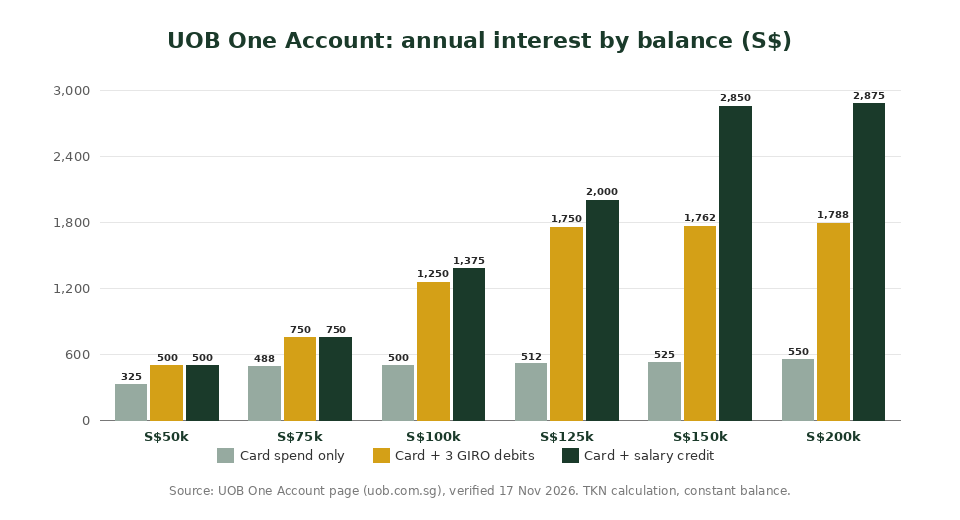
Headline rates are easy to quote and hard to feel. The table below converts them into dollars a year for balances from S$50,000 to S$200,000, assuming the balance stays constant for 12 months and the rates do not change.
| Balance | Card spend only | Card + 3 GIRO debits | Card + salary credit |
|---|---|---|---|
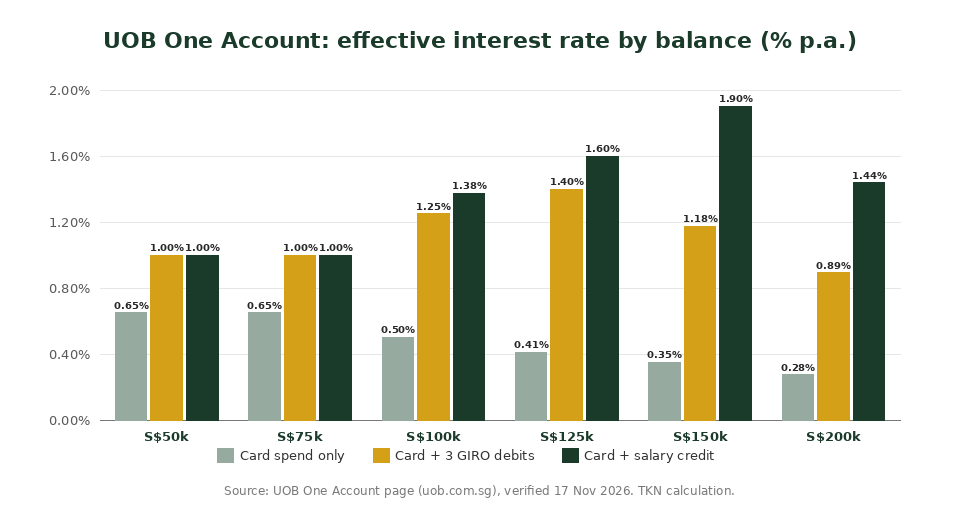
| S$50,000 | S$325 (0.65%) | S$500 (1.00%) | S$500 (1.00%) |
| S$75,000 | S$487.50 (0.65%) | S$750 (1.00%) | S$750 (1.00%) |
| S$100,000 | S$500 (0.50%) | S$1,250 (1.25%) | S$1,375 (1.38%) |
| S$125,000 | S$512.50 (0.41%) | S$1,750 (1.40%) | S$2,000 (1.60%) |
| S$150,000 | S$525 (0.35%) | S$1,762.50 (1.18%) | S$2,850 (1.90%) |
| S$200,000 | S$550 (0.28%) | S$1,787.50 (0.89%) | S$2,875 (1.44%) |
Source: TKN calculation using UOB One Account rate table, uob.com.sg, verified 17 November 2026. Effective rates rounded to two decimals.
A few practical takeaways for Singapore savers:
The S$125,000 to S$150,000 band is worth S$850 a year. If you are already on the salary route, moving your balance from S$125,000 up to S$150,000 adds S$25,000 earning 3.40% p.a., which is S$850 of extra interest. Few savings accounts in Singapore pay that much on a marginal S$25,000.
Money above S$150,000 is close to idle. At 0.05% p.a., an extra S$50,000 adds just S$25 a year. Anything beyond S$150,000 is usually better in fixed deposits or digital bank accounts, T-bills or a money market fund.
Card spend only is a weak route. At S$75,000 you earn S$487.50 a year. That is better than a plain savings account but well below what a no-conditions digital bank account may pay, so check current digital bank rates before settling for it.
UOB One Salary Credit and GIRO Rules
Most people who miss a month of bonus interest do so on a technicality, so the fine print is worth a few minutes.
What counts as salary credit
According to UOB’s UOB One Account salary credit FAQ (updated 1 April 2026), you must credit at least S$1,600 of salary to the One Account within the calendar month. It must come in by GIRO or FAST with the transaction reference “SALA”, or by PayNow with the reference “PAYNOW SALA”. Transfers you make yourself from another personal account, cash deposits and cheques do not count, so self-employed savers and freelancers paid by bank transfer may not qualify. If your employer uses a different reference code, ask HR or check with UOB before relying on the 1.90% figure.
What counts as GIRO
The GIRO route needs three GIRO debit transactions from the account in the calendar month. Common candidates are utilities, telco bills, insurance premiums, town council charges and income tax instalments. Three separate billing organisations are the safest way to hit the count every month.
What counts as card spend
The S$500 must be charged to an eligible UOB credit or debit card and posted within the calendar month. UOB excludes certain transaction types from eligible spend, so read the card terms on the UOB site rather than assuming every transaction counts. A practical tip: aim for S$550 to S$600 so that a refund or a late-posting transaction does not push you under the line.
UOB One Fees, Minimum Balance and Initial Deposit
The account’s fees are modest, but they are not zero. These figures come from UOB’s Deposits Fees & Charges schedule, updated 15 May 2026.
| Item | UOB One Account |
|---|---|
| Minimum initial deposit | S$1,000 |
| Minimum balance fee | S$5 if the average daily balance for the month falls below S$1,000 |
| Early account closure fee | S$30 if closed within 6 months of opening |
| Interest on balances above S$150,000 | 0.05% p.a. |
Source: UOB Deposits Fees & Charges (updated 15 May 2026) and UOB One Account page, verified 17 November 2026
For anyone using the account as intended, with tens of thousands parked in it, the S$1,000 threshold will not matter. It mainly bites people who open the account, chase a sign-up promotion and then drain it.
Who the UOB One Account Suits
It fits well if you already hold, or are happy to hold, a UOB card you will use for at least S$500 a month, your employer credits your salary with the SALA reference, and you keep roughly S$100,000 to S$150,000 in cash. In that zone the account pays 1.38% to 1.90% p.a. with no insurance or investment products attached.
It fits less well if your cash savings are below S$75,000 and you would rather not change your spending habits, your income arrives by personal transfer, or you have well over S$150,000 in cash. In the first case, the payoff for meeting conditions is small. In the last case, everything above S$150,000 earns almost nothing.
A worked example. Mei, 34, earns S$5,200 a month, keeps S$140,000 as her emergency fund and house savings, and already spends about S$900 a month on a UOB card. If she credits her salary to the One Account, she earns S$75,000 x 1.00% + S$50,000 x 2.50% + S$15,000 x 3.40% = S$750 + S$1,250 + S$510 = S$2,510 a year, an effective 1.79% p.a. If she topped up another S$10,000 to reach S$150,000, she would earn S$2,850, so the extra S$10,000 adds S$340.
If you are building towards a retirement number rather than an emergency fund, use our Singapore retirement planning calculator to see how much should sit in cash versus investments.
UOB One vs Other Places to Park Cash
The UOB One Account is one of several “do more, earn more” accounts at Singapore banks, and each rewards a slightly different lifestyle. If you are comparing, read our guides to the Standard Chartered Bonus$aver interest rate and the BOC SmartSaver bonus tiers, which use different salary and spend thresholds. If you cannot or will not credit your salary, our list of the best savings accounts without salary credit is a better starting point.
Digital banks are the other obvious comparison. They usually pay a flat rate with fewer conditions, which suits money above S$150,000 or savers who do not want to manage card spend. See our best digital bank in Singapore comparison for the current picture. If you open one, you can use these referral codes: MariBank 2DCT80WQ via our MariBank referral code page, Trust Bank HTWYQP95 via the Trust Bank referral code page, and GXS Bank YONG477 via the GXS Bank referral code page. The Kopi Notes may earn referral rewards from these.
A sensible structure for many households is to keep up to S$150,000 in the UOB One Account if you meet the salary route, put any overflow into a digital bank account or short-term fixed deposit, and invest longer-term money separately. That way no single account has to do everything, and no dollar sits at 0.05%.
Frequently Asked Questions
What is the UOB One Account interest rate in November 2026?
Up to 1.90% p.a. effective on S$150,000 if you spend at least S$500 a month on an eligible UOB card and credit a salary of at least S$1,600. By band, the salary route pays 1.00% on the first S$75,000, 2.50% on the next S$50,000 and 3.40% on the next S$25,000. Balances above S$150,000 earn 0.05% p.a.
Can I earn UOB One bonus interest without salary credit?
Yes. Spend S$500 a month on an eligible UOB card and make three GIRO debit transactions, and you earn 1.00% p.a. on the first S$75,000 and 2.00% p.a. on the next S$50,000, a maximum EIR of 1.40% p.a. on S$125,000. Card spend alone earns 0.65% p.a. on the first S$75,000.
What happens if I miss the S$500 card spend?
The card spend is required on all three routes. If you miss it in a month, the account earns 0.05% p.a. for that month, even if your salary or GIRO transactions went through.
How much interest does S$100,000 earn in the UOB One Account?
About S$1,375 a year on the salary route (1.38% effective), S$1,250 on the GIRO route (1.25%) and S$500 on card spend only (0.50%). These are The Kopi Notes estimates assuming a constant balance and unchanged rates.
What is the minimum salary for UOB One?
S$1,600 a month, credited by GIRO or FAST with the reference “SALA”, or by PayNow with “PAYNOW SALA”, within the calendar month. Transfers from your own personal accounts, cash and cheques do not count.
Is there a minimum balance or fall-below fee for UOB One?
The minimum initial deposit is S$1,000. UOB charges a S$5 minimum balance fee if the average daily balance for the month falls below S$1,000, and S$30 if you close the account within 6 months of opening.
Should I keep more than S$150,000 in UOB One?
Usually not. Every dollar above S$150,000 earns 0.05% p.a., so S$50,000 extra adds about S$25 a year. Overflow money tends to work harder in a digital bank, fixed deposit, T-bills or a money market fund.
Is money in the UOB One Account insured?
Singapore dollar deposits with UOB, a full bank and Deposit Insurance Scheme member, are covered up to S$100,000 per depositor per member bank by the Singapore Deposit Insurance Corporation. Balances above that amount are not insured.
Disclaimer: This article was researched and drafted with the help of AI tools and checked against UOB’s official One Account page, its Deposits Fees & Charges schedule (updated 15 May 2026) and its UOB One salary credit FAQ (updated 1 April 2026) on 17 November 2026. It is general information, not financial advice. Interest rates, eligibility rules and promotions can change without notice. Always confirm the latest terms on the bank’s website before opening an account or moving money. The Kopi Notes may earn referral rewards from some links.
This article was researched with the help of AI. While we strive to keep all information accurate and up to date, there may be errors. If you notice any discrepancies, please contact us.