Syfe vs MariBank 2026: Beyond Cash+ — Investing, Credit and SRS Compared
One is a robo-advisor with brokerage and SRS access. The other is a full digital bank with a credit card and loans. Here is what each actually replaces in your financial stack.
Syfe is a managed robo-advisor and brokerage offering portfolios, SRS-dedicated accounts and self-directed trading, with fees tiered from 0.65% down to 0.25% p.a. by assets. MariBank is a MAS-licensed full digital bank paying a flat 0.88% p.a. on savings, with its own credit card, instant loan and debit card — but no investment products at all. They overlap only on cash management, and even there the mechanics differ completely.
Not financial advice. All figures are for educational reference only. Data verified as at November 2026 unless noted.
- Syfe covers investing end-to-end: managed portfolios (0.65% to 0.25% p.a. by AUM tier), a brokerage (Syfe Trade), and a dedicated SRS Portfolios account — MariBank offers none of this.
- MariBank covers everyday banking: a flat 0.88% p.a. SDIC-insured savings rate, a Mari Credit Card with an Instant Loan feature, and a Mastercard debit card with no FX fee — Syfe offers none of this.
- The only real overlap is cash parking, and that is a guaranteed insured bank rate (MariBank) versus a projected, uninsured fund yield (Syfe Cash+) — covered in full in our Syfe Cash+ vs MariBank cash yield comparison.
Syfe and MariBank at a Glance
Most “Syfe vs MariBank” searches are really asking one narrow question: which one pays more on idle cash. We have covered that specific question in detail in our Syfe Cash+ vs MariBank comparison. This article answers a broader one: if you had to pick just one of these two platforms to run more of your money through, what would you actually be giving up?
The honest answer is that they barely compete. Syfe, regulated by MAS as a capital markets services licensee, is built around investing — managed ETF portfolios, a self-directed brokerage called Syfe Trade, and a dedicated SRS Portfolios product for Supplementary Retirement Scheme funds. MariBank, backed by Sea Limited (parent of Shopee and Garena), is a full MAS-licensed digital bank — its product line is a savings account, a Mastercard debit card, and a credit-card-linked instant loan. Neither one touches the other’s core business.
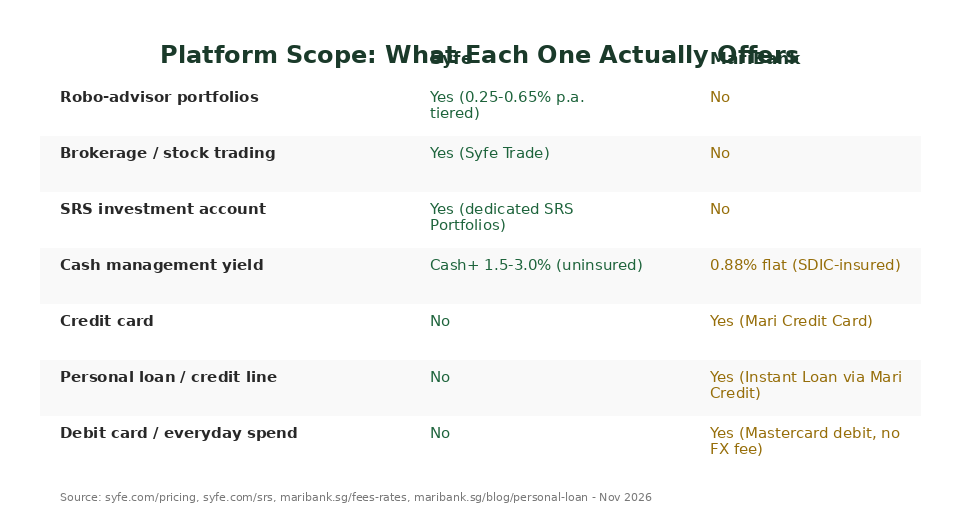
| Feature | Syfe | MariBank |
|---|---|---|
| Product type | Robo-advisor + brokerage (CMS licensee) | MAS-licensed full digital bank |
| Managed portfolios | Yes, 0.65%-0.25% p.a. tiered by AUM | No |
| Self-directed brokerage | Yes (Syfe Trade) | No |
| SRS account | Yes, dedicated SRS Portfolios | No |
| CPF-OA support | No | No |
| Savings / cash yield | Cash+ 1.5%-3.0% p.a.* (not SDIC-insured) | 0.88% p.a. flat (SDIC-insured) |
| Credit card | No | Yes (Mari Credit Card, no annual fee) |
| Personal loan | No | Yes (Instant Loan via Mari Credit Card) |
| Debit card | No | Yes (Mastercard debit, no FX fee from 2026) |
*Syfe Cash+ yields are projected, non-guaranteed fund returns and vary by tier. Source: syfe.com/pricing, syfe.com/srs, maribank.sg/fees-rates, maribank.sg/blog/personal-loan — verified November 2026.
Investing, Brokerage and SRS Access
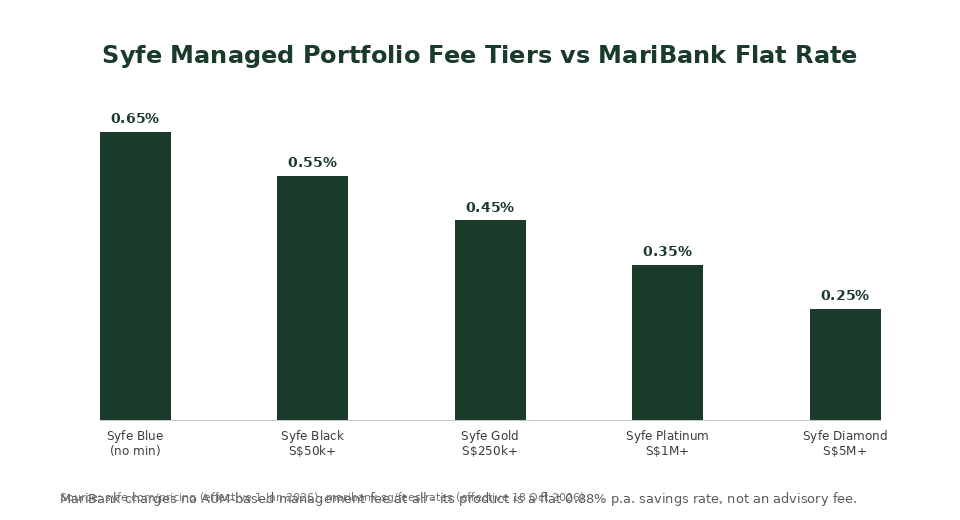
Syfe’s managed portfolios charge an advisory fee tiered by assets under management (or net worth, whichever is higher): 0.65% p.a. at the Blue tier with no minimum, stepping down to 0.55% (Black, S$50,000+), 0.45% (Gold, S$250,000+), 0.35% (Platinum, S$1M+) and 0.25% (Diamond, S$5M+), effective 1 January 2026. This covers Syfe’s core, Equity100, Income+ and REIT+ portfolios.
Syfe Trade, the self-directed brokerage layer, charges SGX commissions of roughly 0.04%-0.06% of trade value (minimum around S$1.98) and offers a monthly allowance of free US stock trades at lower tiers, with free US trading once you reach Gold (S$250,000+ in assets). Options trading is priced per contract from S$0.59 (Blue) down to S$0.00 (Diamond), with no platform fee at any tier.
SRS Portfolios let Supplementary Retirement Scheme funds be invested through Syfe under the same advisory fee structure as the cash portfolios — our Syfe SRS account guide covers the full mechanics.
MariBank has none of this. It does not offer managed portfolios, a brokerage, or an SRS-linked account of any kind — it is a transactional and savings bank, not an investment platform. A MariBank balance earns its flat savings rate and nothing more.
Credit Card, Loans and Debit Card
This is where MariBank pulls ahead on breadth, and Syfe simply has nothing to offer. MariBank issues a Mari Credit Card with no annual fee and cashback rewards, and removed its foreign transaction fee from 1 January 2026 — useful for overseas online spending, though the card does not support overseas ATM withdrawals.
The card also unlocks MariBank’s Instant Loan feature: a portion of your Mari Credit Card’s available limit can be converted to cash, disbursed to your Mari Savings Account or another linked bank account. Reported flat rates start from around 1.28% p.a. (effective interest rate from roughly 1.92% p.a. on a 3-month tenor per MariBank’s own disclosures), though other reviews cite an effective rate closer to 5-8% p.a. depending on tenor and applicant profile — always check the exact rate quoted at application, since it is personalised. Missed repayments trigger standard credit-card late interest (reported at 30.99% p.a.), and early repayment fees may apply. Applicants need both a Mari Savings Account and a Mari Credit Card, and must be a Singapore citizen or PR aged 21-65. Our MariBank personal loan guide breaks down the full terms.
MariBank also issues a Mastercard debit card for everyday spending at any Mastercard-accepting merchant, online or in person, linked directly to your Mari Savings Account balance.
Syfe offers none of this. There is no Syfe credit card, no lending product, and no debit card — money moves in and out of Syfe via bank transfer only. If you want a single app that also replaces your everyday spending card and gives you access to a personal loan, Syfe cannot do that job; MariBank can.
Cash Yield and SDIC Protection
The one place these two platforms genuinely compete is parking idle cash — and even here the structures are fundamentally different. MariBank pays a flat 0.88% p.a. on SGD balances (effective 18 Oct 2026), fully insured by the Singapore Deposit Insurance Corporation (SDIC) up to S$100,000, with zero conditions and no tiers to climb.
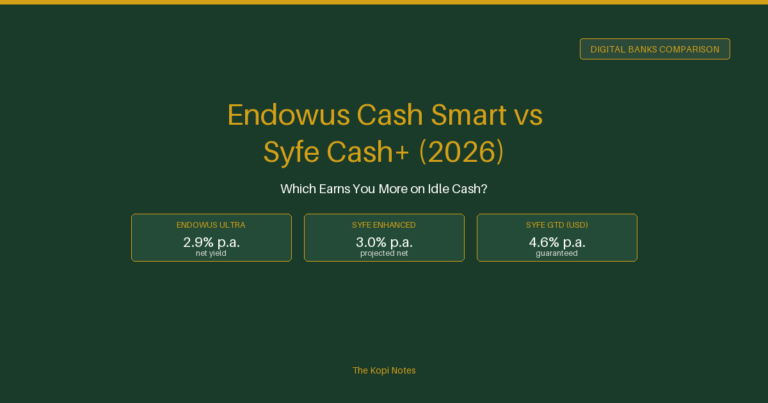
Syfe Cash+ offers three non-SDIC-insured tiers instead: Guaranteed (around 1.5% p.a., capital and return locked for the term), Flexi (around 1.7% p.a., withdraw anytime) and Enhanced (around 3.0% p.a. projected, using a short-duration bond fund with small historical drawdowns). None of these are bank deposits, so none carry SDIC cover — they are investment products, even the “Guaranteed” tier, which is contractually guaranteed by the fund structure rather than government-insured.
This is a guaranteed-insured-but-lower rate versus a higher-but-uninsured-projected rate trade-off, and we have built a full breakdown — including a dollar-by-dollar yield table at S$10k/S$30k/S$100k and the exact SDIC mechanics — in our dedicated Syfe Cash+ vs MariBank cash yield comparison. If cash parking is your only question, read that article; this one is about everything else both platforms do.
Who Should Use Which?
Syfe may suit you if:
- You want a managed robo-advisor portfolio, a brokerage, or an SRS-linked investment account — none of which MariBank offers
- You are comfortable with projected, non-SDIC-insured cash yields in exchange for a potentially higher rate via Cash+
- Your core need is investing and growing capital, not everyday banking or credit
MariBank may suit you if:
- You want a simple, fully SDIC-insured place to park cash with zero conditions
- You want a no-annual-fee credit card, an attached instant loan facility, or a fee-free-FX debit card for everyday spending
- You are not looking to invest through this account at all — it is pure banking, not investing
In practice, many Singapore investors run both: MariBank for everyday banking, SDIC-insured savings and the occasional credit-card-linked loan, and Syfe for the actual investing — portfolios, brokerage trades and SRS. For the cash-yield-only trade-off, see our Syfe Cash+ vs MariBank comparison; for how MariBank stacks up against other digital banks, see MariBank vs Trust Bank and GXS vs MariBank vs Trust Bank. For how Syfe stacks up against other investing platforms, see our Syfe vs FSMOne and Syfe vs moomoo comparisons. Not sure how either fits your broader plan? Run the numbers through our Singapore retirement calculator, or see how it fits into a wider passive income Singapore strategy, and check our CPF investment strategy guide if CPF-OA access matters to you (note: neither Syfe nor MariBank supports CPF-OA).
Not financial advice. For educational purposes only. Investment returns and deposit insurance carry different risk profiles — read product terms before committing funds. Data as at November 2026, sourced from syfe.com/pricing, syfe.com/srs, maribank.sg/fees-rates, maribank.sg/blog/personal-loan and TKN’s own verified reviews.
Frequently Asked Questions
Is Syfe or MariBank better for investing?
Syfe is the investing platform of the two — it offers managed portfolios (0.65%-0.25% p.a. tiered by AUM), a self-directed brokerage (Syfe Trade), and a dedicated SRS Portfolios account. MariBank does not offer any investment products at all; it is a savings-and-banking platform only.
Does MariBank offer a credit card or loan?
Yes. MariBank issues a no-annual-fee Mari Credit Card with cashback and no foreign transaction fee (from 1 January 2026), and an attached Instant Loan feature that converts part of your credit limit into cash, with flat rates reported from around 1.28% p.a. depending on tenor and applicant profile. Syfe offers no credit card or lending product.
Can I use Syfe or MariBank for my CPF-OA or SRS funds?
Syfe offers a dedicated SRS Portfolios product for Supplementary Retirement Scheme funds, but does not support CPF Ordinary Account (CPF-OA) investing. MariBank supports neither CPF-OA nor SRS — it is a cash-only digital bank.
Which one pays more on idle cash?
MariBank pays a flat, SDIC-insured 0.88% p.a. on SGD savings. Syfe Cash+ offers projected, non-SDIC-insured yields from roughly 1.5% p.a. (Guaranteed tier) up to around 3.0% p.a. (Enhanced tier). The higher Syfe figure is a fund-based projection, not a bank-guaranteed rate — see our full Syfe Cash+ vs MariBank yield comparison for the detailed numbers.
Does MariBank have a debit card?
Yes, MariBank issues a Mastercard debit card linked to your Mari Savings Account, usable at any Mastercard-accepting merchant online or in person, with no foreign transaction fee from 1 January 2026. Syfe does not issue a debit card of any kind.
Should I use Syfe and MariBank together?
Many Singapore users do, since the two products barely overlap. MariBank covers everyday banking — SDIC-insured savings, a credit card and an attached loan facility — while Syfe covers the investing side: managed portfolios, brokerage trades and SRS. Using both means neither platform is doing a job it was not built for.
Where to Sign Up
Open a Syfe account for managed investing, brokerage and SRS access, or a MariBank account for SDIC-insured savings, a credit card and an instant loan.
This article was researched with the help of AI. While we strive to keep all information accurate and up to date, there may be errors. If you notice any discrepancies, please contact us.