Syfe vs FSMOne 2026: Managed Portfolio vs Self-Directed — Which Fits Your Investing Style?
A side-by-side breakdown of fees, minimums, and CPF/SRS access for Singapore investors choosing between Syfe’s managed robo-advisor portfolios and FSMOne’s self-directed ETF and unit trust platform.
Syfe is a managed robo-advisor charging a tiered 0.65%-0.25% annual fee on diversified ETF portfolios with no minimum investment, while FSMOne is a self-directed platform charging 0% on unit trust sales and roughly 0.08% per ETF trade (min S$8.80) with no annual management fee. Syfe wins on convenience and hands-off rebalancing; FSMOne wins on raw cost for investors willing to pick and rebalance their own holdings, and it uniquely supports CPF Ordinary Account investing, which Syfe does not.
Not financial advice. All figures are for educational reference only. Data as at October 2026 unless noted.
- Syfe’s fee tiers run 0.65% (Blue, no minimum) down to 0.25% (Diamond, S$5M+) a year on its managed portfolios — you pay for ongoing rebalancing and portfolio construction.
- FSMOne charges 0% sales charge on unit trusts and roughly 0.08% per ETF trade (min S$8.80), with no annual AUM-based fee — cheaper at larger balances if you’re comfortable picking your own holdings.
- FSMOne supports CPF Ordinary Account investing at a 0% platform fee; Syfe does not support CPF-OA at all, only SRS on select portfolios.
Table of Contents
Why Compare Syfe and FSMOne
Syfe and FSMOne sit on opposite ends of the investing spectrum in Singapore. Syfe is a managed robo-advisor: you answer a few risk-profile questions, deposit money, and Syfe builds and rebalances a diversified ETF portfolio for you. FSMOne (now rebranded FSM Global) is a self-directed fund supermart and brokerage: you pick your own unit trusts, ETFs, bonds, or stocks and manage the portfolio yourself, with no ongoing advisory fee.
This comparison matters most for anyone trying to decide between paying for hands-off convenience versus doing the legwork themselves for a lower headline cost — and for CPF Ordinary Account holders specifically, since the two platforms differ sharply on what you’re even allowed to invest with your CPF-OA savings.
Fee Structure Compared
Syfe’s fee schedule, effective 1 January 2026, charges a single all-inclusive annual rate on its Managed Portfolios (Core, Income+, REIT+, Themes, Custom): 0.65% for the Blue tier (no minimum), 0.55% for Black (S$50,000+ in assets or net invested amount), 0.45% for Gold (S$250,000+), 0.35% for Platinum (S$1M+), and 0.25% for Diamond (S$5M+). Tier qualification is based on whichever is higher — your total Syfe assets or your net invested amount — and upgrades apply within one business day. Its Cash+ suite is priced separately: Flexi (SGD) runs 0.15%-0.05% depending on tier, Flexi (USD) 0.20%-0.15%, and Cash+ Guaranteed charges no fee at all.
FSMOne charges 0% sales charge on its 1,500+ unit trusts, with a platform fee of 0.0875% per quarter (roughly 0.35% a year) on equity and mixed funds held in cash or SRS accounts — but there is no fee at all for CPF-held unit trusts. For ETFs and stocks, FSMOne charges 0.08% per trade on SGX (minimum S$8.80), a flat S$8.80 on US stocks and ETFs, and a S$3-per-quarter platform access fee that’s waived if you hold S$1,000+ in SGX securities or trade at least once a quarter. There is no ongoing AUM-based advisory fee on self-directed ETF or stock holdings — you only pay when you trade.
The practical difference: Syfe’s fee scales with your balance every year, win or lose, in exchange for someone else doing the rebalancing. FSMOne’s cost is mostly transactional — if you buy and hold a small number of ETFs and rebalance only a few times a year, your effective annual cost stays flat in dollar terms rather than rising as your portfolio grows, which tilts the math in FSMOne’s favour at larger balances.
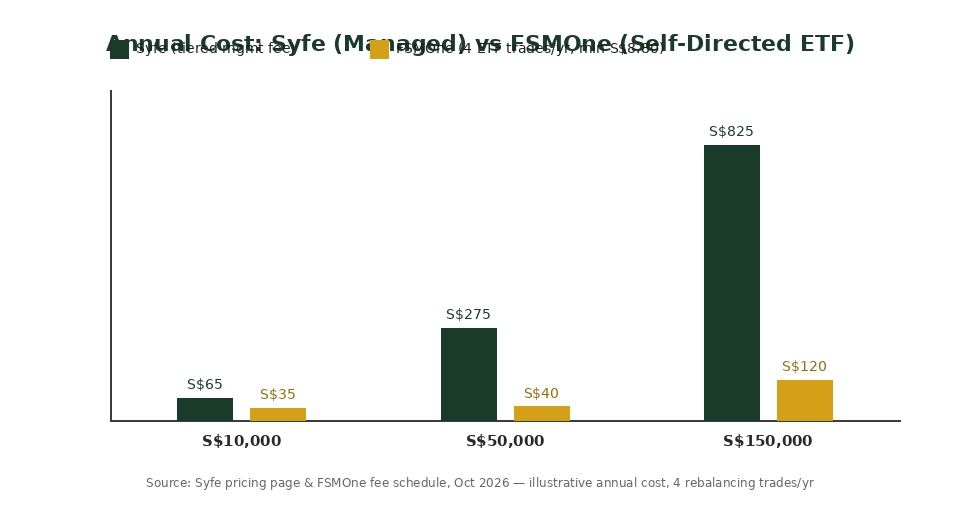
FSMOne’s flat per-trade cost stays low as balances grow, while Syfe’s percentage fee rises with AUM. Source: Syfe & FSMOne fee pages, Oct 2026.
Managed vs Self-Directed: What You Actually Get
Syfe builds and rebalances the portfolio for you. Its Core range (Equity100, Growth, Balanced, Defensive) allocates across low-cost global ETFs based on your declared risk profile, and goal-based options like Income+ and REIT+ add targeted income or Singapore REIT exposure without you having to pick individual funds. You never place a trade yourself — Syfe handles allocation drift and rebalancing automatically. Our Syfe fees breakdown covers the full schedule across every portfolio type.
FSMOne is the opposite: you choose from over 1,500 unit trusts, SGX/US/HK stocks, ETFs, and bonds, and you decide when to buy, sell, and rebalance. There’s no model portfolio or robo-advisory layer — FSMOne is a distribution platform, not an advisor. This gives you full control over fund selection (including Singapore REIT ETFs like the Lion-Phillip S-REIT ETF or NikkoAM-StraitsTrading Asia Ex-Japan REIT ETF) but also means you’re responsible for your own asset allocation, rebalancing discipline, and diversification.
If you want a done-for-you portfolio and are willing to pay an ongoing fee for it, Syfe is the simpler path. If you already know what you want to hold — or want to build a best S-REITs in Singapore 2026-style basket yourself at the lowest possible trading cost — FSMOne gives you that control.
CPF and SRS Investing
This is the sharpest difference between the two platforms. FSMOne is CPFIS-approved, so you can invest your CPF Ordinary Account savings directly in eligible unit trusts and ETFs through the platform, and CPF-held investments carry a 0% platform fee — no ongoing cost on top of the fund’s own expense ratio. FSMOne also supports SRS accounts for unit trusts, ETFs, and bonds.
Syfe does not support CPF-OA investing at all. It offers SRS investing only through select portfolios, and standard Syfe accounts are funded with cash. If your priority is putting idle CPF-OA funds (which otherwise earn a 2.5% floor rate) to work in a low-cost, CPFIS-approved fund, FSMOne is the only one of the two platforms that can do it. See our CPF investment strategy guide for how CPFIS-OA investing fits into a broader retirement plan, and our CPF OA/SA allocation calculator to check whether investing or leaving funds in your OA/SA makes more sense for your numbers.
Which Platform Wins for Which Investor
Syfe generally wins if: you want a done-for-you portfolio with automatic rebalancing, you don’t want to spend time picking or managing individual holdings, you want access to thematic or REIT-focused sleeves without building them yourself, or you want SRS exposure through a managed portfolio rather than self-directed trades.
FSMOne generally wins if: you’re comfortable picking your own ETFs or unit trusts and rebalancing a few times a year, you want the lowest possible headline cost at a larger balance, or — most importantly — you want to invest your CPF Ordinary Account savings, which Syfe cannot do at all.
Some investors use both: FSMOne for CPF-OA and low-cost self-directed ETF holdings, and Syfe for a smaller hands-off cash sleeve they don’t want to manage. For a broader view of how robo-advisors and self-directed platforms stack up across the market, our best investment platform in Singapore 2026 roundup covers IBKR, Syfe, Endowus, FSMOne and more side by side.
Whichever you choose, run the numbers against your own likely balance using our Singapore retirement calculator before committing — a fee gap that looks small in percentage terms compounds meaningfully over a 10-20 year investing horizon.
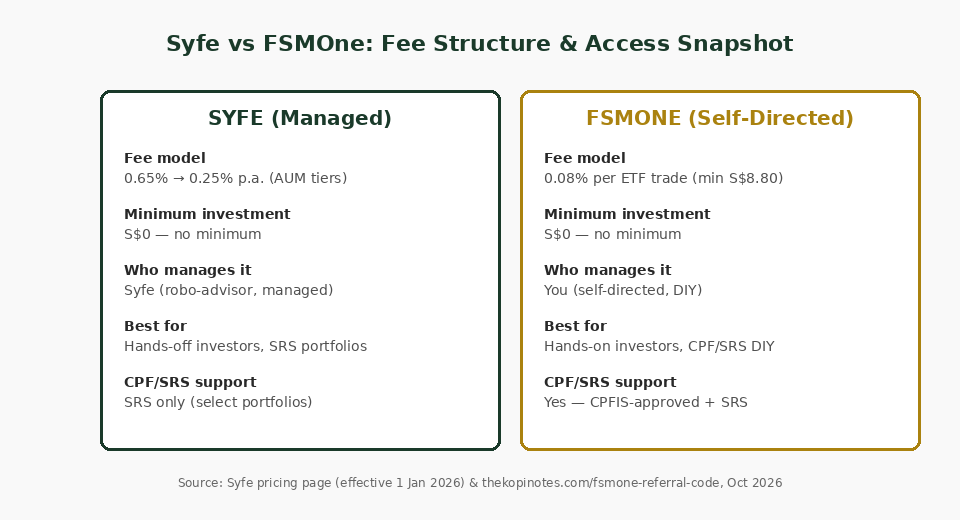
Managed convenience (Syfe) versus self-directed control (FSMOne) at a glance. Source: Syfe & FSMOne product pages, Oct 2026.
Fee and Access Tables
| Factor | Syfe | FSMOne |
|---|---|---|
| Minimum investment | S$0 | S$0 |
| Fee model | 0.65%-0.25% p.a. (AUM tier) | 0% unit trust sales; ~0.08% per ETF trade |
| Who manages the portfolio | Syfe (robo-advisor) | You (self-directed) |
| CPF Ordinary Account support | No | Yes — CPFIS-approved, 0% platform fee |
| SRS support | Select portfolios only | Yes — unit trusts, ETFs, bonds |
| Thematic / REIT-focused sleeves | Yes (Themes, REIT+) | Pick your own REIT ETFs/unit trusts |
Source: Syfe pricing page (effective 1 Jan 2026) and thekopinotes.com/fsmone-referral-code, Oct 2026
Frequently Asked Questions
Is Syfe or FSMOne cheaper?
It depends on your balance and behaviour. Syfe charges an ongoing 0.65%-0.25% annual fee that scales with your balance, win or lose. FSMOne charges 0% on unit trust sales and roughly 0.08% per ETF trade (minimum S$8.80), with no ongoing AUM fee — so at larger balances with infrequent trading, FSMOne is usually cheaper, while Syfe’s convenience fee can be worth it for smaller, hands-off portfolios.
Can I invest my CPF Ordinary Account savings with Syfe or FSMOne?
Only FSMOne. It is CPFIS-approved and charges a 0% platform fee on CPF-held unit trusts. Syfe does not support CPF-OA investing at all — it only offers SRS investing through select portfolios, funded in cash.
What is the minimum investment for Syfe vs FSMOne?
Both platforms have no minimum investment requirement — you can open an account and start with any amount on either platform.
Does Syfe rebalance my portfolio automatically?
Yes. Syfe’s managed portfolios are rebalanced by Syfe to stay aligned with your target allocation. FSMOne does not rebalance for you — since it’s a self-directed platform, you decide when and how to rebalance your own holdings.
Does FSMOne charge a platform or access fee on top of trading fees?
FSMOne charges a S$3 per quarter platform access fee, which is waived if you hold S$1,000 or more in SGX securities or make at least one trade per quarter. There is no separate platform fee on CPF-held investments.
Which platform is better for building a REIT portfolio, Syfe or FSMOne?
Syfe’s REIT+ portfolios give you ready-made, professionally managed Singapore REIT exposure. FSMOne lets you build your own REIT ETF or individual S-REIT basket at a lower per-trade cost, but you choose and manage the holdings yourself. Either can work — it depends on whether you want convenience or control.
Sources: Syfe pricing page, effective 1 Jan 2026, FSMOne fees & charges, The Kopi Notes, Oct 2026, FSM Global (FSMOne) official site.
This article was researched with the help of AI. While we strive to keep all information accurate and up to date, there may be errors. If you notice any discrepancies, please contact us.