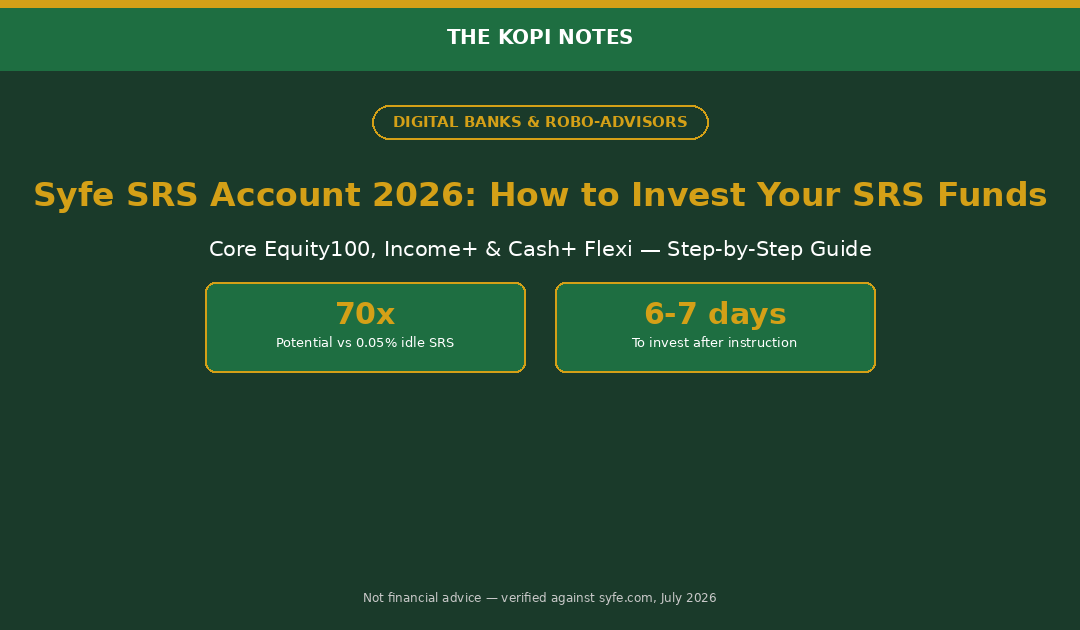
Syfe SRS Account 2026: How to Invest Your SRS Funds With Syfe (Step-by-Step)
Leaving your SRS balance uninvested earns just 0.05% p.a. Here’s exactly how Core Equity100, Income+ and Cash+ Flexi (SGD) work for SRS money on Syfe — fees, returns, and the honest comparison vs T-bills and fixed deposits.
If you have a Supplementary Retirement Scheme (SRS) account with DBS/POSB, OCBC or UOB, your uninvested balance earns just 0.05% p.a. — barely more than a piggy bank. Syfe is one of the digital wealth platforms that lets you invest that idle SRS cash directly, without moving it out of your SRS account first.
This guide covers exactly which Syfe portfolios accept SRS money, how the fees compare, how long it takes to actually get invested, and an honest look at whether Syfe’s SRS-eligible Cash+ Flexi portfolio actually beats a plain fixed deposit or T-bill. This is not financial advice — do your own due diligence before investing.
Table of Contents
SRS-Eligible Portfolios on Syfe
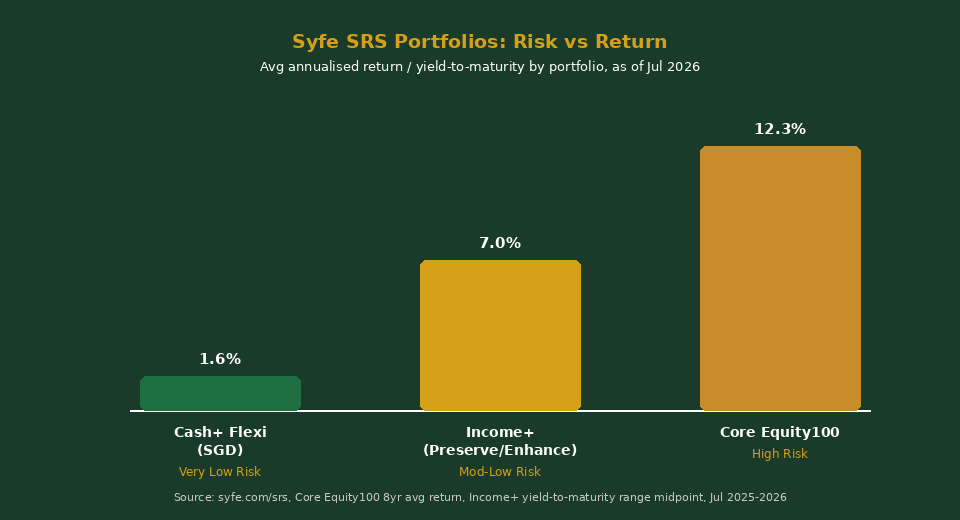
Syfe offers three portfolio types you can fund directly with SRS money — you pick based on risk tolerance and how soon you’ll need the funds:
| Portfolio | Risk Level | Return / Yield | Fund-Level Fee |
|---|---|---|---|
| Core Equity100 | High | 12.3% p.a. (8yr avg) | 0.15%* |
| Income+ (Preserve/Enhance) | Moderately Low | 6.7%-7.0% yield-to-maturity | ~0.65% (institutional) |
| Cash+ Flexi (SGD only) | Very Low | ~1.5%-1.6% p.a. (projected) | Built into projected yield |
*Returns are illustrative, sourced from Syfe’s own published figures as of Jul 2026 and not guaranteed. Core Equity100 returns are pre-fee, calculated in USD terms. Past performance does not guarantee future results.
Note: Cash+ Flexi USD is not SRS-eligible — only the SGD version can be funded with SRS money, since SRS balances are held in SGD.
How to Invest Your SRS Funds With Syfe (Step-by-Step)
- Fund your SRS bank account. You need an existing SRS account with DBS/POSB, OCBC or UOB — Syfe doesn’t open the SRS bank account for you. If you’re starting from scratch, open one first, then contribute.
- Create your Syfe account. Sign up with SingPass and complete KYC — takes a few minutes.
- Set up your SRS portfolio. In the Syfe app, go to “Managed Portfolios” → “Add Portfolio” → select the SRS card.
- Choose a portfolio. Pick Core Equity100, Income+ (Preserve or Enhance), or Cash+ Flexi (SGD).
- Fund with your SRS account. Select “SRS Account” as the funding source and submit your investment amount — you can invest your entire SRS balance if you want, there’s no minimum requirement to keep cash uninvested.
- Wait for the transfer. Syfe debits your SRS bank account and invests the funds into your chosen portfolio — this takes 6-7 business days from the point you submit instructions, noticeably slower than a same-day cash top-up.
One quirk worth flagging: if you already have SRS money invested elsewhere (e.g. in a unit trust via your SRS bank operator), you’ll need to first liquidate and transfer those funds back into your SRS bank account before Syfe can invest them.
Syfe SRS Fees
Syfe doesn’t charge a separate “SRS admin fee” — you pay the same underlying fund-level and management fees as the non-SRS version of each portfolio:
| Portfolio | Management Fee | Fund-Level Fee |
|---|---|---|
| Core Equity100 | Included in AUM tier pricing (0.35%-0.65% typical AUM fee) | 0.15% |
| Income+ | 0.25%-0.65% | ~0.65% (institutional share class) |
| Cash+ Flexi | None separately charged — built into projected yield | — |
For comparison, Income+’s institutional fund-level fee (~0.65%) is meaningfully cheaper than the 1.5%+ typical retail unit trust fee you’d pay buying the same underlying PIMCO-style funds directly through a bank.
Cash+ Flexi (SRS) vs T-Bill vs Fixed Deposit
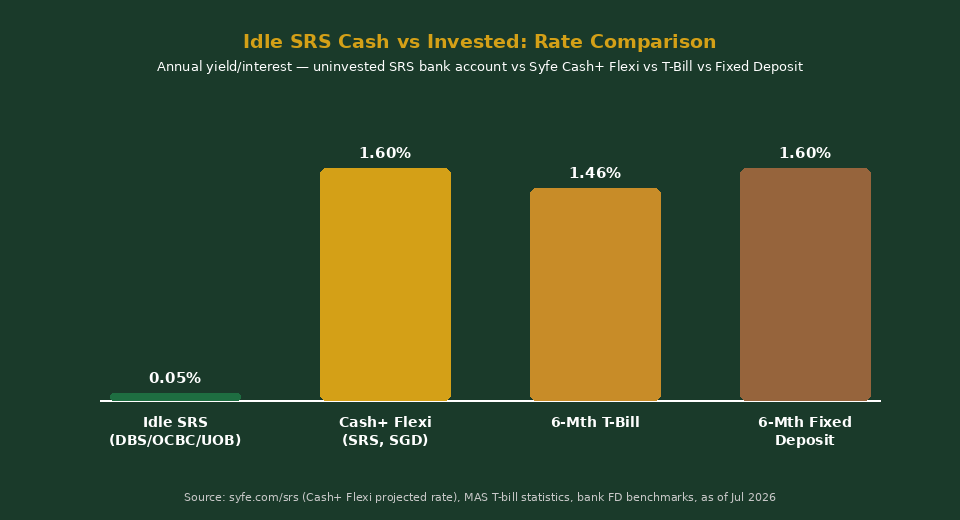
If your goal is simply to stop your SRS cash earning 0.05%, Cash+ Flexi isn’t your only option — here’s how it stacks up against a 6-month T-bill and a 6-month fixed deposit, honestly:
| Option | Rate | Lock-in | Guaranteed? |
|---|---|---|---|
| Idle SRS (DBS/OCBC/UOB) | 0.05% | None | Yes |
| Syfe Cash+ Flexi (SRS) | ~1.5%-1.6%* | None — redeem anytime | No — projected, not guaranteed |
| 6-Month T-Bill | ~1.45%-1.46% | 6 months | Yes |
| 6-Month Fixed Deposit | ~1.6% | 6 months (early withdrawal penalty) | Yes |
*Cash+ Flexi projected rate as of Jul 2025, not guaranteed, and not a bank deposit product — Syfe explicitly states it “does not provide any guarantee or assurance of returns.”
The honest takeaway: at current rates, Cash+ Flexi’s projected yield is roughly in line with — not clearly better than — a 6-month fixed deposit or T-bill, and unlike those two, it isn’t guaranteed. Its real advantage is flexibility (no lock-in, redeem anytime) rather than a meaningfully higher rate. If you specifically want a guaranteed return and don’t mind a 6-month lock-in, a T-bill or FD inside SRS may suit you just as well, if not better on a risk-adjusted basis.
SRS Tax Savings Worked Example
Before even considering returns, the core benefit of SRS is the upfront tax relief. Every dollar contributed reduces your taxable income, up to S$15,300/year for Singaporeans/PRs or S$35,700/year for foreigners.
| Chargeable Income Bracket | Marginal Tax Rate | Tax Saved on Max S$15,300 Contribution |
|---|---|---|
| S$40,001 – S$80,000 | 7% | ~S$1,071 |
| S$80,001 – S$120,000 | 11.5% | ~S$1,760 |
| S$120,001 – S$160,000 | 15% | ~S$2,295 |
| S$160,001 – S$200,000 | 18% | ~S$2,754 |
Based on 2026 IRAS resident tax brackets. Actual savings depend on your full chargeable income and applicable reliefs — use IRAS’s calculator or consult a tax advisor for your exact figure.
That tax saving happens the moment you contribute — regardless of which Syfe portfolio (or none at all) you later choose to invest in. Investing on top of that is what turns “tax-deferred” into “tax-deferred and growing”.
Pros and Cons
| Pros | Cons |
|---|---|
| 3 risk-tiered portfolios to match different SRS goals | 6-7 business days to actually get invested — slower than same-day cash investing |
| No minimum SRS investment amount — invest your full balance if you want | Cash+ Flexi returns are projected, not guaranteed, unlike a T-bill or FD |
| Institutional-class fund fees (Income+) cheaper than typical retail unit trusts | No SRS support for Cash+ Flexi USD or other Syfe products (Trade, REIT+) |
| One dashboard to manage SRS alongside your other Syfe portfolios | Must liquidate any existing SRS investments elsewhere before transferring in |
Ready to Stop Your SRS Cash Earning 0.05%?
Sign up with Syfe using referral code SRPRFFFCD and explore Core Equity100, Income+, or Cash+ Flexi for your SRS funds.
Related Reading
- SRS Account Singapore 2026: Complete Guide to the Supplementary Retirement Scheme
- Syfe Singapore: Complete Beginner’s Guide (2026)
- Is Syfe Safe? MAS Regulation, Custody & SDIC Explained (2026)
- CPF Investment Strategy Guide
- Retirement Planning Calculator (Free Tool)
- Endowus SRS Account 2026: How to Invest Your SRS Funds With Endowus
Frequently Asked Questions
Can I invest my entire SRS balance with Syfe?
Yes. There is no minimum amount you must leave uninvested — you can direct your full SRS bank account balance into a Syfe SRS portfolio, subject to your annual SRS contribution cap for new contributions (this doesn’t apply to money already sitting in your account from prior years).
How long does it take for my SRS funds to be invested after I submit instructions to Syfe?
Syfe states it takes approximately 6-7 business days from when you submit your investment instructions to when your SRS bank account is debited and the funds are invested into your chosen portfolio.
Which SRS bank account do I need to use with Syfe?
Syfe works with SRS accounts opened at any of the three official SRS operators: DBS/POSB, OCBC, or UOB. You need to already have (or open) an SRS bank account with one of these before you can link it to Syfe.
Is Syfe Cash+ Flexi (SRS) the same as a fixed deposit?
No. Cash+ Flexi is a low-risk investment portfolio managed by Syfe, not a bank savings or deposit product. Its projected yield is not guaranteed, unlike a fixed deposit or SGS T-bill, both of which offer a fixed, guaranteed return over their tenor.
Can I use Syfe Cash+ Flexi USD for my SRS funds?
No. Only Cash+ Flexi (SGD) is SRS-eligible, since SRS contributions and balances are held in Singapore dollars. Cash+ Flexi USD is only available for cash accounts, not SRS.
What happens if I already have SRS money invested with my bank (e.g. in a unit trust)?
You’ll need to liquidate those existing SRS investments and have the funds transferred back into your SRS bank account first, before you can then direct that cash into a Syfe SRS portfolio.
Does investing my SRS funds with Syfe affect my SRS tax relief?
No. The tax relief is tied to the act of contributing to your SRS bank account, not to how the funds are subsequently invested. Whether you leave the money uninvested or invest it via Syfe, the tax relief on your original contribution is unaffected.
What's the difference between Income+ Preserve and Income+ Enhance for SRS?
Both are SRS-eligible and managed in partnership with PIMCO. Preserve is positioned as lower-risk, focused on capital preservation with income slightly above money-market rates, while Enhance targets a higher yield-to-maturity with correspondingly more risk. Check Syfe’s own portfolio pages for the current risk/return profile of each before choosing.
Are Syfe's SRS portfolio returns guaranteed?
No. All three SRS-eligible portfolios — Core Equity100, Income+, and Cash+ Flexi — are investment products, not deposit products. Returns shown (including the 12.3% p.a. Core Equity100 average and 6.7%-7.0% Income+ yield-to-maturity figures) are historical or projected illustrations, not guarantees of future performance.
This article was researched with the help of AI. While we strive to keep all information accurate and up to date, there may be errors. If you notice any discrepancies, please contact us.