Fixed Deposit Rates Singapore 2026: Digital Banks vs Traditional FDs
Current rates, minimum deposits, lock-in terms and SDIC insurance — everything you need to compare.
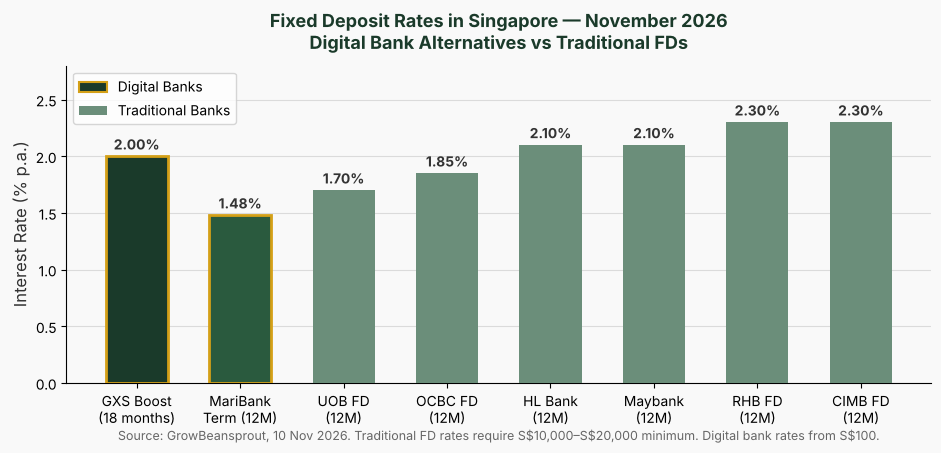
Singapore digital banks like GXS, MariBank, and Trust Bank don’t offer traditional fixed deposits — but they do have lock-up savings products that pay up to 2.00% p.a. with just S$100 minimum. Meanwhile, the best traditional fixed deposit rates in November 2026 stand at 2.30% from CIMB and RHB, requiring at least S$10,000. Here’s how every option compares.
Not financial advice. All figures are for educational reference only. Data verified as at 12 November 2026 unless noted.
Table of Contents
Contents — Click to expand
- What Is a Fixed Deposit?
- Best Fixed Deposit Rates in Singapore (November 2026)
- Why Digital Banks Don’t Offer Traditional Fixed Deposits
- GXS Bank Boost Pocket: Rates and Conditions
- MariBank: Savings Account and Term Deposit
- Trust Bank: Savings Options
- Digital Banks vs Traditional FDs: Full Comparison
- Are Your Savings Safe? SDIC Insurance Explained
- Who Should Use a Digital Bank Instead of a Traditional FD?
- Frequently Asked Questions
What Is a Fixed Deposit?
A fixed deposit (FD) — also called a time deposit — is a savings product where you lock in a sum of money with a bank for a fixed period (the “tenor”) in exchange for a guaranteed interest rate. When the tenor ends, you receive back your principal plus interest. The key features that distinguish FDs from regular savings accounts are the locked-in period (you typically cannot withdraw early without penalty), a fixed guaranteed rate (not variable), and usually a minimum deposit requirement (often S$500–S$20,000 depending on the bank).
Fixed deposit rates in Singapore fluctuate with the macroeconomic environment. When interest rates were high during the 2022–2024 global rate-tightening cycle, FD rates spiked above 3.5%. As rates moderate in 2025–2026, the best traditional FD rates have settled in the 2.10–2.30% range for a 12-month tenor — still attractive by historical standards.
For Singapore investors looking to park cash safely, FDs compete with Singapore T-bills in 2026, Singapore Savings Bonds, and high-yield savings accounts — including those from digital banks.
Best Fixed Deposit Rates in Singapore (November 2026)
Traditional banks currently offer the highest headline FD rates, but most require minimum deposits of S$10,000 or more. The table below shows the best rates available as of 10–12 November 2026.
| Bank | Best Rate | Tenor | Min. Deposit | Notes |
|---|---|---|---|---|
| CIMB | 2.30% p.a. | 12 months | S$10,000 | Online placement |
| RHB | 2.30% p.a. | 12 months | S$20,000 | Mobile banking or branch |
| Bank of China | 2.30% p.a. | 3M / 6M | S$200,000 | 2.10% from S$20,000 |
| HL Bank | 2.20% p.a. | 24 months | S$10,000 | 2.10% for 6M–12M; HLB Connect |
| Maybank | 2.10% p.a. | 6M / 12M | S$20,000 | Standard rate |
| OCBC | 1.85% p.a. | 12 months | S$20,000 | Online placement |
| UOB | 1.70% p.a. | 12 months | S$10,000 | Promo runs Nov 2026 |
| DBS/POSB | 1.00% p.a. | 12 months | S$1,000 | S$1k–S$19.9k; much lower at S$20k+ |
Source: GrowBeansprout, 10 November 2026. Rates and promotions are subject to change. Always verify on the bank’s official site before placing a deposit.
A worked example: placing S$10,000 in a 12-month CIMB FD at 2.30% p.a. earns approximately S$230 in interest. Singapore residents pay no personal income tax on bank deposit interest, so this is your full take-home return.
Why Digital Banks Don’t Offer Traditional Fixed Deposits
GXS Bank, MariBank, and Trust Bank are licensed by the Monetary Authority of Singapore (MAS) but operate exclusively online without physical branches. Rather than offering traditional FD counters, they have built their own mobile-first equivalents: lock-up savings features built directly into their apps.
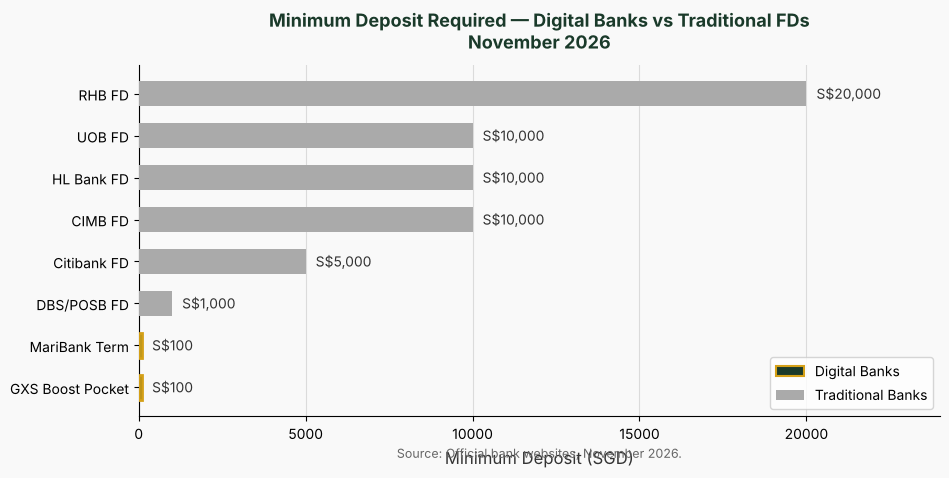
These products are designed around the digital-native experience: low minimums, instant setup, and simple terms with no paperwork. While their headline rates are generally lower than the best traditional FD rates, the gap narrows significantly once you factor in the much lower minimum deposit — S$100 versus S$10,000 to S$20,000 at most traditional banks.
For a Singapore saver with S$2,000 to park short-term, a digital bank lock-up product at 1.70% can be more practical than hunting for a traditional FD that requires five to ten times as much capital to get started.
GXS Bank Boost Pocket: Rates and Conditions
GXS Bank’s Boost Pocket is the closest digital equivalent to a fixed deposit currently available from a Singapore digital bank. You choose a lock-up period (from 1 month up to 18 months), and GXS pays a bonus interest rate on top of the base 0.88% p.a. — with the full rate credited when the pocket matures. Early withdrawal may forfeit the bonus interest, reverting to the base rate.
| Tenor | Rate (p.a.) | Interest on S$5,000 | Interest on S$10,000 |
|---|---|---|---|
| 1 month | 1.01% | ~S$4.21 | ~S$8.42 |
| 3 months | 1.22% | ~S$15.25 | ~S$30.50 |
| 4 months | 1.40% | ~S$23.33 | ~S$46.67 |
| 8 months | 1.70% | ~S$56.67 | ~S$113.33 |
| 12 months | 1.75% | ~S$87.50 | ~S$175.00 |
| 18 months (highest) | 2.00% | ~S$150.00 | ~S$300.00 |
Source: GrowBeansprout, 10 November 2026. Minimum S$100, maximum S$95,000 per pocket. Rates subject to change without notice.
The 2.00% at 18 months is GXS’s best available rate but requires the longest lock-up. You can open multiple Boost Pockets for different tenors to ladder your savings. To open a GXS account, download the GXS app and complete MyInfo-based KYC via Singpass. Use referral code YONG477 for any available sign-up bonus.
MariBank: Savings Account and Term Deposit
MariBank (backed by Sea Group, operator of Shopee and Garena) offers two ways to earn interest on your Singapore dollars:
Mari Savings Account — a standard savings account with interest credited daily. The base rate is 0.88% p.a., but bonus layers can push this to a maximum of 3.08% p.a.:
- Base rate: 0.88% p.a. (available to all account holders)
- New-user welcome bonus: +1.60% p.a. (first 30 days after account opening only)
- ShopeeVIP bonus: +0.40% p.a. (requires active ShopeeVIP subscription)
- Salary crediting bonus: +0.20% p.a.
Source: MariBank official product page, effective 18 October 2026.
No minimum deposit, no fall-below fee. For most Singaporeans without a ShopeeVIP subscription, the sustained rate after the welcome bonus expires is typically 1.08% p.a. with salary crediting. Without salary crediting, it reverts to the 0.88% base. SDIC insured up to S$100,000.
MariBank Term Deposit — MariBank also offers a fixed-tenor product with higher rates. As of 10 November 2026:
| Tenor | Rate (p.a.) | Interest on S$5,000 |
|---|---|---|
| 1 month | 1.08% | ~S$4.50 |
| 3 months | 1.28% | ~S$16.00 |
| 6 months | 1.38% | ~S$34.50 |
| 12 months (highest) | 1.48% | ~S$74.00 |
Source: GrowBeansprout, 10 November 2026. Minimum S$100, maximum S$100,000. Rates subject to change.
MariBank’s term deposit rates are lower than the best traditional FD rates, but the S$100 minimum makes them accessible for smaller savers who don’t meet the S$10,000+ threshold elsewhere. To open a MariBank account, visit maribank.sg. Use referral code 2DCT80WQ for any available sign-up bonus.
Trust Bank: What to Expect
Trust Bank (a collaboration between Standard Chartered and FairPrice Group) structures its savings offering around tiered activity plans — the Trust Flex and Trust Lock features — with rates that increase based on your activity such as shopping at FairPrice group merchants and salary crediting, rather than a fixed lock-up tenor.
As of our last confirmed data (March 2026), Trust Bank’s Flex Plan offered up to 2.40% p.a. for accounts in the highest activity tier. We were unable to independently verify Trust Bank’s current rates as of November 2026, so the figures above should be treated as a reference point. We strongly recommend checking trustbank.sg directly for the latest rate tier requirements before opening an account. Use referral code HTWYQP95 for any available sign-up bonus.
Digital Banks vs Traditional FDs: Full Comparison
The table below brings together the key products side by side so you can see exactly where each stands for a typical Singapore saver in November 2026:
| Product | Best Rate | Min. Deposit | Lock-In | SDIC | Best For |
|---|---|---|---|---|---|
| CIMB FD | 2.30% (12M) | S$10,000 | Yes (12 months) | Up to S$100k | Best rate, S$10k+ |
| RHB FD | 2.30% (12M) | S$20,000 | Yes (12 months) | Up to S$100k | Best rate, S$20k+ |
| GXS Boost Pocket | 2.00% (18M) | S$100 | Yes (1–18M choice) | Up to S$100k | Small savers, flexible tenor |
| MariBank Term | 1.48% (12M) | S$100 | Yes (1–12M choice) | Up to S$100k | Shopee users, S$100 min |
| MariBank Savings | 3.08% (w/ all bonuses) | None | None (savings a/c) | Up to S$100k | ShopeeVIP + new users |
| Trust Bank (Flex)* | Up to 2.40% | Low | Activity-based | Up to S$100k | FairPrice/SC customers |
Sources: Official bank sites, GrowBeansprout and MariBank.sg, 10–12 November 2026. *Trust Bank Flex rate is from March 2026; verify at trustbank.sg. SDIC coverage is per depositor per Scheme member (bank).
The takeaway: if you have S$10,000 or more and want the absolute best guaranteed rate, traditional FDs from CIMB or RHB currently edge ahead at 2.30% for 12 months. For savers starting below the S$10,000 threshold, GXS Boost Pocket at 2.00% for 18 months is genuinely competitive. MariBank Term at 1.48% for 12 months trades some rate for a maximum S$100,000 cap and simple app-based placement.
Are Your Savings Safe? SDIC Insurance Explained
All three Singapore digital banks — GXS Bank, MariBank, and Trust Bank — are fully licensed by the MAS and are members of the Singapore Deposit Insurance Corporation (SDIC) scheme. Your SGD deposits are insured up to S$100,000 per depositor per Scheme member (bank) — the exact same protection that applies to DBS, OCBC, and UOB.
In practice: if you hold S$80,000 in GXS Bank and GXS Bank were to fail, you’d receive the full S$80,000 through the SDIC scheme. The fact that these banks have no physical branches makes no difference to your insurance coverage. MAS-licensed digital banks and traditional banks are covered equally under the Singapore Deposit Insurance Act.
For deposits above S$100,000 at a single bank, the excess is uninsured. Spreading large sums across multiple MAS-licensed banks (keeping under S$100,000 at each) is a standard risk management approach. This is relevant for those building passive income in Singapore from cash savings — SDIC limits your risk exposure within the scheme.
Who Should Use a Digital Bank Instead of a Traditional FD?
Digital bank savings products make the most sense for:
- Smaller savers (below S$10,000): Traditional banks’ S$10,000–S$20,000 minimums are simply out of reach for many savers. GXS Boost Pocket and MariBank Term Deposit’s S$100 minimum opens up lock-up savings to virtually everyone.
- Savers who value simplicity: No branch visits, no paperwork, no complex salary crediting or credit card spending conditions. Everything is managed through a smartphone app. Opening a GXS or MariBank account via MyInfo takes under 10 minutes.
- Shorter-tenor flexibility: GXS Boost Pocket lets you lock in for as little as 1 month. Very few traditional banks offer short-tenor FDs at competitive rates, and many require a minimum S$10,000 even for 1-month placements.
- Savers building good financial habits: For first-time savers starting with S$500 or S$1,000, digital bank lock-up products provide the discipline of a commitment mechanism with the accessibility of a modern app.
Traditional FDs remain the better choice for:
- Savers with S$10,000+ who want maximum returns: CIMB and RHB at 2.30% still beat GXS’s 2.00% (even at 18 months) if you can hit the minimum.
- Multi-currency needs: Traditional banks offer FDs in USD, AUD, and other currencies at competitive rates. Digital banks are primarily SGD-focused.
- Fixed maturity planning: If you’re parking a renovation fund for exactly 6 or 9 months, a traditional FD with a matched tenor can be more straightforward, especially if the rate is better.
Planning for retirement? Use a Singapore retirement calculator to understand how much of your savings should be in cash-equivalent instruments vs longer-term growth assets. Many Singapore investors also allocate a portion of their savings to their CPF investment strategy for higher long-term returns. For shorter-term cash management, Singapore T-bills and Singapore Savings Bonds are also worth comparing against FD rates before you commit.
Frequently Asked Questions
What is the best fixed deposit rate in Singapore right now?
As of November 2026, the best fixed deposit rates in Singapore are 2.30% p.a. for a 12-month tenor, available from CIMB (minimum S$10,000, online placement) and RHB (minimum S$20,000). Bank of China also offers 2.30% for 3-month and 6-month tenors but requires a S$200,000 minimum; at S$20,000, their rate is 2.10%. Always check each bank’s official website before placing a deposit, as rates and promotional windows change frequently.
Do Singapore digital banks offer fixed deposits?
Singapore digital banks — GXS Bank, MariBank, and Trust Bank — do not offer traditional fixed deposits. However, they offer functionally similar lock-up products: GXS Boost Pocket (up to 2.00% for 18 months, min S$100), MariBank Term Deposit (up to 1.48% for 12 months, min S$100), and Trust Bank’s tiered savings plans. These products require you to commit funds for a fixed period in exchange for a higher interest rate, similar to an FD.
Are digital bank deposits safe in Singapore?
Yes. All three Singapore digital banks — GXS Bank, MariBank, and Trust Bank — are fully licensed by the Monetary Authority of Singapore (MAS) and are members of the Singapore Deposit Insurance Corporation (SDIC) scheme. Your SGD deposits are insured up to S$100,000 per depositor per Scheme member, which is the same level of protection as DBS, OCBC, and UOB. Digital bank deposits carry the same SDIC protection as traditional bank deposits — the absence of a physical branch is irrelevant to your insurance coverage.
How does GXS Boost Pocket work?
GXS Boost Pocket lets you lock a portion of your GXS savings for a chosen period — from 1 month to 18 months — in exchange for a bonus interest rate on top of the base 0.88% p.a. The bonus is credited when the pocket matures. Minimum is S$100 and maximum is S$95,000 per pocket. If you need your funds before maturity, you typically forfeit the bonus interest and earn only the base rate. You can open multiple Boost Pockets with different tenors to manage liquidity — a technique called deposit laddering.
Is MariBank a legitimate bank in Singapore?
Yes. MariBank Pte. Ltd. holds a full digital bank licence issued by the Monetary Authority of Singapore (MAS), making it a licensed bank under Singapore law. It is backed by Sea Limited (the parent company of Shopee, Garena, and SeaMoney). As a licensed bank and SDIC member, MariBank deposits are insured up to S$100,000 per depositor. MariBank’s rates, fees, and limits are effective as at 18 October 2026 on its official website.
Should I put my savings in a fixed deposit or a digital bank?
It depends on your savings amount and priorities. If you have S$10,000 or more and want the highest guaranteed return, a 12-month FD from CIMB or RHB at 2.30% p.a. currently offers the best rate. If you have less than S$10,000, or you value simplicity and app-based management, GXS Boost Pocket (up to 2.00% at 18M, min S$100) is competitive and accessible. Both options are SDIC insured up to S$100,000. For amounts above S$100,000, spread across multiple institutions to stay within the SDIC limit at each bank.
What happens if I withdraw early from a digital bank lock-up?
Policies vary by bank, but typically if you break a GXS Boost Pocket before maturity, you forfeit the bonus interest and earn only the base rate of 0.88% p.a. for the period held. For MariBank Term Deposits, you should check MariBank’s specific early withdrawal terms on their app or website, as these may differ. This mirrors traditional FD early-withdrawal penalties, where you usually receive a reduced or zero interest rate for the full tenor if you exit before the maturity date.
Make Your Cash Work Harder
Whether you choose an FD, a digital bank, or a mix of both — here are more tools to help you plan.
This article was researched with the help of AI. While we strive to keep all information accurate and up to date, there may be errors. If you notice any discrepancies, please contact us.