CSPX vs IWDA: S&P 500 or MSCI World for Singapore Investors? (2026)
Both are Ireland-domiciled, LSE-listed UCITS ETFs with the same tax treatment — the real choice is concentration vs diversification.
CSPX tracks the S&P 500 (100% US large caps, TER 0.07%) while IWDA tracks the MSCI World (23 developed markets, TER 0.20%, but still about 70% US). Both are Ireland-domiciled UCITS ETFs on the London Stock Exchange, so Singapore investors pay the same 15% US dividend withholding tax and face no US estate tax on either — the decision comes down to how much non-US diversification you actually want to pay extra for.
Not financial advice. All figures are for educational reference only. Data as at 11-12 November 2026 unless noted.
Quick Answer: CSPX or IWDA?
For a Singapore investor building a long-term core holding, both CSPX (iShares Core S&P 500 UCITS ETF, ticker CSPX on the LSE, ISIN IE00B5BMR087) and IWDA (iShares Core MSCI World UCITS ETF, ISIN IE00B4L5Y983) are reasonable anchors — the difference is not tax or broker access, it is index construction. CSPX gives you 100% exposure to roughly 500 of the largest US-listed companies. IWDA gives you exposure to about 1,248 companies across 23 developed markets, but the US still makes up roughly 70% of that basket (MSCI World country weights, as at 27 February 2026, cited by Jupiter/Scottish Widows). If your real goal is to meaningfully reduce US concentration, IWDA only gets you partway there — you would need to add an ex-US or emerging-market sleeve. If you are comfortable being US-heavy and want the lowest possible cost, CSPX at 0.07% TER is hard to beat.
Key Differences at a Glance
| Feature | CSPX | IWDA |
|---|---|---|
| Full Name | iShares Core S&P 500 UCITS ETF (Acc) | iShares Core MSCI World UCITS ETF (Acc) |
| Index Tracked | S&P 500 (~500 US large-caps) | MSCI World (~1,248 stocks, 23 developed markets) |
| Domicile | Ireland | Ireland |
| Exchange | London Stock Exchange (USD) | London Stock Exchange (USD) |
| TER | 0.07% p.a. | 0.20% p.a. |
| Structure | Accumulating | Accumulating |
| AUM (Fund Net Assets) | USD 158.3 billion (12 Nov 2026) | USD 151.8 billion (11 Nov 2026) |
| Launch Date | 18 May 2010 | 25 September 2009 |
| US Weight | ~100% | ~70% (varies with market moves) |
Source: BlackRock/iShares product pages for CSPX (ISIN IE00B5BMR087) and IWDA (ISIN IE00B4L5Y983), as at 11-12 November 2026.
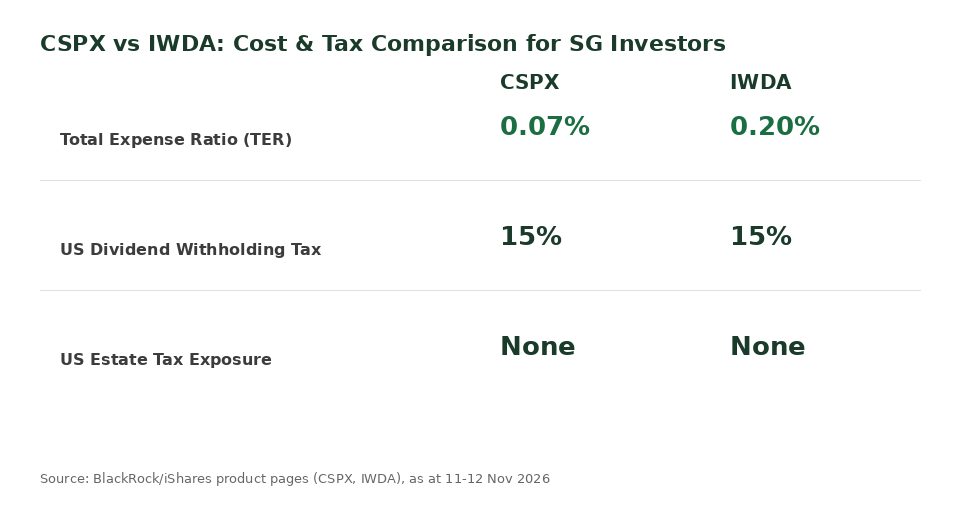
Tax & Cost Comparison for Singapore Investors
This is where most comparisons between US and Ireland-domiciled ETFs go wrong — but CSPX vs IWDA is actually a clean comparison, because both funds sit on the exact same tax footing. Both are domiciled in Ireland, which means dividends paid out by their underlying US holdings are taxed at a 15% US withholding tax under the US-Ireland double tax treaty, rather than the 30% rate that applies to US-domiciled ETFs (like VOO or SPY) held by a Singapore resident with no US tax treaty relief. For a worked example, on a SGD 100,000 CSPX or IWDA position yielding roughly 1.3% in dividends a year (both are accumulating, so the dividend is reinvested inside the fund rather than paid to you, but the 15% WHT is still deducted by the fund before reinvestment), the tax drag works out to roughly SGD 195 a year versus SGD 390 a year if you held the equivalent exposure through a US-domiciled fund instead.
Neither CSPX nor IWDA exposes you to US estate tax, because the fund itself — not you — holds the underlying US shares, and the fund is Irish property, not US-situs property. A non-resident alien (which includes most Singapore citizens and PRs) holding US-situs assets directly, such as individual US stocks or US-domiciled ETFs, faces US federal estate tax on anything above a USD 60,000 threshold, with rates running from 18% up to 40% on the excess (Form 706-NA; threshold is fixed by statute and not indexed for inflation). Singapore has no estate tax treaty with the US, so this exposure is real for anyone holding US stocks or VOO/SPY directly — and it is the single biggest reason most of our readers default to LSE-listed, Ireland-domiciled funds like CSPX and IWDA over their US-listed equivalents. Read our guide to why Singapore investors buy ETFs on the London Stock Exchange for the full mechanics.
Where the two funds genuinely differ is the management fee. CSPX’s 0.07% TER versus IWDA’s 0.20% TER means a SGD 100,000 holding costs roughly SGD 70 a year in CSPX versus SGD 200 a year in IWDA — a SGD 130 annual difference that compounds over decades. That gap exists because IWDA has to track, rebalance and hold ~1,248 constituents across 23 countries and several currencies, which costs more to run than a single-country, 500-stock index.
The Diversification Myth: How Different Is IWDA, Really?
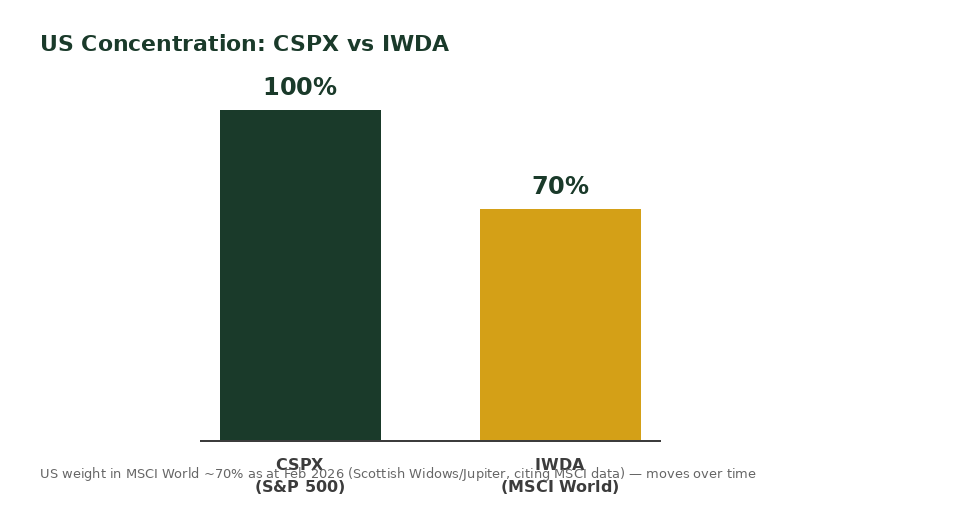
The standard pitch for IWDA over CSPX is “global diversification” — you are no longer betting everything on one country. That is true in theory, but the numbers are less dramatic than most investors expect. As at 27 February 2026, the US made up roughly 70% of the MSCI World Index by market capitalisation (Jupiter Asset Management, citing MSCI data), up from closer to 60% a decade ago, driven largely by the dominance of US mega-cap technology stocks. That means an investor who swaps CSPX for IWDA to “diversify away from the US” is still running a portfolio that is roughly seven-tenths concentrated in the same market — the remaining ~30% is spread thinly across Japan, the UK, France, Canada, Switzerland and a handful of other developed markets, none of which individually moves the needle much.
This does not make IWDA a bad choice — a 70/30 split is still meaningfully different from a 100/0 split, especially during periods when non-US markets outperform. But Singapore investors who want real diversification away from US mega-cap concentration typically need to go further than IWDA alone: adding a dedicated ex-US developed markets fund, an emerging markets ETF, or a broader global fund like VWRA (which itself still carries roughly similar US weighting, since it also tracks a market-cap-weighted global index — see our VWRA ETF Singapore guide for how it compares). If the goal is simply “own the world’s largest companies at the lowest reasonable cost,” either CSPX or IWDA does that job; if the goal is specifically to reduce US concentration risk, neither alone fully achieves it.
Historical Performance Comparison
Because IWDA is roughly 70% US-weighted, its historical returns tend to move in the same direction as CSPX, just with a smaller amplitude — IWDA generally lags CSPX in strong US bull markets (like most of 2023-2025) and holds up somewhat better in periods when non-US developed markets outperform, such as parts of 2026 when European and Japanese equities had stretches of relative strength against a softening US tech sector. Neither fund has outperformed the other consistently over every rolling period; the gap is driven almost entirely by how the non-US ~30% of IWDA performs relative to the US. We’d caution against picking either fund based on trailing 1-3 year returns alone — check the live factsheets on ishares.com for current NAV performance tables before making a decision, since short-term outperformance in either direction says little about the next decade.
Who Should Pick Which?
CSPX is a better fit if you: want the lowest-cost, simplest way to hold US large-cap equities; are comfortable being 100% exposed to one economy because you believe large US companies will keep leading global earnings growth; already hold other geographic exposure elsewhere (e.g. a Singapore or Asia-focused sleeve via S-REIT ETFs) and want your “core growth” holding to be as cheap and concentrated as possible.
IWDA is a better fit if you: want one single fund that covers essentially the entire developed world without having to manage multiple positions; are willing to pay an extra 0.13% a year in TER for broader (if still US-heavy) diversification; prefer not to actively decide country allocations yourself and are comfortable letting market-cap weighting do that for you.
Both are eligible for SRS investment through brokers that support LSE trading (such as Interactive Brokers, Saxo, or moomoo’s SRS-linked account), though neither is CPF-investable since they are not on the CPFIS list of approved unit trusts. If retirement planning is part of your decision, our Singapore retirement calculator can help you work out how either allocation fits your long-term numbers, and you can open a brokerage account to buy either ETF through the Syfe referral code and sign-up bonus if you want a simpler, app-based route onto the LSE.
Where to Buy CSPX or IWDA
Both trade in USD on the London Stock Exchange, so you need a broker with LSE market access. Interactive Brokers (IBKR) offers the lowest commissions for larger, infrequent trades; moomoo and FSMOne are easier for beginners with lower minimum funding and SGD-to-USD conversion built into the app. Compare live fees before you fund an account:
- moomoo referral code — SGD-denominated account, LSE access, beginner-friendly app
- FSMOne referral code — fund supermarket with LSE ETF access and CPFIS-eligible unit trust alternatives
Not financial advice. CSPX and IWDA both carry market risk, currency risk (both trade in USD against SGD), and concentration risk — IWDA is diversified by stock count but not by country weighting. Data as at 11-12 November 2026; TER, AUM and index weightings change over time, so check the live iShares and MSCI factsheets before investing.
Frequently Asked Questions
What is the main difference between CSPX and IWDA?
CSPX tracks the S&P 500 — about 500 of the largest US-listed companies — while IWDA tracks the MSCI World Index, which covers roughly 1,248 companies across 23 developed markets. CSPX is 100% US; IWDA is global but still around 70% US-weighted, so the diversification gap between them is smaller than most investors assume.
Which has lower fees, CSPX or IWDA?
CSPX is cheaper, with a Total Expense Ratio of 0.07% a year versus IWDA’s 0.20% a year (BlackRock/iShares product data, as at 11-12 November 2026). On a SGD 100,000 holding, that is roughly SGD 70 a year for CSPX versus SGD 200 a year for IWDA.
Is CSPX or IWDA more tax-efficient for Singapore investors?
Both are equally tax-efficient. Since both CSPX and IWDA are Ireland-domiciled UCITS ETFs, both benefit from the 15% US dividend withholding tax rate under the US-Ireland tax treaty, and neither exposes a Singapore investor to US estate tax, because the Irish fund — not the investor — holds the underlying US shares directly.
Can I switch from CSPX to IWDA without triggering tax in Singapore?
Yes — Singapore does not tax capital gains for individual investors, so selling CSPX and buying IWDA (or vice versa) does not trigger a capital gains tax event locally. You will still pay brokerage commissions and bid-ask spread on both the sale and the purchase.
Can I buy CSPX or IWDA using my SRS funds?
Yes, if your broker supports SRS-linked trading on the London Stock Exchange — Interactive Brokers, Saxo and some moomoo SRS accounts allow this. Neither CSPX nor IWDA is approved for CPF Investment Scheme (CPFIS) use, since they are not on the CPFIS list of approved unit trusts; CPF money cannot be used to buy either ETF directly.
Which is better for a long-term retirement portfolio, CSPX or IWDA?
Neither is objectively “better” — it depends on how much US concentration risk you are comfortable carrying. IWDA adds a modest amount of non-US diversification (about 30% of the fund) at a 0.13% higher annual cost. If you already hold other non-US assets (such as Singapore REITs or an Asia-focused fund), CSPX’s lower cost may be more efficient; if you want one simple global core holding, IWDA covers more ground in a single trade.
Ready to Build Your Core ETF Holding?
Open a brokerage account with LSE access and buy CSPX or IWDA today. Use our referral links for exclusive sign-up bonuses.
This article was researched with the help of AI. While we strive to keep all information accurate and up to date, there may be errors. If you notice any discrepancies, please contact us.