How to Invest in Singapore: Inflation-Proofing Your Portfolio with Real Assets (2026 Guide)
Gold ETFs, S-REITs, CPF — practical strategies to protect your Singapore portfolio from rising prices in 2026 and beyond.
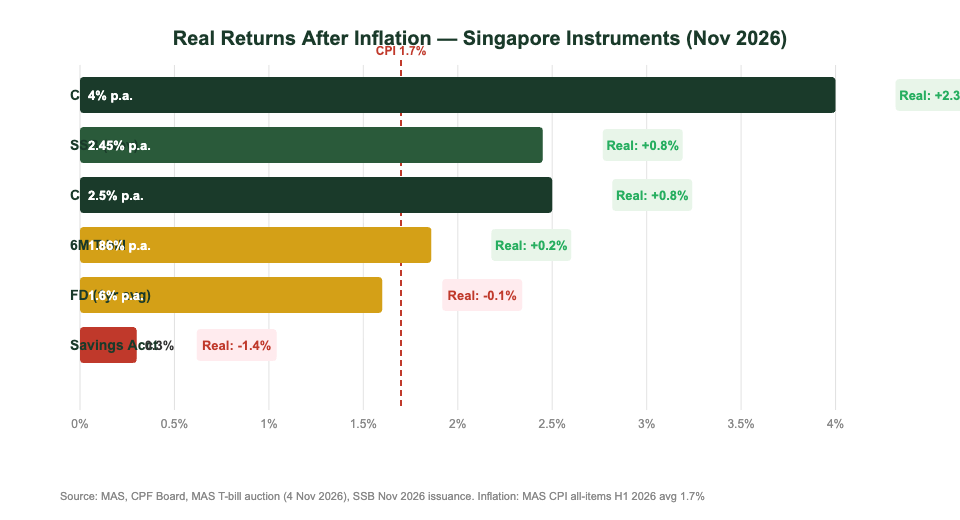
Inflation in Singapore rose 1.7% in the first half of 2026 — and while that sounds modest, the real danger is in the instruments you use to “protect” your savings. T-bills yield just 1.86%, barely ahead of inflation. Cash in a standard savings account earns 0.3% — a guaranteed real loss of 1.4% per year. This guide shows Singapore investors exactly which real assets actually beat inflation, how to access them, and how to build a portfolio that holds its purchasing power for the long term.
Not financial advice. All figures are for educational reference only. Data as at November 2026 unless noted.
Table of Contents
Contents — Click to expand
- Why Inflation Is a Bigger Threat Than You Think
- How Inflation Erodes Your Portfolio — The Real Numbers
- CPF: Singapore’s Built-In Inflation Buffer
- The Four Best Inflation Hedges for Singapore Investors
- Building Your Inflation-Resistant Portfolio Step by Step
- Where to Buy Inflation-Hedge Investments in Singapore
- Frequently Asked Questions
Why Inflation Is a Bigger Threat Than You Think
When people hear “1.7% inflation”, they tend to shrug. But inflation’s impact on a portfolio is not linear — it compounds. A Singapore investor with S$200,000 in savings that earns 0.3% per year while inflation runs at 1.7% loses approximately S$2,800 in real purchasing power every single year. Over a ten-year horizon, that “modest” inflation wipes out S$30,000 in real terms before the account even feels it.
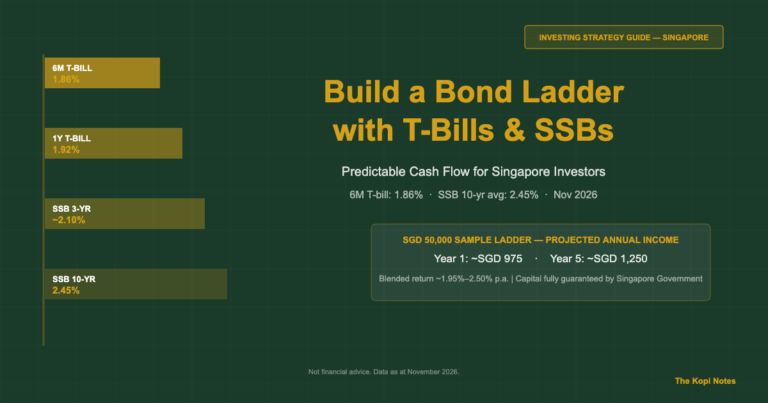
The challenge in 2026 is specific to Singapore’s rate environment. MAS tightened monetary policy in July 2026 to manage the SGD exchange rate — which has held inflation lower than peer economies. But the consequence is that Singapore dollar interest rates have fallen well below what they were in 2023–2024. The 6-month T-bill cut-off yield at the 4 November 2026 auction came in at just 1.86%. Singapore Savings Bonds for November 2026 average 2.45% over ten years. Meanwhile, MAS’s own data shows CPI-All Items averaged 1.7% in the first half of 2026, with core inflation running slightly lower at 1.6%.
The arithmetic is simple: if you hold the safest instruments Singapore offers, you are barely treading water in real terms. And if you hold cash in a standard savings account earning 0.3%, you are definitely falling behind.
What Singapore investors often miss is that inflation protection is not about finding instruments that “beat inflation this year” — it is about owning assets whose value grows proportionally with broad price levels over time. These are called real assets: physical commodities, real property, and equity in productive businesses. This is fundamentally different from bonds and cash, which pay a fixed nominal rate that inflation steadily erodes.
This guide focuses specifically on the how-to for Singapore investors: which instruments are available locally, what the actual costs and mechanics are, and how to combine them into a coherent portfolio — building on the broader core-satellite portfolio strategy we covered previously.
How Inflation Erodes Your Portfolio — The Real Numbers
To understand what you are protecting against, let us run the numbers on a Singapore investor with a S$150,000 portfolio held in common instruments as at November 2026.
| Instrument | Nominal Return | Inflation (CPI) | Real Return | Real $ Gain/Loss (S$150k) |
|---|---|---|---|---|
| CPF SA / Retirement Account | 4.0% | 1.7% | +2.3% | +S$3,450/yr |
| Singapore Savings Bonds (Nov 2026) | 2.45% | 1.7% | +0.75% | +S$1,125/yr |
| CPF OA | 2.5% | 1.7% | +0.8% | +S$1,200/yr |
| 6-Month T-bill (4 Nov 2026) | 1.86% | 1.7% | +0.16% | +S$240/yr |
| 1-Year Fixed Deposit (avg bank rate) | 1.60% | 1.7% | −0.10% | −S$150/yr |
| Standard Savings Account | 0.30% | 1.7% | −1.40% | −S$2,100/yr |
Source: MAS T-bill auction (4 Nov 2026), SSB November 2026 issuance, CPF Board interest rates (Q4 2026), MAS CPI data H1 2026. Real return = nominal − CPI all-items 1.7%.
The table above reveals two things. First, CPF is by far the strongest inflation protection among fixed-rate instruments available to Singaporeans — the SA/RA’s 4% rate beats inflation by a full 2.3 percentage points. Second, everything outside CPF either barely keeps up or falls behind. T-bills give you a marginal real gain of 0.16%, not 1.86%. This is why relying solely on T-bills and SSBs for inflation protection is a strategy that works only if your time horizon is under three years.
For long-term wealth building — say, investing for retirement 15–25 years away — you need instruments with returns that structurally outpace inflation over decades: equities, real property (via REITs), and hard assets like gold. For a deeper look at how to combine these with capital-preservation instruments, see our Singapore T-bills 2026 guide and Singapore Savings Bonds guide.
CPF: Singapore’s Built-In Inflation Buffer
Before exploring market-based inflation hedges, Singapore investors should fully understand the most powerful inflation protection tool they already own: CPF. The CPF Ordinary Account (OA) pays 2.5% per annum, while the Special Account (SA) and Retirement Account (RA) pay 4.0% per annum — both guaranteed by the Singapore government and adjusted periodically to reflect market conditions, though they have remained stable for most of the past decade.
At 4.0%, the CPF SA/RA beats Singapore’s current inflation rate by 2.3 percentage points per year. This is a genuinely attractive real return for a risk-free instrument. By comparison, global inflation-linked bonds (TIPS in the US, ILGS in the UK) offer much smaller real yields — US TIPS 10-year real yield was approximately 1.8–2.0% in late 2026, and Singapore has no domestic equivalent. For a detailed breakdown of how to use CPF as part of a broader investment strategy, see our CPF investment strategy Singapore guide.
The practical implication: for conservative investors or those within 10 years of retirement, maximising CPF balances (via Voluntary Contributions, top-ups, and careful CPFIS decisions) is likely the single most impactful inflation-protection step available. For younger investors with longer time horizons, CPF serves as the fixed-income anchor of a broader portfolio, freeing you to take more equity risk in the growth portion — knowing the CPF floor protects your base against inflation.
One common misconception is that CPF investments (via CPFIS) offer better inflation protection than leaving money in CPF to compound at 2.5–4%. In fact, the CPF base rates are very competitive against most medium-risk investments once fees are accounted for. The case for CPFIS-OA investments is strongest for equities (global index ETFs) where long-term expected returns substantially exceed 2.5% — not for bonds, REITs, or gold ETFs, which may not clear the OA’s 2.5% hurdle after fees.
The Four Best Inflation Hedges for Singapore Investors
Beyond CPF, four asset classes have historically provided meaningful inflation protection over long time horizons. Here is how each works for Singapore investors specifically.
1. Global Equity ETFs (VWRA, CSPX, IWDA)
Equities are the most powerful long-term inflation hedge because companies can pass rising costs on to customers, and their earnings grow in nominal terms. A global equity ETF like VWRA (Vanguard FTSE All-World UCITS, LSE-listed) has historically returned approximately 8–10% per annum in nominal terms over 20+ year periods — far ahead of any realistic inflation scenario. The key is the time horizon: equities are volatile over 1–3 years but highly reliable over 15+ years. For Singapore investors concerned about withholding tax, LSE-listed UCITS ETFs like VWRA and CSPX are domiciled in Ireland, meaning dividends carry a 15% withholding tax rate rather than 30% for US-listed equivalents.
2. S-REITs and S-REIT ETFs
Real estate has a structural relationship with inflation: when prices rise, so do property values and rental income. Singapore REITs are legally required to distribute at least 90% of their taxable income, making them income-generating inflation hedges. The Lion-Phillip S-REIT ETF (SGX: CLR) currently yields approximately 6% and provides diversified exposure to Singapore-listed REITs across commercial, industrial, healthcare and retail sectors. The important caveat: S-REITs are sensitive to interest rate changes. When rates rise sharply (as in 2022–2023), REIT prices fall even as property fundamentals improve — because higher rates increase their cost of capital. For a full breakdown, see our Singapore REIT ETF guide and the list of best S-REITs in Singapore 2026.
3. Gold ETCs (LSE-listed)
Gold has served as an inflation store of value for centuries. In practice, gold’s short-term correlation with inflation is imperfect — it can underperform in low-inflation environments and surge during financial stress regardless of CPI data. Its best role in a Singapore portfolio is as a tail-risk hedge: an asset that holds value during currency crises, geopolitical shocks, and periods of extremely high inflation where financial assets are stressed simultaneously.
For Singapore investors, the right gold exposure is through LSE-listed Exchange Traded Commodities (ETCs), which are UCITS-compliant and not subject to US estate tax. Two key options available through Interactive Brokers:
- iShares Physical Gold ETC (IGLN) — LSE-listed, TER 0.12%, physically backed, GBP-denominated on LSE (also USD version: IAUP on LSE)
- Invesco Physical Gold ETC (SGLN) — LSE-listed, TER 0.12%, physically backed, USD-denominated
Both are Irish-domiciled, UCITS-compliant, and physically backed by gold bullion stored in bank vaults. Neither pays dividends (gold produces no income), so there is no withholding tax issue. The main cost is the TER (0.12% per annum) plus brokerage transaction costs. As a guide, 5–10% gold allocation is commonly cited in portfolio research as the optimal hedge position — enough to matter during crises, not so much that it drags long-term returns.
4. Singapore Savings Bonds and T-bills (Tactical, Not Strategic)
As shown in the table above, SSBs and T-bills provide only marginal real returns at current rates. Their role in an inflation-protection portfolio is tactical rather than strategic: they provide capital preservation and liquidity for money you will need in under three years. For the long-term inflation protection mandate, they should be treated as the “cash equivalent” portion of your portfolio, not as the inflation hedge itself.
| Asset Class | Inflation Protection | SG Access | Approx. Cost | Risk Level | Best For |
|---|---|---|---|---|---|
| CPF SA/RA (4.0%) | ★★★★★ | All SG citizens/PR | 0% fees | Risk-free | All investors |
| Global Equity ETF | ★★★★★ | IBKR, moomoo, Syfe | TER 0.07–0.22% | Medium-High | 15+ yr horizon |
| S-REIT ETF (CLR) | ★★★★ | SGX via any broker | TER ~0.5% | Medium | Income + hedge |
| Gold ETC (IGLN/SGLN) | ★★★★ | IBKR (LSE-listed) | TER 0.12% | Medium | Tail-risk hedge |
| T-bills / SSBs | ★★ | MAS / any bank | 0% fees | Risk-free | <3 yr cash hold |
Source: MAS, CPF Board, SGX, iShares factsheet (IGLN), Invesco factsheet (SGLN), Lion-Phillip CLR. TERs as at November 2026. Star ratings are TKN’s editorial assessment based on long-term inflation hedge effectiveness over 10+ years.
Building Your Inflation-Resistant Portfolio Step by Step
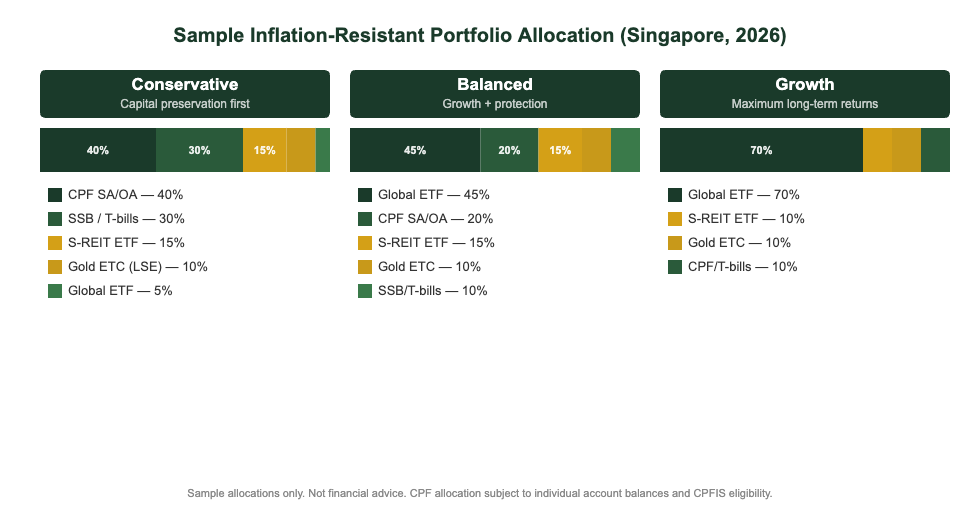
The right portfolio depends on your time horizon, risk tolerance, and existing CPF balances. Rather than a one-size-fits-all prescription, here are three starting frameworks you can adapt — the same logic applies whether your investable portfolio is S$20,000 or S$500,000.
Conservative Framework (Capital Preservation Focus)
If you are within 5–10 years of retirement, or if capital preservation matters more than maximising growth, the priority is maximising CPF balances first, then filling the remainder with SSBs and a small allocation to gold and S-REIT ETFs.
Suggested allocation: CPF SA/OA top-up (40%) + SSBs (30%) + S-REIT ETF (15%) + Gold ETC (10%) + Global Equity ETF (5%). On a S$200,000 portfolio, this gives you S$80,000 compounding at 4% (CPF), S$60,000 in SSBs at 2.45%, S$30,000 in a diversified REIT ETF yielding ~6%, S$20,000 in gold as crisis insurance, and S$10,000 in equities for long-term growth.
Balanced Framework (Growth + Protection)
For investors aged 35–50 with a 15–20 year horizon, the goal is to compound wealth in real terms while maintaining meaningful downside protection. A core position in a global index ETF (VWRA or CSPX) does the heavy lifting, with CPF as the fixed-income anchor, and gold and S-REITs as diversifiers.
Suggested allocation: Global Equity ETF (45%) + CPF (20%) + S-REIT ETF (15%) + Gold ETC (10%) + SSBs/T-bills (10%). This is consistent with the balanced approach in our broader passive income Singapore framework.
Growth Framework (Maximum Long-Term Returns)
Younger investors (under 35) with a 20+ year horizon and stable income can tolerate much higher equity exposure. Inflation protection here comes primarily from the equity premium — stocks grow faster than inflation over long periods — with a small gold allocation and CPF as a risk-free anchor.
Suggested allocation: Global Equity ETF (70%) + S-REIT ETF (10%) + Gold ETC (10%) + CPF/T-bills (10%).
Whichever framework fits your situation, the key action items are: (1) check your CPF SA balance and consider a voluntary top-up to maximise the 4% rate, (2) ensure any “savings account” cash is in SSBs or T-bills earning at minimum 1.86–2.45%, not in a 0.3% savings account, (3) start a regular investment plan in a global equity ETF via a low-cost broker, and (4) add a small gold ETC position (5–10%) as a crisis hedge. Run the numbers on your specific situation with our free Singapore retirement calculator.
Where to Buy Inflation-Hedge Investments in Singapore
Different inflation hedges require different platforms.
Gold ETCs (LSE-listed — IGLN, SGLN): These can only be bought through brokers with LSE access. Interactive Brokers (IBKR) is the most cost-effective option for Singaporeans, with commission from USD 1 per trade and no custodian fee. Use our IBKR referral code (jianxiong368) for a welcome bonus. IBKR also supports SRS accounts.
S-REIT ETF (SGX: CLR): Available on SGX through any local or online broker — moomoo, Longbridge, FSMOne. FSMOne charges 0.08% commission (minimum S$10) with no annual custodian fee for SGX stocks. Use our FSMOne referral code (P0544985) when signing up. FSMOne also supports CPF and SRS investments in eligible SGX instruments.
Hands-off approach: If you prefer a managed portfolio that handles the asset allocation for you, Endowus (use code 2V343 via our Endowus referral code page) offers pre-built portfolios that include equities, REITs, bonds and cash — and critically, Endowus supports both cash, CPF (OA only) and SRS investment. Syfe (use code SRPRFFFCD via our Syfe referral code page) offers similar managed portfolios including a Core Equity100 for maximum equity exposure.
Not financial advice. All figures are for educational reference only. Data as at November 2026. Always read the product prospectus and consider your personal financial situation before investing.
Frequently Asked Questions
Is CPF a good inflation hedge for Singapore investors?
Yes — CPF SA and Retirement Account earn 4.0% per annum, guaranteed by the Singapore government. With Singapore CPI averaging 1.7% in H1 2026, the CPF SA/RA real return is approximately +2.3% per year, which is better than most medium-risk investments once fees are accounted for. CPF OA at 2.5% also beats current T-bill yields (1.86%) and provides a positive real return. For long-term inflation protection, maximising CPF balances is one of the most effective and lowest-risk strategies available to Singapore citizens and permanent residents.
What is the best gold ETF for Singapore investors in 2026?
For Singapore investors, LSE-listed gold ETCs are preferred over US-listed gold ETFs (like GLD or GLDM) because they are UCITS-compliant and not subject to US estate tax on holdings above USD 60,000. Two strong options are iShares Physical Gold ETC (IGLN on LSE, TER 0.12%) and Invesco Physical Gold ETC (SGLN on LSE, TER 0.12%). Both are physically backed by bullion and Irish-domiciled. They are accessible through Interactive Brokers (IBKR), which is the most cost-effective broker for LSE-listed instruments for Singapore investors.
Do S-REITs protect against inflation in Singapore?
S-REITs have structural properties that make them partial inflation hedges: commercial and industrial leases often include annual rent escalation clauses tied to CPI or Singapore’s headline inflation. When prices rise, landlords can pass higher costs to tenants, supporting DPU growth over time. However, S-REITs are also interest-rate sensitive — rising rates increase their borrowing costs and discount rates, pushing prices down. The net effect depends on the inflation-rate relationship. In a “goldilocks” scenario (moderate inflation, stable or falling rates), S-REITs perform well. In a high-inflation, high-rate scenario, they can underperform equities and gold. Use S-REITs for income and diversification, not as a primary inflation hedge.
What is Singapore's current inflation rate in 2026?
According to MAS and MTI data, Singapore’s CPI-All Items inflation averaged 1.7% in the first half of 2026. Core inflation (which excludes accommodation and private transport) has ranged between 1.6% and 2.2% in recent months. This is below the elevated levels of 2022–2023 (when core inflation peaked above 5%) but high enough to meaningfully erode cash savings. MAS tightened monetary policy via SGD appreciation in July 2026 to manage inflationary pressures. Official monthly CPI releases are published by SingStat (singstat.gov.sg).
How much of my portfolio should be in gold for inflation protection?
Academic research generally suggests 5–10% gold allocation provides meaningful portfolio protection in extreme inflation or financial crisis scenarios without significantly dragging long-term returns. At 5% gold allocation in a S$200,000 portfolio (S$10,000 in a gold ETC like IGLN), you have insurance against tail events while keeping 90–95% of your capital in higher-returning assets. Going above 15–20% in gold is generally considered excessive for long-term investors, as gold has zero yield and historically underperforms equities over 20+ year periods in real terms.
Can I invest in gold ETFs using my CPF or SRS in Singapore?
LSE-listed gold ETCs (IGLN, SGLN) are not eligible for CPF Investment Scheme (CPFIS) investment. However, they can be purchased using SRS funds through brokers that support SRS accounts, including IBKR. Some gold-related products in Singapore — such as the POEMS gold savings account via Philip Capital — may have different SRS eligibility. For CPF OA funds, the investment options are limited to approved unit trusts, shares, and ETFs on the CPFIS-OA approved list (which currently does not include LSE-listed gold ETCs). Check the CPF Board’s website for the latest CPFIS-approved product list.
Is T-bill a good inflation protection instrument in Singapore?
At the November 2026 auction yield of 1.86%, T-bills provide only marginal real return above inflation (approximately +0.16% real after the 1.7% CPI average). T-bills are excellent for capital preservation and liquidity for money you will need within 6–12 months — they are government-guaranteed, easy to sell, and offer better rates than most savings accounts. But they are not strategic inflation hedges for long-term wealth preservation. Use T-bills for your emergency fund and short-term savings; use equities, REITs, gold, and CPF for long-term inflation protection.
Start Inflation-Proofing Your Portfolio Today
Open an account with a low-cost broker and add your first inflation hedge. Use our referral links for exclusive sign-up bonuses.
This article was researched with the help of AI. While we strive to keep all information accurate and up to date, there may be errors. If you notice any discrepancies, please contact us.