DBS SRS Account 2026: How to Open, Invest & Maximise Your Tax Savings
A complete Singapore guide — step-by-step opening, investment options, tax relief calculations, and what to watch out for.
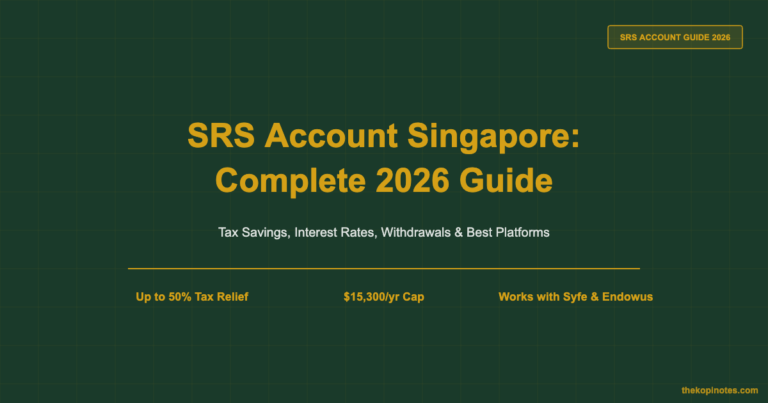
The DBS SRS account is Singapore’s most popular Supplementary Retirement Scheme account, letting Singaporeans and PRs contribute up to S$15,300 per year (foreigners: S$35,700) to reduce their taxable income immediately. Every dollar contributed saves between 11.5% and 22% in income tax depending on your bracket — and DBS’s integration with Vickers, digiPortfolio, and fixed deposits means your SRS cash can be put to work rather than sitting idle at 0.05% p.a.
Not financial advice. All figures are for educational reference only. Data as at November 2026 unless noted.
Table of Contents
What Is the SRS Account?
The Supplementary Retirement Scheme (SRS) is a voluntary savings programme administered by the Ministry of Finance (MOF) and offered through three approved operators: DBS, UOB, and OCBC. It was introduced in 2001 to encourage Singaporeans to save beyond the CPF system for retirement.
Unlike CPF, SRS is entirely voluntary. There is no employer matching and no mandatory withdrawal schedule during your working life. The key benefit is a dollar-for-dollar tax deduction on contributions up to the annual cap: S$15,300 for Singapore Citizens and Permanent Residents, and S$35,700 for foreigners holding an Employment Pass or similar long-term work pass.
Funds inside your DBS SRS account sit in a holding account earning 0.05% per annum until you deploy them into investments. The real return comes from the tax relief — and from whatever your SRS investments earn over the decades before retirement.
Why Choose DBS for Your SRS?
DBS is Singapore’s largest bank and the most-used SRS operator. Its main advantages over UOB and OCBC for SRS holders:
- DBS Vickers integration: Trade Singapore stocks and ETFs (including LSE-listed UCITS ETFs like CSPX and VWRA) directly from your SRS balance via DBS Vickers — no separate funding needed
- digiPortfolio access: DBS’s robo-advisory arm lets SRS holders invest in globally diversified unit trust portfolios with a minimum of S$1,000
- Fixed deposit flexibility: DBS regularly offers SRS-eligible fixed deposit rates, letting you lock in higher returns without leaving cash idle
- Nav Planner integration: DBS’s planning tool maps your SRS balance against retirement income projections alongside your CPF
- Endowment and insurance: Certain endowment plans from Manulife, AIA and others are purchasable with SRS funds via DBS
UOB and OCBC also offer SRS accounts and their own investment platforms, but DBS’s breadth of investment options — particularly the Vickers access to global ETFs — makes it the go-to choice for growth-oriented investors. For a full side-by-side comparison, see the dedicated DBS vs UOB vs OCBC SRS breakdown.
SRS Tax Savings: How Much Can You Save?
The tax relief from SRS contributions is immediate — it reduces your chargeable income in the Year of Assessment (YA) following your contribution year. Here is how it works for different income levels, assuming a maximum contribution of S$15,300:
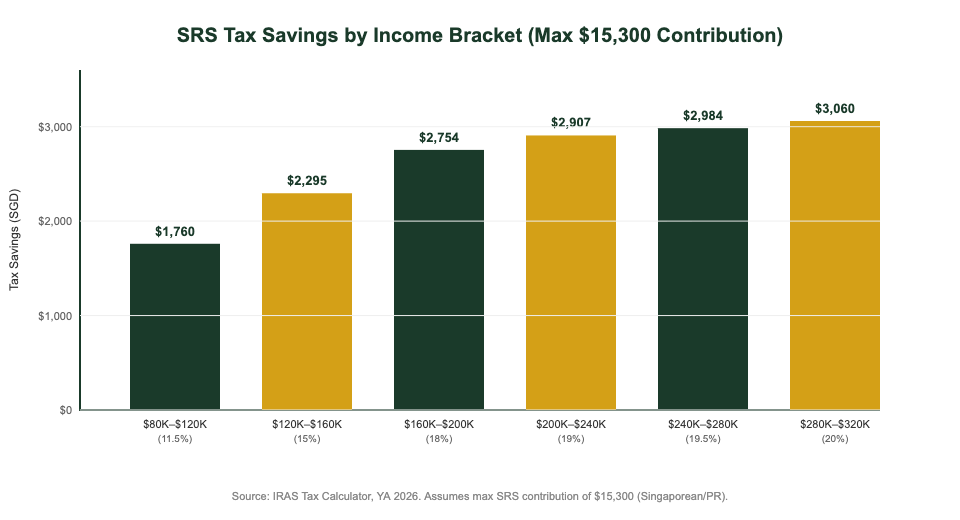
Source: IRAS income tax calculator, YA 2026. Assumes max SRS contribution of S$15,300 for Singaporeans/PRs.
| Annual Income | Marginal Tax Rate | Tax Saved (Max SRS) | Effective SRS “Return” |
|---|---|---|---|
| S$80,000 – S$120,000 | 11.5% | ~S$1,760 | 11.5% Year 1 “return” |
| S$120,000 – S$160,000 | 15% | ~S$2,295 | 15% Year 1 “return” |
| S$160,000 – S$200,000 | 18% | ~S$2,754 | 18% Year 1 “return” |
| S$200,000 – S$240,000 | 19% | ~S$2,907 | 19% Year 1 “return” |
| S$280,000 – S$320,000 | 20% | ~S$3,060 | 20% Year 1 “return” |
Source: IRAS Singapore, YA 2026 tax rates.
The “effective return” framing is important: if you are in the 15% marginal bracket and contribute S$15,300, you receive an immediate S$2,295 tax reduction — a 15% return before your SRS investments earn anything. Combined with long-term investment growth inside the account, SRS is one of the most compelling tax-deferral tools for Singapore’s middle-to-high income earners.
Pairing your SRS with a Singapore retirement calculator can help you estimate exactly how much you need to contribute each year to hit your retirement income target.
How to Open a DBS SRS Account (Step-by-Step)
Opening a DBS SRS account takes under 10 minutes online via the DBS website or digibank app. Here is the process for Singapore Citizens and PRs:
- Log in to DBS iBanking or the digibank mobile app with your NRIC/SingPass
- Navigate to Invest > SRS / CPF > Apply for SRS Account
- Verify your identity via SingPass MyInfo — DBS pre-fills your personal details
- Accept the terms, choose your preferred DBS branch designation (for mailing purposes)
- Your SRS account number is generated instantly — it is a 10-digit number beginning with the same prefix as your DBS savings account
- Fund your SRS account via online transfer from your DBS/POSB account or other local bank
For foreigners, additional documentation may be required including proof of work pass and foreign identification. Visit a DBS branch with your passport and work permit for in-person account opening.
Eligibility: Singapore Citizens and PRs from age 18, foreigners holding valid work passes. You may only have one SRS account across all three operators — you cannot open one at DBS and another at UOB.
DBS SRS Investment Options
Once funded, your DBS SRS balance can be deployed across several asset classes. Here is what is available as at November 2026:
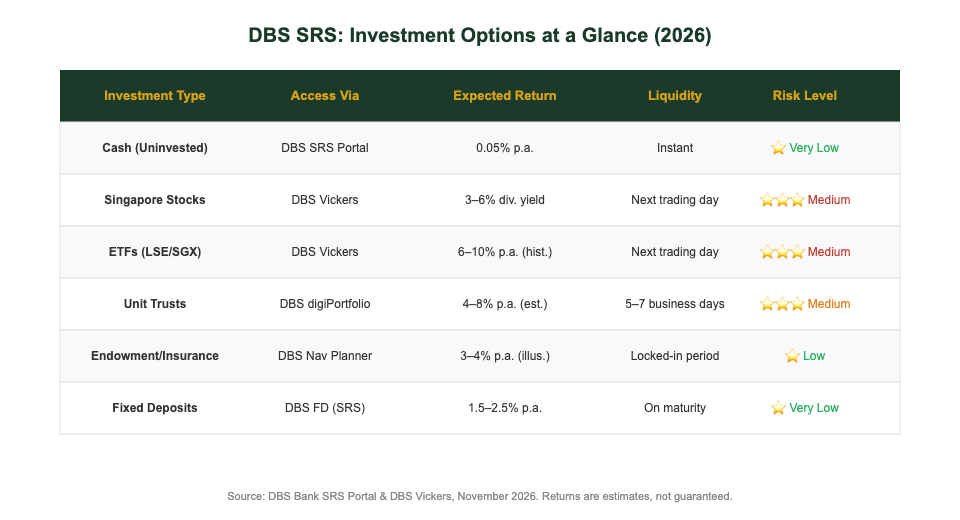
Source: DBS Bank SRS Portal and DBS Vickers, November 2026.
| Investment Type | Platform | Min. Amount | Key Consideration |
|---|---|---|---|
| Cash (Uninvested) | DBS SRS Portal | No minimum | 0.05% p.a. — deploy into investments |
| SGX-listed Stocks/ETFs | DBS Vickers | 1 lot (100 shares) | S$25 min commission or 0.28% |
| LSE ETFs (CSPX, VWRA, etc.) | DBS Vickers | 1 share | USD commission; FX conversion from SRS SGD |
| Unit Trusts | DBS digiPortfolio | S$1,000 | Diversified portfolios; ongoing annual fee ~0.75% |
| Fixed Deposits (SRS) | DBS | S$1,000 | Currently ~1.8–2.0% for 12M |
| Endowment Plans | DBS Nav Planner | Varies by plan | Illiquid; long commitment. Check surrender value early |
Source: DBS Bank, November 2026.
For long-term SRS investors, the most common strategy is to allocate the majority into globally diversified ETFs (such as VWRA or CSPX via DBS Vickers) for growth, with a smaller portion in dividend-generating assets for income closer to retirement. The Syfe referral code gives TKN readers bonus cash when opening a Syfe Core account, an alternative to DBS digiPortfolio if you prefer a standalone robo-advisor.
SRS Withdrawal Rules & What Happens at Retirement
Understanding SRS withdrawal mechanics is critical — it determines how much of your deferred tax you will eventually pay. Here are the key rules as at 2026:
- Statutory retirement age: 63 for accounts opened under the current retirement age framework. You may start penalty-free withdrawals from age 63
- 50% exemption: Only 50% of each SRS withdrawal is added to your taxable income. If you withdraw S$40,000 in a year, only S$20,000 is taxable
- 10-year withdrawal window: You have 10 years from your first penalty-free withdrawal to draw down your SRS balance
- Early withdrawal penalty: If you withdraw before age 63, the full withdrawal amount is taxable PLUS a 5% penalty on the amount withdrawn
- Death: SRS balances are paid to the estate/nominees; 50% is taxable in the year of death
Worked example: A Singapore Citizen retires at 63 with S$400,000 in their DBS SRS account. Over 10 years, they withdraw S$40,000/year. Only S$20,000 is taxable each year — which falls within the first personal income tax bracket and may attract 0% or minimal tax. The effective lifetime tax rate on this S$400,000 is dramatically lower than the 15–20% they saved when contributing in their peak earning years.
DBS SRS vs UOB vs OCBC: Which Should You Choose?
All three banks offer SRS accounts at the same government-mandated interest rate (0.05% p.a. on uninvested cash) and the same tax relief. The differentiation lies in the investment platform:
- DBS: Best for investors who want access to DBS Vickers (stocks and ETFs) and digiPortfolio. Largest network of SRS-eligible products
- UOB: Best for investors who trade via UOB Kay Hian or prefer UOB’s unit trust range
- OCBC: Best for existing OCBC customers who want simplicity, or for those investing via Endowus (accessible via all three banks through a separate Endowus account)
Note: Endowus connects to your SRS account regardless of which bank holds it. So your choice of SRS bank does not limit your ability to invest via Endowus.
Tips to Maximise Your DBS SRS Account
- Contribute early in the year — the earlier your SRS funds are deployed, the more time they have to compound
- Don’t leave cash idle — 0.05% p.a. is negligible. Set up a standing instruction to move SRS funds into DBS SRS fixed deposits or invest via Vickers shortly after contribution
- Plan your withdrawal schedule — work backwards from your retirement age target. Use a retirement calculator to estimate how much to contribute annually
- Consider global ETFs for growth — many TKN readers use their DBS SRS to buy VWRA or CSPX via Vickers for long-term compounding
- Stack with CPF top-ups — SRS and CPF cash top-ups can be combined for maximum tax relief; total personal income tax relief cap is S$80,000/year
- Open as early as possible — there is no minimum age (above 18). Opening now locks in the current statutory retirement age for withdrawal purposes
Disclaimer: This article is for educational purposes only and does not constitute financial advice.
Frequently Asked Questions — DBS SRS Account
What is the DBS SRS account interest rate in 2026?
The DBS SRS account earns 0.05% per annum on uninvested cash balances. This rate is set by the government and is the same across all three SRS operators (DBS, UOB, OCBC). To earn more, invest your SRS funds into stocks, ETFs, unit trusts, or fixed deposits.
How much can I contribute to my DBS SRS account per year?
Singapore Citizens and Permanent Residents can contribute up to S$15,300 per year. Foreigners holding an Employment Pass can contribute up to S$35,700 per year. The contribution limit is per individual across all SRS operators — you cannot split S$15,300 across DBS and UOB.
Can I invest in ETFs with my DBS SRS account?
Yes. DBS SRS account holders can trade Singapore-listed ETFs and international ETFs (including LSE-listed ETFs like CSPX and VWRA) via DBS Vickers. The SRS balance is used as the funding source. LSE trades incur USD commission and require currency conversion from SRS SGD.
What is the penalty for early SRS withdrawal?
Withdrawing from your SRS account before the statutory retirement age (currently 63) incurs a 5% penalty on the amount withdrawn, and the full withdrawal amount becomes taxable income. This makes early withdrawal very costly — it should only be considered as a last resort.
Is the DBS SRS account the same as a CPF account?
No. CPF is a mandatory savings scheme managed by the CPF Board. SRS is voluntary and held by a private bank. CPF has specific sub-accounts (OA, SA, MA) with higher interest rates but stricter withdrawal rules. SRS gives more flexibility in investment choice but no employer contributions and a lower guaranteed interest on cash balances.
Can I use Endowus with my DBS SRS account?
Yes. Endowus supports SRS investments regardless of which bank holds your SRS account. You link your DBS SRS account to Endowus and authorise transfers from DBS to your Endowus SRS portfolio.
When should I start contributing to an SRS account?
Ideally as soon as your income puts you in a meaningful tax bracket — typically when your annual income exceeds S$80,000. Opening the account early also locks in the prevailing statutory retirement age for withdrawal purposes.
This article was researched with the help of AI. While we strive to keep all information accurate and up to date, there may be errors. If you notice any discrepancies, please contact us.