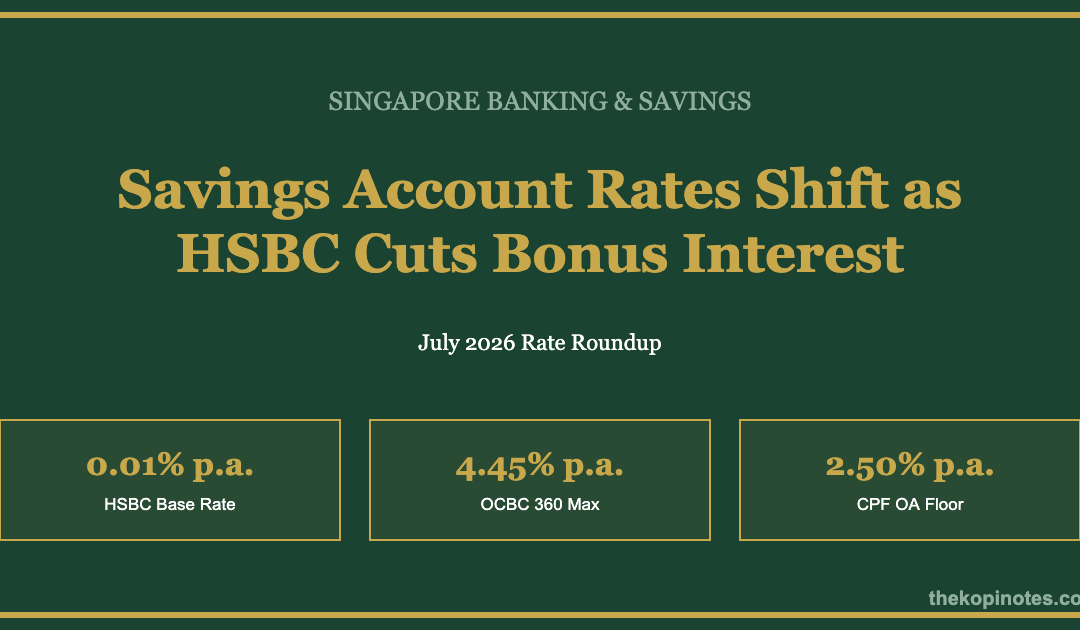
HSBC quietly scrapped its 1% p.a. Everyday+ bonus interest and cut its base rate to 0.01% from 1 July 2026, pushing savers toward better options. UOB, OCBC and DBS still cap bonus tiers around 1.9%–4.45% p.a. on tough conditions, while CIMB, Maybank, Trust Bank and MariBank are running July fresh-fund promos worth checking before you park your next paycheque.
This is an editorial analysis. Not financial advice. Data verified as at 14 July 2026 against each bank’s official rate pages and the CPF Board.
What Changed This Week
From 1 July 2026, HSBC removed the 1% p.a. Everyday+ Rewards bonus interest on its Everyday Global Account entirely, and cut the account’s prevailing base rate from 0.05% p.a. to just 0.01% p.a., according to HSBC’s own Important Notices page. For an account that used to be one of the more approachable multi-currency options for Singapore savers, that’s a near-total wipeout of yield on idle SGD cash.
The timing matters. HSBC’s cut lands in the same month several rivals are doing the opposite — running fresh-fund promotions to pull in new deposits. That combination is why we’re calling this a “rate war”: some banks are quietly retreating from savings yield while others are actively fighting for your cash.
The Big Three Local Banks: Who Still Pays the Most
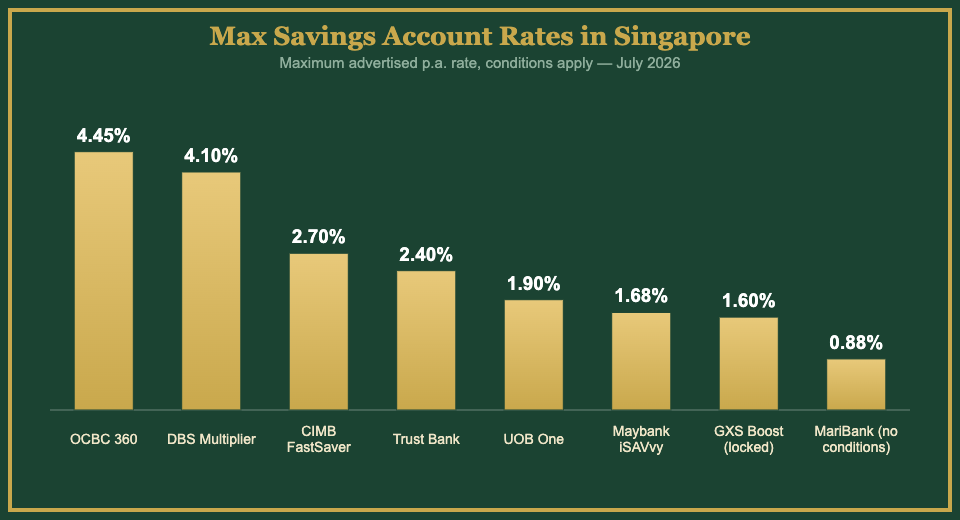
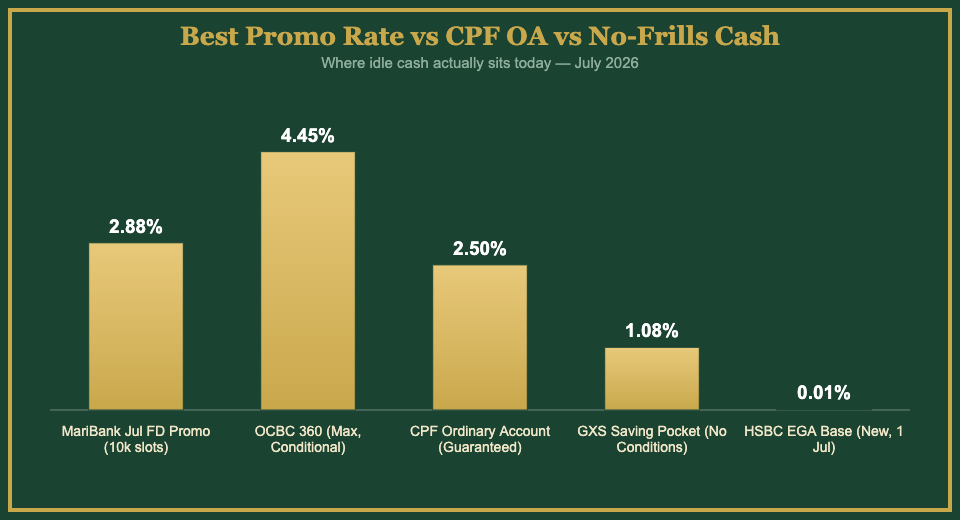
Among the traditional heavyweights, OCBC 360 remains the highest advertised ceiling at up to 4.45% p.a. on the first S$100,000, per OCBC’s official rates page — though that’s already down from 5.45% after a rate cut that took effect 1 May 2026. To hit the max, you need to stack salary crediting, an increased average daily balance, card spend, and an eligible insurance or investment purchase all in the same account.
DBS Multiplier tops out at 4.10% p.a. on the first S$100,000 when you credit income and transact across three or more categories, according to DBS’s official rates page. Fall short of the criteria and you’re back to a 0.05% p.a. base — the same trap most “up to X%” accounts share.
UOB One now caps out at 1.90% p.a. on balances up to S$150,000, requiring both card spend of S$500 a month and salary credit via GIRO/PayNow, per UOB’s official rate revision notice. That’s a meaningful step down from the 2.5% p.a. ceiling UOB offered before its December 2025 revision, and it now trails Trust Bank’s no-frills digital rate. For a full side-by-side, see our DBS Multiplier vs OCBC 360 breakdown.
Digital Banks Are Filling the Gap
Trust Bank pays up to 2.40% p.a. (a 0.05% p.a. base plus up to 2.35% p.a. bonus) on balances up to S$1.2 million when you meet any three bonus criteria, confirmed on Trust Bank’s official Trust+ page as at 1 July 2026. That’s now higher than UOB One’s conditional maximum, and easier to reach for most salaried savers. We cover the exact criteria in our Trust Bank interest rate guide.
GXS Bank pays 1.08% p.a. on its Saving Pocket with zero conditions — no salary credit, no spend, no lock-in — and up to 1.60% p.a. on its Boost Pocket if you’re willing to lock funds in, per GXS’s official savings account page. Full details are in our GXS Bank review.
MariBank pays a flat 0.88% p.a. on its entire balance with no conditions at all, according to MariBank’s official fees and rates page. It’s the lowest headline rate of the digital banks, but the simplicity has a fan base — see our MariBank interest rate breakdown for the trade-offs.
The July 2026 Fresh-Fund Promo Race
While HSBC pulls back, several banks are actively courting new deposits this month:
- CIMB FastSaver is offering up to 0.80% p.a. bonus interest on a minimum S$10,000 in incremental fresh funds deposited between 1–31 July 2026, on top of its base rate of up to 2.70% p.a. on the first S$25,000, per CIMB’s official rates page.
- Maybank iSAVvy is paying up to 1.68% p.a. on incremental average daily balances from a minimum S$20,000 fresh-fund top-up, running 1 July to 31 August 2026, according to Maybank’s official promotions page.
- MariBank is also running a fixed deposit promotion at 2.88% p.a., but it’s capped at the first 10,000 customers who open an account in July 2026 — a hard limit worth knowing before you plan around it.
Fresh-fund promos only pay bonus interest on money that’s genuinely new to the bank — topping up from another account you already hold there usually doesn’t count. Read the terms before you move money.
Savings Account Rates at a Glance (July 2026)
| Account | Max Rate (p.a.) | Type | Key Condition |
|---|---|---|---|
| OCBC 360 | 4.45% | Local bank | Salary + save + spend + insure/invest, first S$100k |
| DBS Multiplier | 4.10% | Local bank | Salary + 2–3 transaction categories, first S$100k |
| CIMB FastSaver | 2.70% (+0.80% Jul promo) | Foreign bank | Fresh funds top-up, first S$25k |
| Trust Bank | 2.40% | Digital bank | Any 3 bonus criteria, up to S$1.2m |
| UOB One | 1.90% | Local bank | Salary credit + S$500 card spend, up to S$150k |
| Maybank iSAVvy | 1.68% (Jul–Aug promo) | Foreign bank | Min S$20k fresh funds top-up |
| GXS Bank | 1.60% (Boost) / 1.08% (Saving) | Digital bank | Lock-in for higher tier; no conditions for base |
| MariBank | 0.88% (flat) / 2.88% (Jul FD, capped) | Digital bank | No conditions on base rate |
| HSBC Everyday Global | 0.01% (base, from 1 Jul) | Foreign bank | Bonus interest programme removed |
What This Means for Singapore Retail Investors
The spread between the best and worst savings accounts is now enormous — 4.45% p.a. at OCBC 360 versus 0.01% p.a. at HSBC’s Everyday Global Account base rate. But the top rates all come with strings attached: salary crediting, minimum spend, or insurance and investment purchases you may not otherwise want. For TKN readers, the practical question isn’t “which bank advertises the highest number” but “which conditions can I actually meet without buying products I don’t need.”
It’s also worth remembering your CPF Ordinary Account pays a guaranteed 2.5% p.a. floor rate, unchanged for the 1 July to 30 September 2026 quarter per the CPF Board’s official announcement. That beats every no-conditions savings account on this list, and it beats UOB One’s conditional maximum too — a reminder that “risk-free government-backed” often quietly outperforms “high street bank promo” once you strip away the hoops.
If you’re chasing the very top of the table, run the numbers on what meeting the criteria actually costs you — a card spend requirement you’d hit anyway is free money, but one that pushes you into unnecessary spending erodes the extra interest fast. Our full savings account comparison breaks down effective rates after realistic spending patterns.
Bottom Line for SG Investors
HSBC’s exit from the bonus-interest race is a signal, not an isolated event — banks are increasingly separating “everyday parking” accounts (near-zero yield) from products that actively compete for new money (fresh-fund promos, digital bank tiers). If your cash is sitting in an account that hasn’t been reviewed since before July, it’s worth five minutes to check whether you’ve quietly become the liquidity HSBC no longer wants to pay for. Compare conditions against your actual spending and salary-crediting habits, keep an eye on promo expiry dates, and don’t assume last year’s “best account” is still this year’s best account — as this roundup shows, several have already been cut once in 2026.
Frequently Asked Questions
What is the best savings account interest rate in Singapore right now (July 2026)?
Why did HSBC cut its Everyday+ bonus interest?
Is CPF OA’s 2.5% p.a. better than a savings account?
Which digital bank pays the highest interest with no conditions?
Are these promotional rates guaranteed to last?
Should I chase the highest advertised rate?
How often do Singapore banks revise their savings account rates?
This article was researched with the help of AI. While we strive to keep all information accurate and up to date, there may be errors. If you notice any discrepancies, please contact us.