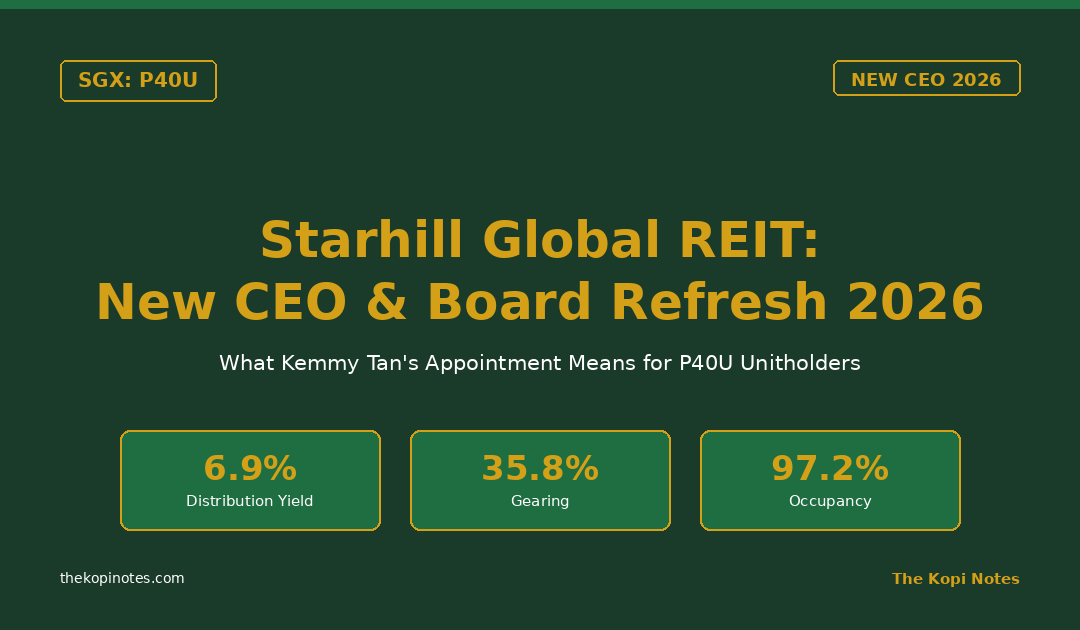
Starhill Global REIT New CEO 2026: What Kemmy Tan’s Appointment Means for P40U Unitholders
SGX: P40U — new CEO, new board director, and a healthier balance sheet, all inside six weeks
Starhill Global REIT appointed Kemmy Tan Peck Mun as CEO on 1 July 2026, followed by Ng Sey Ming joining the board on 29 July 2026 — the REIT’s first leadership refresh in years. It lands alongside strong FY2025/26 results: DPU up 0.8% to 3.68 cents, occupancy at 97.2%, and a S$70 million refinancing plan already locked in. For P40U unitholders, the question is whether new leadership changes the REIT’s Orchard Road-anchored strategy.
Not financial advice. All figures are for educational reference only. Data as at August 2026 unless noted.
- New CEO Kemmy Tan Peck Mun (ex-M+S Pte Ltd) took over on 1 July 2026; new director Ng Sey Ming joined the board on 29 July 2026
- FY2025/26 DPU rose 0.8% to 3.68 cents — a 6.9% yield at the S$0.53 closing price, the highest among comparable retail/commercial S-REITs
- Gearing sits at a comfortable 35.8% with refinancing for debt through FY28/29 already arranged — leadership change comes from a position of strength, not distress
Table of Contents
Contents — Click to expand
- What Happened at Starhill Global REIT
- Who Is Kemmy Tan Peck Mun?
- Board Change: Ng Sey Ming Joins as Director
- Why a REIT Manager’s Leadership Matters
- FY2025/26 Results: The Numbers Behind the Change
- Australia Win: Myer Arbitration Concludes
- Balance Sheet: S$70M Refinancing Plan
- How Starhill Global REIT Stacks Up Against Peers
- Should You Buy Starhill Global REIT Now?
- How to Buy Starhill Global REIT in Singapore
- Frequently Asked Questions
What Happened at Starhill Global REIT
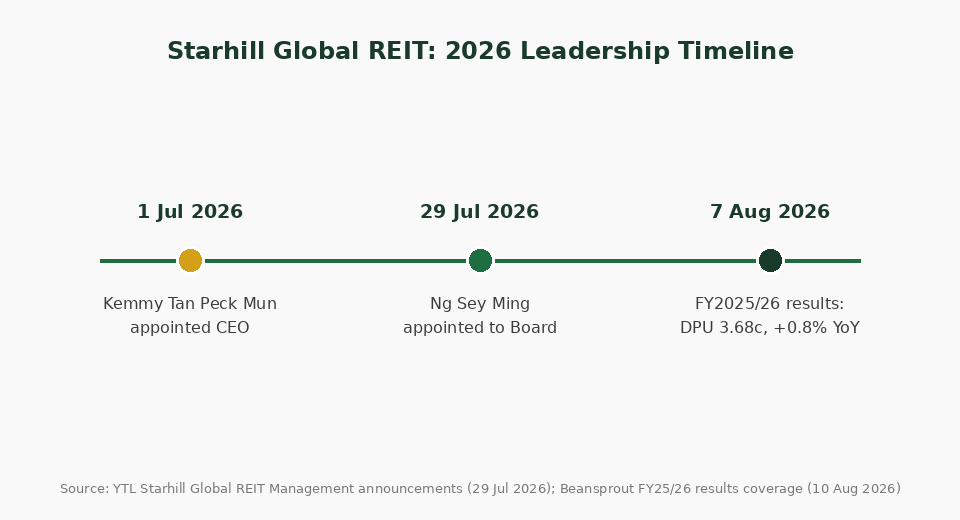
Two leadership changes landed at Starhill Global REIT’s manager, YTL Starhill Global REIT Management Limited, within a single month. On 1 July 2026, Kemmy Tan Peck Mun took over as Chief Executive Officer and Executive Director. Four weeks later, on 29 July 2026, the manager announced Ng Sey Ming’s appointment to the board, effective 1 August 2026.
That’s a full leadership refresh at the top — CEO and board — inside six weeks. However, this isn’t a REIT in trouble reshuffling under pressure. It’s happening right as Starhill Global REIT (SGREIT) posts one of its strongest results in years: FY2025/26 DPU up 0.8% year-on-year, portfolio occupancy at a multi-year high of 97.2%, and a fully mapped-out refinancing plan.
You holding P40U units don’t need to panic. But you do need to understand who’s now steering the REIT’s key Orchard Road assets — Wisma Atria and Ngee Ann City — and what the changes could mean for future capital allocation decisions.
Who Is Kemmy Tan Peck Mun?
Kemmy Tan Peck Mun brings over two decades of Singapore real estate experience to the role. She previously served as CEO of M+S Pte Ltd, where she led the development and management of two of Singapore’s most prominent integrated developments: Marina One and DUO.
That background matters here. Marina One and DUO are large-scale, mixed-use, prime-location developments — not unlike the positioning challenge SGREIT faces at Wisma Atria and Ngee Ann City on Orchard Road. Her experience in tenant repositioning, asset enhancement, and capital-intensive redevelopment projects lines up closely with the work already underway at Wisma Atria, where façade enhancement works at Levels 2 and 3 are targeted for completion by end-2026.
For context, prime Orchard Road retail rents rose 2.1% year-on-year in Q2 2026, and the manager notes no new retail supply is expected along the strip through 2027. That’s a supportive backdrop for a CEO with a track record in premium asset enhancement to work with.
Board Change: Ng Sey Ming Joins as Director
The second change came fast on the heels of the CEO appointment. On 29 July 2026, YTL Starhill Global REIT Management Limited and Starhill Global REIT jointly announced board and board committee changes, effective 1 August 2026 — including the appointment of Ng Sey Ming as a director of the manager.
Here’s why this two-step sequence — new CEO first, then new board appointment weeks later — is a normal governance pattern rather than a red flag. A REIT manager’s board oversees strategy and approves major transactions; the CEO runs day-to-day operations and reports to that board. Bringing in a new director shortly after a CEO transition is a standard way for the manager to refresh oversight capacity alongside new management, not a sign of instability.
Why a REIT Manager’s Leadership Matters to You
If you’re new to REIT investing, it helps to understand the structure. A Singapore REIT has three separate parties: the Trustee (holds the properties in trust for you), the Manager (makes strategic and operational decisions — this is where the CEO and board sit), and Unitholders (you — the investors who own units and receive distributions).
You don’t vote on who becomes CEO. But the manager’s leadership directly shapes decisions that affect your returns: which properties get bought or sold, how much debt the REIT takes on, whether asset enhancement projects go ahead, and how aggressively the REIT pursues growth versus preserving distributions.
The Monetary Authority of Singapore (MAS) regulates S-REIT structures, including the gearing limits and disclosure obligations that govern how much information the manager must share with you about changes like this.
A CEO change is one of the few visible signals you get about a REIT’s future direction before it shows up in the numbers. That’s why it’s worth understanding — not because it’s alarming, but because it’s informative.
FY2025/26 Results: The Numbers Behind the Change
The leadership change didn’t happen against a backdrop of weak results — quite the opposite. Starhill Global REIT reported full-year FY2025/26 results on 7 August 2026, its first full results announcement under the new CEO.
| Metric | FY2025/26 |
|---|---|
| DPU | 3.68 cents (+0.8% YoY) |
| Distribution yield | 6.9% (at S$0.53 close, 7 Aug 2026) |
| Gross revenue | S$192.5 million (+0.2% YoY) |
| Net property income (NPI) | S$150.3 million (+0.1% YoY) |
| Portfolio occupancy | 97.2% (as at 30 Jun 2026) |
| Gearing | 35.8% |
| Portfolio value | S$2.73 billion (-0.9% YoY) |
| Credit rating | Fitch “BBB”, stable outlook |
Source: Starhill Global REIT FY25/26 results presentation, via Beansprout, 7 August 2026.
Occupancy climbed from 94.6% a year earlier to 97.2%, with Singapore, Malaysia, Japan and China all at 100% committed occupancy. Malaysia was the standout performer — revenue from the Malaysian properties (Lot 10 and Starhill Gallery) grew 7.6% year-on-year, helped by rental step-ups and a stronger ringgit. Australia was mixed: Myer Centre Adelaide’s office occupancy improved to 90.6%, but overall Australian NPI dipped 1.5% on higher operating expenses.
Australia Win: Myer Arbitration Concludes in SGREIT’s Favour
One overlooked positive in this results cycle: SGREIT’s long-running arbitration dispute with Myer Pty Ltd, the anchor tenant at Myer Centre Adelaide, concluded in the REIT’s favour. The tribunal ordered Myer to pay part of the legal and professional fees SGREIT incurred as landlord, with payment received in July 2026.
Combined with the backfilling of vacant office space at the Adelaide property — University Senior College began a 10-year, roughly 42,000 sq ft lease in July 2026, and Synergy Construct is set to start an approximately 11,700 sq ft lease in the second quarter of FY26/27 — the Australia segment is stabilising after a rough patch following Technicolor’s departure.
Balance Sheet: S$70M Refinancing Plan Already Locked In
Debt maturities are one of the biggest risks for any S-REIT right now, as many issuers refinance older, cheaper debt at today’s higher-for-longer rates. SGREIT has already dealt with its nearest maturity wall.
The REIT confirmed a S$70 million unsecured sustainability-linked committed revolving credit facility, to be drawn in October 2026 to refinance S$70 million of unsecured medium-term notes maturing that same month. Separately, an unsecured sustainability-linked term loan facility of A$70 million was confirmed to settle an Australian dollar term loan maturing in FY27/28.
Beyond that, SGREIT holds S$350 million in available long-term committed and undrawn revolving credit facilities — enough, the manager says, to cover remaining debt maturities through FY28/29. Average debt maturity stands at 3.3 years, and 80% of debt was fixed or hedged as at 31 March 2026, limiting exposure to further rate swings. Interest coverage of 3.1x comfortably clears the regulatory minimum of 1.5x and beats the peer average of 2.7x.
For you as a unitholder, this matters because it means the new CEO isn’t inheriting a refinancing scramble. She’s stepping into a REIT with its near-term debt obligations already mapped out — giving her room to focus on portfolio strategy rather than balance sheet firefighting.
How Starhill Global REIT Stacks Up Against Peers
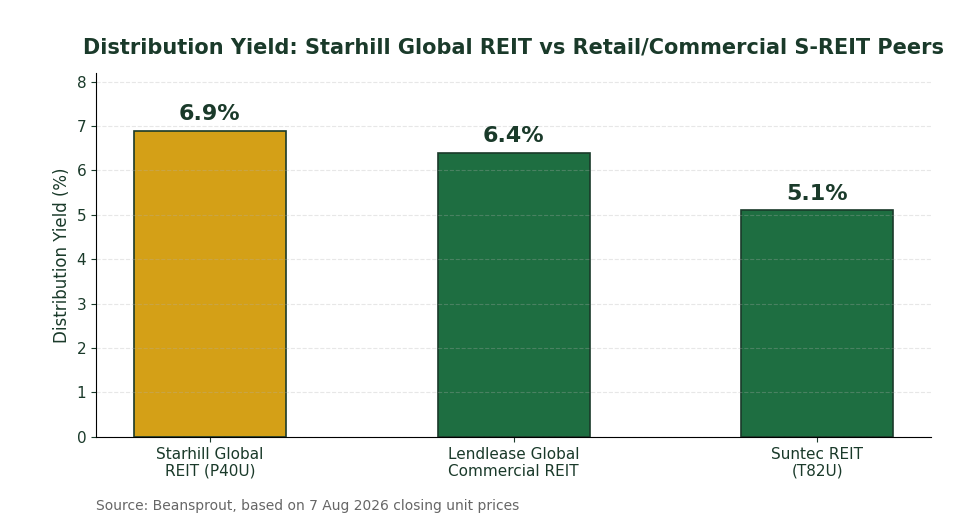
At a 6.9% distribution yield, Starhill Global REIT currently offers a higher payout than comparable retail/commercial S-REITs. Lendlease Global Commercial REIT trades at an estimated 6.4% FY2026 yield, while Suntec REIT trades at around 5.1%.
| REIT | Distribution Yield | Gearing |
|---|---|---|
| Starhill Global REIT (P40U) | 6.9% | 35.8% |
| Lendlease Global Commercial REIT | 6.4% | n/a |
| Suntec REIT (T82U) | 5.1% | n/a |
Source: Beansprout, based on 7 August 2026 closing unit prices.
You should treat a higher yield with some caution though — it can reflect either genuinely better fundamentals or the market pricing in more risk. SGREIT’s P/B ratio of 0.75, based on a S$0.71 NAV per unit, sits below the broader S-REIT sector average of around 0.9x. That discount partly reflects SGREIT’s smaller size and its exposure to secondary markets like China, alongside the leadership transition itself — new CEOs typically get a wait-and-see period from the market before any re-rating.
Should You Buy Starhill Global REIT Now?
Here’s a balanced look at both sides, rather than a one-sided pitch.
The case for: A 6.9% yield well above what you’d get from T-bills or Singapore Savings Bonds, a new CEO with directly relevant premium-asset experience, 97.2% occupancy with no new competing Orchard Road retail supply through 2027, refinancing already sorted through FY28/29, and a P/B discount to the sector.
The case for caution: New leadership means strategy could shift — you don’t yet know whether Tan will prioritise conservative distribution stability or pursue more capital-intensive acquisitions and redevelopment, which could mean higher near-term gearing or a temporary distribution dip if she pursues asset enhancement more aggressively. China and Japan property performance also remains a drag. And a REIT’s discount to NAV can persist for a long time if the market isn’t convinced a new CEO will move the needle.
The bottom line: the leadership change happened from a position of financial strength, not weakness. That’s the key difference between this and a distressed-REIT management shake-up. Still, give it one to two more quarters before assuming the new CEO’s direction is locked in — her first full results cycle without inherited FY25/26 momentum will tell you more.
How to Buy Starhill Global REIT in Singapore
Starhill Global REIT (SGX: P40U) trades on the SGX Mainboard, so you can buy it through any Singapore brokerage that offers local stock trading. Here’s how a few popular platforms compare for a REIT purchase like this.
| Broker | Good For |
|---|---|
| Endowus | CPF/SRS investors wanting a low-cost, all-in-one platform |
| Syfe | Combining REIT purchases with robo-advisory portfolios |
| FSMOne | Cash upfront investors wanting low platform fees |
| Interactive Brokers (IBKR) | Frequent traders wanting the lowest commissions |
You can check current sign-up offers via the Endowus referral code, the Syfe referral code and sign-up bonus, the FSMOne referral code, or the IBKR referral code. TKN may earn a referral fee if you sign up through these links — full transparency, no extra cost to you.
Before buying, it’s worth comparing SGREIT against the rest of the sector using our best S-REITs in Singapore 2026 roundup, and mapping out how a REIT like this fits your broader retirement income plan using our free Singapore retirement calculator.
For a deeper look at SGREIT’s dividend history before this leadership change, see our Starhill Global REIT Dividend & DPU Guide 2026. For the full breakdown of the FY2025/26 results referenced above, read our Starhill Global REIT FY2026 Results article.
Frequently Asked Questions
Who is Starhill Global REIT's new CEO?
When did the board changes at Starhill Global REIT happen?
What is Starhill Global REIT's dividend yield in 2026?
Is Starhill Global REIT financially healthy after the leadership change?
Should I buy Starhill Global REIT after the new CEO announcement?
What happened with Starhill Global REIT's Myer Centre Adelaide dispute?
Ready to Start Investing in S-REITs?
Compare brokers and check today’s sign-up bonuses before you buy your first REIT.
This article was researched with the help of AI. While we strive to keep all information accurate and up to date, there may be errors. If you notice any discrepancies, please contact us.