CSPX and CSP1 are the same iShares Core S&P 500 UCITS ETF (ISIN IE00B5BMR087) listed twice on the London Stock Exchange — CSPX trades in USD and CSP1 trades in GBP, but both share the identical NAV, holdings and 0.07% TER. For most Singapore investors funding their brokerage account in USD, CSPX is the simpler choice; CSP1 only makes sense if your broker settles natively in GBP.
Not financial advice. All figures are for educational reference only. Data verified as at 21 November 2026 against official iShares and Vanguard fund pages unless otherwise noted.
Table of Contents
What Is CSPX, and Why Does It Have a Second Ticker?
CSPX vs CSP1: What's Actually Different
Why iShares Lists the Same Fund Twice on the LSE
Does the Ticker You Pick Actually Matter?
How to Check Which Ticker Your Broker Shows
It's Not Just CSPX: VWRA and IWDA Do This Too
Common Mistakes to Avoid
Where to Buy CSPX
FAQ
What Is CSPX, and Why Does It Have a Second Ticker?
CSPX — the iShares Core S&P 500 UCITS ETF — is the most widely held US equity ETF among Singapore investors buying on the London Stock Exchange (LSE). It is Irish-domiciled, physically replicates the S&P 500, accumulates (rather than distributes) dividends, and charges a Total Expense Ratio (TER) of just 0.07%, according to the iShares Core S&P 500 UCITS ETF factsheet (data as at 20 November 2026). If you want the full rundown on CSPX — fees, tax treatment, how it compares to a US-domiciled S&P 500 fund — we’ve covered that in our complete guide to buying CSPX in Singapore.
What trips up a lot of first-time LSE investors is this: open your broker, search “CSPX”, and depending on the platform you might see two results — one priced in USD (around US$746 as at 20 November 2026) and one priced in GBP pence (around £575 on the same date). Both show up under near-identical names. Which one is the “real” CSPX, and does it matter which you buy? That’s what this guide answers.
CSPX vs CSP1: What’s Actually Different
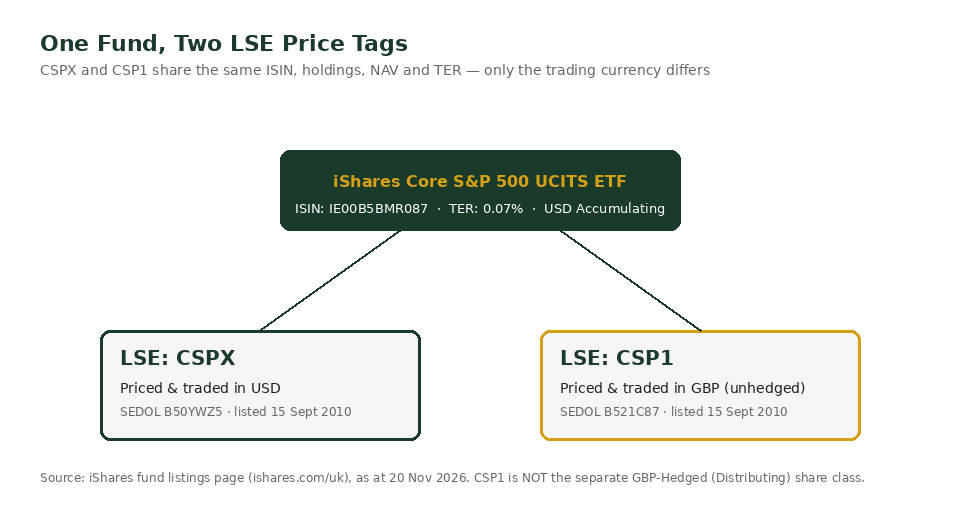
The short answer: nothing about the underlying investment changes. CSPX and CSP1 are the same share class of the same fund — same ISIN (IE00B5BMR087), same 504 underlying holdings, same NAV (denominated in USD), same 0.07% TER, same accumulating treatment of dividends. The only difference is the currency the shares are quoted and settled in on the London Stock Exchange.
| Feature | CSPX (LSE) | CSP1 (LSE) |
|---|---|---|
| ISIN | IE00B5BMR087 | IE00B5BMR087 (same) |
| Trading currency | USD | GBP (pence) |
| SEDOL | B50YWZ5 | B521C87 |
| Listing date | 15 Sept 2010 | 15 Sept 2010 |
| TER | 0.07% | 0.07% (same) |
| Currency hedged? | No | No — GBP price simply floats with the USD/GBP exchange rate |
Source: iShares fund listings page (ishares.com/uk), as at 20 November 2026.
Crucially, CSP1 is not the “iShares Core S&P 500 UCITS ETF GBP Hedged (Distributing)” share class that also appears in iShares’ share-class dropdown for this fund. That hedged distributing class carries its own separate ISIN and return profile, because it uses derivatives to hedge USD/GBP currency risk and pays out distributions rather than accumulating them. CSP1 is simply the USD accumulating share class — the same one as CSPX — quoted in GBP pence for LSE traders who prefer to see and settle prices in sterling. Always check the ISIN on your trade confirmation if you’re unsure which one you’ve been shown.
Why Does iShares List the Same ETF Twice on the LSE?
This isn’t a quirk unique to CSPX — it’s standard practice for UCITS ETFs that trade on multiple European exchanges. The LSE allows a single fund to list several “lines,” each denominated in a different currency, so that investors across different markets can trade and settle in their own preferred currency without the fund itself having to launch a separate product for every market. CSPX, for instance, also has separate lines on the SIX Swiss Exchange (CSSPX, in USD), Deutsche Börse Xetra (SXR8, in EUR), Borsa Italiana (CSSPX, in EUR) and Euronext Amsterdam (CSPX, in EUR) — all the same ISIN, all the same underlying fund.
| Exchange | Ticker | Currency | Listed Since |
|---|---|---|---|
| London Stock Exchange | CSPX | USD | 15 Sept 2010 |
| London Stock Exchange | CSP1 | GBP | 15 Sept 2010 |
| Deutsche Börse Xetra | SXR8 | EUR | 26 May 2010 |
| Borsa Italiana | CSSPX | EUR | 26 May 2010 |
| SIX Swiss Exchange | CSSPX | USD | 19 May 2010 |
| Euronext Amsterdam | CSPX | EUR | 18 Jan 2011 |
Source: iShares fund listings page (ishares.com/uk), as at 20 November 2026. Table shows a selection of the fund’s listings; CSPX also trades on exchanges in Mexico, Chile, Colombia and Israel.
For Singapore investors, only the two LSE lines — CSPX and CSP1 — are typically relevant, since almost every local broker that offers LSE access (IBKR, moomoo, Longbridge, Tiger Brokers) routes orders through London rather than Frankfurt, Milan or Amsterdam.
Does the Ticker You Pick Actually Matter?
For long-term performance, no. Since CSPX and CSP1 are the same share class, your total return (before any FX conversion you personally incur) will be identical whichever line you buy. The 0.07% TER is deducted inside the fund before either price is calculated, so it doesn’t change based on which currency line you trade.
What can differ is what happens outside the fund — specifically, how many currency conversions your money goes through to get from your brokerage account into the ETF:
- If your brokerage account already holds USD (common for investors who fund via IBKR or keep a USD sub-account with moomoo or Tiger Brokers), buying CSPX means no extra conversion: SGD → USD once, then straight into CSPX.
- If you buy CSP1 instead while holding USD, your broker typically has to convert your USD into GBP first (at whatever spread it charges), execute the trade in GBP, and then convert back to USD or SGD whenever you eventually sell — two extra currency conversions you didn’t need to pay for.
- If your broker defaults to settling LSE trades in GBP regardless of what you select, then CSP1 may actually be the more natural choice, and CSPX would be the one that triggers an unnecessary conversion.
Because FX spreads and conversion fees vary by broker and change over time, we’re not going to put a specific dollar figure on this — check your own broker’s current FX conversion fee schedule before trading, since even a small spread compounds over years of regular investing. The practical rule is simple: buy the ticker denominated in the currency you’re already holding or funding in, and avoid letting your broker round-trip your money through a currency you don’t actually need.
How to Check Which Ticker Your Broker Shows
Before placing an order, confirm exactly which line you’re about to buy:
- Search both tickers separately. Type “CSPX” and “CSP1” into your broker’s search bar one at a time — don’t assume the first result that appears when you search “S&P 500” is the one you want.
- Check the quoted currency on the order ticket. If the price shown is in the hundreds (e.g. ~US$746) it’s almost certainly the USD line (CSPX); if it’s in the hundreds of pence or shown as GBX (e.g. ~57,500p / £575) it’s the GBP line (CSP1).
- Confirm the ISIN before you submit the order. Both lines share ISIN IE00B5BMR087 — if the ISIN shown is different, you may be looking at a different share class entirely (such as the GBP-Hedged Distributing class), not simply a different currency line of the same one.
- Check what currency your trade will settle in. Some brokers let you choose a settlement currency independently of the listing currency; others force conversion. If you’re unsure, ask your broker’s support desk directly — this detail isn’t always obvious from the trading screen.
It’s Not Just CSPX: VWRA and IWDA Do This Too
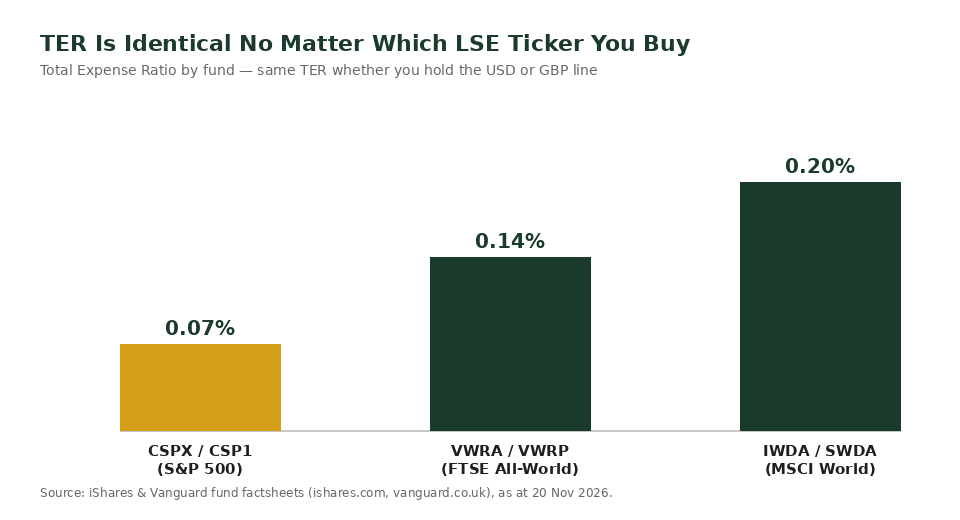
If you also hold Vanguard’s FTSE All-World ETF or iShares’ MSCI World ETF, the same dual-listing pattern applies to both. VWRA (USD) and VWRP (GBP) are the same Vanguard FTSE All-World UCITS ETF share class (ISIN IE00BK5BQT80, TER 0.14% per the Vanguard UK fund page, as at 19 November 2026) listed twice on the LSE. Similarly, IWDA (USD) and SWDA (GBP) are the same iShares Core MSCI World UCITS ETF share class (ISIN IE00B4L5Y983, TER 0.20% per the iShares factsheet, as at 19 November 2026). We go into more depth on choosing between these two funds in our CSPX vs IWDA comparison.
If you’re still deciding between a global index fund and a pure S&P 500 fund in the first place — or want to understand why Singapore investors use the LSE at all instead of buying US-listed ETFs directly — our guide to why Singapore investors buy ETFs on the London Stock Exchange covers the withholding tax and estate-tax reasoning behind that choice. We’ve also broken down the mechanics of CSPX’s 15% dividend withholding tax separately, since it applies identically no matter which LSE ticker you hold.
Common Mistakes Singapore Investors Make
- Assuming CSP1 is a “GBP-hedged” version of CSPX. It isn’t hedged at all — its GBP price simply floats with the live USD/GBP exchange rate, so you still carry full USD exposure (which is what most Singapore investors want when buying a US equity fund anyway).
- Buying whichever ticker appears first in search results without checking the currency, then being confused when the “price” looks wildly different from what they saw on a US broker or financial news site quoting the USD line.
- Averaging cost-basis across CSPX and CSP1 purchases without converting to a common currency first — since they’re the same share class, your actual cost basis should be tracked in one currency (usually USD, the fund’s base currency) for consistency.
- Not checking broker FX fees before repeatedly buying the “wrong” currency line through a recurring investment plan, which compounds a small, avoidable cost every single month.
Where to Buy CSPX
CSPX is LSE-listed, so Singapore investors typically access it through brokers offering UK/European market access. A few starting points:
- Interactive Brokers (IBKR) — typically the lowest-cost route for direct LSE access and lets you hold a native USD balance, which avoids the CSP1 double-conversion issue discussed above.
- moomoo Singapore — offers LSE access alongside SGX and US markets, with promotional cash and commission-free trades for new users.
- Longbridge Securities — another SG-regulated option with LSE access and welcome offers for first-time account funding.
If you’d rather not pick tickers yourself, Endowus and Syfe both offer managed portfolios built on similar global index exposure, handling the underlying fund selection (and currency routing) for you. And if you’re mapping how CSPX fits into a broader retirement plan, our Singapore retirement calculator can help you work out how much you’d need to invest monthly to hit your target.
Frequently Asked Questions
Is CSP1 the exact same fund as CSPX?
Yes. CSP1 and CSPX share the same ISIN (IE00B5BMR087), the same underlying holdings, the same NAV (calculated in USD) and the same 0.07% TER. The only difference is that CSP1 is quoted and traded in GBP pence on the London Stock Exchange, while CSPX is quoted and traded in USD.
Is CSP1 currency-hedged to GBP?
No. CSP1’s GBP price simply moves with the live USD/GBP exchange rate on top of the fund’s USD performance. It is not the same product as iShares’ separate “GBP Hedged (Distributing)” share class of the fund, which carries a different ISIN and uses derivatives to strip out currency risk.
Which ticker should I buy as a Singapore investor — CSPX or CSP1?
In most cases, CSPX (the USD line), because most Singapore investors fund their brokerage accounts in SGD or USD rather than GBP, and holding CSPX avoids an unnecessary GBP conversion leg. The exception is if your specific broker settles LSE trades in GBP by default — in that case, CSP1 may actually involve fewer conversions for you. Check your own account’s settlement currency before deciding.
Does buying CSP1 instead of CSPX change my withholding tax or dividend treatment?
No. Both are accumulating share classes of the same Irish-domiciled fund, so the underlying withholding tax treatment on US dividends inside the fund (reduced under the US-Ireland tax treaty) is identical regardless of which LSE ticker you hold.
How do I find out what currency my broker will actually settle my trade in?
Check your broker’s order ticket before confirming — it should show the trade currency and, separately, your account’s base/settlement currency. If this isn’t clear on-screen, contact your broker’s support team directly, since this detail affects whether you’ll incur an avoidable FX conversion.
Does this dual-ticker issue only affect CSPX?
No — it’s standard practice across most major LSE-listed UCITS ETFs. Vanguard’s FTSE All-World ETF lists as VWRA (USD) and VWRP (GBP), and iShares’ Core MSCI World ETF lists as IWDA (USD) and SWDA (GBP) — both pairs are, respectively, the same share class of the same fund, just quoted in a different currency on the same exchange.
Not financial advice. All figures are for educational reference only, sourced from official iShares and Vanguard fund pages. Data verified as at 21 November 2026 and may change — always check the live fund page and your broker’s order ticket before trading.
This article was researched with the help of AI. While we strive to keep all information accurate and up to date, there may be errors. If you notice any discrepancies, please contact us.