Year-End ETF Portfolio Rebalancing for Singapore Investors (2026 Guide)
SRS deadlines, CPF caps, and a step-by-step SGD rebalancing example for the final weeks of 2026.
Year-end ETF portfolio rebalancing means bringing a drifted allocation back to its target weights before 31 December, while also using Singapore’s SRS and CPF deadlines to lower this year’s tax bill. After the AI-driven tech selloff in November 2026, many Singapore investors’ US-equity ETF weightings have drifted well above target. Rebalancing now — by trimming winners, topping up laggards, or simply directing new contributions — resets risk before the new year.
Not financial advice. All figures are for educational reference only. Data as at November 2026 unless noted.
Table of Contents
Contents — Click to expand
- Why Rebalancing Matters Going Into 2027
- How ETF Rebalancing Actually Works
- Singapore Context: SRS, CPF and Tax Deadlines Before 31 December
- Calendar vs Threshold vs Contribution-Based Rebalancing
- A Worked SGD 100,000 Rebalancing Example
- Where to Rebalance: Broker and Platform Options
- Frequently Asked Questions
Why Rebalancing Matters Going Into 2027
A target asset allocation — say 60% US equities, 25% developed-market global equities and 15% S-REITs for income — is a risk decision, not a one-time event. Once you buy into it, market moves immediately start pulling it away from target. A Singapore investor who built a 60/25/15 portfolio in January 2026 and never touched it again does not still hold 60/25/15 today; the strongest-performing sleeve simply grows to take up more of the pie.
November 2026 made this especially visible. A sharp AI-and-chipmaker-led selloff hit US large-cap tech and Nasdaq-heavy ETFs hard mid-month, after a strong run earlier in the year had already pushed US equity weightings above most investors’ original targets. The practical effect for a typical Singapore ETF holder: a portfolio that drifted overweight US equities on the way up is now drifting again on the way down, just in the opposite direction, and often lands somewhere between the two extremes rather than back at target. Without a rebalancing rule, allocation drift compounds silently — nobody decides to take on more concentration risk, it just happens.
Year-end specifically matters for two additional reasons that have nothing to do with markets: Singapore’s Supplementary Retirement Scheme (SRS) tax relief only counts for contributions that land in your SRS account by 31 December, and CPF’s Annual Limit resets on 1 January. Both deadlines are a natural trigger to review the whole portfolio at once — cash holdings, SRS, CPF investment scheme (CPFIS) holdings and brokerage ETFs — rather than rebalancing each account in isolation.
How ETF Rebalancing Actually Works
Rebalancing means selling (or simply not adding to) the sleeve that has grown above target, and buying (or directing new money into) the sleeve that has fallen below target, until the portfolio is back near its original weights. There are three mechanical approaches:
Target allocation and drift bands. Most rules-based rebalancing uses a “trigger band” around each target weight — commonly 5 percentage points absolute, or a 20–25% relative move (e.g. a 15% target sleeve triggers a rebalance once it moves outside roughly 11.25%–18.75%). A tighter band rebalances more often and keeps risk closer to target, at the cost of more transactions; a wider band tolerates more drift but trades less.
Calendar-based rebalancing. Review and rebalance on a fixed schedule — quarterly, half-yearly, or once a year at year-end — regardless of how far the portfolio has drifted. This is simple and low-effort but can leave a portfolio badly out of target for months if markets move fast between review dates, as they did in November 2026.
Contribution-based (cash-flow) rebalancing. Instead of selling the overweight sleeve, direct all new monthly or ad-hoc contributions into whichever sleeve is currently underweight, until the whole portfolio drifts back to target. This is the lowest-friction method for investors who are still accumulating, because it avoids selling altogether — which matters in Singapore because, as covered below, selling across certain ETF domiciles can have small but real tax and currency-conversion costs even though Singapore itself does not tax capital gains.
Singapore Context: SRS, CPF and Tax Deadlines Before 31 December
Singapore does not levy capital gains tax or a general dividend tax on individuals, so rebalancing a brokerage-held ETF portfolio by itself triggers no local tax event — a meaningful advantage over jurisdictions that tax every realised gain. The costs to watch instead are brokerage commissions, the bid-ask spread, FX conversion fees when switching between SGD, USD and GBP-denominated ETFs, and the 15% US dividend withholding tax that Ireland-domiciled UCITS ETFs such as CSPX and IWDA already have baked into their returns — rebalancing between two Ireland-domiciled ETFs does not change this WHT exposure either way.
Two Singapore-specific deadlines make year-end the natural time to rebalance the whole household balance sheet, not just the brokerage account:
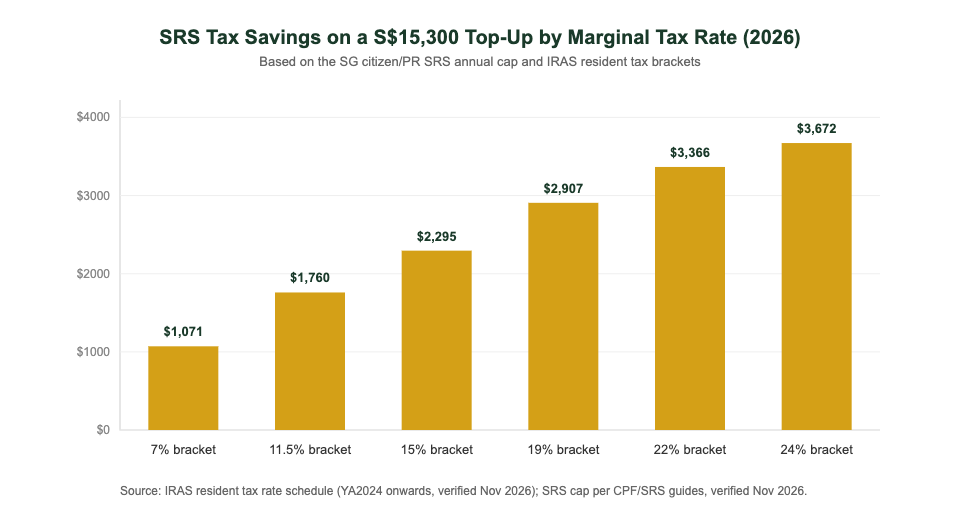
- SRS contributions must land by 31 December 2026 to count as tax relief against 2026 income (assessed in your 2027 tax return). The 2026 annual SRS contribution cap is S$15,300 for Singapore citizens and PRs, and S$35,700 for foreigners, and SRS relief sits inside the overall S$80,000 personal income tax relief cap that applies to all reliefs combined. Contributing late — even by one day — pushes the relief into the following tax year instead.
- CPF’s Annual Limit remains S$37,740 for 2026 (unchanged from prior years), governing how much combined mandatory and voluntary CPF contribution can attract relief or count toward your accounts in a calendar year. Separately, the CPF monthly salary ceiling rose to S$8,000 from 1 January 2026, which raises how much of a salary earns mandatory CPF contributions but does not change the Annual Limit itself.
| Deadline / Cap (2026) | Detail |
|---|---|
| SRS contribution deadline | 31 December 2026 to count as relief against 2026 income |
| SRS annual cap — citizens/PRs | S$15,300 |
| SRS annual cap — foreigners | S$35,700 |
| Overall personal tax relief cap | S$80,000 (all reliefs combined, including SRS) |
| CPF Annual Limit | S$37,740 (unchanged for 2026) |
| CPF monthly salary ceiling | S$8,000 from 1 January 2026 |
Source: IRAS Supplementary Retirement Scheme guidance and CPF Board contribution guidance, cross-checked via public guides on 17 November 2026. Verify your own figures on iras.gov.sg and cpf.gov.sg before acting.
Because SRS funds can themselves be invested in ETFs through SRS-linked brokerage accounts, a year-end SRS top-up is often also the simplest “contribution-based” rebalancing move available: top up SRS, then direct that fresh cash straight into whichever ETF sleeve is currently underweight, achieving the tax relief and the rebalancing in one transaction.
Calendar vs Threshold vs Contribution-Based Rebalancing
None of the three approaches is universally “best” — the right one depends on how actively you want to manage the portfolio and whether you are still adding new money or already fully invested.
| Approach | How It Works | Pros | Cons | Best For |
|---|---|---|---|---|
| Calendar-based | Rebalance on a fixed date, e.g. every 31 December | Simple, low effort, easy to automate mentally | Can leave large drift between dates during fast markets | Passive investors checking in once or twice a year |
| Threshold-based | Rebalance whenever a sleeve drifts beyond a set band (e.g. ±5pp) | Keeps risk tightly controlled regardless of timing | Requires more frequent checking; more transactions and FX conversions | Investors with large portfolios where drift has real dollar impact |
| Contribution-based | Direct new contributions only into underweight sleeves; no selling | No selling, minimal cost, naturally tax- and WHT-neutral | Only works while still actively contributing new cash | Investors in the accumulation phase (most SRS/CPFIS users) |
A practical hybrid many Singapore investors use: default to contribution-based rebalancing throughout the year with every monthly ETF purchase, then do one calendar-based full review at year-end — timed to coincide with the SRS top-up deadline — and only sell down a sleeve if contribution-based buying alone cannot close the gap.
A Worked SGD 100,000 Rebalancing Example
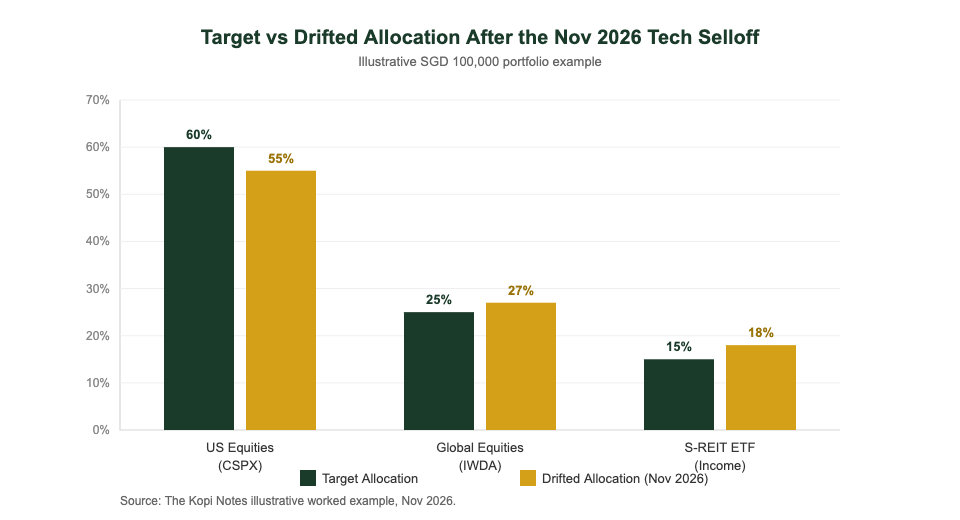
Consider a Singapore investor who started 2026 with a SGD 100,000 portfolio split 60% US equities (via CSPX), 25% developed-market global equities (via IWDA) and 15% in a Singapore REIT ETF for income. After the strong first ten months of 2026 and then the November AI-chip selloff, the portfolio by mid-November looked like this:
| Sleeve | Target Weight | Drifted Weight (Nov 2026) | Current Value | Action to Rebalance |
|---|---|---|---|---|
| US Equities (CSPX) | 60% | 55% | SGD 55,000 | Add ~SGD 5,000 |
| Global Equities (IWDA) | 25% | 27% | SGD 27,000 | Trim ~SGD 2,000 |
| S-REIT ETF (Income) | 15% | 18% | SGD 18,000 | Trim ~SGD 3,000 |
Source: The Kopi Notes illustrative worked example for educational purposes, November 2026. Not a recommendation to hold these exact weights.
Rather than selling CSPX units to fund the shortfall (which would mean converting SGD to USD, paying a brokerage commission, and crystallising any FX spread), the investor can achieve the same result with new money: direct the SGD 15,300 year-end SRS top-up — which also captures this year’s SRS tax relief — entirely into CSPX, and route the next two or three months of regular ETF purchases into IWDA and the S-REIT ETF instead of adding further to US equities. Within a quarter, contribution-based rebalancing alone typically closes a drift of this size without a single sale, which avoids transaction costs and keeps the portfolio continuously invested rather than sitting partly in cash while waiting to execute a lump-sum rebalance.
For investors whose portfolios are large enough, or drifted enough, that new contributions cannot close the gap within a reasonable time, a partial sale of the overweight sleeve is the fallback — in Singapore this triggers no capital gains tax, only the usual brokerage commission and FX spread on the trade.
Where to Rebalance: Broker and Platform Options
Because rebalancing often means buying LSE-listed Ireland-domiciled ETFs like CSPX and IWDA alongside SGX-listed instruments such as S-REIT ETFs, most Singapore investors end up using more than one platform:
For LSE-listed ETFs (CSPX, IWDA, VUAA, SPYL): Interactive Brokers remains the lowest-cost option for larger, less frequent trades; moomoo and Longbridge offer simpler mobile-first interfaces with commission-free promotions that suit smaller, more frequent top-ups.
For SGX-listed ETFs (S-REIT ETFs, the Xtrackers SGD-denominated range): the same moomoo, Longbridge and FSMOne accounts can usually execute SGD trades without any currency conversion, which keeps rebalancing costs lowest when the underweight sleeve happens to be SGX-listed.
Hands-off alternative: robo-advisors such as Endowus and Syfe rebalance diversified portfolios automatically as part of the service, which suits investors who would rather not calculate drift bands themselves. This is also where an SRS or CPFIS allocation is often held, since both platforms accept SRS and CPF Investment Account funds directly.
Frequently Asked Questions
What is ETF portfolio rebalancing and why does it matter for Singapore investors?
ETF portfolio rebalancing is the process of buying or selling ETF holdings to bring your allocation back to its original target weights after market moves cause it to drift. It matters because an un-rebalanced portfolio gradually takes on more concentration risk in whichever sleeve has performed best — which, after the November 2026 AI-and-chip selloff, left many Singapore investors more exposed to US tech than they originally intended.
Does rebalancing an ETF portfolio trigger tax in Singapore?
No. Singapore does not tax capital gains or general investment income for individuals, so selling one ETF to buy another triggers no local tax event. The real costs are brokerage commissions, the bid-ask spread, and any FX conversion spread when switching between SGD-, USD- and GBP-denominated ETFs — not tax.
Can I use my SRS or CPF funds to rebalance my portfolio before year-end?
Yes. SRS funds held in an SRS-linked brokerage account can be used to buy or sell eligible ETFs just like a regular cash account, and a year-end SRS top-up (up to S$15,300 for citizens and PRs in 2026) both earns this year’s tax relief and supplies fresh cash that can be directed straight into an underweight sleeve. CPF Investment Account (CPFIS) funds can similarly be redirected among CPFIS-approved instruments, though not all LSE-listed ETFs such as CSPX and IWDA are CPFIS-eligible — check the CPFIS included investment list before assuming a fund qualifies.
What rebalancing threshold should I use — 5% or something else?
A common starting rule is a 5-percentage-point absolute band around each target weight, or a 20–25% relative move for smaller target weights (for example, a 15% target sleeve triggers at roughly ±3–4 percentage points). Tighter bands keep risk closer to target but mean more transactions and FX conversions; wider bands trade less often at the cost of letting the portfolio drift further from its intended risk level in between.
Is it better to rebalance by selling or by directing new contributions?
For investors still actively contributing, directing new money into the underweight sleeve (contribution-based rebalancing) is usually the lower-cost choice, since it avoids selling altogether and the commissions, bid-ask spread and FX conversion that come with it. Selling down the overweight sleeve becomes the practical fallback only when the drift is too large for new contributions to close within a reasonable time, or when the investor is no longer adding fresh cash.
How often should I check my ETF portfolio for drift?
Most individual investors do well checking quarterly, with a more thorough full review at year-end that is combined with the SRS and CPF deadline planning described above. Checking far more often than that rarely changes the outcome for a long-term portfolio and mainly adds the temptation to react to short-term volatility rather than to genuine allocation drift.
Ready to Rebalance Before the Year-End Deadline?
Top up your SRS, review your allocation, and put new contributions to work — before 31 December 2026.
This article was researched with the help of AI. While we strive to keep all information accurate and up to date, there may be errors. If you notice any discrepancies, please contact us.