STI ETF vs CSPX: Should Singapore Investors Go Local or Global? (2026)
Comparing fees, CPF/SRS access and returns between Singapore’s home-grown STI ETF and the LSE-listed CSPX.
The STI ETF (ES3 or G3B) tracks 30 Singapore blue chips and is CPF-OA and SRS investable with a SGD-denominated, no-FX structure. CSPX tracks the S&P 500 on the London Stock Exchange with a much lower 0.07% expense ratio and broader diversification, but is not CPF-OA eligible. Most Singapore investors are better served using both: STI ETF for CPF-OA money, CSPX for cash or SRS.
Not financial advice. All figures are for educational reference only. Data verified as at 15 November 2026 unless otherwise noted.
Table of Contents
Quick Answer
For a Singapore investor choosing between the STI ETF and CSPX, the honest answer is “it depends on which pocket of money you’re investing.” The STI ETF (SGX: ES3 or G3B) tracks the Straits Times Index — 30 Singapore-listed blue chips dominated by the three local banks, SGX-listed REITs and Singtel. It is quoted and settled in SGD, and critically, it is one of the few equity instruments you can buy with CPF Ordinary Account (CPF-OA) funds. CSPX, by contrast, is an Ireland-domiciled, London Stock Exchange-listed UCITS ETF tracking the S&P 500. It carries a far lower 0.07% total expense ratio (TER) and gives exposure to roughly 500 of the largest US companies, but you cannot use CPF-OA to buy it, and you take on USD currency risk. If you’re investing CPF-OA money you have no better low-cost local option than the STI ETF; for SRS or cash savings, CSPX’s lower cost and broader diversification usually wins.
Key Differences at a Glance
The table below lines up the two SGX-listed STI ETFs against CSPX across the metrics that actually change an investor’s decision — not just the headline TER.
| Feature | SPDR STI ETF (ES3) | Amova STI ETF (G3B) | iShares CSPX |
|---|---|---|---|
| Index Tracked | Straits Times Index | Straits Times Index | S&P 500 |
| Domicile | Singapore | Singapore | Ireland |
| Exchange | SGX | SGX | London Stock Exchange |
| Currency | SGD | SGD | USD |
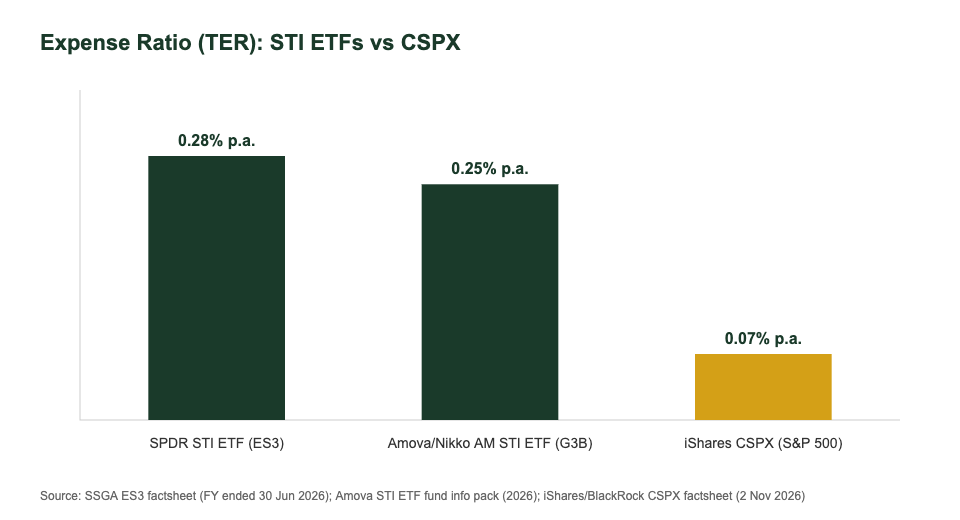
| TER (p.a.) | 0.28% | 0.25% (cap) | 0.07% |
| Structure | Distributing | Distributing | Accumulating |
| Number of Holdings | ~30 | ~30 | ~503 |
| CPF-OA Eligible | Yes | Yes | No |
| SRS Eligible | Yes | Yes | Yes, via SRS-linked brokerage |
Source: SSGA SPDR STI ETF factsheet (financial year ended 30 June 2026); Amova (formerly Nikko AM) STI ETF fund information pack (2026); iShares/BlackRock CSPX factsheet, 2 November 2026.
CPF-OA and SRS Access — The Real Differentiator
This is the part most comparison articles skip, and it’s the single biggest practical difference between these two ETFs. Both SGX-listed STI ETFs — ES3 and G3B — are approved under the CPF Investment Scheme (CPFIS), meaning a Singapore investor can use CPF-OA funds above the first S$20,000 (within the 35% stocks-and-ETFs sub-limit) to buy them through a CPFIS-approved agent bank or broker. CSPX cannot be bought this way at all — it is an LSE-listed, Ireland-domiciled fund, and CPF-OA money is restricted to a narrow list of CPFIS-included instruments that doesn’t extend to foreign-listed ETFs.
For SRS (Supplementary Retirement Scheme) money, both sides are workable. STI ETFs are directly SRS-eligible through your SRS operator bank’s linked brokerage. CSPX is also SRS-compatible, but only through an SRS-linked brokerage account with a broker that supports LSE trading for SRS funds — not every SRS operator offers this by default, so check with your bank or broker before assuming it’s available.
In practice, this means the “STI ETF vs CSPX” choice usually isn’t either/or — it’s about which pot of money you’re deploying. CPF-OA money realistically has no low-cost LSE alternative, so the STI ETF (or a CPFIS-approved global fund) is often the only game in town for that bucket.
Tax, Currency and Cost Comparison
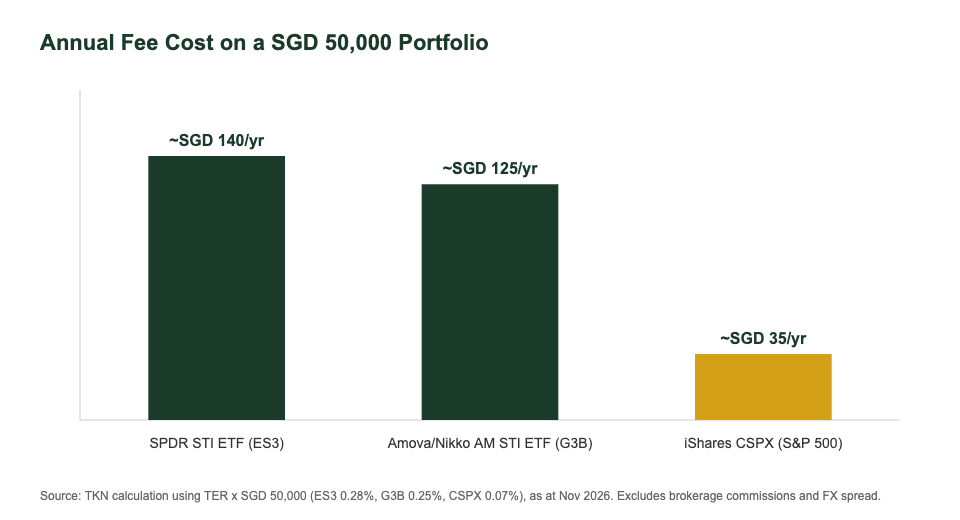
On raw fees, CSPX is the clear winner. On a SGD 50,000 portfolio, ES3’s 0.28% TER costs roughly SGD 140 a year, G3B’s 0.25% cap costs about SGD 125, while CSPX’s 0.07% TER costs only about SGD 35 — CSPX is roughly four times cheaper purely on expense ratio. But fees aren’t the whole cost picture:
- Currency: ES3 and G3B are SGD-denominated — you buy and sell in SGD with no FX conversion. CSPX trades in USD on the LSE, so every buy and sell incurs an FX spread (typically 0.03%–0.5% depending on broker) unless you already hold USD.
- Dividends vs accumulation: ES3 and G3B are distributing funds — dividends land in your brokerage account as cash, untaxed in Singapore (Singapore does not tax dividend income). CSPX is accumulating — dividends are reinvested inside the fund automatically, so there’s no cash payout to manage, but the underlying US dividends are still subject to a 15% US withholding tax at fund level under the Ireland–US tax treaty before reinvestment. This WHT is baked into CSPX’s NAV growth and isn’t a separate bill you pay.
- Brokerage and FX spread: buying ES3/G3B on SGX typically costs less in commission for small SG investors via local brokers; buying CSPX on the LSE usually needs a broker with UK market access (IBKR, Saxo, moomoo, Syfe Brokerage), and larger trades amortise the FX spread better than small ones.
Historical Performance and Concentration Risk
The STI’s long-run annualised total return has historically trailed the S&P 500’s — the Straits Times Index is a 30-stock index heavily concentrated in three local banks (DBS, OCBC, UOB together make up roughly 45% of the index weight), SGX-listed REITs and Singtel, with almost no exposure to technology or healthcare. That concentration cuts both ways: in 2025–2026, a strong rally in Singapore bank earnings and falling SORA rates pushed the STI to multi-year highs, briefly closing the performance gap with US equities. But over a full decade, the S&P 500’s broader sector mix (technology, healthcare, consumer and financials) has delivered a materially higher compounded return than the STI, albeit with higher volatility and currency risk for a SGD-based investor.
The practical takeaway: the STI ETF is not a “safer” version of CSPX — it’s a different risk, concentrated in Singapore financials and property rather than global growth sectors. Holding both reduces single-market concentration risk better than holding either alone.
Where to Buy ES3, G3B and CSPX in Singapore
SGX-listed STI ETFs (ES3, G3B): buy them in SGD through any SGX-connected broker. For CPF-OA purchases you’ll need a CPFIS-approved agent bank or broker account; for cash or SRS, any standard SGX brokerage account works. moomoo and Longbridge both support SGX trading with competitive commissions for local ETFs.
CSPX (LSE): you’ll need a broker with UK/LSE market access. Interactive Brokers (IBKR) offers the lowest FX spread for larger trades; moomoo and Longbridge have added LSE access with simpler onboarding for smaller portfolios. If you’d rather not manage overseas brokerage logins at all, a hands-off robo platform like Endowus or Syfe can give S&P 500 exposure through a managed portfolio instead of buying CSPX directly.
Who Should Pick Which?
Pick the STI ETF (ES3/G3B) if: you’re investing CPF-OA money (it’s one of the few equity options available), you want SGD-denominated exposure with no FX conversion, or you want direct exposure to Singapore bank and REIT dividends without currency risk.
Pick CSPX if: you’re investing SRS or cash savings, you want the lowest possible TER and broad exposure across 500 US companies rather than 30 concentrated Singapore names, and you’re comfortable holding a USD-denominated, accumulating fund for the long term.
Consider holding both if your goal is a core-satellite portfolio: STI ETF inside CPF-OA for the CPF bucket, CSPX (or a broader world-tracking UCITS ETF) for your cash and SRS buckets. This naturally diversifies you across markets without forcing a single “winner.” For a deeper look at building this kind of allocation, see our CPF investment strategy guide and run the numbers in our Singapore retirement calculator.
If you already hold CSPX and want to understand why Singapore investors favour LSE-listed ETFs for their non-CPF money in the first place — lower withholding tax, no US estate tax exposure — read our guide on why Singapore investors buy ETFs on the London Stock Exchange. For the full breakdown of CSPX itself, see our CSPX ETF Singapore guide, and for more on the STI ETF side (including the ES3 vs G3B decision), see our STI ETF Singapore guide.
Not financial advice. Figures are for educational reference only and may change; verify current fees and eligibility with the fund manager, your CPFIS agent bank, or your broker before investing. Data as at 15 November 2026.
Frequently Asked Questions
Is the STI ETF better than CSPX for Singapore investors?
Neither is universally “better” — they serve different purposes. The STI ETF is CPF-OA eligible and SGD-denominated, making it the practical choice for CPF money, while CSPX has a far lower 0.07% expense ratio and broader diversification, making it the stronger choice for SRS or cash savings. Many Singapore investors hold both.
Can I buy CSPX using my CPF-OA funds?
No. CSPX is listed on the London Stock Exchange and is not on the CPF Investment Scheme’s (CPFIS) approved list. CPF-OA funds can only be used to buy CPFIS-approved instruments, which includes the SGX-listed ES3 and G3B STI ETFs but not foreign-listed ETFs like CSPX.
Which STI ETF should I buy, ES3 or G3B?
Both track the same Straits Times Index and are CPFIS and SRS eligible. G3B (Amova, formerly Nikko AM) has a slightly lower expense ratio cap of 0.25% versus ES3’s 0.28%, and a lower minimum trading lot in some cases. The difference in annual cost on a typical portfolio is small — a few dollars a year — so liquidity and your broker’s available order sizes often matter more than the fee gap.
Why is CSPX's fee so much lower than the STI ETF's?
CSPX benefits from iShares’ massive global scale — it manages over USD 150 billion in assets, letting BlackRock spread fixed fund costs across a huge investor base. The STI ETFs are much smaller funds tracking a narrower, less liquid 30-stock index, so their fixed costs are spread more thinly, keeping their TER higher despite being simpler, single-market products.
Does the STI ETF pay dividends, and is CSPX's accumulating structure better?
Yes — both ES3 and G3B are distributing funds that pay out dividends in cash, usually semi-annually. CSPX is accumulating, meaning dividends are automatically reinvested rather than paid out. Neither is “better” outright: distributing suits investors who want cash income now, while accumulating suits investors focused purely on long-term compounding who don’t need the cash flow.
What are the biggest risks of holding only the STI ETF instead of a global ETF like CSPX?
Concentration risk is the main one. The STI ETF holds just 30 stocks, with Singapore’s three banks alone making up close to half the index weight, and virtually no exposure to global technology, healthcare or consumer sectors. A Singapore-only portfolio is vulnerable to a downturn in local banks or property, whereas CSPX’s 500 holdings spread that risk across many US sectors and companies.
Ready to Build a Local + Global ETF Portfolio?
Open a brokerage account and start investing across both markets today. Use our referral links for exclusive sign-up bonuses.
This article was researched with the help of AI. While we strive to keep all information accurate and up to date, there may be errors. If you notice any discrepancies, please contact us.