Is GXS Bank Safe? MAS Licence, SDIC Insurance & What Happens If GXS Closes (2026)
Everything Singapore savers need to know about GXS Bank’s regulation and deposit protection in 2026
In This Guide
- What Makes a Singapore Bank “Safe”?
- GXS Bank’s MAS Digital Full Bank Licence
- SDIC Insurance: Your S$100,000 Safety Net
- Who Owns GXS Bank? The Grab–Singtel Backing
- What Happens If GXS Bank Closes?
- GXS Bank’s In-App Security Features
- GXS Bank vs Traditional Banks: Safety Comparison
- Frequently Asked Questions
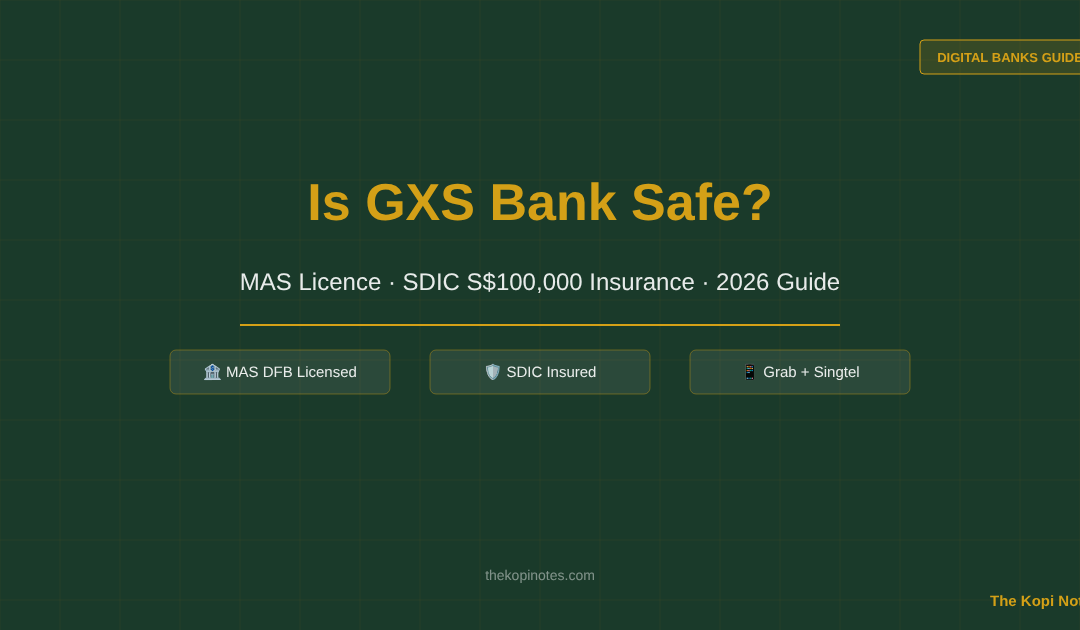
GXS Bank is safe for Singapore depositors: it holds a Digital Full Bank (DFB) licence from the Monetary Authority of Singapore (MAS) and is a member of the Singapore Deposit Insurance Corporation (SDIC), which insures your Singapore-dollar deposits up to S$100,000 per depositor. Backed by Grab and Singtel and launched on 31 August 2022 as Singapore’s first consumer digital bank, GXS Bank Pte. Ltd. (UEN: 202005626H) operates under the same banking laws that govern DBS, OCBC, and UOB.
Not financial advice. All figures are for educational reference only. Data as at November 2026 unless noted.
What Makes a Singapore Bank “Safe”?
When Singaporeans ask whether a digital bank is “safe,” they usually mean three things: Is my money regulated? Is it insured if the bank fails? And who actually owns this app?
In Singapore, three layers of protection apply to any MAS-licensed bank:
1. MAS Licensing and Supervision
Banks must hold a valid MAS licence and comply with the Banking Act, which sets minimum capital adequacy ratios, liquidity requirements, and conduct standards. MAS examiners conduct regular inspections and have broad intervention powers.
2. SDIC Deposit Insurance
All licensed banks must join the SDIC scheme. Member banks contribute annual premiums to the SDIC fund, which pays out to depositors if a bank fails. Coverage is capped at S$100,000 per depositor per bank for eligible Singapore-dollar deposits. MAS raised this limit from S$75,000 to S$100,000 in April 2024.
3. Shareholder Capital
Banks must maintain adequate paid-up capital. For Digital Full Banks, MAS requires significant capital as the bank scales to full operational status. This ensures the institution can absorb losses without putting depositors at risk.
GXS Bank satisfies all three layers. Here is how each one works in practice.
GXS Bank’s MAS Digital Full Bank Licence
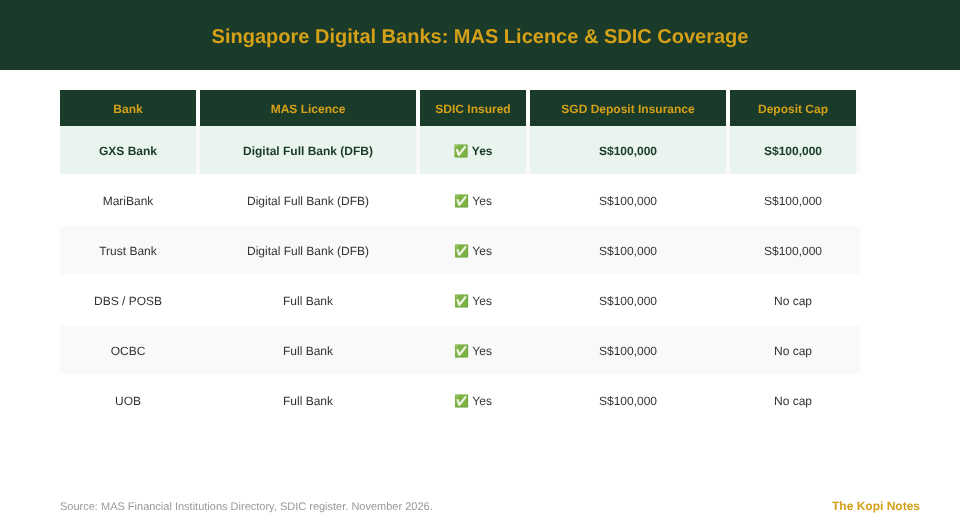
In January 2021, MAS awarded Digital Full Bank (DFB) licences to two consortia: the Grab–Singtel consortium (which became GXS Bank) and Sea Limited’s MariBank. A DFB licence is distinct from a Digital Wholesale Bank (DWB) licence, which is restricted to serving businesses. DFB holders can:
- Accept Singapore-dollar deposits from retail customers
- Offer savings accounts, credit products, and payment services
- Operate under the full Banking Act, identical to traditional banks
- Become an SDIC Scheme member, with their depositors protected by law
GXS Bank launched on 31 August 2022 as Singapore’s first digital full bank for consumers. By that date, it had already met MAS’s initial capital and operational requirements to begin serving retail customers.
What the DFB licence means in practice: MAS examiners scrutinise GXS Bank’s risk management, capital adequacy, and anti-money-laundering (AML) controls just as they do for DBS and OCBC. If MAS finds GXS in breach of the Banking Act, it has the power to impose fines, restrict activities, or in extreme cases revoke the licence entirely. This is the same regulatory framework that makes traditional banks safe.
The key distinction from money apps and e-wallets: GXS Bank is not a Major Payment Institution (MPI) or a stored value account. It is a fully licensed bank under the Banking Act — legally and operationally equivalent to a traditional bank, except for the digital-first delivery model and retail deposit cap.
You can verify GXS Bank’s licence status at any time on the MAS Financial Institutions Directory.
SDIC Insurance: Your S$100,000 Safety Net
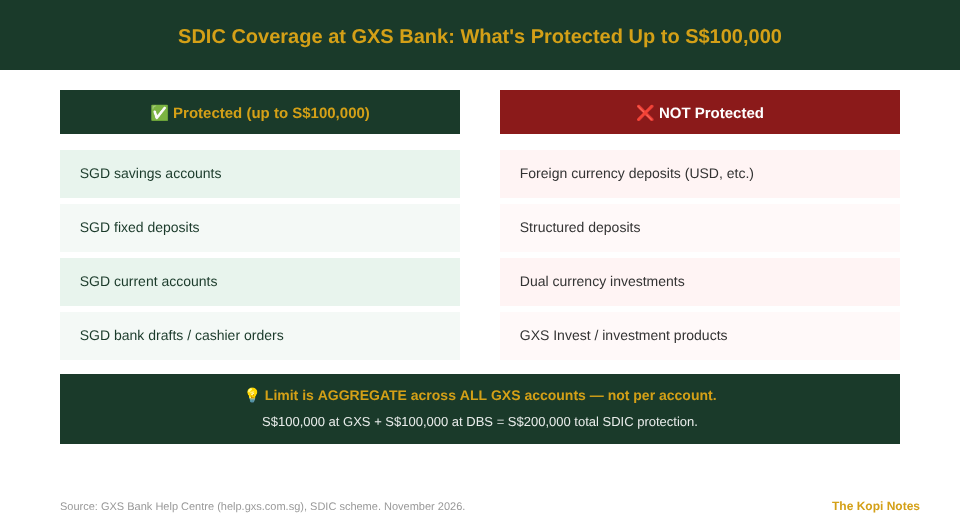
GXS Bank is a full Scheme member of the Singapore Deposit Insurance Corporation (SDIC). This means every eligible Singapore-dollar deposit you hold at GXS Bank is insured up to S$100,000 in aggregate, per depositor, by law.
MAS raised the SDIC coverage limit from S$75,000 to S$100,000 in April 2024, one of the most significant upgrades to depositor protection in Singapore’s history. For more context on how SDIC protection works across digital banks, see our guide on SDIC-insured digital bank options.
| Deposit Type | SDIC Protected at GXS? |
|---|---|
| Singapore-dollar Flex Save account | ✓ Yes, up to S$100,000 aggregate |
| Singapore-dollar Boost Pockets | ✓ Yes, up to S$100,000 aggregate |
| Singapore-dollar fixed deposits | ✓ Yes, up to S$100,000 aggregate |
| Foreign currency deposits (USD, EUR, etc.) | ✗ Not covered |
| Structured deposits | ✗ Not covered |
| Dual currency investments | ✗ Not covered |
| GXS Invest / other investment products | ✗ Not covered (not a deposit) |
Source: GXS Bank Help Centre (help.gxs.com.sg), SDIC scheme. November 2026.
Important: the S$100,000 limit is an aggregate across all your accounts at GXS Bank, not per account. If you have S$60,000 in your Flex Save and S$50,000 in a Boost Pocket, your total at GXS Bank is S$110,000, and only the first S$100,000 is insured. The remaining S$10,000 would be an unsecured claim if GXS Bank were to fail.
The practical implication for most Singaporeans: amounts up to S$100,000 at GXS Bank are as legally protected as the same amount at DBS or UOB. For amounts above S$100,000, spreading across multiple SDIC-member banks is the standard risk management approach. See our digital bank fixed deposit rates guide for how to compare rates across GXS, MariBank, Trust Bank, and traditional banks.
Who Owns GXS Bank? The Grab–Singtel Backing
GXS Bank Pte. Ltd. (UEN: 202005626H) is owned by the Grab–Singtel consortium, two of Southeast Asia’s most recognisable publicly traded companies:
Grab (Nasdaq: GRAB)
Southeast Asia’s leading superapp, ride-hailing, and food delivery platform, operating across eight markets. Grab brought its existing fintech infrastructure — including GrabPay, GrabFinance, and millions of active users — to the GXS venture. Grab is listed on Nasdaq and files audited financial statements with the US Securities and Exchange Commission.
Singtel (SGX: Z74)
Singapore’s largest telecommunications group, with operations across Southeast Asia and Australia. Singtel contributed telco network expertise, regional connectivity, and corporate governance infrastructure. As a SGX-listed company, Singtel files audited financial reports publicly.
Both parent companies are publicly traded, which means their financials are audited and publicly disclosed. Grab has injected additional capital into GXS Bank multiple times since launch, demonstrating ongoing financial commitment to the venture.
Being backed by two listed companies does not automatically guarantee GXS Bank’s safety — the bank stands on its own licence and balance sheet — but it does mean the ownership structure is transparent, subject to public scrutiny, and accountable to shareholders and regulators in multiple jurisdictions.
What Happens If GXS Bank Closes?
This is the question most savers really mean when they ask “is GXS Bank safe?” Here is the step-by-step of what would happen under a worst-case scenario:
Step 1: MAS intervenes first.
Before any bank failure in Singapore reaches insolvency, MAS would likely intervene — through directed merger and acquisition, capital injection facilitation, or placing the bank under judicial management. No Singapore bank has failed to the point of SDIC payout since the scheme was established in 2006. MAS has historically arranged for bank consolidation before depositors were at risk.
Step 2: SDIC takes over.
If MAS intervention is insufficient and the bank becomes insolvent, SDIC would take control. The SDIC scheme is funded by annual premiums paid by all member banks, including GXS Bank. SDIC has a reserve fund for exactly this scenario.
Step 3: SDIC pays out insured deposits.
SDIC would begin paying insured deposits (up to S$100,000 per depositor) as quickly as possible. SDIC has the power to begin partial distributions before the full liquidation process concludes. Your funds would be returned to your registered bank account or NRIC-linked account.
Step 4: Remaining assets distributed.
For amounts above S$100,000, depositors rank as unsecured creditors and would receive a pro-rata share of the remaining assets during the liquidation process — which may be significantly less than the original deposit, and over a longer timeline.
The practical takeaway: for most Singaporeans with under S$100,000 in savings, an GXS Bank failure scenario would result in full recovery of their deposits, backed by law. The SDIC protection at GXS Bank is legally identical to the protection at DBS.
If you are exploring how to structure your savings across multiple banks and digital banks to maximise SDIC coverage, our guide on FSMOne vs GXS covers how complementary platforms can work together.
GXS Bank’s In-App Security Features
Beyond regulation and deposit insurance, GXS Bank has built several app-level security features since its 2022 launch:
Money Lock
Introduced in response to MAS’s anti-scam initiatives, Money Lock allows you to designate a portion of your Flex Save balance as locked. Locked funds cannot be transferred, withdrawn, or moved through any digital channel — unlocking requires a physical visit to a GXS service point. This is specifically designed to protect against scam calls and social engineering attacks where victims are pressured to transfer funds.
Biometric Authentication
Face ID, Touch ID, and device PIN protect app access. All significant transactions require biometric confirmation in addition to the standard 2FA.
Real-Time Transaction Alerts
Every debit or credit triggers an immediate push notification to your registered device. You can temporarily disable outgoing transfers while keeping the account accessible for deposits.
Device Binding
The GXS app can only be active and authenticated on one device at a time. Logging in on a new device requires re-verification of your identity, preventing account takeover via stolen credentials alone.
24/7 Automated Fraud Monitoring
GXS Bank uses automated systems to flag unusual transaction patterns. Suspicious activity can trigger a real-time account freeze, with GXS proactively reaching out to verify transactions.
These features align with MAS’s Technology Risk Management (TRM) Guidelines, which all MAS-licensed banks must follow. For the latest on GXS Bank’s current promotions and rates, see the GXS Bank Holiday Boost for November 2026.
GXS Bank vs Traditional Banks: Safety at a Glance
| Safety Dimension | DBS / OCBC / UOB | GXS Bank | MariBank |
|---|---|---|---|
| MAS Licence Type | Full Bank | Digital Full Bank (DFB) | Digital Full Bank (DFB) |
| SDIC Member? | Yes | Yes | Yes |
| SGD Deposit Insurance | S$100,000 | S$100,000 | S$100,000 |
| Retail Deposit Cap | No cap | S$100,000 | S$100,000 |
| Banking Act Applies? | Yes | Yes | Yes |
| Money Lock Feature | Some (DBS digiVault) | Yes | Check app |
| Physical Branches | Yes | No (digital-only) | No (digital-only) |
| Parent Company Type | Listed SG bank | Grab (Nasdaq) + Singtel (SGX) | Sea Limited (NYSE) |
Source: MAS Financial Institutions Directory, GXS Bank Help Centre, SDIC register. Data as at November 2026. Deposit cap per MAS DFB licence conditions.
The key difference from traditional banks is the retail deposit cap. Digital Full Banks like GXS operate under a cap of S$100,000 per customer as a condition of their DFB licence. This was a risk management measure MAS introduced during the initial rollout of digital banking licences. For amounts above S$100,000, customers are directed to traditional banks.
For a broader comparison of GXS Bank’s savings rates and features, see our complete GXS Bank guide.
The Bottom Line: Is GXS Bank Safe?
Yes — by Singapore’s regulatory standards, GXS Bank is a safe place to keep up to S$100,000 in Singapore-dollar savings. It holds a full MAS licence, is SDIC-insured, is backed by two publicly listed companies, and operates under the same Banking Act that governs DBS and OCBC.
What to keep in mind: GXS Bank is a relatively young bank (launched 2022) compared with decades-old traditional banks. MAS’s DFB deposit cap of S$100,000 is a built-in safeguard, but it also means GXS is not suitable as your only institution if you need to keep more than S$100,000 in a single bank.
If you are considering opening a GXS account, use referral code YONG477 for any available sign-up bonus. Full details on current GXS rates, Boost Pockets, and referral rewards are in our GXS Bank complete guide.
Frequently Asked Questions
Is GXS Bank safe to keep money in?
Is GXS Bank covered by SDIC?
What MAS licence does GXS Bank hold?
Who owns GXS Bank?
What is the SDIC coverage limit for GXS Bank deposits?
What would happen to my money if GXS Bank closed?
Can I trust GXS Bank for my emergency fund?
Is GXS Bank the same as GrabPay?
This article was researched with the help of AI. While we strive to keep all information accurate and up to date, there may be errors. If you notice any discrepancies, please contact us.