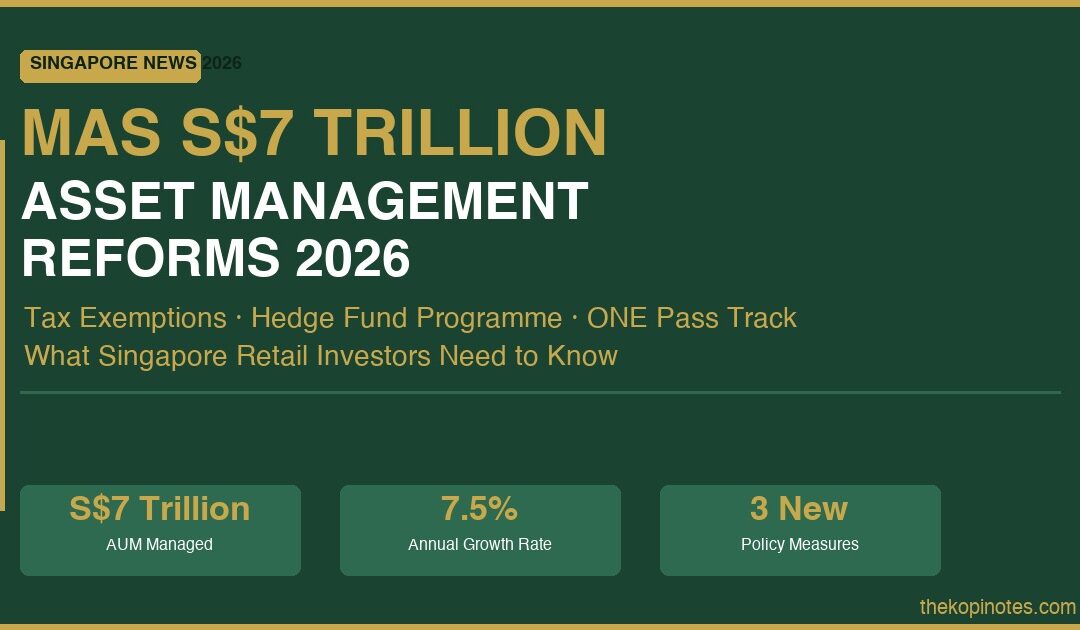
Singapore’s Monetary Authority (MAS) announced three landmark measures on 19 August 2026 to defend the city-state’s position as Asia’s premier asset management hub — covering tax exemptions on carried interest, a new Hedge Fund Investment Programme, and an Investment Management Track under the ONE Pass visa. The reforms target an industry that now manages almost S$7 trillion and employs close to 25,000 people, 80% of them locals. For Singapore retail investors, the changes signal a deeper, more competitive investment ecosystem ahead.
This is an editorial analysis. Not financial advice. Data verified as at 31 August 2026.
Singapore’s S$7 Trillion Asset Management Industry
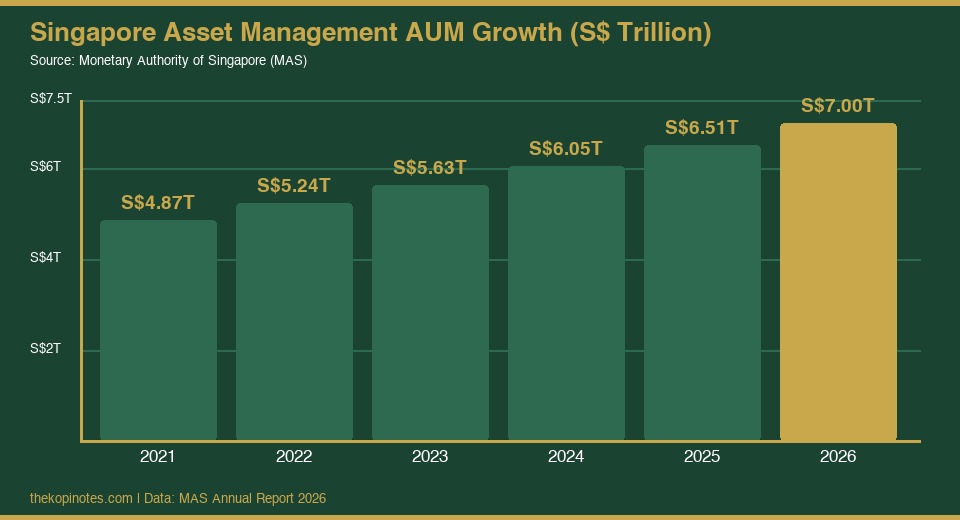
Singapore’s asset management sector has quietly become one of the country’s most important economic pillars. According to MAS, the industry now manages close to S$7 trillion in assets under management (AUM) — a figure that has grown at an average of 7.5% per year over the past five years. To put that in perspective: that’s roughly 13 times Singapore’s entire GDP.
The sector accounts for approximately 15% of the financial sector’s total output and 13% of its employment. With close to 25,000 professionals working in asset management locally — around 80% of whom are Singaporeans or permanent residents — this is an industry that truly matters for local jobs and economic growth.
The problem? Singapore is not the only city competing for fund managers’ attention. Hong Kong, Dubai, and Luxembourg have all been ramping up incentives to attract global asset managers. MAS moved on 19 August 2026 to counter this threat with three concrete measures.
The Three MAS Reforms: A Plain-Language Breakdown
On 19 August 2026, MAS — working alongside the Ministry of Finance (MOF) and Ministry of Manpower (MOM) — announced three measures to anchor high-value asset management activities in Singapore.
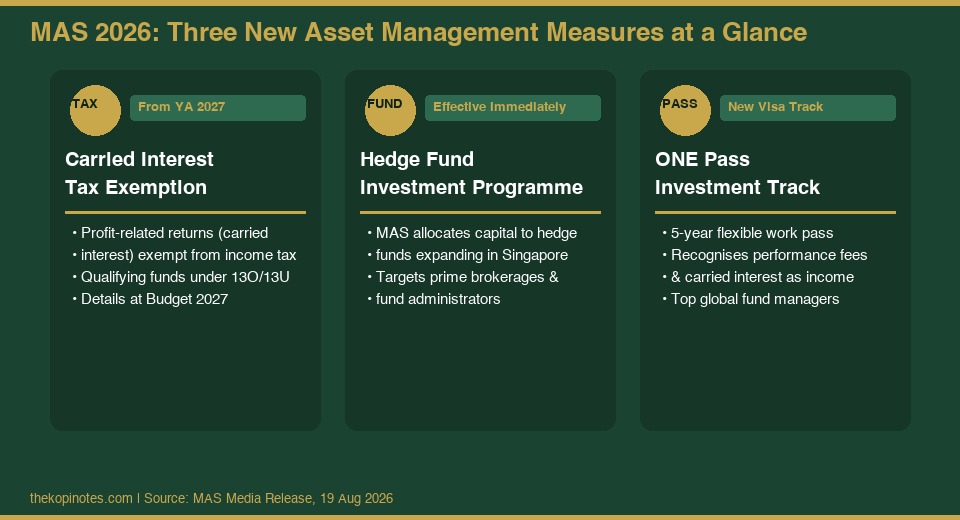
| Measure | Who It Targets | Timeline | Key Benefit |
|---|---|---|---|
| Carried Interest Tax Exemption | Fund managers, investment professionals | YA 2027 | Performance-linked returns exempt from income tax |
| Hedge Fund Investment Programme | Hedge fund managers, prime brokerages | Phased roll-out | MAS allocates direct co-investment capital |
| ONE Pass Investment Management Track | Global investment leaders | Upcoming policy alignment | 5-year flexible pass recognising performance-based pay |
Measure 1: Tax Exemption on Carried Interest
Carried interest is the performance fee structure used by private equity and hedge funds — where fund managers receive a share (typically 20%) of profits above a certain return threshold. Currently, carried interest paid to fund managers in Singapore is subject to standard personal income tax rates, which can reach up to 24% for high earners. The proposed exemption would remove this tax entirely for qualifying carried interest arrangements.
The exemption is expected to take effect from the Year of Assessment (YA) 2027. Full technical guidelines will be released at Budget 2027. To qualify, funds are expected to maintain economic substance in Singapore under the existing Section 13O and 13U tax incentive frameworks.
What it means for retail investors: More fund managers choosing Singapore as their base means more investment products, more competition, and potentially better pricing on investment vehicles available to local investors.
Measure 2: MAS Hedge Fund Investment Programme
MAS will itself invest capital with hedge fund managers that commit to building or expanding their Singapore operations. This is a government-backed seeding programme designed to attract both emerging and established hedge fund names that might otherwise set up in Hong Kong or Dubai.
When hedge funds set up shop locally, they create demand for prime brokerage services, fund administrators, legal advisers, compliance consultants, and technology providers — most of which are Singapore-based firms.
What it means for retail investors: A richer hedge fund ecosystem in Singapore eventually translates into more sophisticated investment products accessible to accredited investors.
Measure 3: ONE Pass Investment Management Track
The ONE Pass — launched in January 2023 — is Singapore’s premium work visa for top global talent. It’s a five-year, flexible pass that allows holders to work for multiple employers simultaneously. Currently, the ONE Pass requires a fixed monthly salary of S$30,000 or more. The problem? Many senior fund managers earn the bulk of their compensation through performance fees and carried interest — not fixed salaries.
The new Investment Management Track addresses this directly. MAS and MOM will refine how compensation is assessed, specifically recognising returns linked to investment performance and fund outcomes as part of the salary calculation.
What it means for retail investors: Better talent in Singapore’s financial ecosystem leads to better-run funds and more innovative investment products.
How This Positions Singapore vs. Hong Kong and Dubai
The timing of these measures is deliberate. Hong Kong has been aggressively marketing its own fund manager incentives, including a Dedicated Fund Manager Programme and its own carried interest concessions. Dubai’s DIFC has similarly been offering zero-tax environments and fast-track residency for fund managers.
Singapore’s response is characteristically pragmatic — rather than racing to zero on taxes, MAS is targeting specific pain points: the tax treatment of performance-linked pay, the availability of seeding capital for new funds, and the work pass framework that had inadvertently excluded top investment talent.
What This Means for Your Investment Portfolio
For most Singapore retail investors — whether you’re building a low-cost ETF portfolio with CSPX or VWRA, maximising your CPF Investment Scheme, or exploring active funds through Endowus — these reforms do not change what you should be doing today.
What these measures do signal is that Singapore’s government is actively investing in the quality and depth of its financial ecosystem. A richer, more competitive asset management industry benefits retail investors in three indirect ways:
- More product choice — as more fund managers establish Singapore operations, expect more locally-domiciled funds and Singapore-listed ETFs to emerge over time.
- Competitive pricing — more competition among fund managers should pressure fees downward over the medium term.
- Market depth — a larger, more active institutional investor base improves market liquidity on the SGX and in Singapore-listed REITs.
Bottom Line for SG Investors
The MAS August 2026 reforms are a significant and well-targeted package to keep Singapore competitive as Asia’s top asset management hub. By addressing three key pain points — tax treatment of carried interest, access to seeding capital for hedge funds, and the work pass framework — MAS has sent a clear signal to global fund managers: Singapore is the place to be.
For retail investors, the direct impact is modest in the short term. But the long-term signal is positive: a deeper, more competitive investment ecosystem in Singapore is good for markets, good for product innovation, and ultimately good for your portfolio.
What did MAS announce on 19 August 2026?
How big is Singapore’s asset management industry in 2026?
What is carried interest and why does the tax exemption matter?
What is the ONE Pass and how does the Investment Management Track change it?
When do the tax exemptions for carried interest take effect?
This article was researched with the help of AI. While we strive to keep all information accurate and up to date, there may be errors. If you notice any discrepancies, please contact us.