Critical Illness Insurance Singapore: The Retrenched Worker’s Complete Guide (2026)
With Q2 2026 retrenchments at a 4-year high, learn how to protect your CI coverage during a job gap — and which plans waive premiums when you lose your job.
Critical illness (CI) insurance pays a lump sum if you are diagnosed with one of the major illnesses covered — typically cancer, heart attack, or stroke. When you are retrenched in Singapore, this coverage becomes even more critical: you lose your employer-provided group insurance, face income disruption, and face higher health risk from prolonged stress. This guide explains how to maintain your CI coverage during retrenchment and which plans offer premium protection features in 2026.
Not financial advice. All figures are for educational reference only. Data verified as at 28 September 2026.
Why Retrenchment Doubles Your CI Risk
Singapore recorded 4,620 retrenchments in Q2 2026 — the highest quarterly figure since Q4 2020, according to the Ministry of Manpower (MOM). Workers in their 50s face the highest retrenchment incidence, followed by those in their 40s. These are precisely the age groups where critical illness incidence rates also climb sharply.
This creates a compounding financial vulnerability. A retrenched worker in their late 40s simultaneously faces loss of employer-sponsored group insurance, income disruption making CI premiums harder to sustain, and elevated health risk — studies link prolonged unemployment with increased cardiovascular and oncological risk from chronic stress.
The “Big 3” critical illnesses — cancer, heart attack, and stroke — account for more than 90% of all CI claims in Singapore, according to the Life Insurance Association (LIA). Cancer alone accounts for 26.5% of all deaths in Singapore, and approximately 1 in 4 to 5 Singaporeans will be diagnosed with a critical illness at some point in their lifetime.
| Indicator | Figure | Source |
|---|---|---|
| Q2 2026 Retrenchments | 4,620 | MOM Sep 2026 |
| Retrenchment rate per 1,000 employees | 2.0 | MOM Q2 2026 |
| Age group with highest retrenchment incidence | 50s (then 40s) | MOM Q2 2026 |
| Big 3 CI claims share | Over 90% | LIA Singapore |
| Cancer share of all deaths | 26.5% | MOH Singapore |
| Lifetime CI diagnosis probability | 1 in 4 to 5 Singaporeans | LIA Singapore |
Source: Ministry of Manpower (MOM) Q2 2026 Labour Market Report; Life Insurance Association (LIA) Singapore; Ministry of Health (MOH) Singapore.
The financial stakes are clear: if you are diagnosed with cancer during unemployment, you face medical costs with no income, no group insurance, and potentially a lapsed CI policy. The lump-sum payout from a CI policy — typically S$100,000 to S$300,000 — is the financial buffer that prevents this from becoming a crisis.
What Happens to Your CI Policy When Retrenched?
Your individual CI policy is not tied to your employment status. A standalone CI plan or whole life plan with a CI rider continues as long as you keep paying the premiums. The risks during retrenchment come from three sources:
1. Premium cashflow strain. Without a salary, maintaining monthly CI premiums from savings or severance puts pressure on household finances. For a 45-year-old male non-smoker, a S$200,000 standalone CI policy may cost S$150 to S$300 per month depending on the plan. This is often the first expense cut in a financial squeeze — and one of the most dangerous decisions.
2. Group insurance lapse. Most employers provide group CI or group hospital insurance as a benefit. This terminates on your last day of employment. If you relied entirely on group coverage with no individual CI policy, you become uninsured immediately upon retrenchment.
3. Reinstatement difficulty. If premiums lapse and the policy terminates, reinstatement requires a fresh health declaration and new underwriting. Conditions that developed during the lapsed period may be excluded or attract higher premiums — making a lapsed policy far harder to restore than the original purchase.
For a detailed breakdown of what CI policies pay and when, see our guide on how CI insurance payouts work in Singapore — including the difference between severe-stage and early-stage claims.
CI Plans With Retrenchment Protection Features (2026)
Several insurers offer specific provisions that protect policyholders during involuntary retrenchment. These fall into two categories: premium deferral options and waiver-of-premium riders.
Premium Deferral: The insurer allows you to pause premium payments for up to 12 months without the policy lapsing. Deferred premiums are typically recovered through future payments or at claim time. AIA Guaranteed Protect Plus (IV) is the main plan offering this as a built-in feature for involuntary retrenchment.
Retrenchment Waiver of Premium Rider: Since April 2026, this rider class waives rider premiums for 12 months if you are involuntarily retrenched and remain unemployed for 6 or more consecutive months.
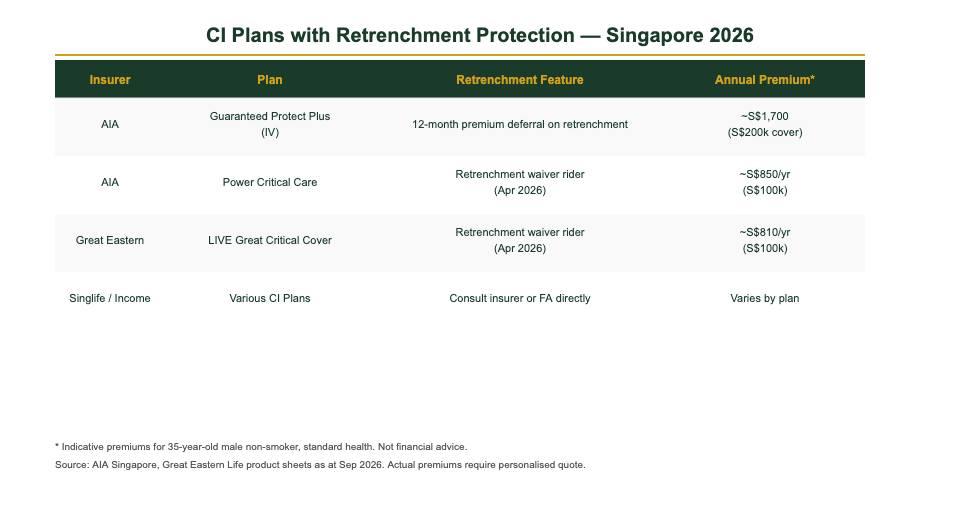
| Insurer | Plan | Retrenchment Feature | Indicative Annual Premium (35M NS S$100k) |
|---|---|---|---|
| AIA | Guaranteed Protect Plus (IV) | 12-month premium deferral on involuntary retrenchment | Request quote (whole life + CI rider) |
| AIA | Power Critical Care | Retrenchment waiver rider available from Apr 2026 | ~S$850/year |
| Great Eastern | LIVE Great Critical Cover | Retrenchment waiver rider available from Apr 2026 | ~S$810/year |
| Singlife / Income | Various CI Plans | Check with insurer or licensed financial adviser | Varies by plan |
Source: AIA Singapore, Great Eastern Life product sheets, insurer websites as at Sep 2026. Premiums are indicative for a 35-year-old male non-smoker with S$100,000 sum assured. Actual premiums depend on age, health, coverage term, and plan features. Always request a personalised quote from a licensed FA.
For a full comparison of CI plans including coverage terms and exclusions, see our best critical illness insurance Singapore guide.
How Much CI Coverage Do You Need While Unemployed?
The standard guideline used by financial advisers in Singapore is to hold CI coverage equivalent to 3 to 5 years of annual income. During retrenchment, your income is temporarily zero but your living expenses continue. Size your CI coverage based on these three factors:
- Replace 3 to 5 years of household expenses: A household spending S$5,000 per month needs at least S$180,000 to S$300,000 in CI coverage. Use monthly expenses — not your previous salary — as the benchmark during unemployment.
- Cover medical treatment costs independently: Early-stage cancer treatment in Singapore can cost S$80,000 to S$150,000 before MediShield Life and your Integrated Shield Plan (ISP) apply. Late-stage treatment regularly exceeds S$200,000. Your CI lump sum should bridge gaps not covered by your ISP.
- Factor in the extended gap period: CI recovery typically takes 6 to 24 months before a person can return to work. If you are already 3 to 6 months into a job search, your total income-replacement need could extend to 5 to 7 years.
Use our Singapore retirement planning calculator to factor CI coverage into your overall financial resilience plan. During retrenchment, recalculate coverage needs based on household expenses rather than your previous salary.
If you transition to self-employment or freelance work after retrenchment, your CI gap typically widens. The CI insurance guide for the self-employed in Singapore explains this in detail.
5-Step Action Plan: What to Do If You Are Retrenched Today
If you have just been retrenched or expect to be, take these steps in the first 30 days to protect your CI coverage and minimise uninsured risk.
Step 1: Audit all your CI policies. List every CI policy you hold — standalone CI, whole life with CI rider, early CI riders, and employer group policies. Note premium due dates, sum assured amounts, and whether each policy is individual or employer-sponsored.
Step 2: Contact your insurer or financial adviser within the first week. Ask specifically about premium deferral options, retrenchment waiver riders, and any hardship assistance programmes. Insurers are substantially more accommodating when you contact them proactively rather than after a missed payment.
Step 3: Do not let your CI policy lapse. This is the single most costly mistake retrenched workers make. A lapsed CI policy reinstated after a diagnosis cannot cover that condition. Prioritise CI premiums alongside housing and utilities — before discretionary spending.
Step 4: Reduce coverage strategically if cashflow demands it. Work with your FA to reduce the sum assured temporarily rather than cancelling the policy entirely. Some plans allow partial sum assured reduction without requiring a new health declaration.
Step 5: Maintain a 6-month premium reserve in liquid assets. If you invest via Endowus or similar platforms, keep a minimum 6-month premium reserve in a liquid, low-risk fund to eliminate lapse risk during a prolonged job search.
Frequently Asked Questions
Does my CI insurance continue when I am retrenched in Singapore?
Can I defer CI insurance premiums if I lose my job?
What happens if I let my CI policy lapse during retrenchment?
How much CI insurance should I hold while unemployed?
Is CI insurance worth maintaining if I need to cut costs after retrenchment?
Can I apply for new CI insurance while unemployed in Singapore?
What critical illnesses are covered under Singapore CI policies in 2026?
Get Free Insurance Advice
Speak with a licensed insurance advisor. No obligation, no cost.
By submitting this form, you agree to our Privacy Policy.
This article was researched with the help of AI. While we strive to keep all information accurate and up to date, there may be errors. If you notice any discrepancies, please contact us.