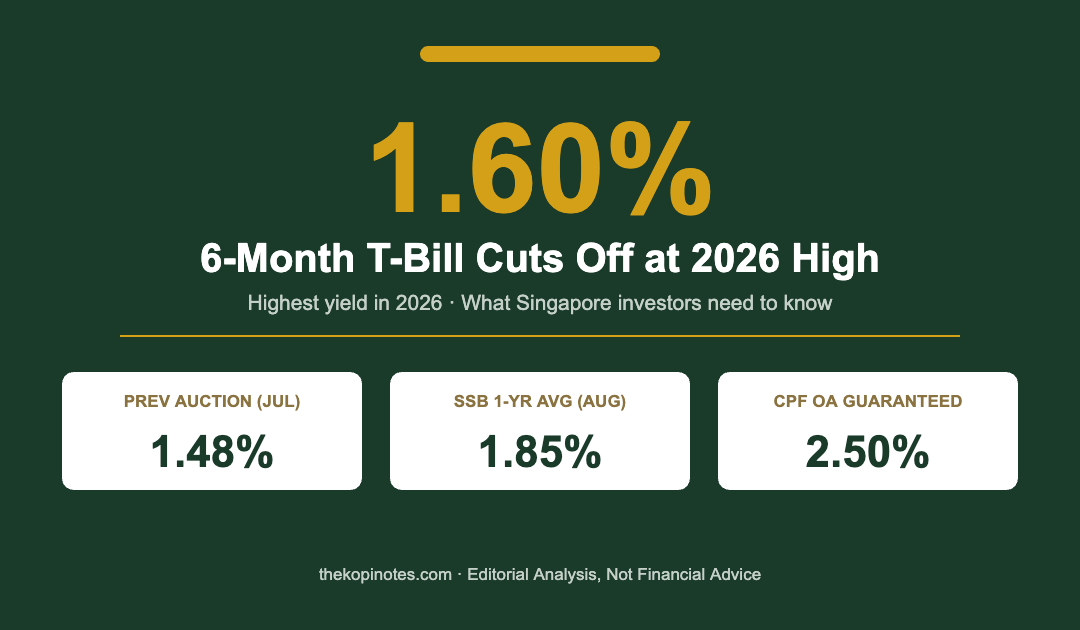
Singapore’s 6-month Treasury bill cut-off yield jumped to 1.60% at the August 27, 2026 auction — the highest reading so far this year. For anyone parking cash in T-bills, SSBs, or high-yield savings accounts, this matters. Here’s what the latest auction tells us, and what you should do next with your idle money.
What Happened at the August 27 Auction?
The Monetary Authority of Singapore (MAS) conducted a 6-month T-bill auction on August 27, 2026, with a total issue size of S$6.5 billion. The cut-off yield settled at 1.60% per annum — the highest since December 2025. Applications came in at a total of S$14.2 billion, translating to a bid-to-cover ratio of roughly 2.18x, reflecting continued robust demand from retail and institutional investors alike.
This is a meaningful uptick from the 1.48% recorded in the July 2026 auction, and marks a clear break above the 1.50% ceiling that had capped yields for most of Q1 and Q2 2026. The sharp re-rating reflects evolving expectations around global rate trajectories, with markets re-pricing the timing and pace of any potential Fed pivot following mixed US labour data released earlier in August.
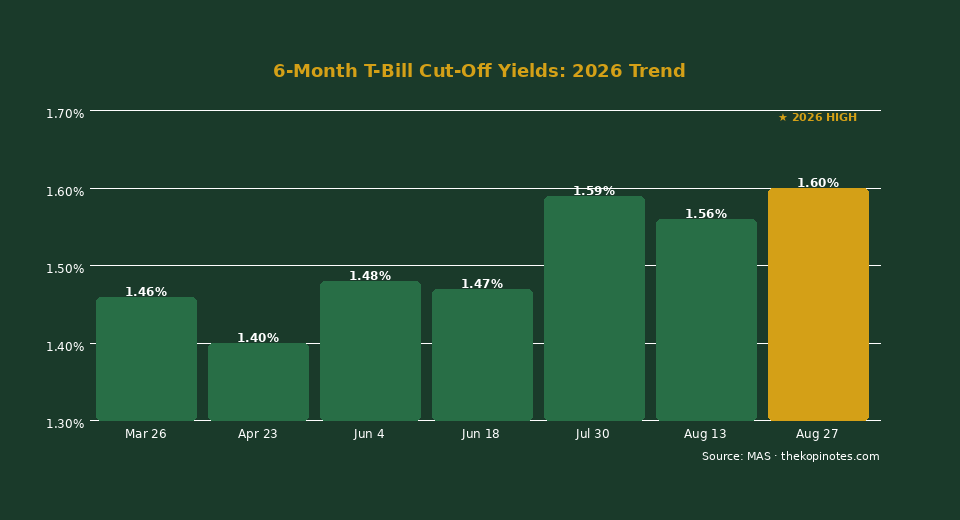
Why Did Yields Jump to 1.60%?
Several converging factors pushed yields higher this auction cycle:
Global rate recalibration. Despite earlier hopes of a US Federal Reserve rate cut in September, the August US Non-Farm Payrolls report printed stronger than expected at 215,000 jobs added. This delayed market expectations of a cut to Q4 at the earliest, keeping short-term US Treasury yields elevated — and Singapore T-bill yields typically shadow these moves.
SGD SORA (Singapore Overnight Rate Average) remains sticky. The 3-month compounded SORA averaged 2.31% through mid-August 2026 — still elevated relative to 2024 levels. As T-bill yields are anchored partly to SORA dynamics, any persistence in SORA above 2% provides a floor for T-bill cut-off rates.
Less competition from SSBs. The August 2026 Singapore Savings Bond offered a 1-year average return of 1.85%, attracting a large chunk of retail money. With SSBs offering better longer-term rates, some institutional and corporate cash shifted back toward T-bills for shorter duration, keeping bids competitive and pushing the cut-off higher.
T-Bill vs SSB vs HYSA: Where Should You Park Your Cash?
At 1.60%, T-bills are competitive — but they’re not the only game in town. Here’s how the current rates stack up across popular cash management options for Singapore investors:
| Product | Rate if you do nothing | Best achievable | What the best rate requires |
|---|---|---|---|
| 6-Month T-Bill | 1.60% p.a. | 1.60% | Hold to maturity; 6-month tenure |
| Singapore Savings Bond | 1.85% (1-yr avg) | Rises with each year held | Redeemable monthly without penalty |
| DBS Multiplier | Low base tier | Up to 4.10% | Salary credit plus eligible transactions |
| UOB One Account | Low base tier | Up to 3.85% | Min S$500/month card spend plus salary credit |
| OCBC 360 | Low base tier | Up to 4.05% | Several bonus categories must be met |
| GXS Savings | 0.88% (Main Account) | 1.75% (12-month Boost Pocket) | Lock-in required for bonus; S$95,000 account limit |
| MariBank | 0.88% on all balances | Up to 3.08% (promotional) | Promotion terms apply; base rate is 0.88% |
| Syfe Cash+ Guaranteed | 1.25% guaranteed | 1.25% | 1, 3 or 6-month terms |
| Syfe Cash+ Flexi | ~1.6% projected (net) | ~1.6% | Not capital guaranteed; T+1 liquidity |
| Syfe Cash+ Enhanced | ~3.0% projected (net) | ~3.0% | Not capital guaranteed; higher risk |
| Endowus Cash Smart | 1.2%–2.4% (net) | 2.4% | Not capital guaranteed; T+2 liquidity |
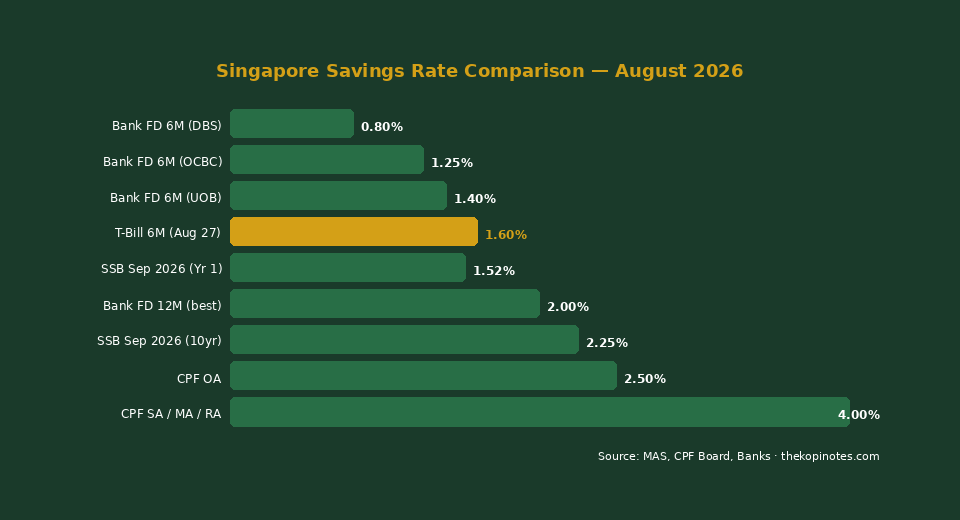
The headline takeaway: T-bills still make sense for risk-free, guaranteed returns over a 6-month horizon — and at 1.60% they currently beat the unconditional rates of both major digital banks, since GXS and MariBank each pay 0.88% on ordinary balances. Bonus savings accounts such as DBS Multiplier and OCBC 360 can beat T-bills substantially, but only if you meet their salary-credit and spending criteria. If you don’t meet them, the advertised “up to” rate is not the rate you get.
How to Apply for T-Bills in Singapore
If you’re ready to participate in upcoming T-bill auctions, the process is straightforward for Singapore residents:
Via internet banking (DBS/POSB, OCBC, UOB): Log in to your bank’s internet banking portal, navigate to “Investments” or “Government Securities,” and submit a non-competitive bid. Non-competitive bidders receive the cut-off yield regardless of how high or low the auction clears — ideal for retail investors who don’t want to guess the rate.
Via ATM: DBS/POSB ATMs allow T-bill applications linked to your CDP account. This is less common today as most investors prefer internet banking, but it remains a valid option.
Using CPF-OA funds: You can apply for T-bills using your CPF Ordinary Account funds (via CPFIS). The CPF-OA currently earns 2.5% p.a. guaranteed — meaning T-bills at 1.60% are not better than keeping money in CPF-OA. Do not use CPF-OA funds for T-bills at current rates. For more on this, read our guide on CPFIS investing.
Using SRS funds: Supplementary Retirement Scheme (SRS) funds can also be used to buy T-bills. Given the SRS earns just 0.05% in the default SRS bank account, T-bills at 1.60% represent a significant improvement. Learn more in our SRS account guide.
What’s the Outlook for T-Bill Yields?
The direction of T-bill yields for the rest of 2026 depends heavily on two variables: US Fed policy and MAS’s exchange rate management stance.
Current market consensus (as of late August 2026) expects one US Fed cut of 25bps by December 2026. If that materialises, Singapore T-bill yields could ease modestly to the 1.40%–1.50% range by year-end. However, if inflation data surprises to the upside or employment remains robust, the cut could be deferred to 2027 — keeping T-bill yields elevated or even pushing them slightly higher.
MAS’s semi-annual policy meeting (October 2026) is also a key watch point. Any adjustment to the SGD NEER policy band — either a further tightening or a slight easing — would flow through to SORA and, by extension, T-bill cut-off rates.
Bottom line for planning purposes: if rates hold near current levels, locking in 6-month T-bills now secures 1.60% through February 2027. That’s a reasonable proposition for emergency fund cash or money you don’t need in the near term.
The Bottom Line
The August 27 T-bill auction clearing at 1.60% is a healthy signal for Singapore savers. Yields are the highest in 2026, and even if they drift down later in the year, current rates offer competitive, risk-free returns for 6-month money. The decision of T-bills versus alternatives depends on your eligibility for bonus rates on HYSA accounts, your investment horizon, and whether you’re using cash, CPF, or SRS funds.
For most retail investors who don’t qualify for the full DBS Multiplier or OCBC 360 bonus tiers, T-bills at 1.60% comfortably beat leaving cash in a digital bank’s base account — while a GXS or MariBank account still earns its keep for the portion you need instantly liquid. Check our complete Singapore T-bills guide for step-by-step instructions and upcoming auction dates.
Frequently Asked Questions (FAQ)
What was the T-bill cut-off yield on August 27, 2026?
The 6-month Singapore T-bill auction on August 27, 2026 cleared at a cut-off yield of 1.60% per annum — the highest yield recorded so far in 2026.
Should I use my CPF-OA to buy T-bills at 1.60%?
No. CPF-OA already earns a guaranteed 2.5% p.a., which is higher than the current T-bill rate of 1.60%. Using CPF-OA funds for T-bills would result in a lower return. Only consider CPFIS T-bill purchases when T-bill yields exceed 2.5%.
When is the next Singapore T-bill auction?
6-month T-bill auctions are held roughly every two weeks. The next auction after August 27, 2026 is typically scheduled for mid-September 2026. Check the MAS auction calendar for exact dates.
Is a 1.60% T-bill yield good compared to savings accounts?
It depends on your situation. T-bills offer guaranteed, unconditional returns at 1.60%, making them attractive versus standard savings rates. However, bonus savings accounts (DBS Multiplier, OCBC 360, UOB One) can offer 3.5%–4.1% if you meet spending and salary credit criteria. Digital banks are often assumed to beat T-bills, but their unconditional rates do not: GXS pays 0.88% on its Main Account (rising to 1.75% only if you lock funds into a 12-month Boost Pocket), and MariBank pays 0.88% on all balances, with higher headline rates available only under time-limited promotions.
Can I sell T-bills before maturity?
Yes, but T-bills are not easily liquidated at face value before maturity. You can sell them on the secondary market through MAS’s bond platform, but prices fluctuate with interest rates. For money you may need before 6 months, a high-yield savings account or money market fund with daily liquidity may be more appropriate.
This article was researched with the help of AI. While we strive to keep all information accurate and up to date, there may be errors. If you notice any discrepancies, please contact us.