Nasdaq 100 ETF Singapore: How to Buy EQQQ on the LSE (2026 Guide)
A complete Singapore investor’s guide to EQQQ and its accumulating alternative — tax advantages, step-by-step broker instructions, and 2026 data.
EQQQ is an Ireland-domiciled ETF listed on the London Stock Exchange (LSE) that tracks the Nasdaq-100 index. You buy it through brokers like Interactive Brokers, Saxo, or moomoo. Versus a US-listed Nasdaq-100 fund like QQQ, EQQQ charges 15% withholding tax on dividends instead of 30%, and it carries no US estate tax exposure above USD 60,000.
Not financial advice. All figures are for educational reference only. Data verified as at 30 August 2026 unless noted.
- EQQQ (LSE) tracks the Nasdaq-100, charges a 0.30% TER, and pays out dividends quarterly.
- You pay 15% US withholding tax on EQQQ’s dividends, not 30% — that’s the whole reason SG investors use the LSE listing instead of the US one.
- Prefer no dividend paperwork? The Xtrackers Nasdaq 100 UCITS ETF (XNAS/XNAQ) does the same job but reinvests everything automatically.
Table of Contents
Contents — Click to expand
What Is EQQQ?
EQQQ is the common name for the Invesco EQQQ Nasdaq-100 UCITS ETF (ISIN IE0032077012), which has traded on the London Stock Exchange since December 2002. That makes it one of the oldest Nasdaq-100 trackers in Europe — older than most of the thematic tech ETFs already covered on this site.
The fund holds 104 stocks and uses physical replication. That means it buys the actual Nasdaq-100 companies — Nvidia, Apple, Microsoft, Amazon, and so on — rather than using a swap contract to copy the index’s return. It’s domiciled in Ireland, distributes income quarterly (rather than reinvesting it for you), and reports its net asset value in USD even though it trades on the LSE.
Here’s the distinction that matters for you: the Nasdaq-100 is not the same as the Nasdaq Composite. It only includes the 100 largest non-financial companies listed on the Nasdaq exchange. In practice, that skews the index heavily toward technology — IT alone makes up 57.9% of EQQQ’s sector weighting, with Communication Services (13.7%) and Consumer Discretionary (11.2%) rounding out the top three.
Key Facts at a Glance
| Metric | Detail |
|---|---|
| Full Name | Invesco EQQQ Nasdaq-100 UCITS ETF |
| ISIN | IE0032077012 |
| Index Tracked | Nasdaq-100 |
| Domicile | Ireland |
| Structure | Distributing (quarterly) |
| TER (Ongoing Charge) | 0.30% p.a. |
| Fund Size (AUM) | USD 19.3 billion (as at 31 Jul 2026) |
| Number of Holdings | 104 |
| Currency | USD |
Source: Invesco EQQQ Nasdaq-100 UCITS ETF official factsheet, 31 July 2026.
Why the Nasdaq 100 Is Trending in 2026
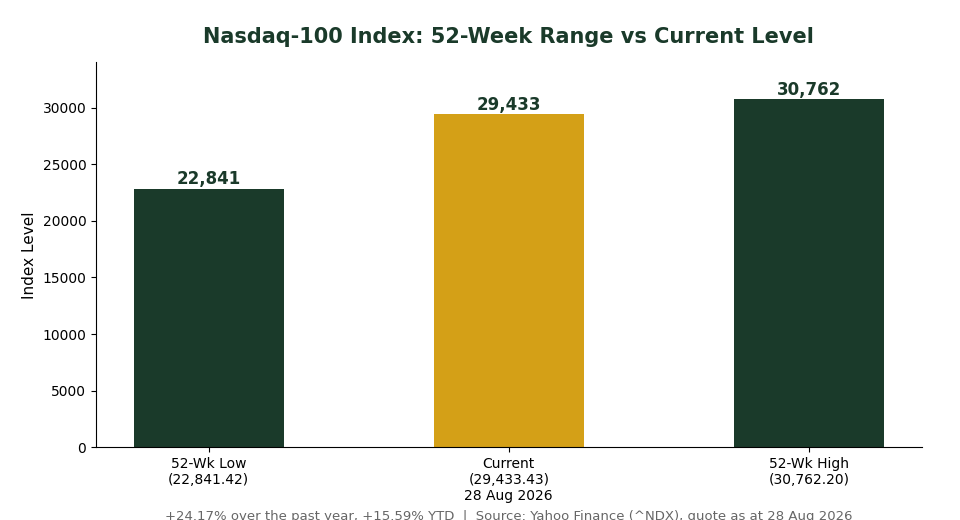
The Nasdaq-100 closed at 29,433.43 on 28 August 2026, up 24.17% over the past year and 15.59% year-to-date, according to live index data. That’s roughly 4.3% below its 52-week high of 30,762.20 — the index has spent much of August 2026 near record territory, not just recovering toward it.
The immediate trigger was Nvidia’s earnings on 26 August 2026. Nvidia guided for roughly 70% revenue growth in its next fiscal year, and the stock posted its biggest single-day gain since April 2025 — adding around USD 442 billion in market value in one session, according to Bloomberg. Nvidia’s plan to invest up to USD 100 billion in OpenAI added further fuel. Salesforce and CrowdStrike also beat guidance the same week, which broadened the rally beyond just chipmakers, according to Bloomberg’s markets coverage of the earnings reaction.
This is the third major AI-driven rally EQQQ holders have ridden through in three years, following similar moves after Nvidia’s 2023 and 2024 earnings beats. The pattern is worth noting precisely because it’s a pattern: a handful of earnings reports from a handful of companies can move the entire index. That’s the nature of a 104-stock, tech-heavy benchmark — it doesn’t average out concentration the way a 500-stock index does.
A second tailwind sits on the calendar: markets are widely expecting the Fed’s first rate cut of the cycle at the 17–18 September 2026 FOMC meeting. That said, this isn’t settled — some commentary flags hawkish risk tied to energy prices, so treat a September cut as likely, not guaranteed, when you’re positioning around it.
For you, the practical takeaway isn’t “buy because it’s going up.” It’s that EQQQ concentrates your exposure in exactly the handful of mega-cap tech names driving this move — which cuts both ways, as the concentration section below explains.
Why Singapore Investors Buy It on the LSE, Not the US
You could buy QQQ, the US-listed Nasdaq-100 ETF, directly on Nasdaq. Many Singapore investors do. But as a non-US person, that choice carries two costs that EQQQ avoids.
First, withholding tax (WHT) — the tax the US government takes off dividends before they reach you. US-domiciled ETFs like QQQ withhold 30% from dividends paid to non-US investors. EQQQ, because it’s domiciled in Ireland, benefits from the US-Ireland tax treaty and only withholds 15% at the fund level. On a fund yielding a modest 0.24% (EQQQ’s current distribution yield), that difference is small in dollar terms today — but it compounds, and it matters more for higher-yielding holdings in your broader portfolio.
Second, US estate tax. If you hold US-situated assets — including US-domiciled ETF shares — above USD 60,000 at your death, your estate can owe US estate tax of up to 40% on the excess. This applies to non-US persons too. An Ireland-domiciled fund like EQQQ isn’t a US-situs asset, so it sits outside this exposure entirely, regardless of your account size. If you’re unfamiliar with how this threshold works, our guide to why Singapore investors buy ETFs on the London Stock Exchange covers it in more detail, alongside the CSPX and VWRA cases.
| ETF Type | Domicile | US Dividend WHT | US Estate Tax Risk |
|---|---|---|---|
| EQQQ (LSE) | Ireland | 15% | None |
| QQQ (Nasdaq) | USA | 30% | Yes (above USD 60k) |
Source: SSGA “Considerations for non-US investors: US-domiciled ETFs vs. Irish-domiciled UCITS ETFs,” June 2026; Revenue Ireland CAT exemption (s.75 CATCA 2003) via Bogleheads wiki summary.
Expense Ratio and Total Costs
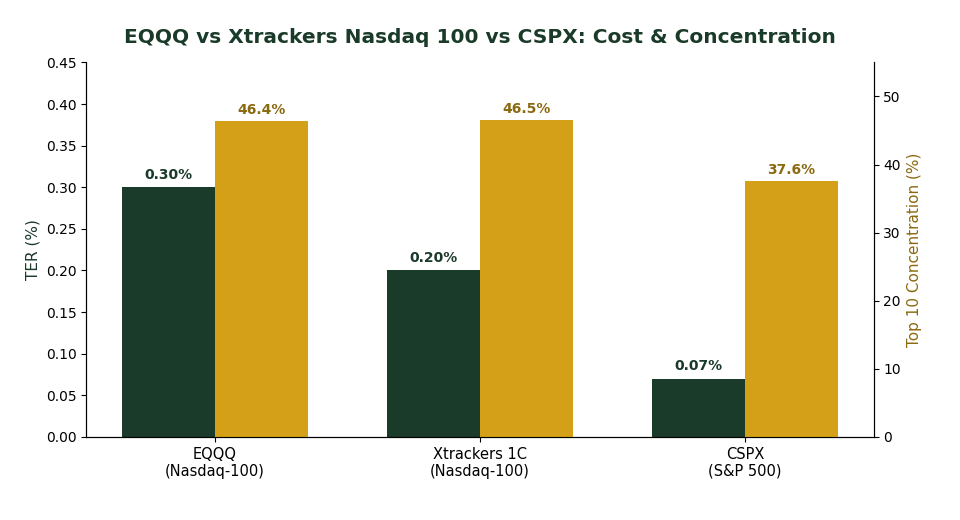
EQQQ’s TER is 0.30% a year. That’s higher than CSPX’s 0.07%, and it’s the price of concentrated Nasdaq-100 exposure rather than the broader, cheaper-to-run S&P 500. On a SGD 50,000 position, 0.30% works out to roughly SGD 150 a year in fund-level fees — deducted automatically from the fund’s NAV, so you never see a separate bill.
Don’t just compare TERs in isolation, though. QQQ’s US TER is lower on paper (around 0.20%), but the 30% dividend WHT usually erodes more of your net return than EQQQ’s extra 0.10% TER plus 15% WHT combined, especially as your holding grows. The two costs need to be weighed together, not separately.
EQQQ vs the Accumulating Alternative vs CSPX
EQQQ pays dividends out quarterly, which means a small amount of paperwork and, depending on your setup, a taxable event outside Singapore in some cases. If you’d rather the fund reinvest everything automatically, the Xtrackers Nasdaq 100 UCITS ETF 1C (LSE tickers XNAS in USD, XNAQ in GBP; ISIN IE00BMFKG444) tracks the same index, costs less at 0.20% TER, and accumulates instead of distributing.
It’s also worth sizing EQQQ against CSPX, since both are common LSE building blocks for Singapore portfolios. The Nasdaq-100’s tech concentration is the key difference: EQQQ’s top 10 holdings make up roughly 46.4% of the fund, versus 37.56% for CSPX’s top 10. Fewer, larger bets — that’s the tradeoff you’re making by choosing EQQQ over a broader S&P 500 fund.
| ETF | TER | Index | Structure | Holdings | Top 10 % |
|---|---|---|---|---|---|
| EQQQ (LSE) | 0.30% | Nasdaq-100 | Distributing | 104 | ~46.4% |
| Xtrackers Nasdaq 100 1C (XNAS/XNAQ) | 0.20% | Nasdaq-100 | Accumulating | 100 | ~46.5% |
| CSPX (LSE) | 0.07% | S&P 500 | Accumulating | 504 | 37.56% |
Source: Invesco EQQQ factsheet (31 Jul 2026), Xtrackers/DWS factsheet (31 Jul 2026), iShares CSPX factsheet (31 Jul / 7 Aug 2026). Top 10% figures summed from each factsheet’s individually listed holding weights.
If you already hold CSPX or a global fund like VWRA, adding EQQQ on top increases your overlap with the same mega-cap tech names both funds already hold heavily — it’s a concentration decision, not pure diversification. Investors who specifically want more exposure to the AI capex trade sometimes pair EQQQ with a name like our semiconductor ETF guide, though that only compounds the concentration further.
How to Buy EQQQ in Singapore (Step-by-Step)
All four platforms below let you buy EQQQ on the LSE. The steps are broadly the same across each: fund your account, search the ticker on the LSE listing, and place your order in USD or GBP.
Interactive Brokers (IBKR): Fund your account via bank transfer, search “EQQQ” in the order entry screen, select the LSE exchange (IBKR usually defaults to the USD-quoted line), and place a limit order. IBKR’s commissions and FX spreads are typically the lowest of the four, which matters most once your position gets into the tens of thousands of SGD.
Saxo Markets: Similar flow — fund your account, search EQQQ, confirm you’re viewing the London listing, and buy. Saxo’s platform fee (custody) applies on top of the trade commission, so factor that into your total cost if EQQQ is a smaller slice of a larger multi-asset account.
moomoo Singapore: moomoo has added more LSE-listed ETFs over time, but always confirm EQQQ is tradable on your account tier before funding — not every LSE ticker is available to every user. Our moomoo Singapore review covers current fee tiers and what’s tradable.
Syfe Brokerage: The simplest option if you’re new to LSE-listed ETFs — Syfe’s brokerage interface is built for retail investors and doesn’t require you to manually select an exchange the way IBKR does. Check current promotions via our Syfe referral code and sign-up bonus page.
Whichever platform you use, place limit orders rather than market orders on LSE-listed ETFs — liquidity is thinner outside London trading hours (which fall in the evening/night for Singapore), so a market order placed at an odd hour can fill at a worse price than you’d expect.
Who Should Buy EQQQ?
EQQQ suits you if you already hold a core S&P 500 or global fund and specifically want to overweight large-cap tech — you understand you’re adding concentration risk, not removing it, and you’re comfortable with a fund that can swing harder than CSPX or VWRA in either direction.
Consider skipping it, or keeping the position small, if you’re building your very first ETF holding, if concentration in a handful of mega-cap names already makes up a large share of your portfolio through CSPX or VWRA, or if you’re investing money you’ll need within the next few years — the Nasdaq-100’s history includes sharper drawdowns than the broader market, notably in 2000-2002 and 2022.
Here’s a concrete way to size the decision: say you hold SGD 80,000 in CSPX already and are weighing whether to add SGD 20,000 into EQQQ. Because both funds already overlap heavily in Nvidia, Apple, Microsoft, and a handful of other names, your combined portfolio’s exposure to those top holdings would rise by more than the simple 20% allocation suggests — Nvidia alone could end up representing 7-8% of your total equity holdings once you account for its weight in both funds. That’s not necessarily wrong, but it’s worth doing the sum before you click buy, rather than after.
Note that EQQQ, like other LSE-listed UCITS ETFs, isn’t CPF-investable. If you’re routing retirement money through CPF or SRS, check our CPF investment strategy guide and run your numbers through the Singapore retirement calculator before deciding how large a slice of your total portfolio a single-sector-tilted fund like this should be.
Disclaimer: This article is for educational purposes only and does not constitute financial or tax advice. ETF prices, index levels, and fund data can change quickly — verify current figures directly with the fund provider before investing. Consult a licensed financial adviser for advice specific to your situation.
Frequently Asked Questions
What is EQQQ and why do Singapore investors buy it?
EQQQ is the Invesco EQQQ Nasdaq-100 UCITS ETF, an Ireland-domiciled fund listed on the London Stock Exchange that tracks the 100 largest non-financial companies on the Nasdaq. Singapore investors buy the LSE listing instead of a US-listed Nasdaq-100 fund because it charges 15% US dividend withholding tax instead of 30%, and it carries no US estate tax exposure.
Is EQQQ the same as QQQ?
They track the same Nasdaq-100 index, but they’re not the same fund. QQQ is US-domiciled and trades on Nasdaq; EQQQ is Ireland-domiciled and trades on the LSE. For a non-US investor, EQQQ’s tax treatment is generally more favourable, though its TER (0.30%) is higher than QQQ’s typical US TER.
Can I buy EQQQ using my CPF or SRS funds?
You cannot buy EQQQ with CPF Ordinary Account funds — LSE-listed UCITS ETFs are not on the CPF Investment Scheme’s approved list. SRS funds can be used if your brokerage supports SRS-funded trades on foreign exchanges; check with your specific broker, as this varies by platform.
Which broker is best for buying EQQQ in Singapore?
Interactive Brokers typically offers the lowest commissions and FX spreads for LSE-listed ETFs, making it cost-effective for larger positions. Syfe Brokerage is simpler for first-time LSE investors since it doesn’t require manually selecting an exchange. Saxo and moomoo also support EQQQ, though fee structures and available tickers vary — always confirm before funding your account.
Is EQQQ riskier than CSPX?
EQQQ is more concentrated than CSPX — its top 10 holdings make up around 46.4% of the fund versus 37.56% for CSPX, and it holds 104 stocks against CSPX’s 504. That concentration in large-cap tech names means EQQQ can rise or fall more sharply than the broader S&P 500, including during tech-specific downturns like 2000-2002 and 2022.
Should I choose the distributing EQQQ or an accumulating Nasdaq-100 ETF?
Choose EQQQ if you want quarterly cash payouts you can reinvest yourself or use as income. Choose an accumulating alternative like the Xtrackers Nasdaq 100 UCITS ETF (XNAS/XNAQ) if you’d rather the fund reinvest dividends automatically — it also carries a lower 0.20% TER, versus EQQQ’s 0.30%.
Ready to Start Investing in ETFs?
Open a brokerage account and buy your first ETF today. Use our referral links for exclusive sign-up bonuses.
This article was researched with the help of AI. While we strive to keep all information accurate and up to date, there may be errors. If you notice any discrepancies, please contact us.