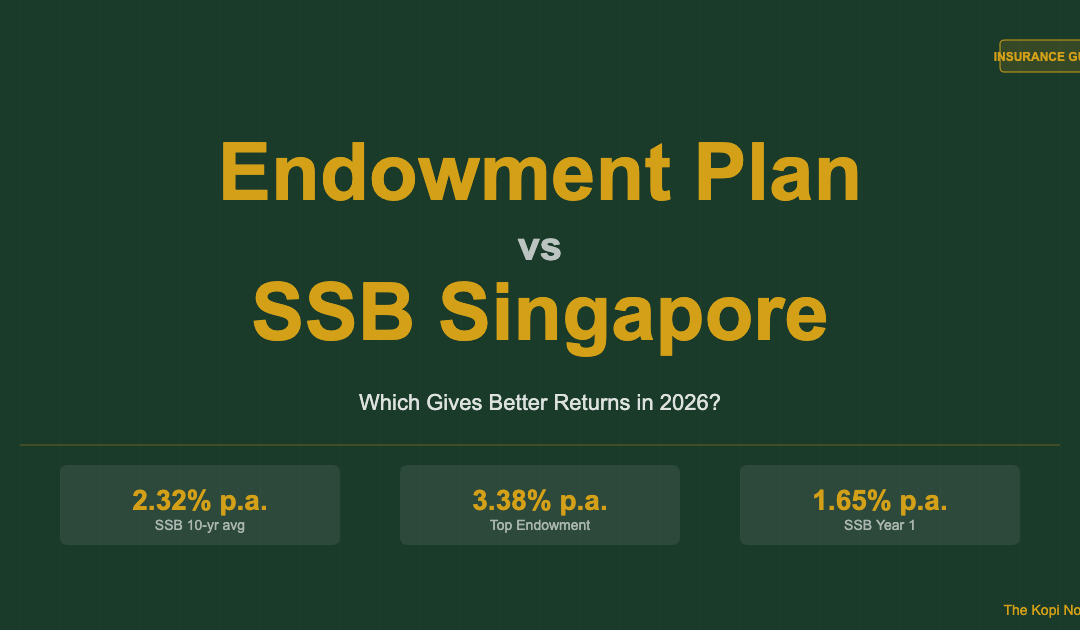
Endowment Plan Singapore vs SSB 2026:
Which Gives Better Returns?
Compare guaranteed rates, lock-in periods, and flexibility to find the right fit for your money.
Endowment plans and Singapore Savings Bonds (SSB) are both low-risk, capital-guaranteed savings tools — but they suit very different investors. The SSB October 2026 issue offers a 10-year average of 2.32% p.a. with full flexibility to redeem anytime. Short-term endowment plans can go higher — AIA #Wealth Savvy III returns 3.38% p.a. guaranteed over 2 years — but require you to lock in your capital fully. Here is how to decide which fits your situation.
Not financial advice. All figures are for educational reference only. Data verified as at 29 September 2026 unless noted.
At a Glance: SSB vs Endowment Plan
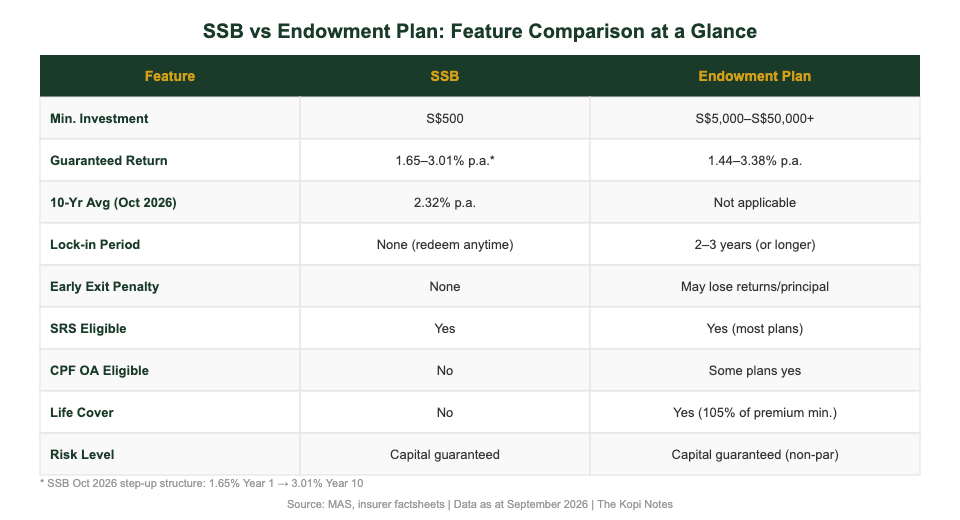
Both options are capital-guaranteed and suitable for conservative investors. The key difference is flexibility versus yield. The SSB lets you redeem any month with no penalty; endowment plans lock your money in for 2 to 10 or more years, but can reward you with a higher guaranteed return for doing so.
| Feature | SSB (Oct 2026) | Short Endowment Plan |
|---|---|---|
| Minimum Investment | S$500 | S$5,000 – S$50,000+ |
| Guaranteed Return | 1.65% (Yr 1) to 3.01% (Yr 10) | 1.44% to 3.38% p.a. |
| 10-yr Average Yield | 2.32% p.a. | N/A (2-3 yr tenor) |
| Lock-In Period | None – redeem any month | 2-3 years typical |
| Early Exit Penalty | None | May lose guaranteed returns |
| Life Cover Included | No | Yes (105% of premium min.) |
| SRS Eligible | Yes | Yes (most plans) |
| Max Investment | S$200,000 total | No cap |
Source: MAS Singapore Savings Bond, insurer websites | Data as at September 2026
See our full comparison of savings plans vs T-bills vs SSB in 2026 for a wider view across all conservative options.
SSB October 2026 Rates Explained
The Singapore Savings Bond October 2026 (SBOCT26) offers a 10-year average return of 2.32% p.a. This is a 14-month high for SSB yields. Applications close on 25 September 2026, with allotment results due 30 September 2026.
The SSB uses a step-up coupon structure. You earn less in the early years but more as you hold longer:
| Year | Annual Interest Rate | Effective Return (if held to this year) |
|---|---|---|
| Year 1 | 1.65% | 1.65% |
| Year 2 | 2.02% | 1.84% |
| Year 3 | 2.33% | 2.00% |
| Year 5 | 2.43% | 2.17% |
| Year 10 | 3.01% | 2.32% |
Source: MAS Singapore Savings Bond Oct 2026 factsheet | Data as at September 2026
The key advantage: you can redeem any month with no penalty. This makes SSB ideal for money you might need back within 1-2 years but want to earn more than a savings account. The S$200,000 individual cap means it is most relevant for small-to-medium cash holdings.
Best Endowment Plan Rates in Singapore 2026
Endowment plan rates in Singapore have improved significantly since the Fed rate hike cycle. For context, our full guide to short-term endowment plans in Singapore covers all open tranches and their key terms.
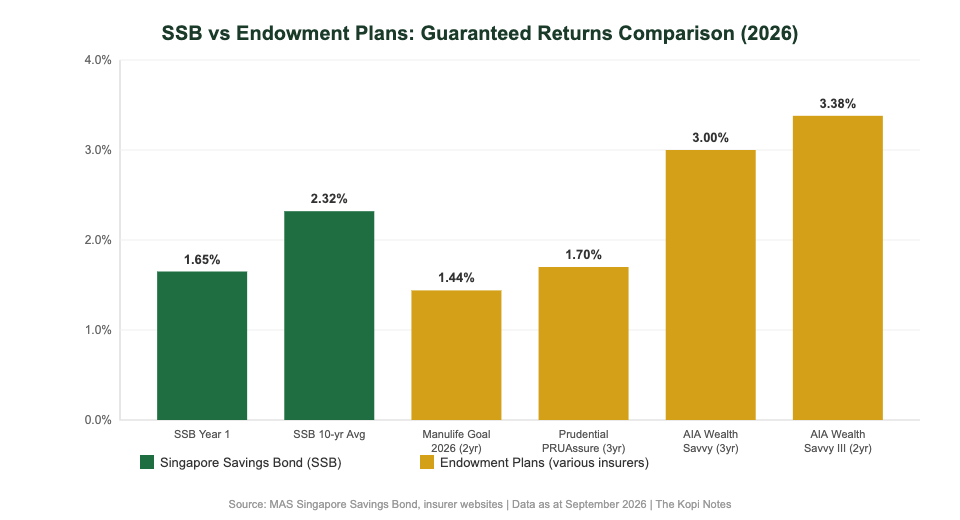
Here are the best guaranteed rates currently available from major insurers for short-term (2-3 year) single-premium endowment plans:
| Plan | Insurer | Tenor | Guaranteed Return | Type |
|---|---|---|---|---|
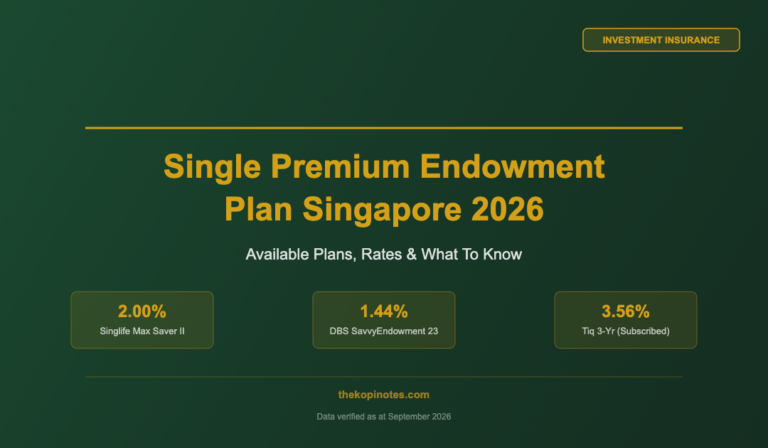
| AIA #Wealth Savvy III | AIA | 2 years | 3.38% p.a. | Non-par |
| AIA #Wealth Savvy | AIA | 3 years | 3.00% p.a. | Non-par |
| PRUAssure Growth | Prudential | 3 years | 1.70% p.a. | Non-par |
| Manulife Goal 2026 | Manulife | 2 years | 1.44% p.a. | Non-par |
Source: Insurer websites and MoneySmart | Data as at September 2026. Tranche availability changes frequently – verify before applying.
Important: Endowment plan tranche availability changes rapidly. AIA #Wealth Savvy III has historically sold out quickly when its rates are competitive. Check directly with your financial adviser or insurer for current availability and terms before committing.
If you are considering a single premium endowment plan in Singapore, ensure you review the complete plan brochure and surrender value schedule before signing.
Head-to-Head: Endowment Plan vs SSB
Let us compare the two options for a Singapore investor placing S$50,000 over a 2-year horizon:
| Scenario (S$50,000 over 2 Years) | SSB (Held 2 Yrs) | AIA #Wealth Savvy III |
|---|---|---|
| Effective Rate (2-yr) | ~1.84% avg | 3.38% p.a. |
| Interest Earned (2 yrs) | ~S$1,840 | ~S$3,434 |
| Return Difference | – | +S$1,594 more |
| Early Exit Flexibility | Full – no penalty | None – full lock-in |
| Life Cover | None | Included (105% of premium) |
Illustrative calculation. SSB uses Oct 2026 step-up rates held for 2 years. Endowment figures use AIA #Wealth Savvy III 3.38% p.a. guaranteed. Verify all figures directly with MAS and insurer before investing.
The endowment plan wins on yield by a significant margin for those who can commit. But if you might need the S$50,000 back before the 2-year mark, the SSB wins on flexibility.
Also worth comparing: endowment plans vs the current 1.92% T-bill rate if you are weighing all short-term fixed-income options.
When to Choose an Endowment Plan Over SSB
An endowment plan is the better choice in these situations:
- You have a firm 2-3 year horizon. If you know the money will not be touched – a house downpayment fund in 3 years, a child’s education fund – the higher guaranteed rate rewards your commitment.
- You have more than S$200,000 to deploy. The SSB caps each individual at S$200,000 total across all tranches. Endowment plans have no cap, making them suitable for larger sums.
- You want some life cover included. All MAS-regulated endowment plans include at least 105% of single premium as death benefit. For investors who lack insurance coverage, this is a useful bonus.
- You are using SRS funds. Both are SRS-eligible, but endowment plans offer higher guaranteed returns for the same SRS lock-in discipline already required by the SRS framework.
- You want the highest possible guaranteed yield. At 3.38% p.a. (AIA #Wealth Savvy III), the best endowment plans beat the SSB 10-year average by over 1 percentage point, even after accounting for the flexibility trade-off.
If you invest with Endowus (referral code 2V343), you can access a curated selection of endowment plans alongside other fixed-income options, making it easier to compare and apply in one place.
When to Choose SSB Over an Endowment Plan
Stick with SSB in these situations:
- You need flexibility. If there is any chance you might need the funds back before 2 years – an emergency, a market opportunity, a job change – SSB lets you redeem the next month with full principal returned and all accrued interest paid.
- You are just starting out with small amounts. The S$500 minimum makes SSB accessible at any income level. Most endowment plans require S$5,000 or more as a minimum single premium.
- You prefer simplicity. SSB is fully government-backed (AAA), has no intermediary, and is purchased directly through DBS/POSB, OCBC, or UOB ATMs and Internet Banking. No adviser, no paperwork, no surrender value schedule to read.
- You are holding for 5 to 10 years. If you can keep the SSB all the way to Year 10, you earn 3.01% p.a. on that final year’s interest – and the 10-year average of 2.32% remains competitive for a government bond with no credit risk.
- You already have insurance coverage. If you are fully insured elsewhere, the life cover in an endowment plan is redundant – you are paying for something you do not need.
Syfe Cash+ or a similar cash management solution can sit alongside your SSB for liquidity you want to keep working harder. See our Syfe referral code and current sign-up bonus if you want to open an account.
Which Should You Pick? A Simple Decision Framework
Use this quick guide to decide:
- Do you have more than S$200,000 to place? If yes, an endowment plan is the only option for the excess above the SSB cap.
- Is there any chance you will need the money within 12 months? If yes, go SSB.
- Can you commit the full amount for 2 years without touching it? If yes, a top-rate endowment plan outperforms SSB on yield.
- Are you investing via SRS? Both work. Choose the endowment plan if maximising guaranteed return matters more than flexibility.
- Is this an emergency fund? Neither. Keep emergency funds in a high-yield savings account or cash management account.
Many Singapore investors use both: SSB for core liquidity reserves where flexibility is paramount, and a short-term endowment plan for surplus savings committed for 2-3 years. This barbell approach captures the best of both options without sacrificing all flexibility.
For a broader view of all fixed-income options including T-bills, read our full savings plan vs T-bills vs SSB comparison.
Frequently Asked Questions
Is an endowment plan better than SSB in Singapore?
What is the SSB October 2026 interest rate?
Can I invest in both SSB and an endowment plan?
What is the maximum I can invest in SSB?
Are endowment plans in Singapore capital-guaranteed?
Can I use CPF to buy SSB or endowment plans?
Get Free Insurance Advice
Speak with a licensed insurance advisor. No obligation, no cost.
By submitting this form, you agree to our Privacy Policy.
This article was researched with the help of AI. While we strive to keep all information accurate and up to date, there may be errors. If you notice any discrepancies, please contact us.