High-yield savings accounts advertise up to 4.45% p.a. The average Singapore endowment plan guarantees only 1.8% p.a. Here is what you actually earn on each — and why the two numbers are not really comparable.
Singapore’s high-yield savings accounts advertise headline rates of up to 4.45% p.a., while the average Singapore endowment plan guarantees only about 1.8% p.a. But savings account bonus rates need monthly salary crediting, card spend or minimum balances — and banks cut them often. Endowment plans lock in their (lower) rate for the full policy term, no conditions attached. Here is the real trade-off.
Not financial advice. All figures are for educational reference only. Data verified as at 1 August 2026 against each bank’s and insurer’s own official rate pages.
- Savings accounts can beat endowment plans on paper (up to 4.45% p.a.), but only if you hit salary, spend and balance conditions every single month — miss one and you can drop to a base rate as low as 0.05% p.a.
- No-hoop savings accounts like GXS and MariBank pay 0.88%–1.08% p.a. flat, which is below the average endowment guarantee of 1.8% p.a.
- Endowment plans lock in their guaranteed rate for the full term (often 10–25 years). OCBC 360, Trust Bank and UOB One have all cut their rates within the past 12 months — your savings account rate is not guaranteed to stay where it is today.
Contents — Click to expand
- What Singapore High-Yield Savings Accounts Actually Pay in 2026
- What Singapore Endowment Plans Actually Guarantee
- Endowment Plan vs Savings Account: Side-by-Side Comparison
- What S$20,000 Actually Grows Into After 5 Years
- The Catch: Why “Up To” Rates Rarely Apply to You
- When a Savings Account Beats an Endowment Plan
- When an Endowment Plan Still Makes Sense
- How to Decide: A Simple 3-Step Framework
- Pros and Cons
- FAQ
What Singapore High-Yield Savings Accounts Actually Pay in 2026
Every Singapore high-yield savings account works the same way. There is a base rate that everyone earns, and then a bonus rate that you only earn if you tick certain boxes each month. The advertised “up to X% p.a.” headline is almost always the bonus rate, not what a typical saver actually gets.
Here is what six popular accounts pay right now, split into two tiers — the rate you get with zero effort, and the maximum rate if you meet every condition every month.
No-Condition Tier (You Do Nothing)
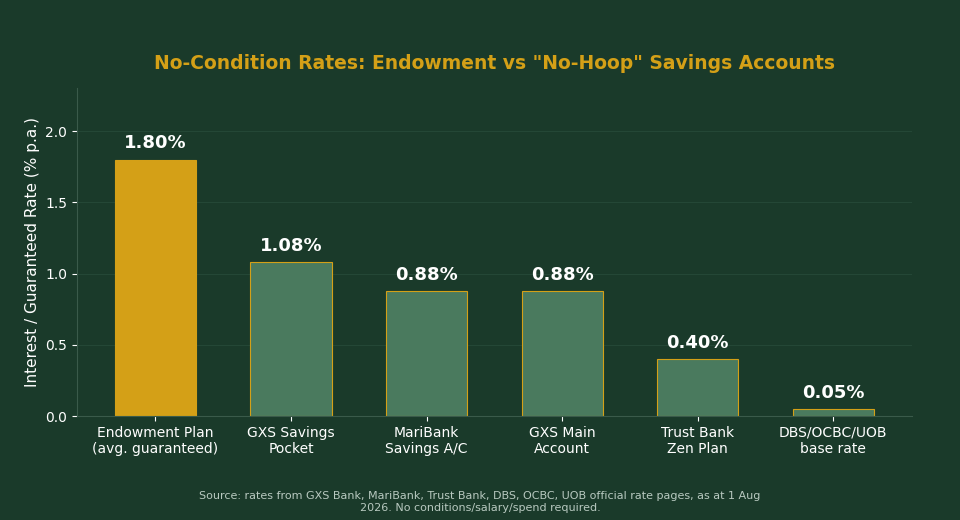
Digital banks GXS and MariBank pay a flat rate with no salary crediting, no card spend and no minimum balance. You just need to have money in the account.
- GXS Savings Pocket: 1.08% p.a., credited daily, no conditions, no lock-in.
- GXS Main Account: 0.88% p.a., credited daily.
- MariBank Savings Account: 0.88% p.a. flat on all balances, effective 1 June 2026, no minimum deposit or salary crediting required.
- Trust Bank Zen plan: a flat 0.40% p.a. with zero conditions — the “no strings attached” option if you do not want to think about bonus criteria at all.
- DBS, OCBC and UOB base rate: just 0.05% p.a. if you don’t meet any bonus criteria on their bigger accounts.
Conditional Maximum Tier (You Meet Every Bonus Category, Every Month)
The “big number” accounts require real effort — and usually a five-figure balance — to hit their advertised maximum.
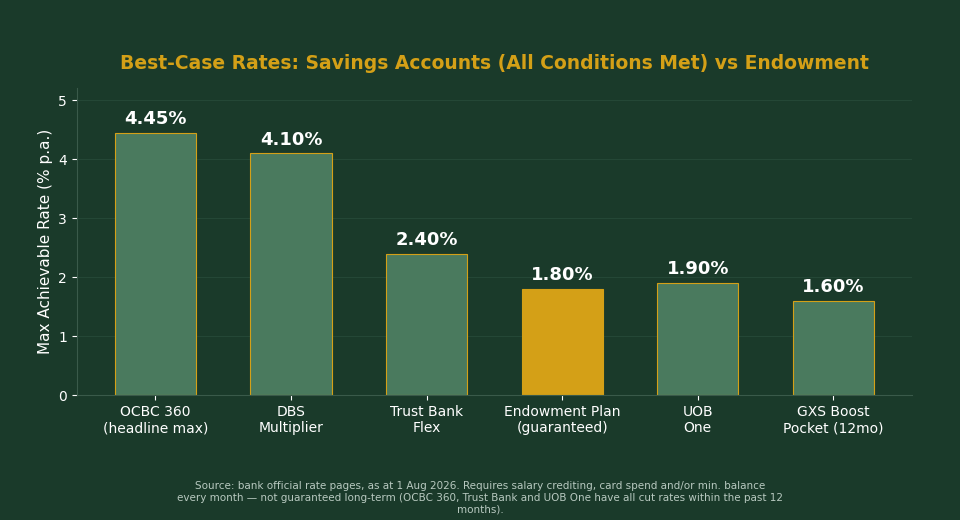
- DBS Multiplier: up to 4.10% p.a. if you credit your salary and transact in at least two other categories (card spend, home loan, insurance, or investments) each month.
- OCBC 360: up to 4.45% p.a. headline if you hit all five bonus categories (Salary, Save, Spend, Insure, Invest). From 1 May 2026, the rate for a typical saver meeting just Salary + Save + Spend fell to about 1.95% p.a. — the 4.45% figure needs Insure and Invest too, which most savers don’t have.
- UOB One: up to 1.90% p.a. on the first S$150,000, requiring S$500 in card spend plus S$1,600 monthly salary credit via GIRO, PayNow or FAST.
- Trust Bank Flex plan: up to 2.40% p.a. if you complete any 3 of 8 “bonus scoops” each month — salary crediting, card spend, PayNow inflows, foreign currency spend, referring a credit card sign-up, or investing S$20,000 in TrustInvest funds.
- GXS Boost Pocket: up to 1.60% p.a. if you lock funds for a 12-month tenure (0.88% base + 0.72% bonus at maturity) — you lose flexibility for a modest bump.
Notice the pattern: the accounts advertising 4%+ p.a. require either a S$100,000+ balance across multiple products, or five separate monthly conditions. The accounts most people can realistically sustain — UOB One, Trust Bank Flex, GXS Boost Pocket — land between 1.60% and 2.40% p.a.
What Singapore Endowment Plans Actually Guarantee
An endowment plan is a savings insurance product. You pay premiums for a set period (single premium, or 2–10 years), and the insurer promises to pay you back a guaranteed sum plus non-guaranteed bonuses at maturity.
Across the 13 Singapore endowment plans we have individually reviewed on this site — from Great Eastern and Prudential to Etiqa, FWD, Tokio Marine and Singlife — the average guaranteed rate works out to about 1.8% p.a., ranging from as low as 0.70% to as high as 2.80% depending on the insurer and premium term.
That 1.8% is the number the insurer is contractually obligated to pay you, regardless of how the market performs. Insurers also publish “projected” or “illustrated” returns of 3%–4.5% at maturity — but that upper figure includes non-guaranteed bonuses that depend on the insurer’s participating fund performance and are not promised. If you want to compare products on a like-for-like basis, the guaranteed rate is the only number you should trust.
For the full insurer-by-insurer breakdown, see our best endowment plans in Singapore 2026 comparison.
Endowment Plan vs Savings Account: Side-by-Side Comparison
| Feature | Endowment Plan | High-Yield Savings Account |
|---|---|---|
| Guaranteed rate | ~1.8% p.a. avg (fixed for full term) | 0.05%–1.08% p.a. (no-condition tier) |
| Best-case rate | Same as guaranteed (no bonus tier) | 1.60%–4.45% p.a. (conditions apply) |
| Rate stability | Locked for the full policy term | Reviewed and cut without notice |
| Liquidity | Locked in; early surrender = loss | Withdraw anytime, no penalty |
| Effort required | None after signing up | Monthly conditions for top rate |
| Protection scheme | Policy Owners’ Protection Scheme (up to S$100K) | SDIC deposit insurance (up to S$100K) |
| Typical horizon | 10–25 years | Open-ended, no fixed term |
Source: insurer product pages (endowment guaranteed range) and bank official rate pages, as at 1 August 2026.
What S$20,000 Actually Grows Into After 5 Years
Numbers in isolation are hard to compare, so here is an original calculation. Say a Singapore investor has S$20,000 in guaranteed savings they will not touch for 5 years. What does each option actually leave them with, assuming interest compounds annually at the stated guaranteed or sustained rate?
| Scenario | Rate Used | Value After 5 Years | Gain |
|---|---|---|---|
| Endowment plan (guaranteed, locked) | 1.80% p.a. | S$21,865.98 | S$1,865.98 |
| GXS Savings Pocket (no hoop, liquid) | 1.08% p.a. | S$21,103.58 | S$1,103.58 |
| OCBC 360, realistic tier, sustained | 1.95% p.a. | S$22,027.55 | S$2,027.55 |
| DBS Multiplier, theoretical max, sustained | 4.10% p.a. | S$24,450.27 | S$4,450.27 |
Source: original calculation by The Kopi Notes, S$20,000 principal, annual compounding, 5-year horizon, rates as at 1 August 2026. Illustrative only — assumes the stated rate and bonus conditions are sustained without interruption for the full 5 years, which is not guaranteed for any bank account.
The realistic middle-ground savings account (OCBC 360 at its typical achievable 1.95% p.a.) beats the endowment plan by about S$162 over 5 years — but only if you hit Salary, Save and Spend criteria every single month without fail. The DBS Multiplier theoretical max looks the most attractive on paper, but very few savers actually sustain 3 bonus categories with a large enough balance for 5 straight years. Meanwhile, the endowment plan’s S$1,865.98 gain is locked in from day one — no monthly admin, no risk of missing a condition.
The Catch: Why “Up To” Rates Rarely Apply to You
Here’s why “up to 4.45% p.a.” is not the same as “you will earn 4.45% p.a.” Three things work against you.
First, the caps are small relative to the headline. OCBC 360’s 4.45% p.a. only applies to a limited slice of your balance once you stack Salary, Save, Spend, Insure and Invest — most savers who only credit salary and spend on a card land around 1.95% p.a. instead. Miss a category one month, and that month’s bonus interest simply does not apply.
Second, banks cut these rates regularly — often with only a few weeks’ notice. OCBC 360 cut its realistic achievable rate in May 2026. Trust Bank trimmed its maximum from up to 2.50% p.a. to up to 2.40% p.a. in March 2026. UOB One’s headline rate has also fallen from a much higher peak after cuts in late 2025. If you are comparing a savings account to an endowment plan over a 10–25 year horizon, you should assume the bank rate you see today will not be the rate you get in year 3, let alone year 10.
Third, the conditions themselves cost something. Meeting “3 bonus scoops” on Trust Bank Flex, or investing S$20,000 in TrustInvest funds to unlock a bonus, is not free admin — it nudges your spending and investing behaviour to chase a rate, rather than the other way round.
An endowment plan has none of this rate-cut risk. The 1.8% average guaranteed rate you sign up for is contractually fixed for the entire premium and policy term — the insurer cannot revise it downward once you have bought the policy, unlike a bank’s bonus interest programme.
When a Savings Account Beats an Endowment Plan
A savings account is the better home for your money if any of these apply to you:
- You need the money to stay liquid. Your emergency fund, or savings you might need within 1–3 years, should never go into an endowment plan — early surrender usually means getting back less than you paid in.
- You can realistically sustain the bonus conditions. If you already credit your salary to one bank and spend on its card, hitting a savings account’s bonus tier costs you nothing extra.
- You want to chase better rates as they appear. Unlike an endowment plan, you can move your cash to a new digital bank promo or a higher-paying account whenever a better deal shows up.
- You want simple SDIC protection with no medical underwriting. Opening a savings account takes minutes online and needs no health declaration, unlike some endowment plans.
When an Endowment Plan Still Makes Sense
An endowment plan is worth considering when:
- You genuinely will not touch the money for years. If you know you’ll forget about a savings pot and want the rate locked in without having to babysit monthly bonus conditions, an endowment plan removes that temptation and admin entirely.
- You value rate certainty over a long horizon more than a slightly higher but uncertain rate today. Given that 3 major banks have already cut savings rates within the past year, a 10–25 year endowment policy protects you from further cuts — a bank account does not.
- You are saving toward a specific medium-term goal (a child’s education fund, a wedding, retirement top-up) where the maturity date lines up with the policy term, and you want a guaranteed floor plus a shot at non-guaranteed bonuses on top.
- You want forced savings discipline. Regular-premium endowment plans commit you to a fixed monthly outflow, which some savers find useful for building a savings habit.
How to Decide: A Simple 3-Step Framework
Step 1: Sort your cash by how soon you need it. Money you might need within 3 years belongs in a savings account, full stop — no endowment plan should hold your emergency fund.
Step 2: For money you won’t touch for 5+ years, be honest about whether you’ll sustain the bonus conditions. If you can realistically hit a savings account’s top tier every month for years, the “best-case” bank rate can beat the endowment’s guarantee — our calculation above shows OCBC 360’s realistic tier edging out the endowment plan by about S$162 over 5 years. If you’re not confident you’ll sustain it, the endowment’s fixed 1.8% avg is the safer bet.
Step 3: Decide how much you value certainty. If a locked-in rate that can’t be cut matters more to you than chasing a marginally higher but reviewable bank rate, the endowment plan wins on peace of mind — even if the raw number is lower.
Many Singaporeans do both: keep an emergency fund plus near-term savings in a no-hoop or achievable-tier savings account like GXS Bank or Trust Bank, while allocating a separate, genuinely long-term sum to an endowment plan for guaranteed capital protection.
Pros and Cons
Endowment Plan
Pros: Rate locked for the full term; no monthly admin; potential non-guaranteed bonus on top; forced savings discipline; Policy Owners’ Protection Scheme coverage.
Cons: Lower average guaranteed rate (1.8% vs up to 4.45% headline); early surrender usually means a loss; money is illiquid for years; guaranteed portion alone rarely beats inflation.
High-Yield Savings Account
Pros: Fully liquid, withdraw anytime; top-tier rates can beat endowment guarantees; SDIC-insured up to S$100K; free to open, no underwriting.
Cons: Top rates require monthly conditions and often a large balance; rates get cut without much notice; no-hoop options pay below the endowment average; requires ongoing attention to keep earning the best rate.
Frequently Asked Questions
Is a savings account's interest rate guaranteed like an endowment plan's?
Which savings account has the highest interest rate in Singapore right now?
What happens if I don't meet a savings account's bonus conditions one month?
Are savings accounts protected the same way as endowment plans?
Can I lose money in a high-yield savings account?
Is 1.8% a good guaranteed rate for an endowment plan in 2026?
Should I put my emergency fund in a savings account or an endowment plan?
Do high-yield savings account rates change often?
Can I hold both an endowment plan and a high-yield savings account?
Continue Your Guaranteed-Returns Comparison
This article completes our savings-account leg of the guaranteed-returns series. See how endowment plans stack up against other guaranteed options: Endowment Plan vs CPF, Endowment Plan vs T-Bills, or Endowment Plan vs Fixed Deposit.
Get Free Insurance Advice
Speak with a licensed insurance advisor. No obligation, no cost.
By submitting this form, you agree to our Privacy Policy.
This article was researched with the help of AI. While we strive to keep all information accurate and up to date, there may be errors. If you notice any discrepancies, please contact us.