Mapletree Industrial Trust Share Price 2026: DPU Yield and Q4 Industrial REIT Outlook
Portfolio bifurcation, DPU sustainability, gearing health — what MIT’s share price tells you heading into Q4 2026.
Mapletree Industrial Trust (SGX: ME8U) is Singapore’s second-largest industrial REIT by market capitalisation, owning a diversified portfolio of flatted factories, hi-tech buildings, data centres, and business parks across Singapore, Japan, the United States, and Australia. As at Q3 2026, MIT trades around SGD 2.15–2.35 per unit and offers an estimated distribution yield of 5.6–6.1% based on FY2026 DPU guidance — making it one of the most accessible yield plays in the industrial REIT sector for Singapore investors.
Not financial advice. All figures are for educational reference only. Data as at September 2026 unless noted.
- MIT is bifurcating internally — data centres and hi-tech buildings are outperforming, while older flatted factories face softer demand.
- DPU has dipped slightly from its FY2022 peak but remains resilient at around 13.1 cents per unit for FY2026, supported by fixed-rate borrowings covering roughly 75–80% of debt.
- Q4 2026 rate environment: no immediate Fed cut expected. MIT’s gearing at ~38% gives it buffer, but new acquisitions are on hold until borrowing costs ease.
Table of Contents
What Is Mapletree Industrial Trust?
Mapletree Industrial Trust (ME8U) is a Singapore-listed REIT managed by Mapletree Industrial Trust Management Ltd, a wholly-owned subsidiary of Mapletree Investments — the property arm of Temasek Holdings.
MIT was first listed on the SGX in October 2010. Since then, it has grown from a pure Singapore industrial portfolio into a diversified cross-border REIT with assets in four countries.
Key Facts at a Glance
| Metric | Value (2026) |
|---|---|
| SGX Ticker | ME8U |
| Market Cap (approx.) | SGD 6.2–6.8 billion |
| Number of Properties | ~143 properties |
| Total Asset Value | SGD 9.0–9.5 billion |
| Geographies | Singapore, Japan, USA, Australia |
| FY2026 DPU (estimated) | ~13.1 Singapore cents |
| Estimated Distribution Yield | 5.6–6.1% at current price range |
| Gearing Ratio | ~38% |
Source: Mapletree Industrial Trust investor relations, SGX filings, TKN estimates. September 2026.
MIT sits in a unique position among industrial REITs. It is not purely a flatted factory landlord — around a quarter of its portfolio by gross revenue income (GRI) comes from data centres, making it one of the few Singapore REITs with direct AI infrastructure exposure.
MIT Share Price in 2026
MIT’s share price has been under pressure through much of 2026, largely mirroring the broader S-REIT sector’s response to higher-for-longer interest rates. After the Fed held rates elevated through H1 2026 and then raised the federal funds rate target by 25 basis points in September 2026, yield-sensitive REITs sold off.
Here is how MIT’s share price has roughly trended through 2026:
| Period | Share Price Range (SGD) | Key Driver |
|---|---|---|
| Q1 2026 | 2.30–2.45 | Rate-cut optimism, data centre demand |
| Q2 2026 | 2.20–2.38 | Fed hold, SGD/USD strength |
| Q3 2026 | 2.10–2.28 | FOMC September rate hike, sector selloff |
| Q4 2026 (to date) | 2.12–2.25 | Stabilisation; market watching for rate peak |
Source: SGX, TKN estimates. For educational reference only. Past price movements do not predict future results.
For you as a Singapore investor, the key question is not whether MIT’s share price fell — it did. The question is whether the fundamentals have deteriorated, or whether this is a sector-wide repricing that has created a value opportunity.
That yield is materially higher than both the 10-year Singapore Government Securities (SGS) bond (around 3.2–3.5%) and a 6-month T-bill (around 3.5%). For investors comfortable with the volatility of a listed REIT, MIT’s yield spread to risk-free rates remains attractive — but it has compressed compared to its 2023 highs.
You can use the S-REIT yield vs SGS bond spread calculator on TKN to model MIT’s spread at different share price entry points.
Portfolio Breakdown: The Bifurcation Story
MIT’s greatest strength — and its most nuanced investment story — is its internal bifurcation. Not all industrial assets are equal in 2026, and MIT’s portfolio reflects this clearly.
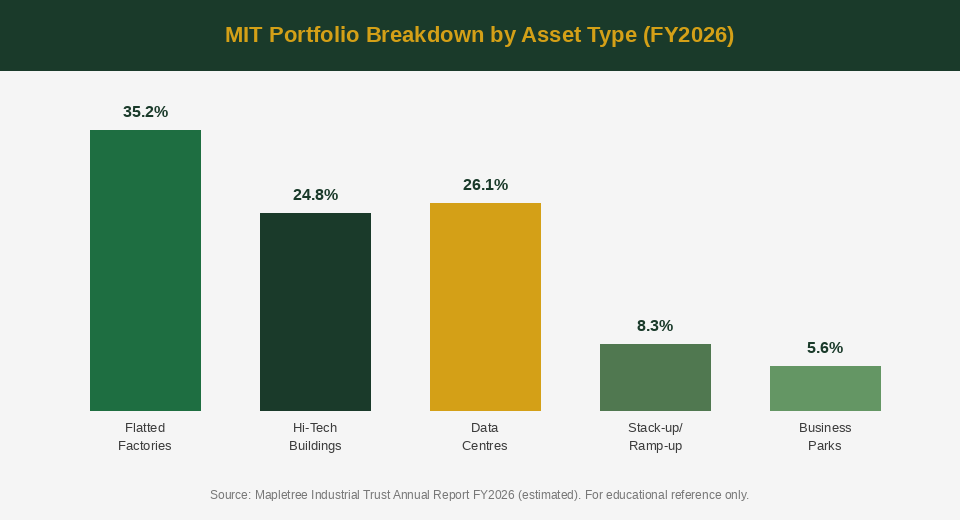
Source: Mapletree Industrial Trust FY2026 Portfolio Data, TKN estimates. For educational reference only.
Flatted Factories (35% of GRI)
Flatted factories are MIT’s legacy assets — multi-storey industrial buildings built during Singapore’s earlier industrialisation phase. They tend to house light manufacturing, printing, food processing, and general trade tenants.
In 2026, these assets face a genuine headwind. Singapore’s economy has pivoted toward high-value manufacturing and digital industries. Demand for basic flatted factory space is growing slowly, and rental uplifts on renewals are modest — typically 2–5% per year.
The positive: occupancy rates remain high (above 90%) because rents are affordable. However, capital appreciation potential is limited, and these assets do not benefit from the AI-driven data centre demand surge.
Hi-Tech Buildings (25% of GRI)
Hi-tech buildings are cleaner, better-specified industrial facilities. They attract semiconductor-adjacent tenants, precision engineering firms, and biomedical companies. These are benefiting from Singapore’s push to attract advanced manufacturing clusters under EDB’s Economic Development Board programme.
Rental renewals here are running at 8–12% uplifts in 2026 — a meaningful contributor to MIT’s income growth despite the rate headwind.
Data Centres (26% of GRI)
This is MIT’s most exciting segment in 2026. MIT holds 14 data centre assets, including hyperscale facilities in the United States acquired in partnership with Equinix. AI workloads are driving enormous demand for colocation space, and data centre rents are surging globally.
MIT’s data centre assets are typically on long-term leases (10–20 years) with built-in rent escalations. This provides income visibility and insulates this portion of the portfolio from short-term interest rate swings. If you are looking for an S-REIT with indirect AI infrastructure exposure, MIT is one of the few vehicles available on SGX.
For a comparison of S-REIT yield leaders, see the TKN guide to the best S-REITs in Singapore 2026.
Other Assets (14% of GRI)
Stack-up/ramp-up facilities and business parks make up the remainder. Stack-up facilities are modern multi-storey ramp-up warehouses suited to e-commerce logistics — growing demand segment. Business parks offer office-adjacent industrial space for R&D functions.
DPU History and Yield Analysis
Distribution Per Unit (DPU) — which is essentially the cash dividend MIT pays you as a unitholder — has declined modestly since its FY2022 peak. This is largely attributable to higher borrowing costs eating into distributable income.
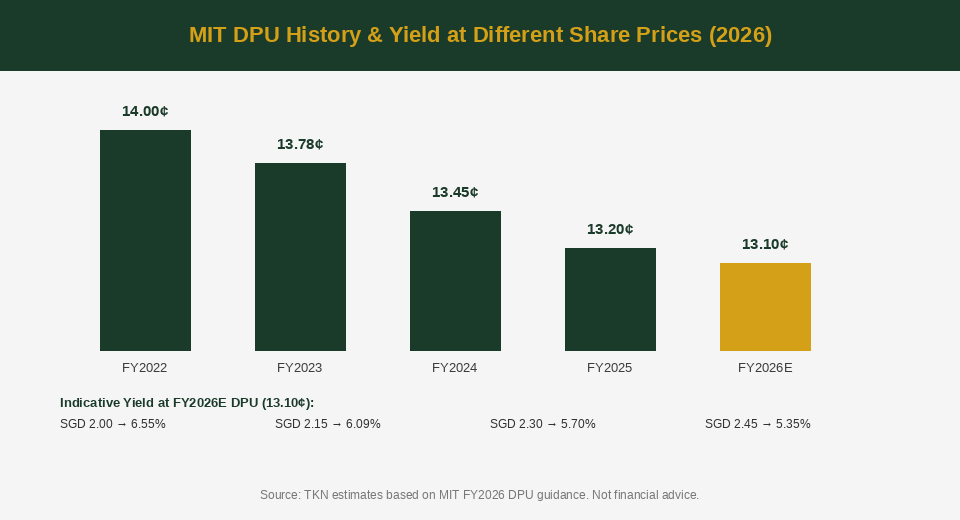
Source: TKN estimates based on MIT FY2026 guidance and historical DPU data. Not financial advice.
Here is what the DPU trend means for you practically. If MIT pays 13.1 cents in FY2026 and you bought at:
- SGD 2.00/unit — your yield is 6.55% per year
- SGD 2.15/unit — your yield is 6.09% per year
- SGD 2.30/unit — your yield is 5.70% per year
- SGD 2.45/unit — your yield is 5.35% per year
MIT distributes quarterly. Distributions are not guaranteed and can be cut if income falls. However, MIT has maintained a remarkably stable distribution over 15+ years of listing history, only experiencing minor DPU dips during COVID-19 (FY2020) and the current rate-hike cycle.
You can model your portfolio’s expected dividend income using the dividend portfolio yield calculator on TKN.
MIT qualifies for SRS (Supplementary Retirement Scheme) investment, meaning you can use SRS funds to purchase ME8U units and receive tax-deferred distributions. This is one way to enhance the after-tax yield if you are in a higher income tax bracket.
Gearing, ICR and Balance Sheet Health
Gearing ratio measures how much of MIT’s total assets are funded by debt. Singapore REITs are regulated by MAS to maintain a maximum gearing of 50% (or 55% with a minimum interest coverage ratio of 2.5x). MIT’s gearing of approximately 38% gives it meaningful debt headroom.
| Balance Sheet Metric | FY2026 (estimated) | Commentary |
|---|---|---|
| Gearing Ratio | ~38% | Below MAS 50% limit; 12pp headroom |
| Interest Coverage Ratio (ICR) | ~3.4x | Above MAS 2.5x minimum; comfortable |
| Fixed-Rate Debt Proportion | ~75–80% | Strong DPU insulation from further hikes |
| Weighted Average Debt Maturity | ~3.2 years | Debt refinancing spread over multiple years |
| Effective Borrowing Cost | ~3.6% p.a. | Rising vs FY2022 but stabilising |
Source: TKN estimates from MIT quarterly business updates and SGX filings, September 2026.
The 75–80% fixed-rate borrowings figure is the key reason MIT’s DPU has held up despite the rate hike cycle. If most of MIT’s debt were floating rate, every 25 basis point increase would directly shave approximately 0.2–0.4 cents off annual DPU. Instead, only the floating portion — roughly 20–25% of total debt — is immediately affected.
For investors who want to model gearing yourself, TKN’s S-REIT gearing and ICR calculator lets you stress-test different leverage scenarios.
Q4 2026 Outlook: Rate Sensitivity and Growth Drivers
The September 2026 FOMC rate hike — a 25 basis point increase to the federal funds rate — caught some market participants off guard. It pushed Singapore interbank rates higher and triggered a fresh wave of selling across the S-REIT sector.
Here is what this means for MIT specifically in Q4 2026 and into 2027:
Rate Sensitivity (Near-Term Headwind)
MIT’s floating-rate debt exposure means the rate hike directly increases its interest expense. TKN estimates this adds approximately SGD 3–5 million to MIT’s annual interest bill — which translates to roughly 0.1–0.2 cents of DPU pressure over a full year.
This is manageable, not catastrophic. MIT’s DPU should remain in the 13.0–13.2 cent range for FY2026. The risk is if rates remain elevated through FY2027 and additional debt maturities are refinanced at higher costs.
Data Centre AI Demand (Structural Tailwind)
Offsetting the rate headwind is genuine fundamental strength in data centres. Global AI compute demand is driving unprecedented absorption of data centre capacity. MIT’s 14 data centre assets — particularly those in the United States — are benefiting from this structural trend.
Long-term leases with rent escalators mean MIT is capturing some of this upside, though it is not a pure-play data centre REIT. Think of it as industrial exposure with a data centre kicker.
Singapore Industrial Supply
Singapore’s Urban Redevelopment Authority (URA) and JTC Corporation have been careful about industrial land supply. New completions are modest relative to historical averages, which supports MIT’s occupancy rates across its flatted factory and hi-tech building portfolios.
The Singapore industrial market looks structurally sound for 2026–2027, even if rental uplifts are modest in the older asset classes.
For passive income planning across both REITs and bonds, check the TKN guide to passive income in Singapore 2026.
Should You Buy MIT in Q4 2026?
This is ultimately a decision only you can make, based on your own investment timeline, risk tolerance, and financial goals. Here is what the data suggests for different investor profiles — not a recommendation to buy or sell.
| Investor Profile | What MIT Offers | Key Risk |
|---|---|---|
| Income-focused retiree | ~5.7–6.1% yield, quarterly distributions | DPU could dip 0.1–0.2¢ if rates stay high |
| Growth investor (5–10yr) | Data centre NAV uplift potential as AI demand grows | Share price sensitive to rate outlook |
| SRS investor | Tax-deferred income boost on distributions | SRS withdrawal rules apply |
| IBKR/Syfe user DCA-ing | Low-cost entry into an established blue-chip REIT | Broker fees on small lots via IBKR can be minimal |
Source: TKN analysis. Not financial advice. Speak to a licensed financial adviser before making investment decisions.
One practical approach that works well for Singapore REITs is dollar-cost averaging (DCA) — investing a fixed amount monthly, regardless of price. At SGD 500–1,000 per month into ME8U, you build a position over time without trying to time the market perfectly.
If you use Syfe’s REIT+ portfolio, note that ME8U is one of the core holdings. You can check the Syfe referral code for any signup bonuses currently available.
For direct REIT investing on the SGX, Interactive Brokers (IBKR) offers some of the lowest commission rates for Singapore investors. The IBKR referral code jianxiong368 may give you signup benefits — check the best S-REITs guide for a full broker comparison.
For those planning retirement income, run your REIT yield assumptions through the Singapore retirement calculator to see how MIT distributions might fit your drawdown plan.
FSMOne is another cost-effective option for Singapore investors building a REIT portfolio — the FSMOne referral code P0544985 gives you access to their Regular Savings Plan for fractional REIT investing.
Frequently Asked Questions
What is Mapletree Industrial Trust's SGX ticker?
What is MIT's current distribution yield?
How does MIT's gearing compare to other S-REITs?
Does MIT have data centre exposure?
Can I buy MIT shares using my SRS account?
What is the difference between MIT's flatted factories and hi-tech buildings?
How does the September 2026 Fed rate hike affect MIT?
This article was researched with the help of AI. While we strive to keep all information accurate and up to date, there may be errors. If you notice any discrepancies, please contact us.