T-Bill Singapore September 2026: Roll Over or Switch to SSBs?
Singapore’s latest 6-month T-bill cut-off yield came in at 3.50% per annum for the September 2026 auction. If your T-bill is maturing in Q4 2026, you face a straightforward choice: roll it over into the next tranche, switch to Singapore Savings Bonds, or lock into a fixed deposit. Here is a data-backed framework to help you decide which option fits your situation.
Not financial advice. All figures are for educational reference only. Data as at September 2026 unless noted.
- 6-month T-bills are yielding 3.50% in Sep 2026 — still the highest liquid rate available.
- SSBs offer lower yield (2.89–3.18%) but let you exit any month without penalty.
- Fixed deposits offer a middle ground: no auction risk, but your cash is locked for the term.
September 2026 T-Bill Auction Results
Singapore’s Monetary Authority of Singapore (MAS) auctions 6-month Treasury Bills every four weeks and 3-month T-bills every two weeks. The September 24, 2026 auction delivered a cut-off yield of 3.50% per annum for the 6-month tranche. The 3-month T-bill cut-off came in slightly higher at 3.63% per annum.
These yields have moderated from the peak levels seen in late 2023, reflecting a global easing cycle. However, they remain attractive compared to cash savings accounts and money market funds for Singapore investors.
| T-Bill Tranche | Sep 2026 Cut-Off Yield | Allotment (Non-Competitive) |
|---|---|---|
| 6-Month T-Bill | 3.50% p.a. | 100% (fully allotted) |
| 3-Month T-Bill | 3.63% p.a. | 100% (fully allotted) |
| Previous 6-Month (Sep 10) | 3.48% p.a. | 100% |
Source: MAS.gov.sg. September 2026 auction results. For educational reference only.
The 3-month tranche yields slightly more than the 6-month this cycle — suggesting the market expects rates to ease gradually over the next 6 to 12 months. This is an important data point when deciding whether to roll over.
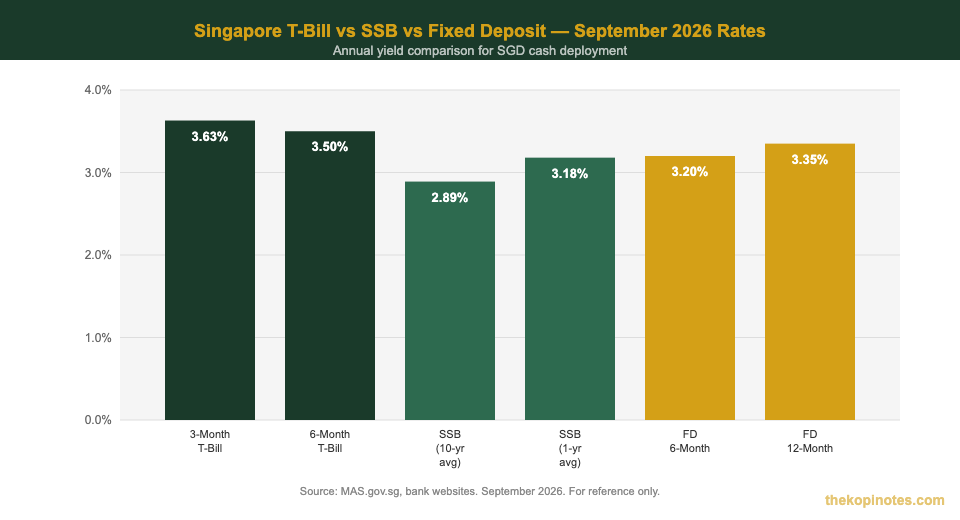
T-Bill vs SSB vs Fixed Deposit: September 2026 Rate Comparison
Before making your decision, you need to see the full picture. Here is how Singapore’s main short-to-medium-term instruments compare as at September 2026.
| Instrument | Current Yield | Liquidity | Minimum |
|---|---|---|---|
| 6-Month T-Bill | 3.50% p.a. | Locked 6 months | S$1,000 |
| 3-Month T-Bill | 3.63% p.a. | Locked 3 months | S$1,000 |
| SSB (Sep 2026 issue) | 3.18% Yr1 / 2.89% avg | Monthly redemption | S$500 |
| Bank FD (12-month) | 3.20–3.40% p.a. | Locked (penalty to break) | S$5,000–10,000 |
| High-Yield Savings | 2.00–3.00% p.a. | Fully liquid | No minimum |
Source: MAS.gov.sg, bank websites as at September 2026. FD rates reflect best promotional rates at major Singapore banks. For educational reference only.
T-bills currently offer the highest yield for a locked period. But yield is only one part of the decision. Liquidity, reinvestment risk, and your personal cash flow needs all matter.
You can use the Singapore T-bills 2026 guide to understand how T-bill auctions work before applying. For SSBs, the Singapore Savings Bonds guide covers the full mechanics of how step-up rates work across the 10-year term.
When to Roll Over Your T-Bill
Rolling over your maturing T-bill means submitting a new non-competitive bid for the next auction. You get the cut-off yield again, and your principal goes back to work immediately. This is the right choice in most cases — unless your situation has changed.
Here are the specific scenarios where rolling over makes sense:
Your emergency fund is fully topped up. If you already hold 6 months of expenses in a liquid savings account, the T-bill’s 6-month lockup is not a problem. You can afford to keep chasing the higher yield without worrying about needing the cash suddenly.
You expect rates to stay flat or rise. The 3-month T-bill at 3.63% yielding more than the 6-month at 3.50% signals a mild inversion. Markets expect modest cuts ahead, but if you think cuts will be slow and shallow, locking in for 6 months at 3.50% still makes sense versus a savings account at 2.50–3.00%.
You have a large sum and want maximum yield. On a S$100,000 portfolio, the yield difference between T-bills (3.50%) and SSBs (2.89% average) works out to S$610 per year. Over two to three years, that compounds meaningfully.
You are building a T-bill ladder. If you already hold staggered T-bills maturing in different months, simply rolling over maintains your ladder structure. This is a strategy we covered in depth in the earlier laddering guide from September 2026 — this article focuses on the single-tranche decision for investors with one maturing bill.
The main risk with rolling over is auction risk. If you submit a competitive bid and the cut-off yield drops significantly, you might receive a lower rate than expected. Non-competitive bids receive the cut-off yield regardless, so always apply non-competitively unless you are an experienced investor managing a very large position.
Rolling over is also ideal for investors using their CPF investment strategy — T-bills can be purchased with CPF Ordinary Account funds via CPFIS, and rolling over keeps your CPF capital earning above the 2.5% floor rate.
When to Switch to Singapore Savings Bonds
SSBs offer a different trade-off. The yield is lower upfront — the September 2026 SSB pays 3.18% in year one, stepping down to a 10-year average of 2.89%. But what SSBs give you is full flexibility: you can redeem any month with no penalty and receive your interest accrued to date.
This flexibility has real value in three specific situations:
You think you might need the cash within 12 months. If there is any chance you will need your principal back before 6 months is up, a T-bill is the wrong instrument. You cannot sell a T-bill before maturity without potentially taking a loss. An SSB can be redeemed in any given month with a 4-week notice period.
You believe rates will fall sharply. If you expect the Fed to cut more aggressively than the market currently prices — and for Singapore short rates to follow — locking into a 10-year SSB now means you keep earning the current step-up schedule even as T-bill yields fall. The SSB issued in September 2026 will keep paying its contracted rates for a full decade.
You want to simplify your cash management. T-bills require you to reapply every three to six months. You need to track auction dates, submit bids, and ensure your bank account is correctly linked. SSBs are a one-time application with automatic interest credited monthly. For investors who find T-bill auctions operationally annoying, SSBs remove the hassle.
The individual SSB cap is S$200,000 (and S$500,000 aggregate across all tranches). Most retail investors are well under this limit, but it is worth checking your current SSB holdings if you plan to subscribe a large sum.
To understand how SSB step-up rates compare over a multi-year horizon, the Singapore retirement calculator can help you model how different rates compound over time if you are planning for your retirement nest egg.
What About Fixed Deposits?
Singapore bank fixed deposits (FDs) have made a comeback. Several banks are currently offering promotional 12-month FD rates of 3.20–3.40% per annum in September 2026 — competitive with SSBs and not far behind 6-month T-bills.
FDs have one key advantage over T-bills: no auction risk. You walk into the bank (or apply online), confirm the rate, and your money earns that exact rate for the full term. There is no cut-off yield uncertainty.
However, FDs have two disadvantages worth noting:
First, early redemption penalties. Most FD products in Singapore will waive interest (partially or fully) if you break the FD before maturity. Unlike SSBs, you cannot get your money back cleanly mid-term. Second, FD minimums are typically S$5,000 to S$20,000, which is higher than the S$1,000 minimum for T-bills or S$500 minimum for SSBs.
FDs make the most sense if you have cash that you will definitely not need for 12 months, and you want the certainty of a known rate without tracking MAS auction dates. They are also a good option for investors who find T-bill applications administratively cumbersome.
For passive income planning, combining a T-bill ladder with some SSBs and a 12-month FD gives you diversified maturity dates — an approach covered in the broader passive income Singapore 2026 guide.
The Decision Framework: A Simple Guide
Here is a practical decision table for Q4 2026. Match your situation to the recommended action.
| Your Situation | Recommended Action |
|---|---|
| Emergency fund fully funded, no large expenses in 6 months | Roll over T-bill (maximize yield) |
| Might need cash within 3–6 months | Switch to SSB (stay flexible) |
| Want certainty, dislike auction applications | Fixed Deposit (set and forget) |
| Long-term retirement savings (5–10 year horizon) | Mix: T-bill ladder + SSB (yield + optionality) |
| Using CPF OA funds via CPFIS | Roll over T-bill (CPF OA eligible, beats 2.5% floor) |
This table is for general educational reference only. It does not constitute financial advice. Consult a licensed financial adviser for personal recommendations.
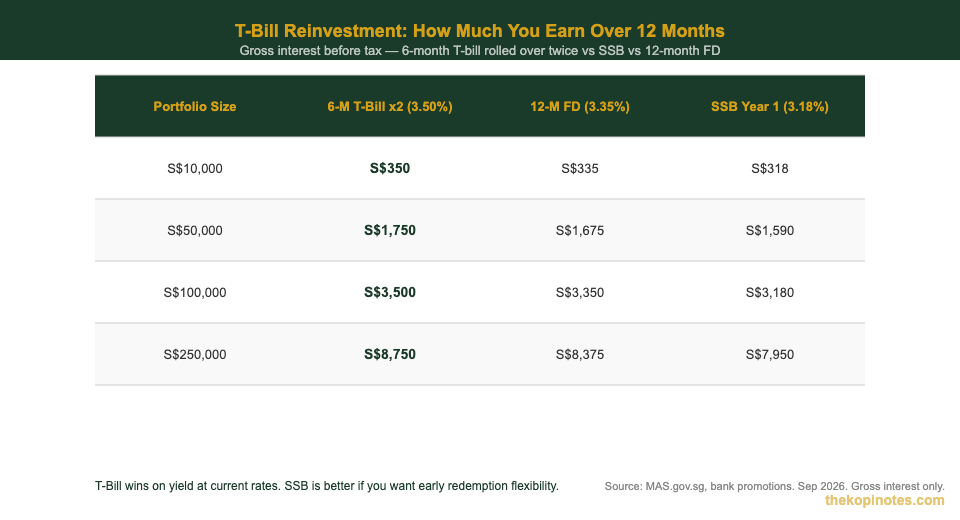
The chart above shows gross interest over 12 months at current rates for portfolios of S$10,000, S$50,000, S$100,000, and S$250,000. Rolling over the 6-month T-bill twice produces the highest absolute return at every portfolio size. However, this assumes the cut-off yield stays at approximately 3.50% for both tranches — which is not guaranteed.
For most Singapore investors with a medium-term horizon and a fully-funded emergency fund, rolling over the T-bill remains the highest-yield option in September 2026. Investors who prioritise flexibility, or who expect rates to fall significantly by early 2027, should consider a partial switch to SSBs.
You can also explore a broader range of investment options through platforms like Endowus (referral code 2V343) for CPF and cash investing, or Syfe (referral code SRPRFFFCD) for robo-advisory and cash management solutions including their Cash+ portfolio.
Disclaimer: All data in this article is for educational reference only. Interest rates change frequently. Verify current rates directly with MAS.gov.sg and your bank before making any financial decisions. This article does not constitute financial advice.
Frequently Asked Questions
What is the latest Singapore T-bill rate in September 2026?
The September 24, 2026 T-bill auction cut-off yield was 3.50% per annum for the 6-month tranche and 3.63% per annum for the 3-month tranche. These rates apply to the full face value of your T-bill for the duration of the term. Rates change with each auction, so always check MAS.gov.sg for the most current auction results before applying.
Should I roll over my T-bill or switch to SSBs in Q4 2026?
Roll over if your emergency fund is fully topped up and you will not need the cash for six months. The T-bill yields 3.50%, which is higher than the SSB year-one rate of 3.18% and the SSB 10-year average of 2.89%. Switch to SSBs if you might need the cash back before maturity, since SSBs allow monthly redemption with no penalty. Your personal liquidity needs should drive this decision more than the yield difference alone.
Can I buy Singapore T-bills using CPF funds?
Yes. You can buy Singapore T-bills using your CPF Ordinary Account (CPF OA) funds via the CPF Investment Scheme (CPFIS). The T-bill must be purchased through an agent bank — DBS, OCBC, or UOB — that is linked to your CPFIS account. The 3.50% T-bill yield is significantly higher than the CPF OA floor rate of 2.5% per annum, making this a common strategy for investors who want their CPF cash working harder. Note: CPF funds cannot be used to buy SSBs directly.
What happens when a Singapore T-bill matures?
When your T-bill matures, the full face value (principal) is credited back to the bank account you used to apply, along with the interest earned. The interest on a T-bill is paid upfront at a discount to face value, but for practical purposes, MAS credits the full maturity amount to your account. If you applied via CPF, the principal and interest return to your CPF Ordinary Account. You must then manually reapply for the next T-bill auction if you wish to roll over.
Is there a minimum investment for Singapore T-bills?
The minimum investment for Singapore T-bills is S$1,000, applied in multiples of S$1,000. SSBs have a lower minimum of S$500. There is no maximum for T-bill applications, but individual SSBs are capped at S$200,000 per issue, with an S$500,000 aggregate cap across all outstanding SSBs per person.
Are Singapore T-bill interest earnings taxable?
For Singapore resident individuals, T-bill interest earnings are not subject to Singapore income tax. This is the same treatment as SSBs and Singapore Government Securities (SGS). For non-residents, withholding tax may apply — consult a tax adviser if you are not a Singapore resident. The tax-free treatment makes T-bills especially attractive compared to fixed deposits, where interest may need to be declared depending on your tax residency and the amount earned.
Make Your Cash Work Harder in Q4 2026
Whether you roll over your T-bill or explore alternatives, the right platform makes a difference. Use our referral links for sign-up bonuses.
This article was researched with the help of AI. While we strive to keep all information accurate and up to date, there may be errors. If you notice any discrepancies, please contact us.